
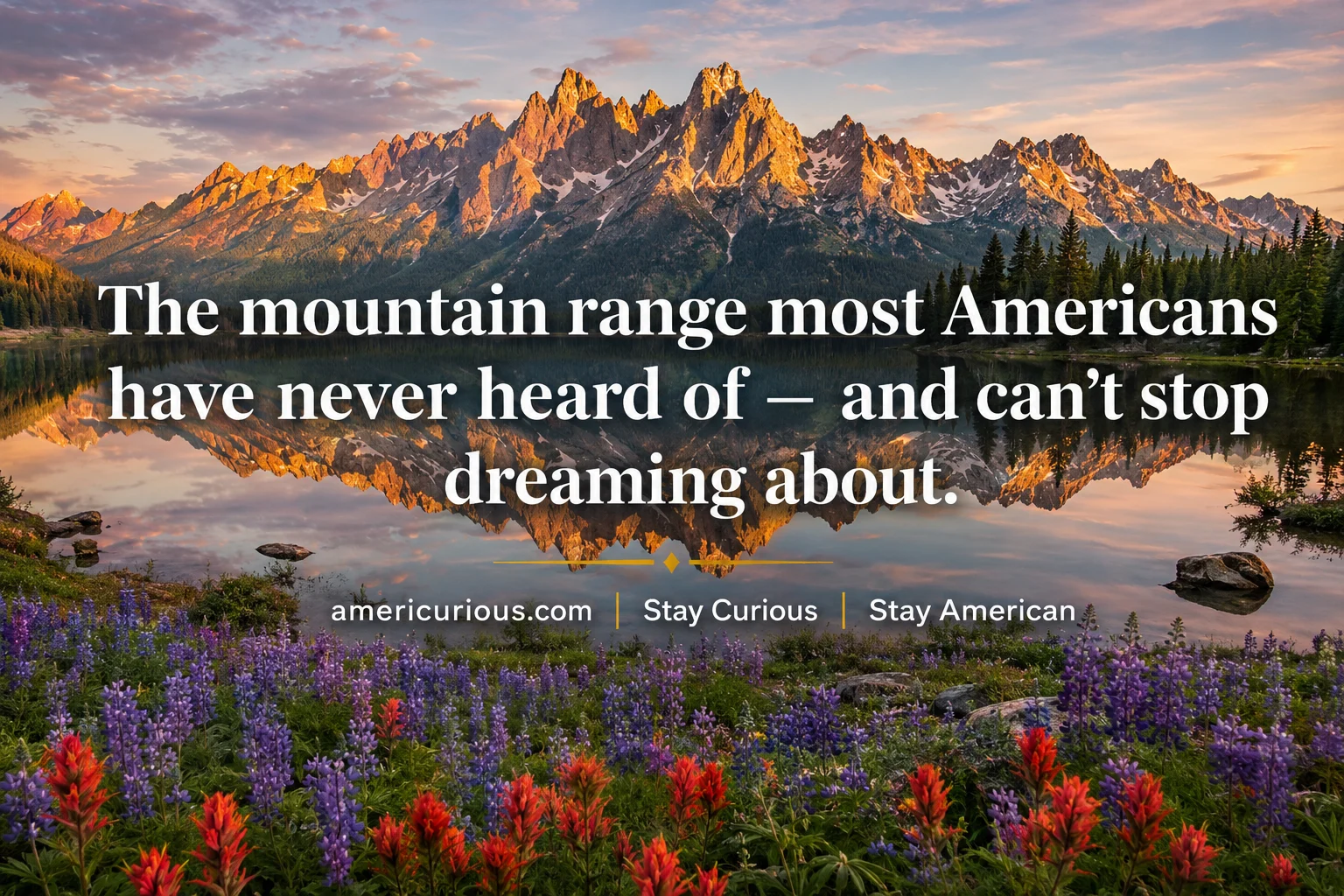
The Sawtooth Scenic Byway cuts through one of America’s most dramatic landscapes — and most Americans have never heard of it. Here’s why that changes today.
The first time you crest Galena Summit at 8,701 feet and the Sawtooth Valley opens below you — forty miles of sage-scented floor, a silver river threading through it, and jagged granite peaks serrating the sky — you will ask yourself one question: How have I never heard of this place? The Sawtooth Scenic Byway in central Idaho isn’t obscure because it lacks drama. It’s obscure because Idaho doesn’t brag, and Americans, on the whole, have been looking the wrong direction. That ends today.
Section 1 — The Story Begins Here
When Congress Decided to Protect Something Rare
In August 1972, Congress passed Public Law 92-400 [opens in new tab], establishing the Sawtooth National Recreation Area — 756,000 acres of central Idaho preserved specifically to prevent the resort development already consuming nearby valleys. This wasn’t a national park. It was something more deliberately American: a decision to leave a place alone. The legislation passed with bipartisan support, rare then and nearly unimaginable now, and was signed into law by President Nixon — formally dedicated on the shores of Redfish Lake on September 1, 1972.
The Road That Runs 116 Miles Through the Heart of Idaho
Highway 75, the spine of the Sawtooth Scenic Byway, runs 116 miles from the high desert near Shoshone northward through Sun Valley, Ketchum, and into the alpine Sawtooth Valley, terminating at the tiny outpost of Stanley. The most striking stretch — from Ketchum’s resort polish to Stanley’s frontier quiet — climbs through Galena Summit and then drops into a valley that stops conversations mid-sentence. It is part of Idaho’s network of 31 designated scenic byways [opens in new tab], and it earns top billing without argument.
A Mountain Range Built to Be Dramatic
The Sawtooths are granite — a relatively young igneous intrusion that pushed up through older surrounding rock, which explains why these peaks look so violently jagged compared to the rounder ranges nearby. Thompson Peak, the highest summit in the range at 10,751 feet, leads more than 40 peaks above the 10,000-foot mark. [Personal touch: I once asked a geologist at a campfire near Stanley why the Sawtooths looked like someone had taken a serrated knife to the sky. Her answer took 45 minutes and was completely worth missing dinner for.] The Sawtooth Wilderness alone — 217,088 acres at the core of the recreation area — holds more than 300 alpine lakes carved out by glaciers that retreated roughly 10,000 years ago.
Summer Arrives Like a Permission Slip
June is the unlock. Snow lingers on Galena Summit into early summer, and nights in the valley can still dip below freezing through mid-June, but the wildflowers are blooming on the valley floor by the second week of the month. This is the sweet spot: the summer crowds haven’t hit their August peak, the Salmon River is running cold and fast with snowmelt, and the long days give you enough light for a morning hike and a lakeside sunset without choosing between them.
Section 2 — Why This Is More American Than You Think
The River That Named Itself
The Salmon River begins near Stanley, fed by snowmelt and springs at over 6,000 feet of elevation, then flows north and west for more than 425 miles before joining the Snake River. Early trappers called it the “River of No Return” because the canyon it carved was too treacherous to navigate back upstream — and the name stayed, permanently, on the map and in the American imagination. The Frank Church–River of No Return Wilderness [opens in new tab], which flanks this section of the Salmon, encompasses 2.3 million acres — the largest wilderness area in the contiguous United States.
The People Who Were Here First
The Sawtooth Valley was not empty when European trappers arrived. The Northern Shoshoni — known in their own language as the Tukudeka, meaning “mountain sheep eaters” — inhabited these high valleys for generations, following seasonal routes that elk and bison still trace today. Prehistoric hunters used the Redfish Lake area nearly 10,000 years ago, and the Salmon River’s sockeye salmon were not merely a food source for Indigenous peoples: they were a foundation of culture, ceremony, and far-reaching trade networks across the Pacific Northwest. That story is rarely printed on the tourism brochure. It is, nonetheless, the first chapter of this valley’s history.
The Countercultural Clarity Moment
Here’s the honest accounting: Yellowstone draws four million visitors a year. The Sawtooth National Recreation Area gets a fraction of that. That is not because Yellowstone is categorically more beautiful — it isn’t, not necessarily. It’s because Yellowstone has a 150-year marketing head start. The Sawtooths have no geyser, no rim-to-rim cable car, no Instagram canyon that everyone recognizes by silhouette. What they have is something rarer: you can hike to a granite alpine lake on a Tuesday in July and share it with almost no one. When did American travel become about finding the most crowded version of the most famous thing?
The Mountain Town Comparison That Doesn’t Get Made Often Enough
If you’ve ever walked the high ridgelines above Telluride, Colorado — that particular combination of mountain scale and small-town gravity — you’ll recognize something familiar the moment you roll into Stanley. The continent rears up in the same way. The peaks make you recalibrate your sense of proportion in the same way. The difference is that Telluride has been thoroughly discovered and polished to a shine, while Stanley is still running on its own schedule — and that schedule includes nobody asking whether your latte is oat or almond.
“America didn’t run out of wild places. We just stopped looking for them.” — AmeriCurious
🗳️ Quick Poll: What draws you most to an off-the-beaten-path road trip destination? ○ Dramatic scenery I haven’t seen anywhere else ○ The sense that I have it mostly to myself ○ A small town with real local character ○ Wildlife and natural experiences
(Share your answer in the comments!)
Section 3 — The Details That Make It Real
Stanley, Idaho: 63 People and a Reputation 10,000 Years in the Making
Stanley sits at over 6,200 feet with 63 year-round residents — one of the smallest incorporated towns in the United States by any measure. In summer it swells with river guides, seasonal workers, and travelers passing through, but the core identity holds: this is a place where everyone knows the river level, nobody locks their truck, and the diner conversation turns to elk migration without any prompting. [Personal touch: I sat at the counter of the Sawtooth Hotel Café one August morning and ended up in a 45-minute conversation with a river guide who’d been running the Salmon for 22 years. He described the river as one that “keeps its promises.” I wrote that down.]
Key Stops Along Highway 75: A Practical Breakdown
| Stop | What It Is | Best Time to Visit |
|---|---|---|
| Galena Summit (8,701 ft) | Panoramic overlook of the entire Sawtooth Valley | Morning — best light and fewest cars |
| Redfish Lake | Glacier-carved lake; hiking, kayaking, lodge, visitor center | Late June through August |
| Stanley | Restaurants, outfitters, hot springs access, local character | June through September |
| Sunbeam Hot Springs | Free roadside natural hot springs on the Salmon River | Year-round; best in cool mornings |
| Sawtooth Wilderness Trailheads | 200+ miles of trails into pristine alpine terrain | July through September |
| Land of the Yankee Fork State Park | Gold mining history and preserved ghost town remnants | May through October |
Caption: Primary stops along the Sawtooth Scenic Byway (Highway 75), with recommended timing for each visit.
Redfish Lake: The Name Has a Story Worth Knowing
Redfish Lake — arguably the valley’s most photographed location — was named for the sockeye salmon that once turned its surface red during their spawning runs. According to the Idaho Department of Fish and Game [opens in new tab], Sawtooth Valley sockeye historically numbered between 25,000 and 35,000 returning fish annually in the 1880s. Then dam construction downstream began blocking passage, and the population collapsed to the edge of extinction. In 1992, exactly one sockeye made it back to Redfish Lake — a fish that became known, with a kind of heartbroken national tenderness, as Lonesome Larry.
📌 Fast Fact: Redfish Lake sockeye salmon travel farther and climb higher than any other sockeye population on Earth — swimming more than 900 miles from the Pacific Ocean and ascending more than 6,500 vertical feet to reach their spawning grounds in the Sawtooth Valley. They were listed as endangered in 1991, the first Idaho salmon species to receive that designation.
Section 4 — Hidden Layers (What Most People Miss)
The Hot Springs Hiding Openly on the Roadside
Most travelers drive past Sunbeam Hot Springs without stopping, partly because the pull-out is understated and partly because “free” doesn’t register as a real option anymore. Sunbeam sits directly on the Salmon River, roughly nine miles east of Stanley — a series of natural pools where water seeps from the hillside at over 100°F and meets the cold river current. You calibrate your own temperature by positioning yourself closer to or farther from the inflow. On a cool June morning, with the Salmon running green and fast six feet away, it is one of the most uncomplicated pleasures in the American West.
The Mining Chapter That Almost Rewrote This Valley
Before Congress established the SNRA in 1972, mining had already left visible marks on the landscape. The ghost town of Bonanza and the remnants of Custer — reached by a dirt road off Highway 75 — preserve the bones of silver and gold boomtowns from the 1870s onward. The star exhibit is the gold dredge at Land of the Yankee Fork State Park [opens in new tab], a massive machine that churned through the Yankee Fork riverbed between 1940 and 1952, leaving behind the rippled tailings mounds still visible from the highway today. Most people driving Highway 75 don’t know this chapter exists. That’s the gap this byway specializes in — layers that reward the unhurried.
📌 Fast Fact: The Sunbeam Dam, built in 1913 to power a mine, blocked Salmon River salmon passage entirely. It was only partially removed in 1934 — and even then, no concerted effort was made to restore the salmon runs for decades. The ecological reckoning of that decision is still unfolding today.
The Wilderness Beyond the Byway
The backcountry surrounding the Sawtooths — stretching into the Frank Church Wilderness and the Selway-Bitterroot — is some of the most genuinely remote terrain in the lower 48. There are no roads through it. There is no cell signal. There are wolves, mountain lions, black bears, and elk in numbers that recalibrate your understanding of what “wild” actually means. If you’ve done the Narrows at Zion and know what it feels like to be inside a landscape rather than simply looking at it, stepping into the Frank Church turns that volume up by an order of magnitude.
🧠 AmeriCurious Quiz: How Well Do You Know the Sawtooths?
Q1: What gave Redfish Lake its unusual name? A) Reddish minerals in the lakebed B) Sockeye salmon that once turned the water red during spawning C) The color of the surrounding granite at sunset D) A Northern Shoshoni legend about fire and water
Q2: The Salmon River’s enduring nickname is: A) The Clearwater Corridor B) The Idaho Wild C) The River of No Return D) The Mighty Salmon
Q3: How far do Sawtooth Valley sockeye salmon travel from the Pacific Ocean to reach Redfish Lake? A) Approximately 200 miles B) Approximately 500 miles C) Approximately 700 miles D) More than 900 miles
✅ Answers: Q1-B | Q2-C | Q3-D
Section 5 — The Human Story
The Town Where Everyone Knows the River Level
The Sawtooth Hotel in Stanley is the kind of place that slows you down without apologizing for it. The building is old, the menu doesn’t pretend otherwise, and the coffee arrives before you’ve fully settled into your seat. Ranchers, guides, seasonal workers, and retirees cycle through these rooms all summer, constituting a kind of informal American town hall — the real kind, not the organized kind. The conversations are local in the best sense: grounded in specific knowledge of specific land, entirely unimpressed by where you came from.
The People Who Stayed
What draws someone to live year-round in a town of 63 people, at over 6,200 feet, where winter temperatures regularly drop below -30°F and the nearest hospital is 60-plus miles away on mountain roads? In almost every case: they came for a summer, felt something shift inside them, and couldn’t leave. [Personal touch: I met a woman in Stanley who’d driven through in 1994 on her way to somewhere else entirely. She’s still there. Runs a fly shop. Shows no signs of reconsidering.] Is there a place like that in your life — one that made a before and an after?
The Guides and the River They Know
The Salmon River attracts a specific kind of outfitter: people who have chosen this particular river, this particular valley, with a conviction that reads as almost devotional. Multi-day float trips carry you through canyons with no road access, past homesteads accessible only by river or small plane, through a stretch of America that has been left largely as it was. [Personal touch: A guide I floated with on the Main Salmon knew the names of the great blue herons that nested on specific bends. Not as a selling point — just as what you learn when you spend enough years on one river.] That kind of knowledge isn’t for sale. It accumulates.
“Some places don’t just change your plans. They change your baseline for what the world can look like.” — AmeriCurious
Section 6 — Your Move, America
The Road Is Literally Open Right Now
Mid-June is one of the best possible moments to drive Highway 75 through the Sawtooth Valley. The wildflowers are peaking on the valley floor, snow has largely cleared the high passes, and the summer crowds haven’t yet hit their August volume. Road trip season is here — and one of the best drives in America is sitting mostly undiscovered, waiting for you to show up.
Reader’s Road Trip Action List
- 🚗 Drive south to north — Begin in Ketchum/Sun Valley, climb to Galena Summit for your first panoramic view of the valley, then drop down into Stanley for the full dramatic reveal
- 🏕️ Reserve Redfish Lake Lodge or campgrounds early — Sites book fast in July and August; secure them now via Recreation.gov [opens in new tab]
- 🌊 Float the Main Salmon — Book a day float or multi-day trip through a Stanley-based outfitter; this is one of the great American river experiences, full stop
- ♨️ Stop at Sunbeam Hot Springs — Pull over, take off your boots, and sit in natural 100°F water with the Salmon River running alongside you — at no charge
- 🥾 Hike Sawtooth Lake — The Iron Creek Trailhead to Sawtooth Lake (approximately 10 miles round-trip, 1,600 feet of gain) delivers a granite cirque and alpine lake that earns every step
- 🏛️ Spend 30 minutes at Land of the Yankee Fork — The gold dredge alone is worth it
- 📸 Reach Redfish Lake at dawn — Bring a camera, or don’t. The reflection of the Sawtooths on still water in early light is the kind of thing you don’t need to document to remember
- 🍳 Eat at the Sawtooth Hotel Café in Stanley — Order whatever’s hot
If you’re building a longer Pacific Northwest and Mountain West swing, this pairs naturally with some of the spectacular natural spectacles hiding just outside Seattle — the Western states reward those who keep looking after they think they’ve seen enough.
“The mountains most worth knowing are the ones that don’t know they’re famous yet.” — AmeriCurious
❓ Frequently Asked Questions
Q: When is the best time to visit the Sawtooth Scenic Byway?
A: Late June through early September is the prime window for most visitors. High-country trails open as snowpack melts in late June, wildflowers peak in July, and valley temperatures are mild. Pack layers regardless of when you go — nights at 6,200-plus feet can drop sharply even in midsummer. Fall (September into early October) is quieter, with golden aspen groves and elk in rut, and is worth serious consideration.
Q: Is Highway 75 (the Sawtooth Scenic Byway) paved the whole way?
A: Yes — Highway 75 itself is fully paved from Shoshone to Stanley. Side roads leading to campgrounds, trailheads, and attractions like the ghost towns near the Land of the Yankee Fork may require a high-clearance vehicle, particularly early in the season. Check current conditions through the Idaho Transportation Department before you go.
Q: What are the best hikes near Stanley, Idaho?
A: The Iron Creek Trailhead to Sawtooth Lake (approximately 10 miles round-trip with 1,600 feet of elevation gain) is the most popular and most rewarding day hike in the area. For a shorter option, the trail from the Redfish Lake Inlet toward Bench Lakes is manageable for a wider range of fitness levels. The Alice-Toxaway Loop is the gold-standard multi-day backpacking circuit in the Sawtooth Wilderness — roughly 27 miles through some of the finest alpine terrain in Idaho.
Q: Are there good camping options along the Sawtooth Scenic Byway?
A: Yes — the Sawtooth National Recreation Area offers numerous campgrounds ranging from full-service sites at Redfish Lake to more primitive options in the Stanley Basin and along the Salmon River corridor. Sites at Redfish Lake fill early in July and August; reservations through Recreation.gov are strongly recommended, and can often be made months in advance.
Q: How far is the Sawtooth Scenic Byway from Boise?
A: Stanley is approximately 130 miles north of Boise — roughly a 2.5-hour drive under normal conditions. Many visitors pair the Sawtooths with a stop in Sun Valley and Ketchum (about 60 miles south of Stanley on the same Highway 75), creating either a natural there-and-back or a loop through central Idaho’s mountains that you’ll immediately want to repeat.
📚 Sources & Further Reading
[1] U.S. Forest Service, “Sawtooth National Recreation Area,” USDA Forest Service, 2024. fs.usda.gov/sawtooth
[2] Idaho Department of Fish and Game, “Snake River Sockeye Salmon — Species Profile,” IDFG, 2024. idfg.idaho.gov
[3] Idaho Department of Parks and Recreation, “Land of the Yankee Fork State Park,” Idaho Parks, 2024. parksandrecreation.idaho.gov
[4] Cornell Law School Legal Information Institute, “16 U.S. Code § 460aa — Sawtooth National Recreation Area Establishment,” Public Law 92-400, 1972. law.cornell.edu
[5] Sawtooth Society, “Preserving Nature and Heritage: The Story of the Sawtooth National Recreation Area Act,” 2024. sawtoothsociety.org
[6] Visit Idaho, “Sawtooth Scenic Byway,” Idaho Tourism, 2024. visitidaho.org
The AmeriCurious Sign-Off
What’s the most unexpectedly beautiful stretch of American road you’ve ever driven — the one that hit you before you were ready for it? Drop it in the comments. Someone reading this right now needs to add it to their list.
Save this before your summer fills up with obligations. And if you know someone who has been saying “I should really explore more of America” for the past three years running — send it to them. The road is open and it isn’t getting any less beautiful.
If you want more stories like this — the ones hiding in the spaces between the famous places — follow americurious.com and you’ll never run out of reasons to get in the car.
— AmeriCurious americurious.com Stay Curious | Stay American 🇺🇸
Discover more from AmeriCurious
Subscribe to get the latest posts sent to your email.