
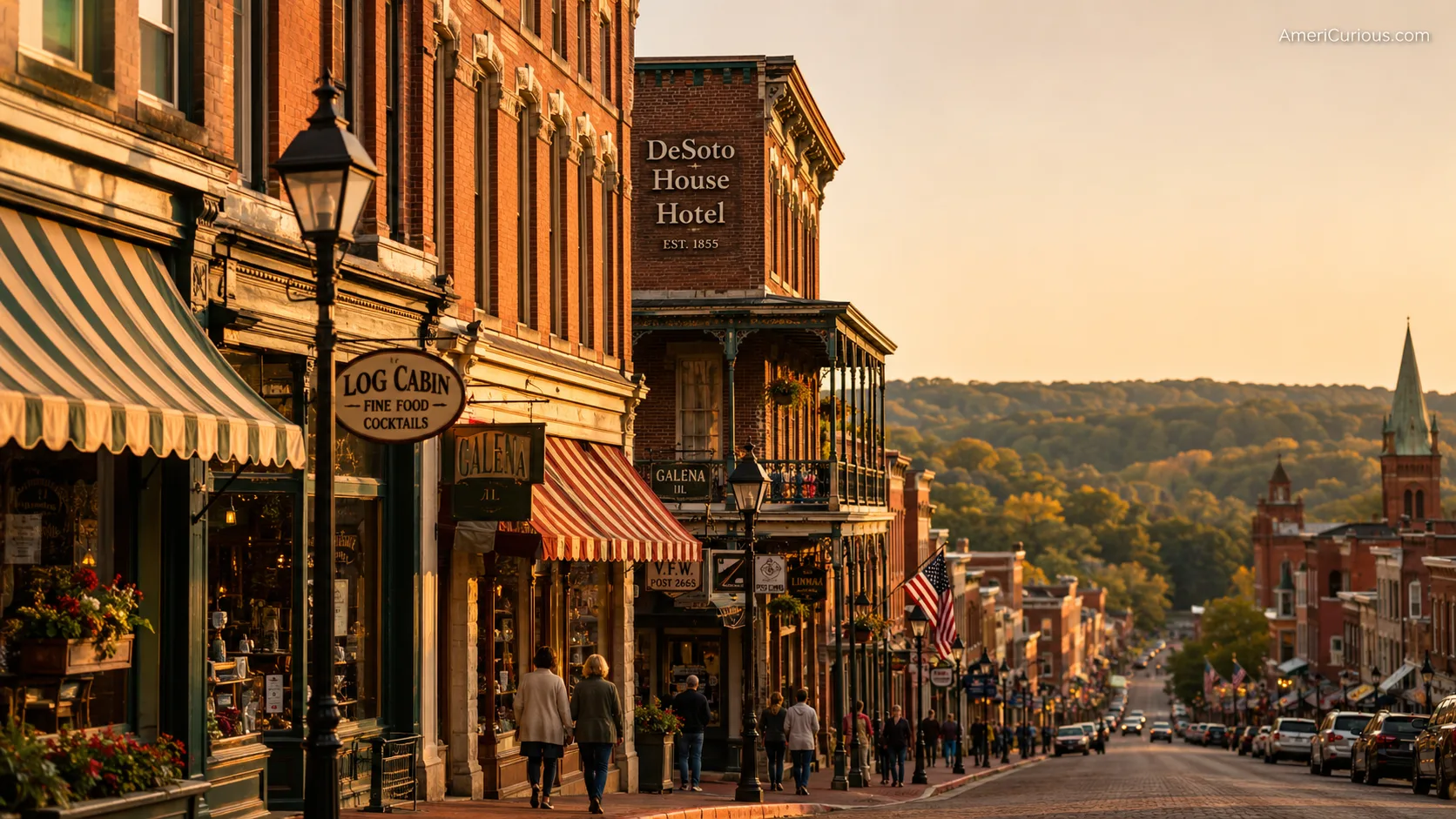
Galena’s population is 3,200. Its 2026 bicentennial-meets-America250 double anniversary is riding a $554 million tourism economy. Here’s the honest visitor guide — crowds, prices, and all.
The Year Two Anniversaries Collided
Picture the DeSoto House Hotel on a July evening in 1856. Abraham Lincoln — not yet a president, just a lanky Illinois lawyer stumping for a candidate named Fremont — steps out onto the second-floor balcony over Main Street and starts talking. Somewhere down below, a crowd that would eventually swell into the thousands is craning its neck to listen. Two years later, Stephen Douglas would stand on that same balcony and do the same thing. Four years after that, Ulysses S. Grant would come home from the Civil War to find 25,000 people — more than seven times Galena’s entire population today — lining the streets to welcome him, bands playing, cannons firing.
That’s the kind of town Galena, Illinois used to be: a place presidents and future presidents treated like a required stop.
Here’s the twist nobody’s really talking about yet: in 2026, Galena turns 200 years old — the townsfolk voted to adopt the name in December 1826, back when it was still just the “Village on Fever River” — and it’s turning 200 in the exact same calendar year the entire country turns 250. Two birthdays, one summer, one very small Midwestern river town caught directly in the middle of both. If you’re the type who believes in signs, this is a pretty good one. If you’re just trying to plan a long weekend, it means something more practical: Galena is about to have the biggest, busiest, most expensive year it’s had in a long, long time — and you need to decide if that’s a reason to go or a reason to wait.
Let’s get into it.
How a Lead-Mining Boomtown Nearly Became a Ghost Town
Long before Galena was known for wine tastings and antique shops, it was known for one thing: lead. The name itself comes from galena, the raw ore that put this stretch of the Mississippi River bluffs on the map. By the mid-1800s, Galena was one of the busiest river ports in the entire country — steamboats stacked up on the Galena River, fortunes made overnight, a Main Street lined with the kind of Italianate brick buildings that only get built when a town thinks its boom is permanent.
It wasn’t. The lead played out, the river started silting up, the railroads picked other towns to run through, and by the early 20th century Galena had gone from boomtown to backwater — the kind of place time genuinely seemed to forget. And here’s the part that should sound familiar if you’ve ever watched a small town nearly disappear: for decades, nobody tore anything down, mostly because nobody could afford to. No demand for new construction meant no reason to bulldoze the old stuff. Galena’s poverty accidentally became its preservation plan.
Fast forward to the 1960s and 70s. The Branigar Organization started buying up land around town in 1970 — an initial 4,800-acre purchase that would eventually grow into The Galena Territory, a resort and residential development that gave people an actual reason to drive out here. Around the same time, antique dealers and history buffs started rediscovering what a genuinely remarkable stretch of untouched 1850s architecture was just sitting there on Main Street, mostly ignored. Illinois’ own governor at the time, James Thompson, and his wife were reportedly frequent antique-shopping visitors — the kind of low-key celebrity foot traffic that helps put a place back on the map without anyone planning it that way.
Today, more than 85% of Galena’s historic buildings are still standing, according to local tourism figures — which is a wild number for a town this old in a country that tends to knock things down and start over. That’s not an accident. That’s what happens when a town goes broke at exactly the right moment in architectural history.
What the Numbers Actually Say
Here’s where most articles about Galena stop at “charming” and “quaint” and call it a day. Let’s actually look at what this town is pulling in, because the scale might surprise you.
According to the 2025 Galena Country Tourism Impact Report, as reported by the Telegraph Herald, Galena draws roughly 1 million visitors a year. For a town of 3,200 people. That’s more than 300 visitors for every single resident, annually. Those visitors generate a $554 million economic impact and support more than 3,000 tourism-related jobs in Jo Daviess County — which means tourism isn’t a nice side hustle for Galena, it’s very nearly the entire economy.
Put another way: Galena has almost exactly as many tourism-supported jobs as it has residents. This is a town that has fully, deliberately, and successfully rebuilt itself around the business of being looked at — and 2026’s double-anniversary timing means this is very likely the single busiest year that $554 million figure has ever seen.
The Grant House and the Rest of the Bicentennial Calendar
If Galena has a patron saint, it’s Ulysses S. Grant, and the town isn’t shy about it. On August 18, 1865, a grateful Galena threw Grant a homecoming parade and handed him the keys to a fully furnished house on Bouthillier Street — just a “welcome home, general” gift from the neighbors. That house, the Ulysses S. Grant Home State Historic Site, opened to the public in 1904 and is still stocked with original furnishings today, managed now by the Illinois Historic Preservation Agency. You can tour it Wednesday through Sunday, and if you want the fuller story — the leather-goods store he ran before the war, the Vicksburg campaign flag, a genuinely surreal hologram exhibit where Grant and his wife Julia “welcome” visitors — the Galena & U.S. Grant Museum a few blocks over rounds it out with more than 6,000 square feet of exhibit space inside an 1858 Italianate mansion.
But 2026 isn’t just about Grant — it’s a packed bicentennial calendar on top of the regular attractions, and this is the part that trips up a lot of first-time visitors who show up expecting a quiet weekend. There’s a Bicentennial Pie Eating Contest at the Galena Eagles Club (because apparently every 200th birthday deserves dessert), a Galena History Symposium at the DeSoto House Hotel in mid-May packed with expert talks, a French choir performance at the historic Turner Hall in late June, a season-long “Bees, Bounty, and Bicentennial” agricultural exhibit running through Labor Day, and the big one: the Bicentennial Corn Boil and Music Festival at Recreation Park on August 29, 2026, which is shaping up to be the single largest community gathering of the whole bicentennial year. There’s even a drone show planned to close things out around New Year’s.
If you’re the kind of traveler who wants a quiet, uncrowded Main Street stroll, you’ll want to pick your dates carefully — because a lot of Galena, this particular year, is going to be showing up all at once.
A Day on Main Street
Okay, so say you actually show up on a normal (non-Corn-Boil) weekend. What does a day in Galena actually look like?
You’d probably start on Main Street itself, which is genuinely one of the best-preserved 19th-century commercial districts in the entire Midwest — a long, gently sloping stretch of 1850s brick storefronts now filled with independent shops, wineries, and cafés instead of dry-goods stores and blacksmiths. Grab a coffee, and if you’re the type who collects a little local color with your caffeine, the general theme in town this year is “everything gets a bicentennial spin” — commemorative blends, bicentennial stickers at the Galena Country Tourism Visitors Center, that sort of thing.
For lunch or dinner, the DeSoto House Hotel itself is worth a stop even if you’re not staying there — it’s Illinois’ oldest continuously operating hotel, built in 1855, with three separate dining rooms tucked inside: the four-story atrium Courtyard Restaurant for breakfast and lunch, the Generals’ Restaurant (named for Galena’s nine Civil War generals — yes, nine, out of one tiny river town), and Green Street Tavern, a cozy corner pub that’s been serving drinks since the building’s 1883 addition went up. Rooms here run in the $185–$225 range on a normal week — keep that number in your back pocket for the next section.
From there, wander down toward the Old Market House State Historic Site, poke into a winery or two (Galena Cellars is the local institution, with its own Fall Harvest & Art Festival every September), and if you’ve got a car and an afternoon to spare, Chestnut Mountain Resort is about a 15-minute drive out of town, overlooking the Mississippi River — alpine slides and hiking in summer, skiing in winter, and a genuinely great spot to watch the sun go down over the water.
The whole thing has a walkable, unhurried, “everybody knows everybody” feel to it — right up until a bus tour rolls in, which brings us to the part of this article most Galena write-ups skip entirely.
The Honest Catch
Here’s the part your Pinterest board won’t tell you.
This is going to be Galena’s most crowded year in recent memory, and the town knows it. Between the bicentennial’s own packed calendar (the Corn Boil, the History Symposium, the Pie Eating Contest, the Bees & Bounty exhibit) and the broader national wave of America250 travel — small-town tourism has been trending up across the country all summer as travelers look for domestic, historically-flavored trips closer to home — Galena is sitting at the intersection of two separate tourism surges at once. That’s great for the 3,000 people whose jobs depend on visitor spending. It’s a little less great if you were picturing a peaceful, empty Main Street.
Practically, that means: book your room early, especially anything downtown near Main Street. The DeSoto House’s normal $185–$225 range is exactly the kind of rate that tends to climb fast once a milestone event fills the calendar — so don’t assume you’ll get walk-up availability the weekend of August 29th, or really any major event weekend for the rest of the year. Parking on Main Street gets tight fast on event days, and restaurant wait times stretch out accordingly.
Second honest note: Galena’s charm is very real, but it is a curated charm. This isn’t a town that got preserved by accident and stayed rough around the edges — it’s a town that leaned hard into its tourism economy decades ago, and everything from the antique shops to the winery tastings to the bicentennial coffee blends reflects that. If you’re hoping for a gritty, undiscovered river town nobody’s heard of, that ship sailed sometime around 1980. What you get instead is a genuinely well-run, well-preserved historic destination that knows exactly what it is and does it very well — just don’t expect it to feel like a secret.
Third: the 250th-anniversary tie-in is real, but it’s mostly vibes-adjacent rather than programmed. Galena’s bicentennial calendar is its own thing, built around its own December 1826 founding date — it’s not an official America250 event series. The coincidence of timing is what makes this year special, not a shared national program. Worth knowing before you show up expecting red-white-and-blue signage everywhere; most of what you’ll actually see is Galena-specific bicentennial branding.
None of that means skip it. It just means go in with your eyes open, book ahead, and pick your weekend on purpose instead of by accident.
Should You Visit in 2026?
If you’re weighing a trip like Dana from Rockford — parents’ anniversary, tempted by Galena, worried it’s “just antique shops” or that it’ll be a zoo — here’s the honest breakdown. Galena in 2026 is absolutely worth the drive, but timing is everything. If you want the full bicentennial spectacle — live music, a packed Main Street, genuine small-town-America energy — aim for the Corn Boil weekend on August 29th and book your room the moment you decide to go. If you’d rather have Main Street mostly to yourselves, a quiet Tuesday-through-Thursday stretch in September or October, after the Corn Boil crowds clear out and before the holiday drone-show rush, is going to feel like an entirely different, much calmer town — same 1850s buildings, same Grant history, a fraction of the foot traffic.
Either way, this isn’t “just antique shops.” It’s a town that went broke at exactly the right moment, kept its buildings by accident, and then spent fifty years turning that accident into a $554 million tourism economy — the kind of only-in-America reinvention story that shows up more often than you’d think if you go looking for it. We’ve told a version of this same story out in Point Pleasant, West Virginia, where a legend became a business plan, and in Mansfield, Ohio, where a dying Rust Belt town found its second act on a movie screen. If you’re chasing that same small-town-momentum energy on a bigger road trip, our North Dakota road trip guide digs into another corner of the country riding this same 2026 wave.
Two anniversaries, one very small town, one very real $554 million question mark hanging over how crowded your visit’s going to be. Book early, pick your weekend on purpose, and go see it before the bicentennial banners come down — because Galena’s not going to look quite like this again for another 200 years.
Discover more from AmeriCurious
Subscribe to get the latest posts sent to your email.