
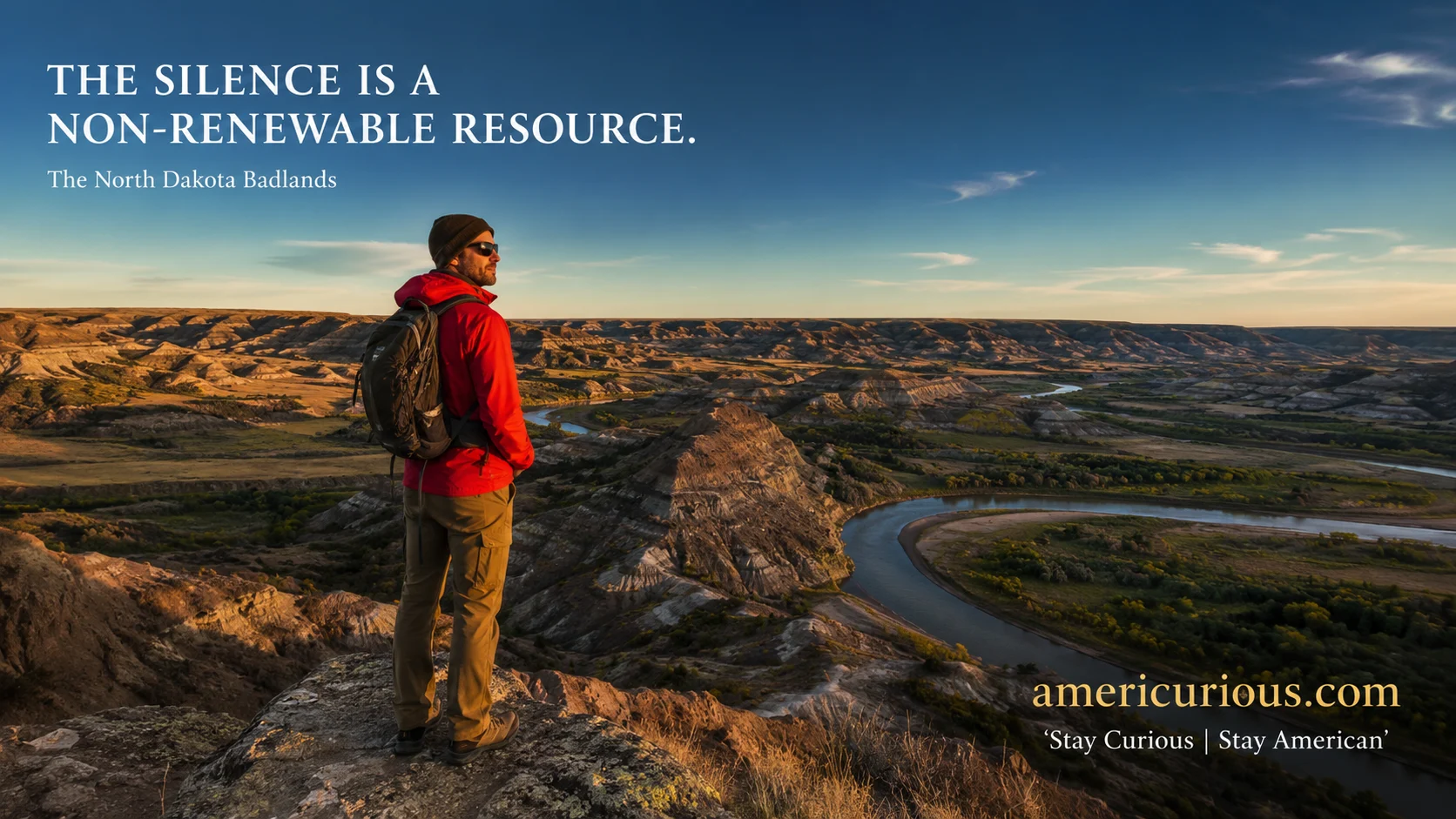
North Dakota just landed its $450M Theodore Roosevelt Presidential Library, a record-shifting bison herd, and one of the Midwest’s boldest food scenes — yet still logs a fraction of the crowds. This 2026 six-day road trip guide moves clockwise from Bismarck through Medora’s badlands, the Enchanted Highway, Watford City oil country, Minot’s Nordic heart, Grand Forks, and Fargo. Expect fresh stats, verified openings, small-town detours the guidebooks miss, and a grounded take on what the Peace Garden State actually delivers when you slow down long enough to notice. Built for travelers who’d rather earn a story than rack up a checklist.
The State Everyone Saves for Last (and Why That’s About to Backfire)
North Dakota is the state most Americans visit 49th — a running joke serious enough that Fargo runs an official Best for Last Club handing out T-shirts to procrastinators. Here’s the direct answer up top: a six-day, roughly 700-mile clockwise loop from Bismarck to Medora to Minot to Grand Forks to Fargo is the cleanest way to see the state’s two very different halves — cowboy-country badlands in the west, Scandinavian-flavored prairie towns in the east — and 2026 is the year the math flips, because the $450 million Theodore Roosevelt Presidential Library opened on July 4 and put Medora on every serious road-trip shortlist.
Which means the “empty state” window is closing. Not slamming shut — but closing.

Painted Canyon, Theodore Roosevelt National Park — the badlands most travelers don’t realize North Dakota has.
The receipts, up front
North Dakota welcomed 25.6 million visitors in 2025 who spent $3.4 billion across the state, per the North Dakota Department of Commerce’s 2026 tourism report. That was actually a 2.6% dip year-over-year, driven almost entirely by a nearly 24% collapse in Canadian border crossings — Canadian visitors spent roughly $14.4 million less in just the first half of 2025. Translation for you: fewer license plates from Manitoba, more elbow room at trailheads. Early 2026 numbers show momentum returning, so the honeymoon window is real but finite.
Takeaway: Book Medora lodging by March if you’re going in peak summer 2026 — the library opening is going to move numbers fast.
Day One — Bismarck: The Capital That Skipped the Dome
An art deco skyscraper walks into a prairie
Fly into Bismarck. The name is a marketing move from 1873 — railway executives betting German investors would open their wallets if they honored Chancellor Otto von Bismarck. It worked. What didn’t get built was the domed neoclassical capitol you’d expect. Instead, the North Dakota State Capitol is a 19-story 1930s art deco tower — still the tallest building in the state — with chandeliers shaped like wheat and bronze elevator doors depicting prairie life. It’s the least-photographed statehouse in America, which is exactly why you should photograph it.
The morning move locals actually make
Skip the hotel breakfast. Anima Cucina does a porchetta hash and prosciutto Benedict that would draw a line in Minneapolis; here you walk in. Next door to the capitol, the North Dakota Heritage Center threads dinosaur casts, a full 1950s soda fountain, and Mandan beadwork into a single afternoon — and the gift shop sells a state-shaped Christmas ornament made from lefse (Norwegian potato flatbread). That is not a sentence I expected to type either.
Fort Abraham Lincoln — the CCC’s underrated cathedral
Twenty minutes across the Missouri River sits Fort Abraham Lincoln State Park, the state’s oldest, layered with a reconstructed Mandan earth-lodge village and Custer’s rebuilt home. Here’s what most itineraries miss: the reconstructions exist because Depression-era Civilian Conservation Corps crews worked alongside Scattered Corn, the first female Corn Priest of the Mandan tribe, to rebuild the earth lodges authentically. That collaboration — 1930s federal labor plus Indigenous ceremonial authority — is the actual story on this hill.
Dinner and lights out: Laughing Sun Brewery pairs axe-throwing with barbecue (a combination that reads worse than it plays). Sleep at EverSpring Suites.
✅ Skimmable takeaway — Day 1: Capitol → Heritage Center → Fort Lincoln → brewery. Distance covered: ~30 miles. Prime attraction most guides underplay: Scattered Corn’s role in the earth-lodge reconstruction.
Day Two — Bismarck to Medora: The 65-Mile Sculpture Detour
Meet the principal who welded a highway
At exit 72 off I-94, a 110-foot-tall flock of steel geese rises out of the prairie. That’s Geese in Flight, the Guinness-certified world’s largest scrap metal sculpture, built by a former junior-high principal named Gary Greff. He had no welding background. He just decided his hometown of Regent, population then ~200, needed a reason to exist on maps. Over decades he built seven monumental sculptures along a 32-mile stretch — a 70-foot trout, a 60-foot grasshopper, a Teddy Roosevelt on horseback — that Tripadvisor now ranks as one of the top roadside attractions in the Northern Plains.
“Geese in Flight” — 110 feet tall, all scrap metal, built by a former school principal with something to prove.
Allow 75 minutes round-trip if you’re going all the way to the Enchanted Castle. Do it. You will not regret slowing down for a giant tin knight.
The gateway that used to be a mourning retreat
Medora is a tidy 1880s frontier town of about 130 permanent residents that swells into thousands in summer. Its origin story is grief: after Theodore Roosevelt lost both his mother and his first wife within hours of each other on Valentine’s Day 1884, he headed to the Dakota Territory and built a ranch to walk himself back into the world. That’s the emotional weight underneath every kitschy cowboy show here — and it matters.
Check into the Rough Riders Hotel, which houses one of the largest private T.R. book collections anywhere. Some rooms get a Teddy Bear in period costume waiting on the bed. It should be tacky. It isn’t.
Theodore Roosevelt National Park’s South Unit — the numbers you should know
| Fact | 2025 number | Source |
|---|---|---|
| Total recreation visits | 729,900 | NPS 2025 data |
| Overnight stays | 37,240 | NPS 2025 data |
| National-park ranking | 33rd of 63 | NPS 2025 data |
| Scenic-drive length (South Unit) | 36 miles | NPS |
| Prairie dog towns visible from road | 6+ | NPS field guide |
Caption: Theodore Roosevelt NP recorded roughly 730,000 visits in 2025 — for context, Great Smoky Mountains cleared 12 million. This is a top-40 national park that still feels top-100.
Give the South Unit’s scenic loop two hours minimum. Bison herds cause genuine traffic stoppages. Short hikes worth the pull-off: the 0.2-mile Boicourt Overlook (sunsets), and the 0.4-mile Wind Canyon Trail (best river view in the park).
The dinner that shouldn’t work — and does
Above town, the Pitchfork Steak Fondue skewers New York strips onto actual pitchforks and lowers them into barrels of hot oil. It plays like theater; it eats like a very good steakhouse. Follow it with the Medora Musical in the Burning Hills Amphitheater — a hillside carved by volunteers in 1958, staffed by a cast that reworks pop hits with live horses on stage. Yes, kitschy. Yes, you’ll be humming a country-fried “Don’t Stop Believin’” three states later.
Day Three — Medora to Watford City: The Library, and the Park Almost No One Sees
The most consequential new building in the American West
Opened July 4, 2026, the Theodore Roosevelt Presidential Library is designed by Norwegian firm Snøhetta and buried into the badlands with an earthen roof planted in native prairie grasses. Per CNN’s opening-day coverage, the $450 million campus is among the most eco-forward buildings in the country — and it’s the only presidential library in the United States you can arrive at on horseback. There are actual hitching posts.
What’s inside that surprised me: Roosevelt’s Rough Riders uniform. The eyeglass case that stopped a would-be assassin’s bullet in Milwaukee in 1912. An immersive Amazon River room. And — controversial to some, catnip to others — an AI-enabled T.R. you can converse with.
Salt+Scoria and the argument for foraged food
The library’s on-site restaurant, Salt+Scoria, is led by chef Candace Stock of the Ho-Chunk (Winnebago) Nation, whose menu leans on tepary beans, wild rice, foraged botanicals, and ethically sourced bison and elk. This is not a token nod — it’s a working thesis about what Great Plains cuisine should mean. Try the venison chili. Then think about it for the next 200 miles.
The North Unit — the badlands with the volume turned off
Seventy miles north sits the North Unit of Theodore Roosevelt National Park, which sees a fraction of the already-modest South Unit crowd. A 28-mile out-and-back scenic drive delivers cannonball concretions (weirdly perfect stone spheres eroded out of the cliffs), the River Bend Overlook, and, if you time it right, wild turkeys and lazuli buntings.
The Little Missouri River threads all three units of Theodore Roosevelt National Park.
The bison story most guides skip
Here’s the twist the source article missed entirely: in October 2025, the National Park Service rounded up nearly 700 bison in the South Unit and reduced the herd to roughly 400, rehoming approximately 300 animals to Native American tribes via the Intertribal Buffalo Council. It’s one of the most significant conservation-plus-restitution moves in Plains history, and it means the bison you see on your 2026 drive are quite literally a different, smaller herd than the one photographed in most guidebook stock images.
Watford City — where the oil boom rents you a hotel room
Watford City’s population quadrupled in 25 years on the back of the Bakken shale boom. Dinner at Stonehome Brewing puts you elbow-to-elbow with the rig hands and engineers who built the surge. That is the honest picture of North Dakota — a state where a national park, a Nordic diaspora, and one of America’s largest oil plays share the same map.
For a bigger walk into that landscape, the Maah Daah Hey Trail runs 143 miles from the North Unit down through the South, connecting all three park units. Serious backpackers rate it hard: 15,700 feet of elevation gain, campgrounds 18+ miles apart, and clay that turns treacherous when wet. Not a casual afternoon.
Day Four — Watford City to Minot: The Magic City With a Stave Church
Why “Magic City”
Minot earned the nickname in the 1890s because railway crews built it, essentially, overnight. Two hours northeast of Watford City, it’s the surprise buckle of North Dakota’s Scandinavian belt — visible instantly at the 14-acre Scandinavian Heritage Park, which stitches together nods to all five Nordic countries: a 25-foot Swedish dala horse, a Finnish sauna, and, unmistakably, a full-scale replica of a Norwegian stave church.
Downtown is compact and walkable. Ironhorse Kitchen and Bar tops burgers with everything from poutine to pepperoni pizza. Then browse Koselig at 106 — a home-goods shop named for the untranslatable Nordic idea of koselig: coziness with a whiff of soulful contentment. The word deserves better than “hygge for people who can’t pronounce hygge,” but that’s roughly what it is.
Dinner: knoephla poutine, and no I’m not making that up
Beowulf Craft Kitchen at the city golf course serves knoephla poutine — the traditional German-Russian dumpling, fried, then dressed with white cheddar curds and veal demi-glace. Regional fusion at its most unlikely and most defensible. Cap the night at Atypical Brewery, whose Mexican hot chocolate stout is more restrained than its name promises.
Sleep at the new Spark by Hilton — Minot’s lodging skews midrange chain, and that’s fine.
Day Five — Minot to Grand Forks: The Center of the Continent (Allegedly)
The obelisk that started an argument
An hour east in the town of Rugby stands a 1931 stone obelisk claiming the geographic center of North America. Geographers now largely dispute the exact spot — one 2017 recalculation placed it about 145 miles southwest, in the town of Center, ND (which is on-brand). The obelisk still gets its photograph.
Cross state lines for lunch
Grand Forks sits on the Red River, and lunch is technically in Minnesota — a 30-second bridge crossing to Bernie’s in East Grand Forks. It’s the project of Food Network’s Molly Yeh and her farmer husband, and it serves freshly-milled-flour bread, pickle grilled cheese, and tater tot hot dish with unironic Midwest reverence. Order the hot dog mac and cheese if you’re prepared to defend the choice.
Check into the Olive Ann Hotel, a 2023 Marriott Tribute property named for aviation pioneer Olive Ann Beech and built inside a 1915 bank. Propellers and rivets show up in the design without going full theme-park.
Afternoon: stroll the Greenway (2,200 acres along the Red River), and stop at Widman’s Candy, which has been chocolate-coating rippled potato chips since 1949 — Chippers, they call them. Then dinner at Ely’s Ivy, where the menu genuinely offers walleye smash burgers and grilled kangaroo loin. It’s not showing off; it’s the small-city luxury of a chef who can order what he wants.
❓ People Also Ask: How many days do you need for a North Dakota road trip?
Six days is the sweet spot. Four days works only if you skip the North Unit and Grand Forks. Anything under three, and you’re better off flying into either Bismarck (west) or Fargo (east) and picking one half of the state.
Day Six — Grand Forks to Fargo: The Cultural Anchor Everyone Underrates
Fargo, actually
Fargo has almost 140,000 people and, per the 2025 James Beard Awards, multiple semifinalist nods including Ryan Nitschke of Luna for Best Chef: Midwest — his second nomination. That fact alone reframes the city. This isn’t a stopover; it’s a genuine food destination punching well above the population weight class.
Start at the Fargo-Moorhead Visitors Center — designed to look like a grain elevator, and yes, it houses the actual wood chipper prop from the Coen brothers’ 1996 film. The signed script is displayed nearby. Cinema pilgrims: this is the shot.
Lunch, art, and one very good afternoon
Luna’s rotating menu leans seasonal — spring vegetable panzanella, seared scallops with saffron couscous, curry chickpea lasagna — and its cheese and charcuterie board deserves your full attention. After: the Plains Art Museum, in a 1904 International Harvester warehouse, currently exhibiting contemporary Indigenous quilt work and a treaties exhibition that pulls no punches.
Brewhalla — the closer
Drekker Brewing turned an 1880 locomotive repair building — older than the state of North Dakota itself — into Brewhalla, a hybrid food hall, market, and boutique hotel. Sleep upstairs in a room with murals inspired by the beer downstairs. Shop the ground floor: The Plant Supply, the miniatures-obsessed Tiny Things, and Unglued, a queer-friendly gift shop stocking crafty, progressive souvenirs.
Dinner options split. If you want the surprise: Mångata Wine & Raw Bar — named for the Swedish word for the shimmer of moonlight on water — serves halibut crudo with coconut and calamansi, tinned Danish freshwater trout, and a rotating shrimp cocktail. Twelve hundred miles from an ocean. It really does work.
The Contrarian Read: What This Trip Actually Costs You (and Doesn’t)
Most road-trip pieces sell you the romance and skip the math. Here’s the honest ledger for six days, two travelers, mid-tier lodging, 2026 prices:
- Fuel (700 miles, ~$3.10/gal ND average, 28 mpg): ~$78
- Lodging (5 nights, ~$160/night avg): ~$800
- Food (moderate, no wine flights): ~$550
- Attractions & museums (incl. TR Library timed ticket ~$25): ~$180
- Total, ballpark: ~$1,600 per couple
Compare that to a comparable six-day loop through Yellowstone-adjacent Wyoming in summer, which typically runs $2,400–$2,800 for the same profile. North Dakota is genuinely cheaper — for now.
What the source guide didn’t tell you
Three things I’ll flag that most itineraries won’t:
- The Bakken oil field runs on 12-hour shifts. Watford City and Williston hotels can spike or disappear on rotation weeks. Book direct and confirm.
- Cell service dies inside both units of Theodore Roosevelt NP. Download maps offline before the entrance station.
- The Canadian tourism collapse is your window. If cross-border tensions ease (early 2026 momentum suggests they will), summer 2027 will be markedly more crowded. This is the year.
Quick Quiz (answers at the bottom — no peeking)
- Which North Dakota sculpture holds the Guinness record for world’s largest scrap metal artwork?
- What year did Theodore Roosevelt first arrive in the Dakota Territory, and why?
- How many bison did the National Park Service rehome to Native American tribes in 2025?
- What was the total 2025 visitor spending in North Dakota, according to the state Department of Commerce?
- What’s the name of the Swedish word behind Fargo’s raw bar Mångata?
The Grounded Takeaway
North Dakota is not a destination you conquer. It’s one you let unfold — because it’s built at prairie speed, not itinerary speed. The state’s greatest asset in 2026 isn’t the new library, spectacular as it is; it’s the fact that even with 25.6 million annual visitors, you can still stand at the River Bend Overlook on a Tuesday afternoon and hear nothing but wind. That silence is a nonrenewable resource. Go while you can still hear it.
If you’re planning a broader American road-trip year, this pairs unusually well with two shoulder-season loops we’ve mapped elsewhere: a low-cost stretch through the capital via our insider guide to 35 free things to do in Washington, D.C., and a mid-continent detour tied to the summer harvest — the seasonal ritual of America’s U-pick farms — which happens to peak the same July-August window as Medora. And if the emptiness of the northern plains ends up spoiling you for crowds, our read on why so many people are quietly moving to Dallas-Fort Worth is a useful counter-lens on what population pressure actually feels like on the ground.
Six days. Seven hundred miles. One state that finally stops being punchline and starts being answer.
Quiz answers: 1) Geese in Flight, 110 feet tall. 2) 1883 (returning in 1884 after his mother and wife died the same day) — for hunting first, then to grieve and ranch. 3) Approximately 300. 4) $3.4 billion. 5) Mångata — the shimmering path of moonlight on water.
Discover more from AmeriCurious
Subscribe to get the latest posts sent to your email.