
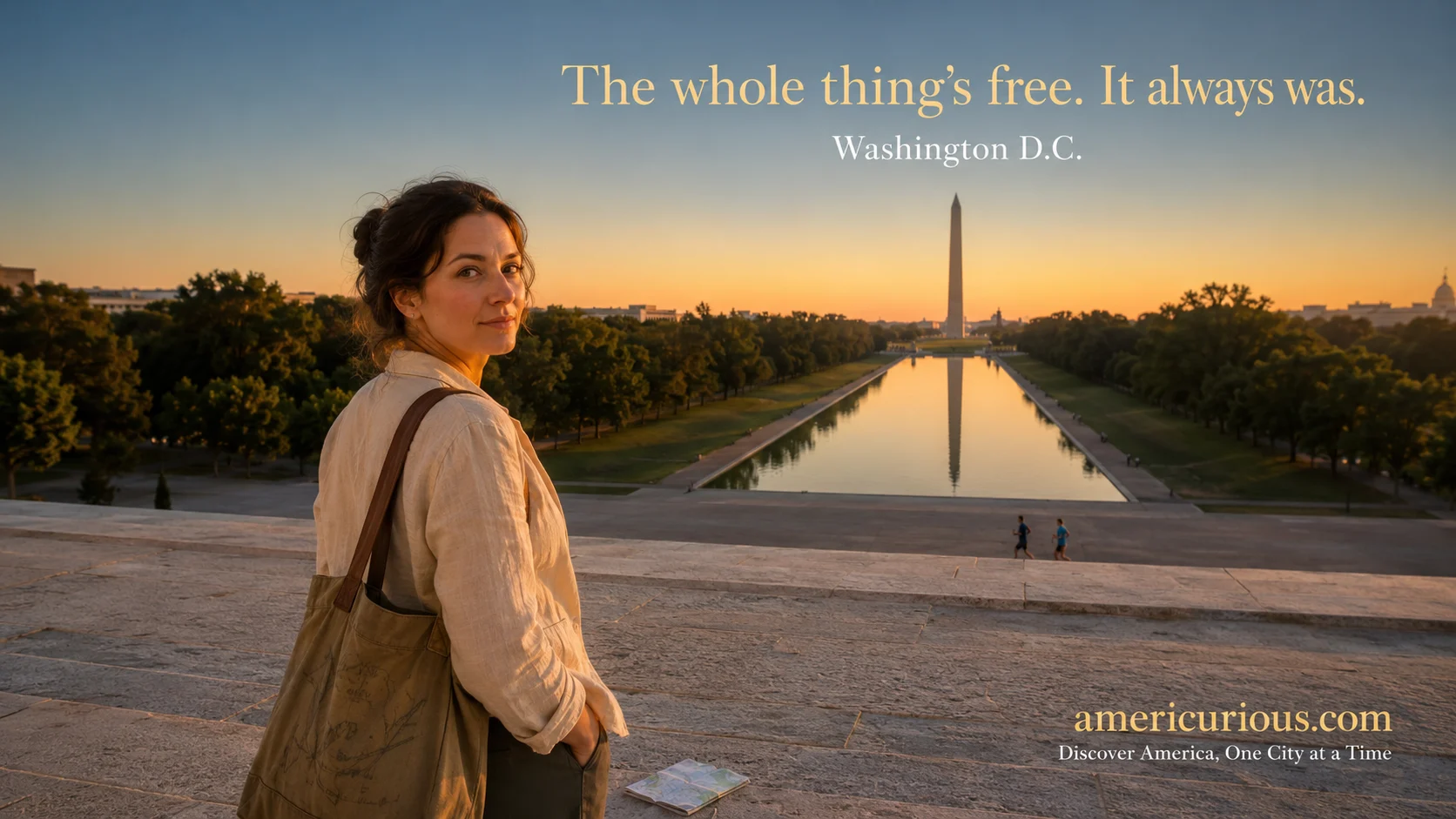
Washington D.C. is the world’s greatest free city — 35 verified, locally-grounded experiences that cost you exactly nothing. Start here.
Most cities make you pay to feel the place. Washington D.C. is the exception — and not by a little. The city was literally designed, at a constitutional level, to be publicly accessible. Every major museum, every monument, the entire cultural spine of the nation: free, walkable, and open to anyone who shows up.
The catch? A bad plan can turn a genuinely epic free day into a sweaty, crowded, “I could’ve just looked this up on Google” disaster. This guide is the difference between those two outcomes.
⚡ Quick Answer: Top 3 Free Things to Do in Washington D.C.
- Walk the National Mall at golden hour — The 1.9-mile stretch from the Capitol steps to the Lincoln Memorial is the most historically loaded walk in America, completely free, open 24/7.
- Smithsonian National Museum of Natural History — No tickets, no passes, no reservations. Walk in. Hope Diamond. Nation’s T. rex. 146 million specimens. Free.
- Lincoln Memorial at sunrise — The Reflecting Pool at 6 a.m., almost no one around, soft light hitting those 36 marble columns. This is the version of D.C. that people describe for the rest of their lives.
🏛️ Free Things to Do in Washington D.C.: The Full 2026 List
Every attraction below was verified live in June 2026. Free means free — no hidden fees, no membership gates, no “suggested donations” framed as mandatory. Where a free timed pass is required, that’s clearly noted so you don’t show up and get turned away.
1. Walk the National Mall — America’s Living Room
The Mall isn’t just a park. It’s a 1.9-mile corridor connecting two hundred and fifty years of American history, with the Capitol on one end and Lincoln sitting heavy on the other. On any given Tuesday morning, you’ll pass school groups, joggers, foreign tourists, and government workers eating lunch on the grass — all of it happening in the shadow of the same monuments.
You can walk the full length in under an hour, but most people meander for half a day. The museums on either side are all free, the monuments are all open, and the whole thing requires nothing but shoes. Come back at night. The Mall illuminated after 9 p.m., nearly empty, with nothing but crickets and the reflection of the Washington Monument in the pool — that’s a different city entirely.
When to go: Weekday mornings before 10 a.m. or after 7 p.m. on summer evenings. Summer 2026 note: some pedestrian and vehicle access along the Mall may be limited due to America 250th anniversary construction and events — check washington.org for current access updates before heading out.
Insider tip: The western end near the Lincoln Memorial is consistently less crowded than the central stretch near the Smithsonian buildings. Start there and walk east toward the Capitol for the best ratio of space to spectacle.
2. Lincoln Memorial — See It Before the Crowds Do
Here’s the thing about the Lincoln Memorial: the version most people get is not the good version. Summer afternoons, there are hundreds of people on those steps, selfie sticks in every sightline, tour guides yelling over each other. You photograph a crowd, not a memorial.
The real experience happens at sunrise. The Reflecting Pool stretches out below you, pink-gold light on the water, the Washington Monument rising in the distance, and Lincoln’s gaze fixed on something you can’t quite name. It’s free, it’s open 24 hours, and it’s one of the few places in D.C. where the scale of the thing actually lands the way it’s supposed to.
When to go: Sunrise is the non-negotiable answer. Summer sunrise in D.C. runs around 5:50 a.m. — arrive 15 minutes before and you may have the entire upper chamber to yourself for a few minutes.
Insider tip: Step inside the chamber and read the Second Inaugural Address carved into the south wall. Most visitors stop at the statue. The words are the whole point.
3. Smithsonian National Museum of Natural History — No Ticket Required (No, Really)
This is the one where people get confused because they assume something this good must cost something. It doesn’t. No tickets, no timed passes, no reservations — you walk in off the Mall, clear security (shoes stay on), and spend the next several hours in one of the most staggering collections on earth.
The Hope Diamond alone — 45.52 carats, deep-blue, allegedly cursed — draws gasps from adults who thought they were past that. The David H. Koch Hall of Fossils has a Nation’s T. rex that’s been through so much that scientists know what parasites it had. The Sant Ocean Hall features an exact-replica 45-foot North Atlantic right whale hanging overhead. This is not a children’s museum with adult captions. It’s the real thing, at the scale it deserves.
When to go: Open daily 10 a.m.–5:30 p.m., 364 days a year (closed December 25). Weekdays before noon are noticeably calmer than weekend afternoons. Security lines peak mid-morning; arriving right at 10 a.m. or after 2 p.m. beats the worst of it.
Insider tip: The Constitution Avenue entrance (north side) typically has a shorter security line than the Mall-facing entrance — useful on busy days.
4. National Gallery of Art — Two Buildings, Zero Dollars
The NGA operates two buildings connected by an underground concourse, and together they cover so much ground that you won’t feel cheated skipping either. The West Building holds the classics — a Vermeer, a da Vinci, a hall of Dutch masters. The East Building is all sharp angles and modern work, including a permanent Alexander Calder mobile hanging from the skylight that children and adults both stare at longer than they expect.
The Sculpture Garden between them is one of the most underrated free spaces in the city. In summer, it’s also home to Jazz in the Garden — free outdoor jazz concerts every Friday evening from May 22 through August 14, 2026. Entry for the concerts is by lottery (register at nga.gov); the garden itself is open to walk through any time during museum hours.
When to go: Museum hours are roughly 10 a.m.–5 p.m. (check the NGA website for current hours). For Jazz in the Garden, Friday evenings from late May through August — but register for the lottery in advance, not day-of.
Insider tip: The underground concourse between the two buildings has a moving walkway and a colorful Multiverse light installation by Leo Villareal. Most people rush through it. Stop and stand still for a minute.
5. National Museum of African American History & Culture — Book Passes Before You Leave Home
⚠️ Tourist Trap Warning: The NMAAHC is free — but if you show up without a timed pass, especially in summer, you may not get in. Same-day passes do release online at 6:30 a.m. and at the museum at 10 a.m., but they disappear fast. Visitors who assume “free = just walk in” end up standing outside a museum they can see but not enter. Book advance passes at nmaahc.si.edu before you book your flight.
If you do the work of securing a pass, what you’ll find inside is genuinely unlike anything else in the country. The museum goes underground — literally — to start the experience in the hold of a slave ship. It ends at the top with a celebration of Black American culture, music, sports, and art. The architectural bronze lattice wrapping the building exterior is itself an artwork, referencing African craft traditions and the ironwork of enslaved craftspeople in the antebellum South.
Budget a full four hours minimum. The permanent collection alone runs four floors. There is no rushing this one.
When to go: Timed passes required. Advance passes are your best bet — released online on a rolling basis. Same-day passes release at 6:30 a.m. (online) and 10 a.m. (on-site kiosks). Weekday morning slots are the easiest to snag.
Insider tip: The Sweet Home Café on the lower level serves actual good food themed around African American culinary traditions. It’s the one museum restaurant in D.C. worth eating at on purpose.
6. Vietnam Veterans Memorial — The List of Names
You approach it from the east, and the wall starts low — just a few names at eye level. Then the path descends and the wall grows, and by the time you reach the center it’s over ten feet tall and there are 58,281 names in front of you. The chronological order means you’re reading time itself. Some people trace names with their fingers. Some make rubbings. Some just stand there.
It is free, it is open 24 hours, and it changes most people who actually let it. The Three Soldiers statue and the Vietnam Women’s Memorial nearby are quieter but complete the story.
When to go: Evening is particularly powerful — the polished black granite becomes reflective after dark, showing you your own face against the names.
Insider tip: The directory books at both ends of the wall are maintained by rangers and let you look up specific individuals by name to find their panel and line number. This is how people find the person they came to find.
7. Hirshhorn Museum & Sculpture Garden — The Modern Art Museum That Doesn’t Ask You to Pretend
The Hirshhorn sits on the Mall like a concrete donut, and that’s essentially the vibe — a little abrasive, unapologetically contemporary, not at all interested in being the museum you expected. Inside, 12,000 works of modern and contemporary art rotate through a collection that includes Yoko Ono, Jeff Koons, and currently — through January 3, 2027 — a landmark solo exhibition by Adam Pendleton called Love, Queen, exploring abstraction and identity through paintings and single-channel video.
The outdoor sculpture plaza wraps the building and is worth walking even if you skip the interior. The Hirshhorn Sculpture Garden, embedded in the Mall itself, is in the midst of a $68 million revitalization and expected to reopen in fall 2026 — check the website for the current status.
When to go: Open daily 10 a.m.–5:30 p.m. Thursday evenings often have programming and longer hours — check the event calendar at hirshhorn.si.edu.
Insider tip: The circular fountain in the plaza is one of the quieter sitting spots on the Mall — surrounded by sculpture, usually much less crowded than the benches facing the main museum entrances.
8. Library of Congress, Thomas Jefferson Building — The Most Underrated Room in D.C.
Every article mentions the Library of Congress. Almost none of them prepare you for what it actually looks like inside. The Great Hall has 75-foot ceilings, mosaic floors, allegorical murals, and a staircase that manages to be grander than most state capitols. The Main Reading Room — if you time it right and get to the gallery overlook — is a circular cathedral of knowledge that stops most people mid-step.
Timed-entry tickets are required (free, available at loc.gov). The Thomas Jefferson Building provides the best visitor experience, with special exhibits supplementing the permanent collection of books, maps, recordings, and papers.
When to go: Tuesday through Saturday (Monday hours are reduced). Aim for a mid-morning slot on a weekday to get gallery access with fewer people crowding the overlook.
Insider tip: Book your time-entry pass at least a week in advance during summer — same-day slots often disappear. Once inside, ask a docent about the Giant Bible of Mainz, one of the rarest printed books in existence. It’s on permanent display and most visitors walk past it without knowing what they’re looking at.
9. Smithsonian American Art Museum & National Portrait Gallery — The Late-Night Move
These two museums share a stunning 1836 Greek Revival building in Penn Quarter, and they stay open until 7 p.m. most days — later than almost every other Smithsonian institution. That makes them the natural end-of-day choice when you’ve exhausted everything on the Mall and still have energy.
The Portrait Gallery holds the only complete collection of presidential portraits outside the White House, including a newly installed Biden portrait in 2026. The American Art Museum runs from colonial-era craft through contemporary video installation. Together, they cover the full span of American creative identity in one building, in one evening, for free.
When to go: Afternoons and evenings, daily 11:30 a.m.–7 p.m. The “Take Five!” jazz series in the Kogod Courtyard runs periodically — check americanart.si.edu for the current schedule.
Insider tip: The Kogod Courtyard (the enclosed courtyard at the building’s center) is one of the most architecturally remarkable spaces in D.C. — a glass canopy by Norman Foster floats above a 19th-century facade. It’s free to sit in, even if you’re just resting.
10. Kennedy Center Free Tour + Millennium Stage + The Rooftop
Here’s how most people experience the Kennedy Center: they don’t, because they assume tickets cost money. Free guided tours depart every 10 minutes during the day and are available in 17 languages. Docents walk you through the Grand Foyer (630 feet long, lined with red carpet and 18 massive Orrefors crystal chandeliers), the Eisenhower Theater, and an interactive exhibit on Kennedy’s life.
Separate from the tours, the Millennium Stage at the Kennedy Center offers free public performances Wednesday through Saturday at 6 p.m. — music, dance, and theater from local and national artists, no ticket required. First-come seating in the Grand Foyer. And then there’s the Rooftop Terrace, accessible via elevator, free to all visitors: unobstructed views of the Potomac River, Georgetown, and the city skyline.
When to go: Tours run 10 a.m.–5 p.m. A free shuttle runs from the Foggy Bottom Metro stop every 15 minutes starting at 9:45 a.m. For Millennium Stage performances, arrive 20–30 minutes early for a good spot.
Insider tip: The Rooftop Terrace at sunset in summer, with the Potomac light going orange below — this is a better free view than the Washington Monument observation deck, and there’s no timed ticket required to get here.
11. U.S. Botanic Garden — The Greenhouse Nobody Goes To
One block from the Capitol, the U.S. Botanic Garden runs a free conservatory with lush indoor tropical rooms, seasonal outdoor gardens, and an exhibit hall that’s quietly one of the most peaceful spaces in all of downtown D.C. In summer, the outdoor Bartholdi Park across Independence Avenue is in peak bloom and worth the five-minute walk.
It tends to be far less crowded than anything on the Mall, and the cool interior is a legitimate relief on a July afternoon. No tickets, no reservations, just walk in.
When to go: Open daily 10 a.m.–5 p.m. Summer mornings before 11 a.m. are calm. The outdoor gardens are at their peak from late June through August.
Insider tip: The corpse flower (Amorphophallus titanum) occasionally blooms here — it’s massive, rare, and smells exactly like what its name suggests. The USBG maintains a bloom tracker on their website when one is approaching.
12. Meridian Hill Park — This Is Where D.C. Actually Lives
Go to the National Mall if you want to see America’s monuments. Come to Meridian Hill Park on a Sunday afternoon if you want to see Washington. The park’s terraced landscape — a 13-acre formal design modeled on Italian Renaissance gardens — descends from 16th Street NW in Columbia Heights, ending at a 13-basin cascading fountain.
Every Sunday from roughly 3 p.m. to 8 p.m. (weather permitting), a spontaneous drum circle fills the lower terrace. Dozens of drummers, hundreds of participants — some dancing, some watching, most somewhere in between. It’s been happening here for decades and it is, without question, one of the most genuinely Washington experiences you can have without spending a dollar.
When to go: Sundays, 3 p.m.–8 p.m. for the drum circle. Any morning for peaceful walks along the upper terraces with views south over the city.
Insider tip: The park’s formal name in local usage is sometimes “Malcolm X Park” — that’s what long-time residents call it. The statues of Joan of Arc and Dante are both worth finding; most visitors don’t even notice them amid the drum circle energy.
13. National Air and Space Museum — Book Your Free Pass in Advance
The Air and Space Museum is midway through a major renovation — new galleries opening through 2026, including the Boeing Milestones of Flight Hall and Barron Hilton Pioneers of Flight. Free timed-entry passes are required; entry times are hourly from 10 a.m. to 4 p.m. Book them in advance at airandspace.si.edu.
What’s there is worth the logistics: the 1903 Wright Flyer, the Apollo 11 command module, a piece of actual moon rock you can touch. The ongoing renovation is improving the experience significantly — if you visited pre-2023, it’s a meaningfully different museum now.
When to go: Weekday morning slots fill slower than weekends. Booking a week or more in advance is strongly recommended for summer visits.
Insider tip: The moon rock touchstone is in the Milestones of Flight Hall and is one of only a handful of extraterrestrial objects in the world accessible to the public to physically touch. Don’t miss it in the rush to see bigger exhibits.
🔍 What Most Blogs Miss About Free D.C.
The Jazz in the Garden lottery detail. Every travel blog will tell you the NGA Sculpture Garden hosts free Friday evening jazz concerts in summer. Almost none mention that in 2026, entry is by lottery. Register early at nga.gov — the events fill up. Showing up Friday evening without a reservation may leave you listening from outside the fence.
Fort Reno free concerts. One of D.C.’s oldest free music traditions happens not on the Mall but in a park in upper Northwest — Fort Reno, near Tenleytown. Monday and Thursday evenings in summer, local bands perform in a completely alcohol-free, community-run series that’s been going since the 1960s. Organized by Amanda MacKaye (sister of Fugazi’s Ian MacKaye), it’s extremely local, zero tourist traffic, and free. Check washington.org for the current season schedule.
The Kennedy Center Rooftop Terrace is not a secret, but everyone still forgets it. The free building tour ends at the Grand Foyer. Most visitors leave. The elevator to the Rooftop Terrace is right there. It takes three minutes. The views of the Potomac from up there — especially at dusk — are the kind of thing you describe to people back home. Walk-up access, free, no ticket.
National Mall summer 2026 access changes. The America 250th anniversary programming has added events, construction, and periodic closures across the Mall through late 2026. The Smithsonian’s own Natural History Museum page flags that pedestrian and vehicle access may be limited this summer. Plan extra transit time, use Constitution Avenue museum entrances rather than Mall-side entrances, and check current access status before your visit.
💎 Free Hidden Gems in Washington D.C.
- Theodore Roosevelt Island — A free island park in the middle of the Potomac River, accessed by a footbridge from the Virginia side (closest parking: Roosevelt Island lot off GW Parkway). Inside: 88 acres of swampy wilderness, nature trails, a massive bronze statue of TR, and almost no one. This is not a small park squeezed between buildings. It’s a genuine island forest in the middle of a major American city. Locals know it. Most visitors never find it.
- Kenilworth Aquatic Gardens — Free admission, summer is the season. In July and August, 12 acres of ponds fill with blooming lotus flowers and water lilies — some leaves the size of serving platters. Located in far Northeast D.C. near the Anacostia River, it’s about as far from a tourist crowd as you’ll get in this city. Arrive in the morning; lotus flowers close by noon. Open daily, 7 a.m. to 4 p.m.
- Smithsonian Arts + Industries Building — The Smithsonian’s second-oldest building (and the country’s first national museum building) has a special exhibit running June 16 through September 7, 2026: Voices and Votes: Exploring Democracy Across America. Free admission, 10 a.m.–6 p.m. The building itself — 19th-century Victorian polychrome brick — is the attraction even before you get to the exhibit.
- The Yards Park, Navy Yard — A riverfront green space along the Anacostia River near Nationals Park, with light-up fountains, hammock zones, and weekend waterfront events through summer. No admission, no fees. This is where D.C. residents who live east of the river actually hang out on weekends — not on the Mall. Clean, modern, and a good twenty degrees cooler than downtown concrete in July.
- U.S. National Arboretum — A 446-acre agricultural research campus in Northeast D.C. with free admission. The highlight: a grove of 22 freestanding Corinthian columns that once supported the East Portico of the U.S. Capitol, removed during a renovation and relocated here in 1990. They stand in an open meadow with no context signs nearby — just the ghost of the Capitol, transplanted into a garden. It’s the most surreal free sight in the city, and tour buses never come here.
✨ Free D.C. by Vibe
Whether you’re planning around a mood, a group, or a scrollable itinerary — here’s the city sorted the way it actually works.
Chill / Nature
- Rock Creek Park — D.C.’s version of Central Park, but bigger and with actual hiking trails (Valley Trail, Ridge Trail). Free, open dawn to dusk.
- Meridian Hill Park — Terraced gardens, cascading fountain, Sunday drum circle. Bring a book on any other day.
- U.S. Botanic Garden — Cool conservatory, peaceful garden, zero crowds by Mall standards.
- Theodore Roosevelt Island — The city disappears here. Bring water.
- Kenilworth Aquatic Gardens — Lotus fields and lily ponds, summer mornings only.
Instagram Spots
- Lincoln Memorial at sunrise — The Reflecting Pool shot that never gets old because the light is different every single morning.
- Kennedy Center Rooftop Terrace at sunset — Potomac River, Georgetown skyline, no ticket required.
- National Gallery of Art Sculpture Garden — The Calder Spider sculpture against the fountain is one of the better ambient DC shots available.
- National Capitol Columns at the Arboretum — 22 marble columns in a meadow. This photograph will confuse everyone who doesn’t know D.C.
- Meridian Hill Park fountain terraces — Cascading stone tiers and European garden geometry. Best light mid-morning.
Culture / History
- National Museum of African American History & Culture — The most emotionally significant museum in America. Plan accordingly and book passes in advance.
- Library of Congress, Thomas Jefferson Building — The Main Reading Room overlook changes how you think about libraries. And knowledge. And America.
- Vietnam Veterans Memorial — The wall at dusk.
- Smithsonian American Art Museum & National Portrait Gallery — Presidential portraits and two centuries of American making, in one building, until 7 p.m.
- Smithsonian Arts + Industries Building — America’s oldest national museum building, with a 2026 democracy exhibit that feels extremely on-time.
💰 Smart Budget Strategy: Maximizing Your Free D.C. Day
Stack your timed passes the night before. Three major free attractions require passes: NMAAHC, Air and Space Museum, and the Washington Monument (if you want to ride to the top). Book all three at once from your hotel room the night before — or the week before if you’re visiting in peak summer. Same-day frustration at these sites is entirely avoidable.
The free Kennedy Center shuttle is your secret weapon. The shuttle from Foggy Bottom Metro station runs every 15 minutes starting at 9:45 a.m. It saves a 20-minute walk each way, it’s free, and almost nobody seems to know about it. Combined with the free Millennium Stage performance at 6 p.m., the Kennedy Center can serve as both your afternoon endpoint and your evening activity — no Uber, no Metro fare, no cost.
Build your Mall day east-to-west, not the other way around. Starting at the Capitol end (east) and walking toward Lincoln (west) means you’re walking into the light in the morning, your back is to the crowds forming around the Smithsonian cluster, and you hit the Lincoln Memorial when the afternoon crowds begin to thin. The instinct is to start at Lincoln because it photographs well — fight that instinct.
Use the Smithsonian app, not paper maps. The official Smithsonian app (free download) shows real-time crowding indicators for each building and maps every exhibition within each museum. It’s the difference between wandering and actually getting to see what you came for. Download it before you lose signal in the Metro.
Eat before the Mall, not on it. The museum cafeterias are convenient and overpriced. Pack lunch (food is allowed on the Mall grounds), or eat a full breakfast before arriving. The one exception: the Sweet Home Café at NMAAHC is genuinely excellent and worth budgeting for. If you’re going there anyway, it’s not a money-wasting detour — it’s part of the experience.
For more money-saving strategies across U.S. cities, check out our deep dive on free things to do in New York City — a very different logistical challenge, but many of the same principles apply.
❓ FAQ: Free Things to Do in Washington D.C.
Are the Smithsonian museums really free?
Yes — every Smithsonian Institution museum charges zero admission. No entry fee, no suggested donation, no membership required. Seventeen museums fall under the Smithsonian umbrella in D.C., and all of them are free to enter. Some require free timed passes to manage crowding (National Air and Space Museum, National Museum of African American History and Culture, National Zoo) — those passes are still free, they just need to be reserved in advance.
Do I need tickets for the Lincoln Memorial or other monuments?
No tickets are required for the Lincoln Memorial, Vietnam Veterans Memorial, WWII Memorial, MLK Jr. Memorial, FDR Memorial, Jefferson Memorial, or Korean War Veterans Memorial. All are open 24 hours a day, seven days a week, year-round, with no reservations needed. The Washington Monument is free but requires a timed-entry ticket — available at recreation.gov, with same-day tickets released each morning at 10 a.m.
What free things to do in Washington D.C. are best for kids?
The National Museum of Natural History is the strongest family option — no tickets, no passes, and the combination of a giant elephant in the rotunda, the Hope Diamond, live insects, and 65-million-year-old fossils keeps kids engaged for hours. The National Zoo is also free (timed entry required, book at nationalzoo.si.edu). For outdoor energy, the National Mall has open lawns for running around between monument stops.
Is it safe to visit the National Mall at night?
The central Mall area near the monuments is well-lit, patrolled by National Park Service rangers, and generally considered very safe at night. Visiting at night is actually one of the better free experiences in D.C. — the monuments are illuminated, the crowds are dramatically thinner, and the atmosphere is genuinely moving. Stick to the lit monument paths, check Metro closing hours by line (they vary), and you’ll have no issues.
What’s the best free museum in Washington D.C.?
It depends on what you’re after — but the National Museum of Natural History has the widest appeal and the lowest logistical barrier (no passes needed). For cultural depth, the National Museum of African American History and Culture is in a class by itself, though it requires advance planning for passes. For art lovers, the National Gallery of Art holds one of the great permanent collections in the Western hemisphere and almost never has the crowd problem the history museums face.
Are there free things to do in Washington D.C. at night?
Several. The monuments on the National Mall are open and illuminated 24 hours — the nighttime visit to the Lincoln Memorial and Vietnam Veterans Memorial is, for many people, the most powerful version of both. The Kennedy Center Millennium Stage runs free performances Wednesday through Saturday at 6 p.m. The Kennedy Center Rooftop Terrace is free to access any time the building is open. The Smithsonian American Art Museum and Portrait Gallery stay open until 7 p.m. on most days, later than other Smithsonian venues.
What costs money in D.C. that people mistake for free?
Several popular attractions charge admission that visitors sometimes assume is free. ARTECHOUSE (immersive digital art near the Mall) is a paid experience. The National Museum of Women in the Arts charges admission — though the first Sunday of each month is a free Community Day. George Washington’s Mount Vernon, just south of the city along the Potomac, charges entry. The Bureau of Engraving and Printing offers free tours but requires a timed ticket and lines form early. Always verify on official websites before arriving.
The Final Word on Free Washington D.C.
Most cities give you their best stuff behind a ticket booth. Washington was designed on the premise that the country’s memory, culture, and achievement belong to everyone — and that design decision, made two centuries ago, has never been walked back.
What that means practically: a first-timer with good logistics can spend a full week in D.C. and not run out of genuinely world-class free experiences. The National Mall alone contains more museum floor space, more historical weight, and more raw astonishment per mile than most entire cities.
The local version — Meridian Hill drum circles, Fort Reno concerts, Theodore Roosevelt Island on a Tuesday morning — adds a different layer. One that feels less curated, more real, and more like the city actually lives. Both versions are worth your time. Both versions are free.
Plan the passes. Go at sunrise. Walk more than you think you need to. Washington rewards the people who show up early and stay late — and it doesn’t charge either of them a dollar for doing it.
Looking for more free travel inspiration across the U.S.? Our complete guide to free things in New York City is a strong next read — and yes, the approach is just as strategic.
Discover more from AmeriCurious
Subscribe to get the latest posts sent to your email.