
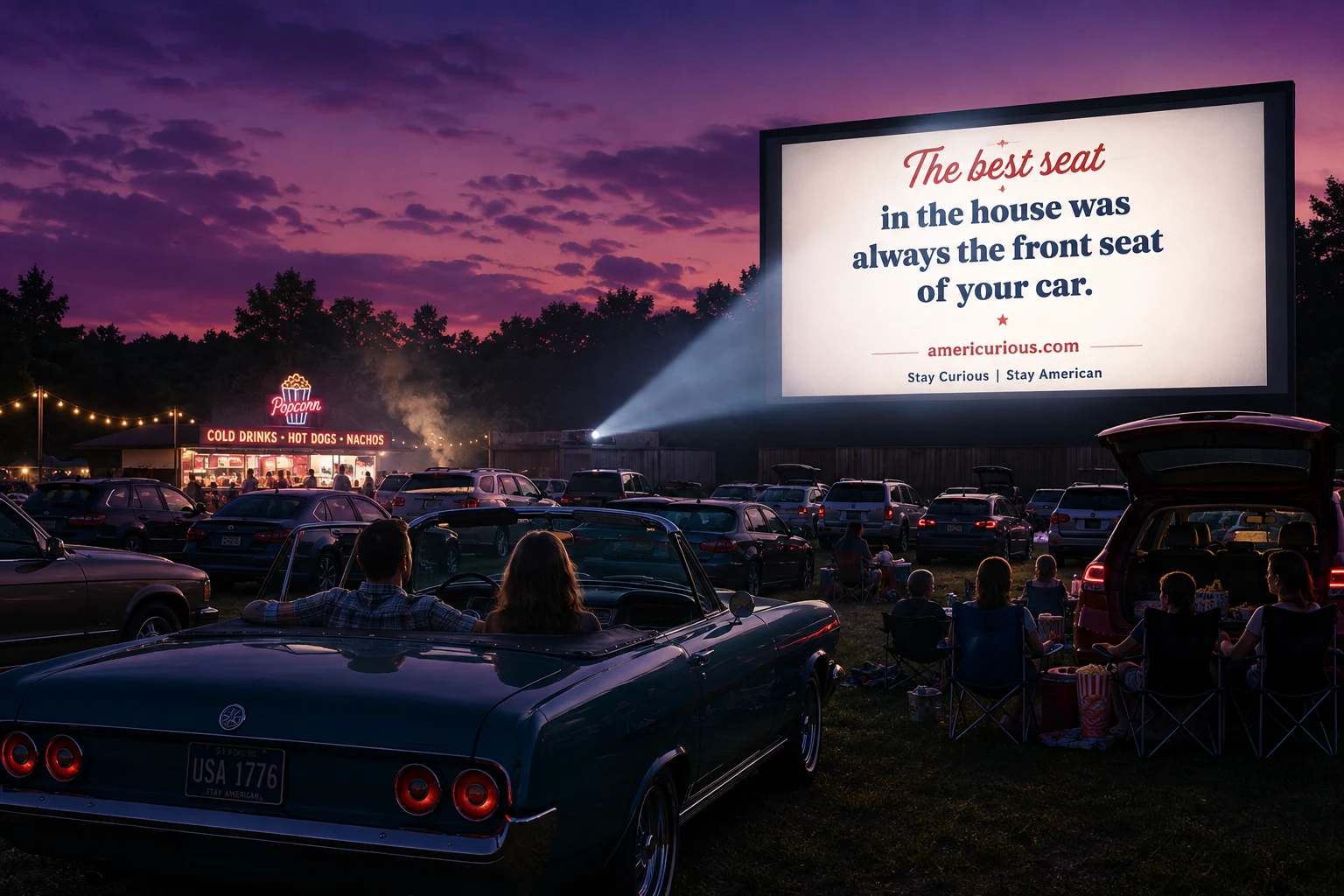
The first drive-in movie theater opened in 1933 New Jersey — a scrappy American invention that turned parking lots into cathedrals of summer memory.
A Camden Parking Lot That Changed American Nights
On June 6, 1933, a chemical company sales manager named Richard Hollingshead flipped a switch on Admiral Wilson Boulevard in Camden, New Jersey — and a 40-by-50-foot screen bloomed against the sky. Four hundred cars idled in gravel rows. Adults paid a quarter, the car paid a quarter, and Wives Beware started rolling. Nobody in that lot knew they were watching the birth of an American ritual — they just knew they didn’t have to squeeze into a stuffy theater seat on a June night. I’ve stood on that stretch of Admiral Wilson Boulevard. It’s a Home Depot now. History rarely leaves a plaque where it needs one.
Section 1 — The Story Begins Here
The Man, The Mother, The Bright Idea
Hollingshead wasn’t a filmmaker or a showman. He was a 32-year-old sales manager at his father’s chemical plant who, according to History.com, watched his mother wince through movies because standard theater seats didn’t fit her comfortably. Most inventors would have shrugged. Hollingshead nailed a Kodak projector to his car hood, hung a bedsheet between two trees in his Riverton driveway, and started experimenting.
A Patent, A Prototype, A Punt
He tested rain (a lawn sprinkler on the windshield), sound (a radio behind the sheet), and sightlines (blocks of wood under tires to angle each car upward). On August 6, 1932, he filed U.S. Patent No. 1,909,537 — granted May 16, 1933. Three weeks later, “Park-In Theaters” opened. Admission was 25 cents per car plus 25 cents per person, capped at a dollar per carload — a Depression-era mercy that instantly outclassed indoor cinemas.
The First Screen Flickers
Opening night ran a wheezy British comedy called Wives Beware. Sound came from three RCA Victor loudspeakers stacked beside the screen — which meant the folks in row twelve heard the movie about half a second after the folks in row one. Nobody cared. They were in their own upholstered living rooms, under a Jersey sky, watching Hollywood come to them.
“America didn’t invent the movie. We invented the parking lot with a soul.” — AmeriCurious
Section 2 — Why This Is More American Than You Think
An Invention Only We Could Have Made
Think about the ingredients: a country besotted with cars, a middle class that had just discovered leisure, cheap suburban land, and a stubborn refusal to sit still in the dark next to strangers. No other nation had all four in 1933. Drive-ins weren’t just a business model — they were an American mood board, drawn up in chrome and canvas.
The Overlooked Origin Story
Here’s the countercultural clarity moment: most Americans assume drive-ins peaked in the 1950s and quietly died. Not quite. They peaked at over 4,000 screens by 1958, according to Shankweiler’s Drive-In, and then endured a slow, uneven bleed. But they never fully vanished — and the story of why is more interesting than the story of when.
The Summer Ritual Nobody Legislated
The drive-in didn’t need advertising to become a summer institution. It slotted itself into American life the same way u-pick berry farms and roadside stands did — organically, seasonally, without asking permission. Which, when you think about it, is the most American way for anything to catch on.
🗳️ Quick poll: What’s the best drive-in double feature pairing?
○ Two blockbusters back-to-back
○ New release + classic throwback
○ Family film + something spookier after the kids sleep
○ Whatever’s on — I’m here for the vibe
(Share your answer in the comments!)
Section 3 — The Details That Make It Real
The Numbers Behind The Nostalgia
By the mid-1950s, drive-ins were a genuine American juggernaut. Southern Living and industry archives place the peak at roughly 4,000+ screens; today, according to drive-ins.com, fewer than 300 remain in regular operation. That’s a 92%+ decline — but the survivors are stubborn, beloved, and often booked solid on summer weekends.
| Era | Approx. U.S. Drive-Ins | Cultural Moment |
|---|---|---|
| 1933 | 1 | Camden, NJ — the original |
| 1948 | ~820 | Postwar car boom |
| 1958 | ~4,000+ | Peak — the golden age |
| 1990 | ~910 | The long decline |
| 2020 | ~305 | Pandemic-era revival |
| 2026 | Under 300 | Steady, stubborn survival |
Estimated U.S. drive-in theater counts across the decades. Sources: UDITOA, drive-ins.com, Wikipedia list of drive-in theaters.
📌 Fast Fact: Shankweiler’s Drive-In in Orefield, Pennsylvania — opened April 15, 1934 — is the world’s oldest continuously operating drive-in. It just wrapped its 92nd summer and still runs year-round.
What The Ticket Actually Bought You
The drive-in wasn’t just a movie. It was a bundle. Here’s what a classic 1950s Friday night included, and honestly, most of it still holds:
- 🚗 A private booth on wheels (a.k.a. your Buick)
- 🍿 A concession stand pushing hot dogs, popcorn, and RC Cola
- 🎠 A playground where kids could burn off supper before the reel started
- 🎬 A double feature — sometimes a triple, if you could stay awake
- 📻 A metal speaker box that clipped to your window and hissed like a haunted seashell
- 🌌 A ceiling made of actual stars
Section 4 — Hidden Layers (What Most People Miss)
The Sound Problem Nobody Talks About
For the first fifteen years, drive-ins had awful sound. Those three giant speakers by the screen bounced audio into the surrounding neighborhood, and residents hated it. In 1941, RCA introduced the in-car speaker on a pole — one per parking spot, volume knob included. That single innovation saved the drive-in and, arguably, saved suburban zoning boards from open revolt.
The Patent That Got Struck Down
Hollingshead’s patent was so broad — essentially “any outdoor theater where you watch from a car” — that competitors flooded in and paid him licensing fees for years. Then in 1950, a Delaware court invalidated it. The floodgates opened. Within eight years, drive-ins quadrupled. Hollingshead lost his monopoly and, in a very American twist, that’s exactly when the drive-in became a national institution.
The Second Life Nobody Predicted
When COVID shuttered indoor cinemas in 2020, drive-ins became the only game in town. Church services, high school graduations, and concerts moved to drive-in lots. The New York Times and dozens of trade outlets covered the mini-boom. Most of those pop-ups faded — but the survivors emerged with new audiences and renewed civic love. When did we stop being curious about the place we call home? Sometimes it takes a crisis to remind us.
Section 5 — The Human Story
The Kid In The Back Seat
Ask any American over 50 about their first drive-in memory, and you’ll hear a variation of the same story: pajamas, a station wagon tailgate, a paper bag of popcorn from home, and falling asleep somewhere between the coming attractions and the cartoon. That story isn’t nostalgia bait — it’s a shared national memory, quietly passed down like a family recipe. My aunt in Toms River claims she was conceived during Bogart’s Sabrina at a drive-in in 1954. I’ve never asked for verification. Some family lore should stay unfact-checked.
The Operators Who Wouldn’t Quit
Walk into Shankweiler’s on a July evening in 2026 and you’ll meet Paul Geissinger, the fifth owner in 92 years. He’ll tell you about running a digital projector where a carbon-arc used to burn. He’ll point at the snack bar, still selling the same soft pretzels. And he’ll shrug when you ask why he keeps it open. Because of course he keeps it open. It’s the oldest drive-in on Earth — you don’t just close that.
Small Businesses, Big Screens
The drive-in’s staying power sits alongside other stubbornly American summer traditions — the county fair, the ice cream stand, the 11-year-old kid who accidentally invented the popsicle. None of these were built for scale. All of them survived by refusing to become anything other than themselves.
“A drive-in isn’t a business plan. It’s a promise you keep to your neighbors, one summer at a time.” — AmeriCurious
🧠 AmeriCurious Quiz: How Well Do You Know The Drive-In?
Q1: In what year did the first drive-in open?
A) 1929 B) 1933 C) 1941 D) 1952
Q2: In which New Jersey city did Richard Hollingshead open Park-In Theaters?
A) Newark B) Camden C) Trenton D) Atlantic City
Q3: Approximately how many drive-ins operate in the U.S. today?
A) Fewer than 300 B) About 800 C) Around 1,500 D) Over 3,000
✅ Answers: Q1-B | Q2-B | Q3-A
Section 6 — Your Move, America
Go See One While You Still Can
A drive-in isn’t a museum, but every year we lose a few more. Here’s how to make the most of what’s left before summer 2026 slips into fall:
Reader’s Action List:
- 🎟️ Book Shankweiler’s — the world’s oldest, in Orefield, PA, open year-round (shankweilers.com)
- 🌊 Hit Wellfleet Drive-In on Cape Cod — the last on the Cape, running since 1957 (wellfleetcinemas.com)
- 📻 Bring an FM radio — most drive-ins now broadcast sound to your car stereo
- 🧺 Pack a low-back lawn chair — tailgate seating hits different
- 🍕 Buy from the concession stand — it’s how these places survive
- 📸 Take exactly one photo, then put the phone down — the movie deserves it
- 🗺️ Use the drive-ins.com locator to find one within an easy road trip
❓ Frequently Asked Questions
Q: Where was the first drive-in movie theater in America?
A: The first drive-in opened on June 6, 1933, on Admiral Wilson Boulevard (then Crescent Boulevard) in Camden, New Jersey. It was called Park-In Theaters and was created by Richard Hollingshead Jr.
Q: Who invented the drive-in movie theater?
A: Richard M. Hollingshead Jr., a chemical company sales manager from Riverton, New Jersey. He filed his patent on August 6, 1932, and received U.S. Patent No. 1,909,537 on May 16, 1933.
Q: What is the oldest drive-in still operating in the United States?
A: Shankweiler’s Drive-In in Orefield, Pennsylvania, opened April 15, 1934. It is the oldest continuously operating drive-in in the world and remains open year-round in 2026.
Q: How many drive-in theaters are left in America?
A: Fewer than 300 drive-in theaters are currently operating in the United States as of 2026, down from a peak of over 4,000 screens in 1958. The exact number fluctuates each season.
Q: Why did drive-in theaters decline?
A: A mix of factors: rising suburban land values, the 1970s move to daylight saving time (which pushed showtimes later), the arrival of home video, multiplex expansion, and the high cost of converting to digital projection in the 2010s.
The Sign-Off
What’s your best drive-in memory — the movie, the car, the person next to you? Drop it in the comments. Save this one for your next summer road trip, or send it to the friend who still keeps a lawn chair in their trunk. And if stories like this are your kind of thing, follow along at americurious.com — there’s always another quietly American place worth chasing.
— AmeriCurious
americurious.com
Stay Curious | Stay American 🇺🇸
📚 Sources & Further Reading
[1] History.com Editors, “First drive-in movie theater opens, June 6, 1933,” HISTORY, updated 2024. https://www.history.com/this-day-in-history/june-6/first-drive-in-movie-theater-opens [opens in new tab]
[2] U.S. Patent Office, “Drive-In Theater, US1909537A,” Richard M. Hollingshead Jr., granted May 16, 1933. https://patents.google.com/patent/US1909537A/en [opens in new tab]
[3] Shankweiler’s Drive-In, “History,” 2026. https://www.shankweilers.com/history [opens in new tab]
[4] Wikipedia, “Shankweiler’s Drive-In Theatre,” last revised 2026. https://en.wikipedia.org/wiki/Shankweiler%27s_Drive-In_Theatre [opens in new tab]
[5] Drive-Ins.com, “The Drive-In Theater Database,” accessed August 2026. https://drive-ins.com/ [opens in new tab]
[6] Southern Living, “Add Drive-In Movies To Your Summer Bucket List,” 2025. https://www.southernliving.com/drive-in-movie-theaters-11749114 [opens in new tab]
Discover more from AmeriCurious
Subscribe to get the latest posts sent to your email.