
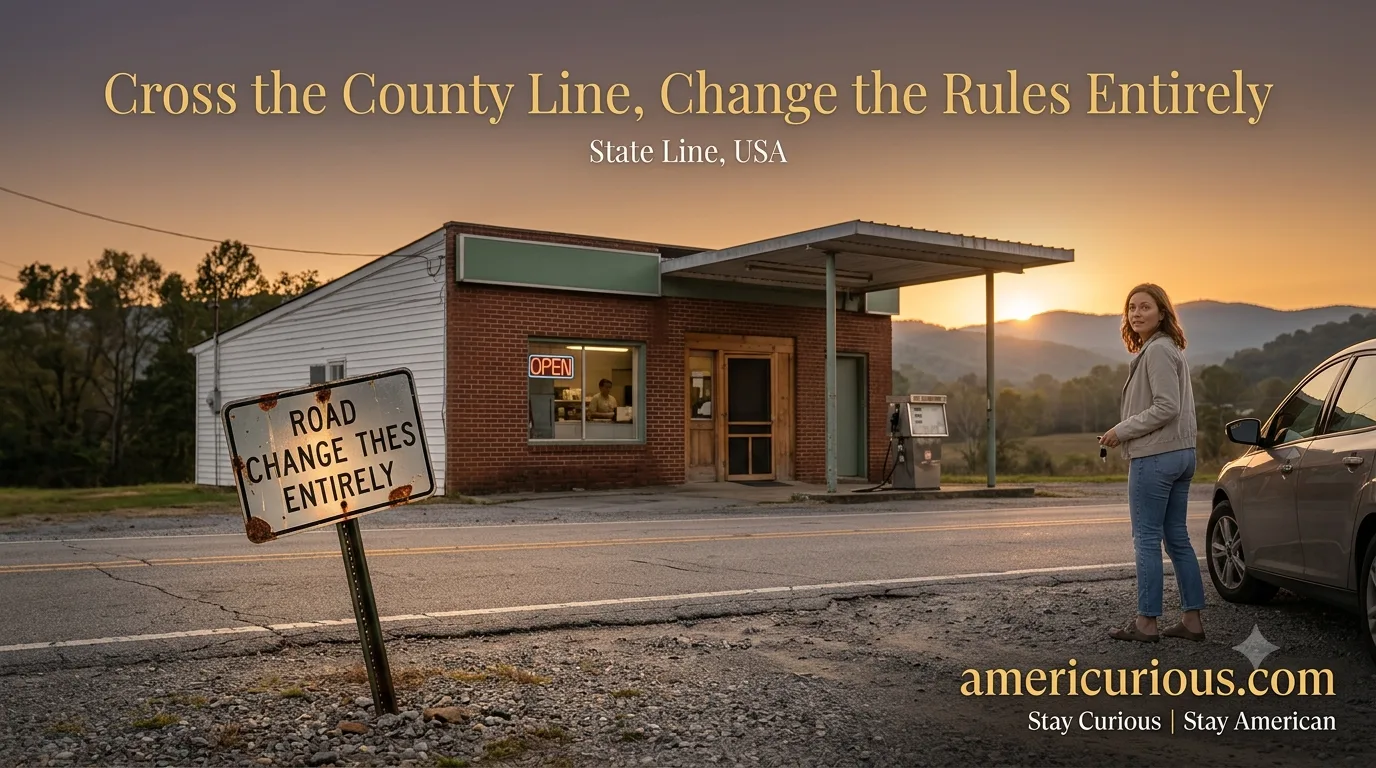
Alcohol laws vary by state because of a 1933 constitutional amendment — discover why 17 states run liquor stores and 83 counties still ban sales entirely today.
Quick answer:
US alcohol laws vary by state because the 21st Amendment, ratified December 5, 1933, repealed national Prohibition and handed almost all regulatory power over alcohol back to the states — not Congress. That’s why 17 states run their own liquor stores, roughly 83 counties across nine states still ban alcohol sales entirely, and rules on Sunday sales, grocery-store wine, and shipping a bottle across state lines look nothing alike from Nashville to Naperville.
It was somewhere past ten on a two-lane road in eastern Tennessee, and I pulled into a gas station wanting exactly one thing: a cold six-pack for the motel room. The clerk didn’t even look up. “Cain’t sell it here, hon. County’s dry.” I’d crossed some invisible line a few miles back, and the same six-pack I’d bought forty minutes earlier in Knoxville was now illegal to sell where I was standing.
That gas station moment isn’t a quirky exception. It’s the system working exactly as designed almost a century ago — and once you know why, you’ll never plan a road trip the same way again.
What Happened in 1933 That Handed Alcohol Law to the States?
Fourteen years earlier, in 1919, the country had gone the opposite direction entirely: the 18th Amendment banned the manufacture, sale, and transportation of alcohol nationwide, and Prohibition took effect the following year. It didn’t work the way anyone hoped. Bootlegging, organized crime, and a genuinely unenforceable law eventually pushed Congress to reverse course.
On December 5, 1933, Utah became the deciding state, ratifying the 21st Amendment and repealing the 18th — the only time in US history the Constitution has been amended specifically to undo a previous amendment. This is the part that actually explains your gas-station beer run: the 21st Amendment didn’t just end Prohibition, it explicitly handed control of liquor law back to the states, letting them ban sales statewide or let individual towns and counties decide for themselves whether to stay “wet” or “dry.”
Congress essentially said, “we’re out — you all figure it out,” and every state did, in its own way, at its own pace. Mississippi, notably, didn’t repeal its own statewide Prohibition until 1966 — more than three decades after the rest of the country got its bar back. If your grandparents grew up there, they lived through Prohibition twice.
Why Do Some States Still Run the Liquor Store Themselves?
Repeal didn’t just create fifty different sets of rules. It created fifty different business models. Seventeen states and jurisdictions — including Alaska, Maryland, Minnesota, and South Dakota — chose what’s called the “control” model, where the government itself wholesales or retails distilled spirits, and sometimes wine and beer too, through state-run agencies instead of licensing private stores.
Pennsylvania, Utah, Michigan, and Alabama are the big names most people recognize, but the list runs deeper. According to the National Alcohol Beverage Control Association, these 17 control jurisdictions represent about 25% of the country’s population and roughly 24% of all US spirits volume. Some states, like Alabama, Mississippi, and Pennsylvania, put the government directly in the retail business — an actual state employee ringing up your bottle of bourbon — while others use the state as wholesaler only and license private “agency stores” to sell at retail.
Control states didn’t pick this model on a whim. It’s a straight line back to the temperance-era compromise: government control instead of an outright ban, so a suspicious legislature could keep alcohol legal while keeping it at arm’s length. If you’ve ever wondered why your Pennsylvania cousin can’t just grab wine at the grocery store, that history is the reason.
Control State Snapshot
| State Type | Example States | How It Works |
|---|---|---|
| Full control (state-run stores) | Pennsylvania, Alabama, Utah, New Hampshire | Government owns and staffs retail liquor stores |
| Wholesale control (private retail) | Ohio, Maine, Michigan | State controls wholesale distribution; private agents run the counter |
| Open/license state | 33 remaining states | Private businesses handle wholesale and retail under state licenses |
What’s a Dry County, and Why Do They Still Exist in 2026?
That sounds simple enough — state repeals Prohibition, state sells booze. But it isn’t, because the 21st Amendment let states delegate the decision even further, down to the county or city level. This is called “local option,” and it’s exactly what got me at that Tennessee gas station.
Thirty-three states currently have laws allowing localities to prohibit the sale, consumption, or possession of alcohol altogether, and most of that patchwork sits in the South, often driven by lingering temperance-era religious sentiment. By one recent count, about 83 dry counties still exist, concentrated in just nine states, with Arkansas alone home to 34 dry counties — 45% of the state. Kentucky has 15 dry counties, Mississippi has a dozen, and Tennessee, Texas, Georgia, Florida, and Kansas each have a handful more.
A few states flip the default entirely. Kansas, Mississippi, and Tennessee are technically dry statewide unless a county specifically votes to allow sales — which is exactly the switch that got flipped against me on that dark two-lane road. And it’s not just full dry-or-wet: New Mexico is wet by default statewide but bans alcohol sales every Sunday until noon, a category of law wonks call “blue laws,” a holdover from an era when Sunday morning belonged to church, not commerce.
“Dry counties” sound like a relic. They’re not. Over 80 of them are still very much in business — or, more precisely, out of it — right now, and one of them might be between you and your next hotel.
Why Is the Drinking Age 21 Everywhere, But Almost Nothing Else Matches?
There’s exactly one piece of alcohol law that’s uniform coast to coast, and how Washington got there is a masterclass in working around the 21st Amendment without technically touching it. The 1984 National Minimum Drinking Age Act requires states to prohibit anyone under 21 from purchasing or publicly possessing alcohol as a condition of receiving federal highway funding. Not a federal mandate — a federal bribe, essentially, and a very effective one.
States that refused faced a 10% cut to their annual federal highway apportionment, later reduced to 8% starting in fiscal year 2012. South Dakota, which had a legal drinking age of 19 at the time, sued, arguing Congress was strong-arming states around their 21st Amendment authority. The Supreme Court disagreed in South Dakota v. Dole, ruling that withholding a relatively small slice of highway money didn’t cross the line from persuasion into unconstitutional coercion. Every state fell in line rather than lose the cash — which is the only reason your ID gets checked the same way in Boise as it does in Boston.
Can States Really Play Favorites With In-State Liquor Stores?
For decades, plenty of states assumed the 21st Amendment gave them nearly unlimited room to write protectionist rules favoring local liquor businesses. Tennessee found out otherwise in 2019. The state required anyone applying for a retail liquor license to have lived in Tennessee for the two years prior, with a ten-year residency requirement for license renewal — a rule that effectively locked out newcomers and out-of-state chains alike.
Total Wine & More and a Memphis couple named Doug and Mary Ketchum challenged it, and the case reached the Supreme Court as Tennessee Wine and Spirits Retailers Association v. Thomas. In a 7–2 decision, the Court sided with the challengers, ruling that Tennessee’s residency rule amounted to protectionist legislation favoring in-state retailers over out-of-state competition, in violation of the dormant Commerce Clause. The Court made clear that states’ 21st Amendment power over alcohol “is not a license to impose all manner of protectionist restrictions,” especially ones with little real connection to public health or safety. Translation: states can still regulate alcohol heavily, but “it’s alcohol” isn’t a blank check to shut out competition.
What About Grocery Store Beer, Sunday Sales, and Shipping Wine Home?
This is where the patchwork gets genuinely personal, because it touches the stuff people actually do every week: grabbing a six-pack with the groceries, ordering wine at Sunday brunch, or having a bottle shipped home from a trip.
Take Utah, long known for having some of the country’s strictest alcohol regulation, rooted in the state’s large Church of Jesus Christ of Latter-day Saints population, which discourages drinking entirely. For years, Utah restaurants had to physically hide bartenders from view behind frosted-glass partitions nicknamed “Zion Curtains,” meant to keep kids from seeing the “glamour” of drink-mixing. A 2017 law finally let many restaurants tear the partitions down in favor of buffer zones instead — proof that even the strictest states adjust, just very slowly.
South Carolina tells its own version of that story. From 1973 until 2006, every single cocktail served in a South Carolina bar or restaurant, by law, had to be poured from a sealed 1.7-ounce mini bottle — the little airline-size kind — making South Carolina the last state in the country requiring it. Voters finally scrapped the mandate through a 2004 constitutional amendment. If you’ve spent a day in Greenville, South Carolina lately, ordering a proper free-poured cocktail on a Main Street patio, you’re drinking the result of that 2006 change — and the state still closes liquor stores on Sundays by law, even though bars and restaurants can serve spirits that same day.
📋 Before You Cross a State Line With Alcohol:
- Check whether your destination county is wet, dry, or “moist” — most state ABC boards publish a searchable map
- On-premise rules (bars, restaurants) and off-premise rules (stores) are often two separate laws, especially on Sundays
- If you’re shipping wine home from a tasting room, ask the winery directly which states and carriers they’re licensed for — it’s not universal, even post-2019
- Never assume what’s legal where you live travels with you
Wander into a tasting room in a town like Galena, Illinois, and the winery pouring your glass has to know Illinois’ shipping rules cold before it can legally mail that bottle to your address in another state.
Why This Patchwork Isn’t Going Away Any Time Soon
This fragmentation is a permanent feature, not a bug slowly being fixed. The 21st Amendment gave states constitutional cover to regulate alcohol as they see fit, and nearly a century of case law — right up through Tennessee Wine in 2019 — has only trimmed the edges of that power, never eliminated it. Dry counties are shrinking in number, but they’re not disappearing. Control states occasionally flirt with privatizing, but rarely follow through, because those state-run stores are genuine revenue engines for local governments.
So build the habit: before a road trip or a move, spend the two minutes checking your route’s alcohol laws the way you’d check the weather. It’s exactly that unpredictable, and just as easy to plan around once you know to look.
Back to That Tennessee Gas Station
I ended up driving another twenty minutes into a county that had voted itself wet decades ago, and grabbed that six-pack after all. Small inconvenience — but a pretty perfect, pocket-sized demonstration of the whole point. Ninety-plus years after Utah cast the deciding vote to end national Prohibition, the United States still doesn’t have alcohol laws, singular. It has alcohol law, plural, times fifty states, times however many counties feel like weighing in — a genuinely American compromise between “let’s not ban it again” and “let’s not all agree on it either.”
Frequently Asked Questions About US Alcohol Laws
Why does alcohol law differ so much between US states?
Because the 21st Amendment, ratified in 1933, repealed national Prohibition and gave states — not the federal government — primary authority to regulate the sale, distribution, and possession of alcohol within their own borders, including the power to let cities and counties set their own rules.
Are there still dry states in the US?
No entire state is fully dry today, but roughly 83 counties across nine states, mostly in the South, still ban alcohol sales entirely under local-option laws, and a few states like Mississippi, Kansas, and Tennessee default to dry unless a county votes otherwise.
Why is the drinking age 21 in every state?
The 1984 National Minimum Drinking Age Act ties full federal highway funding to states enforcing a minimum purchase and public-possession age of 21; the Supreme Court upheld this funding condition in South Dakota v. Dole, so every state complies rather than lose highway money.
What is a control state?
A control state is one of 17 US jurisdictions where a state government agency, rather than private business, controls the wholesale or retail sale of some or all alcoholic beverages, typically distilled spirits — Pennsylvania, Utah, and Michigan are among the largest.
Can I have wine shipped to me from another state?
In most cases yes, following the Supreme Court’s 2019 ruling against protectionist state alcohol rules, but shipping volume limits, licensing requirements, and permitted carriers still vary by state, so check both the shipping state’s and receiving state’s rules before ordering.
Discover more from AmeriCurious
Subscribe to get the latest posts sent to your email.