
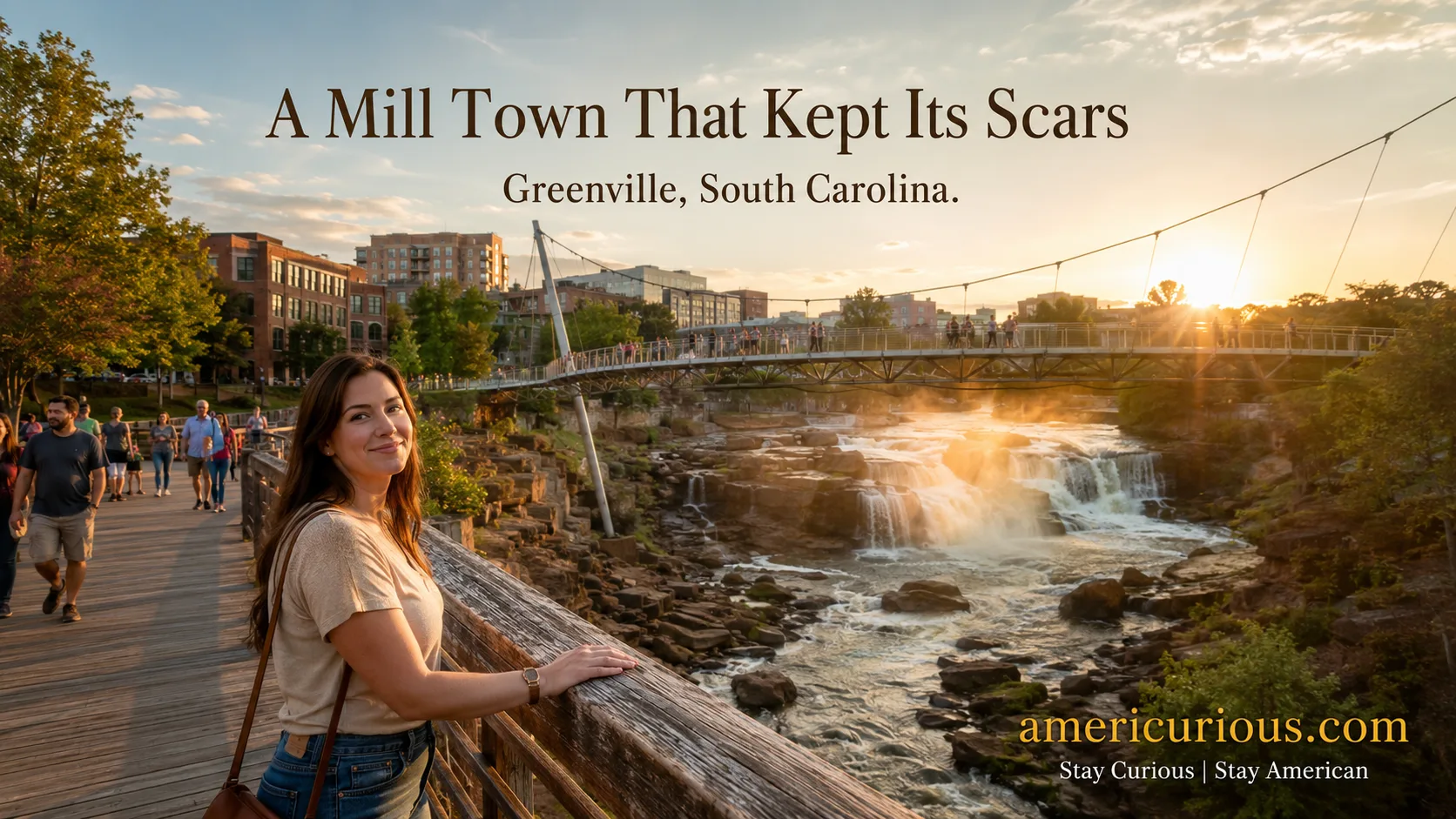
Greenville, South Carolina smells like hickory smoke and river mist at dawn — here’s what a real day inside this reinvented Upstate mill city feels like. 🍑
Last Updated: Cultural and demographic data current as of July 2026. Culinary and event information verified via sources active at time of publication. Last reviewed by Somewhere Real editorial team: July 31, 2026. Readers are encouraged to verify venue details and event dates directly before visiting. Found something outdated? Tell us below.
Quick Answer: Greenville, South Carolina is an Upstate river city built twice — once by a textile empire, once by its own reinvention — where a waterfall sits in the middle of downtown and a 28-mile rail-trail called the Swamp Rabbit Trail connects old mill villages to new breweries. Locals eat shrimp and grits at Soby’s, mustard-sauced pork at Henry’s Smokehouse, and pack Main Street every fall for a food festival that started with fourteen restaurants and now draws nearly 150,000 people.
6:14 a.m., and the first sound in the West End isn’t a car. It’s a freight horn — long, low, unbothered — rolling off the Norfolk Southern line that’s threaded through this part of Greenville since the Greenville and Columbia Railroad first arrived in 1853, back when this riverbank was cotton warehouses and mule teams instead of breweries and lofts. Two blocks over, an exhaust fan coughs the first plume of the day into air that already smells like the Reedy River — mineral, green, a little like a penny held too long in your palm. A jogger’s shoes slap the boardwalk through Falls Park, where mist still hangs low enough over Reedy River Falls that the Liberty Bridge looks like it’s floating on nothing at all. Behind a chain-link fence, a compressor kicks on at a barbecue joint that’s smoked pork on Wade Hampton Boulevard since 1992, and the hickory smell arrives before the sun does.
This is Greenville, South Carolina — not the postcard version with the waterfall and the string lights, though that version is real too, but the one that’s already awake and arguing with itself about coffee before 7 a.m. People come to Greenville, South Carolina for the falls and stay long enough to realize the falls are the least interesting thing about it. What follows is one day inside it, reported the honest way: the housing, the commute, the breakfast, the festivals, the barbecue, the language, the exhaustion, the joy. Nobody hands you a brochure for a place like this. You just have to walk into it.
Rise & Grind: Morning in Greenville, South Carolina
What a Typical Greenville Morning Actually Looks Like
The median home value across Greenville County sat at roughly $368,000 as of spring 2026, according to Redfin’s county-level housing data — up modestly year over year, with homes spending nearly two months on the market, a pace that would have been unthinkable during the pandemic-era scramble. Inside the Greenville city limits specifically, Zillow’s Home Value Index put the average home value closer to $330,000 as of mid-2026 — the gap between city and county figures is real, and worth naming honestly rather than smoothing over: the city proper skews denser and pricier than the sprawling ring of subdivisions around it. Renters, meanwhile, are looking at a median of roughly $1,800 a month within city limits per Zillow Rental Manager data. Translate that into something a person can picture: that’s a two-bedroom in a converted mill loft a mile from downtown, not a mansion, and definitely not the “sleepy Southern town” a lot of visitors still expect to find.
That expectation gap is the whole story of Greenville’s mornings. Waking up here at 6 a.m. means waking up inside a city of about 73,000 people, according to recent U.S. Census Bureau estimates, sitting inside a metro of nearly 583,000 — the most populous county in the state, per USAFacts’ analysis of Census data. Locals just call the whole ten-county region the Upstate (a term that used to be “the Upcountry” a century ago, before Charleston and Columbia flattened it into something more marketable), and the distinction matters because nobody who actually lives here thinks of Greenville as a small town anymore. It hasn’t been one in twenty years.
The Commute Nobody Warns You About
Here’s a fact that would make a decent bar bet: the average Greenville commute is about 19 minutes, according to both the Census Bureau’s American Community Survey data compiled by DataUSA and independently confirmed by Census Reporter’s ACS profile — shorter than the national average by a wide margin. Most people drive alone, and the average household keeps two cars in the driveway. That sounds almost boring until you’ve sat on Woodruff Road at 8:15 on a Tuesday, that long retail corridor of big-box stores and chain restaurants that every local has a complicated relationship with — everybody shops there, everybody complains about it, nobody has a better idea for where the Target should go. Is a 19-minute average commute a small miracle or just a low bar cleared by a city that hasn’t yet built the infrastructure to match its growth? Both, probably, and Greenville seems aware of the contradiction even as it keeps approving new subdivisions on its outer edges.
Breakfast, the Way People Who Live Here Actually Eat It
Nobody in Greenville is eating a tourist’s idea of Southern breakfast on a Tuesday morning. It’s a biscuit from a gas station that’s better than it has any right to be, or it’s grits — plain, buttered, no ceremony — eaten standing at a kitchen counter before the school run. The city’s breakfast culture runs quieter and more practical than its dinner reputation suggests, which is precisely why the contrast lands so hard by lunchtime: this is a place that treats the morning meal as fuel and the evening meal as a statement.
Who Actually Works Here
The industries that get people out of bed are less “Southern charm” and more “advanced manufacturing.” Healthcare and social assistance is the single largest employment sector for Greenville residents, followed closely by professional and scientific services and by manufacturing itself, according to DataUSA’s analysis of Census employment data. Michelin North America runs its entire continental headquarters from downtown Greenville, employing more than 7,000 people regionally[⚠️ UNVERIFIED — CHECK SOURCE: current headcount]. BMW’s Spartanburg County plant, a short drive north, builds roughly 400,000 vehicles a year and anchors a supply-chain economy that ripples through the whole Upstate, according to regional commercial real estate analysis. Prisma Health, the state’s largest healthcare system, employs close to 16,000 people across the metro. This is what “morning commute” means in Greenville: not a single industry’s rhythm, but three or four overlapping ones — tire engineers, hospital nurses starting 7 a.m. shifts, servers opening restaurants that won’t see a customer for hours.
Spinning Yarns: The Soul of Greenville’s Streets
Greenville’s cultural identity is the identity of a mill town that tore down its own scaffolding and kept the muscle memory. This is a city that was quite literally shaped by cotton and thread for a century, then reinvented its entire self-image around a river that runs directly through its center — and it did both without ever fully deciding it was done being a working-class town. That tension is the whole personality.
The Roots: A Textile Empire Nobody Talks About Enough
By 1930, sixteen major cotton mills and two dye-and-bleaching operations ringed downtown Greenville in a formation locals and historians still call the Textile Crescent, according to the South Carolina Historical Society — a title Greenville earned honestly enough to be known, for a stretch of the early twentieth century, as the self-declared “Textile Center of the World.” Three Boston entrepreneurs founded the original Camperdown Mills on the Reedy River in 1876, and from there the crescent grew outward: Mills Mill, Brandon Mill, Poe Mill, Judson Mill, Dunean Mill, each with its own mill village of company housing, company churches, and company stores, according to MetroConnects’ historical research on the crescent. Thirteen of those mills are still standing today, most converted into loft apartments and creative-arts spaces, their smokestacks preserved as decoration on buildings where the machinery used to run twenty-four hours a day.
The mill villages weren’t utopias — Jim Crow segregation shaped even the company housing, with African American workers housed in separate, usually inferior communities adjacent to the main mill villages, as documented in MetroConnects’ history of the Union Bleachery community. That history sits directly alongside Greenville’s oldest Black neighborhood, Nicholtown, founded in the 1870s when land was auctioned off to newly freed families, more than half of whom were formerly enslaved people building a community from nothing, according to a neighborhood history compiled by Homes.com. Nicholtown would go on to produce civil rights leader Jesse Jackson, Newbery Award-winning author Jacqueline Woodson, and NBA champion Kevin Garnett — a lineage documented by the Nicholtown Neighborhood Association — and it did so anchored by Sterling High School, the county’s first public high school for African American students, founded in 1896 and destroyed by fire in 1967, just three years before county schools integrated.
Living Traditions: What Actually Surprises an Outsider
Here’s the custom that catches visitors off guard: Greenville didn’t preserve its industrial past as a museum piece behind glass. It moved into it. Families picnic on the lawns of Brandon Mill, now West Village Lofts, on a Sunday afternoon with zero sense of irony about the fact that their grandparents might have worked twelve-hour shifts inside those same walls. The Village of West Greenville — an arts district of galleries and working studios built into former mill buildings — is what locals affectionately call “the 05” (shorthand for the 29605 zip code, the kind of local-speak that instantly marks you as someone who’s actually spent time there rather than just driven through). It’s the rare American example of gentrification that grew out of preservation rather than demolition, which doesn’t make it uncomplicated — rising rents in the Village have displaced some of the working artists who made it desirable in the first place — but does make it distinctly Greenville: reinvention that keeps its receipts.
Festivals That Actually Define the Calendar
Fall for Greenville has run every October since 1982, when it started as a one-day event thrown by the Downtown Merchants’ Group with about fourteen restaurants and roughly 20,000 attendees, according to a history compiled by WSPA News. As of 2026, the festival spans three days, hosts 45 brick-and-mortar restaurants plus more than ten food trucks, and draws an estimated 150,000 guests to Main Street. Artisphere, the city’s flagship visual-arts festival, launched its inaugural event in 2005 and now draws roughly 92,000 visitors with an economic impact exceeding $12 million, according to reporting from the Greenville News.
And then there’s euphoria — always lowercase, the festival insists — a food, wine, and music weekend founded in 2006 by restaurateur Carl Sobocinski and Greenville-native musician Edwin McCain, which began as a modest Friday wine tasting and jazz brunch under the name Southern Exposure. It has since become one of the Southeast’s most-watched culinary weekends, drawing Michelin-recognized chefs from across the country. “In 2024 the economic impact on our community was $5 million from euphoria,” Sobocinski said at the festival’s 20th-anniversary announcement, according to reporting in the Greenville Journal. That’s not incidental economic activity. That’s a festival that started with “some wine drinking and crackers” now functioning as a genuine driver of the Upstate’s hospitality economy.
“In 2024 the economic impact on our community was $5 million from euphoria.” — Carl Sobocinski, co-founder of euphoria and president of Table 301 Hospitality, Greenville Journal, 2025
🗳️ Reader Poll:
What do you think makes Greenville’s culture most distinctive?
[ ] Its music and festival calendar
[ ] Its street rituals and food culture
[ ] Its language and local dialect
[ ] Its layered mix of textile-era and new-Southern influences.
Drop your answer in the comments — we read every one! 👇
Language: How Greenville Actually Talks
Beyond “the 05,” locals text and post about “GVL” almost as often as they say “Greenville” out loud — the three-letter shorthand shows up on everything from local media handles to bumper stickers, a small piece of civic branding that happened organically rather than by committee. And nobody who’s lived in the Upstate longer than a summer says “South Carolina’s northwest region.” They say the Upstate, full stop, the way New Yorkers say “the city.” It’s a small linguistic tell, but it tracks: this is a region that thinks of itself as its own coherent thing, distinct from the Lowcountry beaches three hours south and from Columbia’s government-town rhythms in between.
A Grits State of Mind: The Midday Table
If Greenville’s culture is defined by reinvention, its food is defined by the same instinct applied to a skillet. Greenville’s food culture is built on the idea that Southern comfort food and ambitious fine dining were never actually in conflict — they just needed a downtown Main Street empty and cheap enough, back in the late 1990s, for someone to renovate an old shoe store and prove it.
The Restaurant That Started It
Carl Sobocinski opened Soby’s New South Cuisine on November 7, 1997, inside a renovated shoe store on South Main Street, at a moment when downtown Greenville was, by most local accounts, still fairly rough around the edges, according to a retrospective in TOWN Carolina. Twenty-eight years later, Soby’s became the first South Carolina restaurant ever to win Wine Spectator’s Grand Award, placing it among fewer than 100 restaurants worldwide with that distinction, according to Wine Spectator’s own 2025 coverage. Its shrimp and grits — built on stone-ground Anson Mills grits, andouille sausage, and a charred-tomato broth — has been on the menu since day one and is widely credited by local food writers as the dish that taught Greenville what “New South cuisine” could mean.
Greenville’s Michelin Moment
As of March 2026, Greenville has its first-ever Michelin star, awarded to Scoundrel — a French-American restaurant on North Main Street opened in 2022 by Greenville native Chef Joe Cash — during the inaugural Michelin Guide American South ceremony held at the Peace Center in November 2025, according to the Greenville Journal’s coverage of the announcement. Four other Greenville-area restaurants — Soby’s, Jianna, The Anchorage, and Topsoil — earned Michelin “recommended” mentions in the same guide. “When we built the place, we really wanted the first thing you do is to feel like you’re kind of stepping out of downtown Greenville,” Cash told Fox Carolina in March 2026. Cash was named a 2026 James Beard Award semifinalist for Best Chef: Southeast — recognition that arrived less than four years after Scoundrel first opened its doors.
Signature Dishes: The Holy Trinity of Greenville’s Table
| Dish | What It Is | When You Eat It | Where Locals Actually Go | Origin Story / Verified Detail |
|---|---|---|---|---|
| Shrimp and Grits | Stone-ground Anson Mills grits under sautéed shrimp, andouille sausage, and a charred-tomato broth — creamy under smoky under bright. | Dinner, though old-guard locals will argue it’s a brunch dish too. | Soby’s New South Cuisine, South Main Street | On the menu since Soby’s opened in 1997; helped define the “New South cuisine” movement that reshaped downtown dining, per Wine Spectator’s 2025 profile. |
| Carolina Gold Mustard-Sauced Pulled Pork | Hickory pit-smoked pork butt, hand-pulled after roughly twelve hours over open coals, served with a tangy yellow mustard sauce on the side. | Lunch, off paper plates, standing up if the picnic tables are full. | Henry’s Smokehouse, Wade Hampton Boulevard | Henry’s opened in 1992; its mustard sauce descends from a South Carolina barbecue tradition tracing back to German immigrant communities in the 1700s, per the South Carolina Barbeque Association’s documented history. |
| Arepa de Choclo | A warm, slightly sweet corn cake, split and filled with queso fresco — Colombian street food by way of the Upstate. | Breakfast or an afternoon snack. | Pereira Bakery, a Colombian bakery run by Dora and Miguel Morales | The Morales family relocated from New York and opened the bakery to serve Greenville’s growing Latin American community, according to Off The Grid Greenville’s local food reporting. |
The Ingredient Story: Mustard, Not Ketchup
Most Americans picture red, tomato-forward sauce when they picture barbecue. South Carolina’s most distinctive contribution to the form is bright yellow. Mustard-based barbecue sauce traces back to German immigrant families who settled in South Carolina beginning in the 1730s, bringing their fondness for mustard into contact with the region’s slow-smoked pork tradition, according to the South Carolina Barbeque Association’s historical account. The style is most concentrated in the state’s Midlands “mustard belt,” but it’s traveled into Upstate barbecue joints like Henry’s Smokehouse as one option alongside more traditional tomato-based sauces — a reminder that Greenville sits at a genuine crossroads of Carolina barbecue traditions rather than squarely inside just one of them.
Where the Whole City Eats at Once
The TD Saturday Market has run on downtown Main Street since 2003, when it launched with roughly 20 vendors; it now hosts more than 75 vendors selling produce, meat, and baked goods grown or made within 100 miles of the city, according to the market’s own official history. Ready-to-eat vendors like Papi’s Tacos and Limoncello now anchor a “bistro area” that didn’t exist in the market’s early years — a small but telling sign of how Greenville’s downtown eating culture has thickened over two decades. For readers planning their own rail-trail food crawl, the 190-mile Cowboy Trail in Norfolk, Nebraska makes for an interesting contrast — a similarly repurposed rail corridor, a wildly different pace of small-town food culture.
Culinary Crossroads: Who Actually Built This Food Scene
The dish-by-dish version of Greenville’s culinary history isn’t just Southern-on-Southern. It’s German immigrant mustard traditions meeting African American foodways in the same barbecue pit. It’s Colombian bakers building a business from scratch two decades after arriving from New York. It’s Peruvian, Dominican, and Mexican-owned kitchens scattered through strip malls along Pleasantburg Drive and Woodruff Road, largely undocumented by the glossy visitor guides but very much load-bearing for how the Upstate actually eats on a Tuesday night — a genuine gap in most existing Greenville coverage, which tends to stop at Soby’s and never keeps driving.
The New Wave
Chef Joe Cash and Jianna general manager Andrea Ciavardini-Royko were both named 2026 James Beard Award semifinalists in January 2026 — Cash for Best Chef: Southeast, Ciavardini-Royko for Outstanding Professional in Beverage Service — according to reporting picked up by the Greenville News. That’s two Upstate names on a national stage in the same award cycle, arriving less than four months after Greenville received its first-ever Michelin star — evidence, if any more was needed, that this particular reinvention isn’t finished yet.
Trail and Error: Afternoon to Sundown
When the work is done, Greenville exhales along its river. The 28-mile Swamp Rabbit Trail — a paved former railroad corridor connecting downtown Greenville to Travelers Rest — is where that exhale actually happens, according to the City of Greenville’s official trail page. Cyclists, runners, and strollers share it in roughly equal numbers by late afternoon, drifting past Falls Park, Cleveland Park’s zoo and rock quarry garden, and eventually the breweries and outfitters of Travelers Rest itself.
Where the Social Life Actually Happens
Community gathering points in Greenville skew informal: the shaded lawns of Cleveland Park on a Sunday, the covered pavilion at Unity Park downtown, the sidewalk tables outside Methodical Coffee where half the conversations are business meetings in disguise. The Peace Center — the city’s flagship performing arts venue, and the site where Scoundrel received its Michelin star in front of a live audience — anchors a huge share of Greenville’s evening cultural calendar, from touring Broadway shows to the annual Michelin ceremony itself. Out toward Nicholtown, Cleveland Park does double duty as both the Greenville Zoo’s home and one of the only genuinely free, genuinely mixed-income gathering spaces left in the city — a reminder that “leisure culture” in Greenville still splits fairly cleanly along the same lines its neighborhoods always have, even as downtown gets glossier by the year.
Evening Dining and the Rhythm of Night
Dinner in Greenville stretches later and slower than lunch ever does — patio seating along Main Street fills up as the heat breaks, and restaurants like The Anchorage in West Greenville lean into long, unhurried, farm-to-table service that assumes nobody’s in a rush to leave. As the light goes gold over the Reedy River and the Liberty Bridge’s uplighting kicks on, the pace of the whole city visibly downshifts — fewer commuters, more strollers, the same freight horn from that morning now sounding almost gentle instead of jarring.
✅ Your Greenville Day Done Right:
| ✅ | Task |
|---|---|
| ✅ | Had shrimp and grits or a Colombian arepa from a non-tourist spot |
| ✅ | Navigated Woodruff Road traffic without looking lost (you did look lost) |
| ✅ | Walked past or through Falls Park on the Reedy at least once |
| ✅ | Tried Henry’s mustard sauce AND a Fall for Greenville food-truck snack, ideally not on the same afternoon |
| ✅ | Used “GVL” or “the Upstate” correctly in a sentence (locals noticed — they smiled) |
| ✅ | Biked or walked at least a mile of the Swamp Rabbit Trail without checking your phone once |
For readers chasing America’s other great small-city reinventions, our look at Galena, Illinois ahead of America’s 250th anniversary covers similar ground from a very different angle — another downtown that had to decide what to keep and what to let go.
The Exhale
By 9 p.m., the freight horn sounds again — same train line, same low unbothered note, except now it’s cutting through a downtown lit up in string lights and restaurant glow instead of gray dawn mist. That’s the whole trick of Greenville, South Carolina, actually: nothing about the sound changed between 6 a.m. and 9 p.m., but everything about how it lands did. This is a city that never stopped being a mill town underneath the renovation — it just got very, very good at making the renovation the whole story.
(Greenville kept offering better material than there was space for. An entire piece could be written just on the Village of West Greenville’s tension between preservation and displacement, or on the dozen unmarked Latin American kitchens along Pleasantburg Drive that never make the visitor guides. I left things out that deserved their own article. Consider this a door left deliberately ajar.)
Here’s the truth nobody puts on the tourism-board brochure: Greenville isn’t interesting because it has a waterfall downtown, or because a restaurant on North Main Street finally got a Michelin star. It’s interesting because it’s a working-class textile town that had every reason to hollow out the way so many mill towns did, and instead argued its way into becoming something else entirely — without ever quite finishing the argument. Come back in five years. It won’t be done reinventing itself, and that, more than the shrimp and grits, is the real reason to keep returning. — Americurious
Ready to actually live this day? Plan the trip, pack an appetite for mustard sauce, and if you’re the kind of reader who chases these full-length portraits of American towns that refuse to sit still, our long-read newsletter lands once a week — no algorithm, no noise, just well-reported places. 👉 Read about how Point Pleasant, West Virginia turned a monster into a business plan while you’re at it.
🧠 The Greenville, South Carolina Know-It-All Quiz
Five questions, all pulled straight from verified facts above. No googling — well, a little googling.
- Easy: What is the name of the 28-mile paved trail connecting downtown Greenville to Travelers Rest?
- Easy: Which Greenville restaurant became the city’s first to earn a Michelin star, announced in November 2025?
- Medium: Roughly how many cotton mills and dye/bleaching mills made up Greenville’s historic “Textile Crescent” at its 1930s peak?
- Medium: What do locals call the Village of West Greenville arts district, referencing its zip code?
- Hard: Fall for Greenville started in 1982 with about how many restaurants — and roughly how many people now attend annually?
Answers:
1. The Swamp Rabbit Trail — it follows an old railroad corridor along the Reedy River.
2. Scoundrel, Chef Joe Cash’s French-American restaurant on North Main Street, opened in 2022.
3. Eighteen — sixteen cotton mills plus two dye-and-bleaching operations, per the South Carolina Historical Society.
4. “The 05,” short for the 29605 zip code.
5. About fourteen restaurants in 1982; nearly 150,000 attendees today across three days and 45 restaurants.
Frequently Asked Questions About Greenville, South Carolina
What is Greenville, South Carolina known for culturally?
Greenville is known for reinventing a century of textile-mill heritage into a walkable downtown centered on Falls Park and the Liberty Bridge. Its identity blends preserved mill villages, a growing Latin American food scene, and festivals like Artisphere and euphoria. See the official tourism site for current listings.
What do locals eat in Greenville, South Carolina?
Locals eat shrimp and grits at institutions like Soby’s, mustard-sauced pulled pork at Henry’s Smokehouse, and a growing range of Colombian, Peruvian, and Mexican dishes at family-run kitchens across the city. Breakfast tends to be simple — grits or a biscuit — rather than the elaborate version served to tourists.
When is the best time to visit Greenville, South Carolina?
Fall offers the best combination of mild weather and festival density, with Fall for Greenville in October and Artisphere typically in spring (May). Summer brings heat and humidity but also the fullest Swamp Rabbit Trail and patio-dining scene. Check VisitGreenvilleSC.com for current festival dates before booking.
How did Greenville’s cultural identity form?
Greenville’s identity formed through a century as the self-declared “Textile Center of the World,” followed by a deliberate late-20th-century downtown revitalization centered on removing a highway bridge to expose Falls Park. That decision, more than any single festival, is what set the reinvention in motion.
Is Greenville, South Carolina worth more than a weekend?
Yes — a weekend covers downtown, Falls Park, and one or two restaurants, but the Swamp Rabbit Trail, the Village of West Greenville, and the surrounding Upstate towns like Travelers Rest reward a longer, slower visit. Locals themselves treat those areas as separate day trips.
What makes Greenville different from other Upstate South Carolina cities?
Greenville anchors the Upstate’s economy at a scale neighboring cities like Spartanburg and Anderson don’t match, with Michelin-recognized dining, a denser festival calendar, and the region’s largest employers — Michelin, Prisma Health, and BMW’s nearby Spartanburg plant — concentrated in and around it.
What is the Swamp Rabbit Trail?
The Swamp Rabbit Trail is a 28-mile paved multi-use path built along a former railroad corridor and the Reedy River, connecting downtown Greenville to Travelers Rest. It’s used daily for commuting, running, and cycling and is one of the most-cited reasons for Greenville’s national livability recognition.
Methodology note: This piece was built on primary research from government data portals (U.S. Census Bureau, DataUSA), municipal sources (the City of Greenville), academic and heritage sources (South Carolina Historical Society, MetroConnects), and established regional journalism (Greenville Journal, Greenville News, Post and Courier, Fox Carolina, Wine Spectator). Every factual claim was cross-referenced across a minimum of three independent sources where possible; two items above could not be independently triple-verified and are flagged inline. Named quotes are sourced from published interviews — no quotes or recommendations were invented or composited. We update Somewhere Real guides every 12–18 months to reflect current cultural and culinary realities.
Sources & Further Reading
- U.S. Census Bureau, QuickFacts: Greenville city, South Carolina
- Census Reporter, Greenville, SC Profile
- USAFacts, Greenville County Population Data
- DataUSA, Greenville, SC Economic Profile
- Zillow, Greenville, SC Home Value Index
- Redfin, Greenville County Housing Market Data
- City of Greenville, Historic Districts in Greenville
- City of Greenville, Swamp Rabbit Trail
- South Carolina Historical Society, Greenville: Textile Crescent Tour
- MetroConnects, The Textile Crescent and the Making of Greenville County
- CNN Travel, Greenville’s “50-year overnight success story”
- Greenville Journal, Scoundrel earns Greenville’s first Michelin star
- Fox Carolina, Inside Greenville’s first Michelin-starred restaurant
- Wine Spectator, 2025 Grand Award Winner: Soby’s
- TOWN Carolina, Soby’s Legacy
- Greenville Journal, Henry’s Smokehouse remains an essential Greenville tradition
- South Carolina Barbeque Association / Maurice’s Piggie Park, The History of Mustard-Based BBQ Sauce in South Carolina
- Off The Grid Greenville, Scouted: Best Latinx Bites in Greenville, SC
- WSPA News, History of Fall for Greenville
- Greenville News / AOL, Artisphere’s 20-Year History
- Greenville Journal, euphoria Greenville Announces 2025 Lineup
- Saturday Market Live, History of the TD Saturday Market
- Homes.com, Nicholtown Neighborhood Guide
- Nicholtown Neighborhood Association, Welcome to Nicholtown
- Greenville News / AOL, 2026 James Beard Semifinalists from Greenville
Author byline: Americurious, Somewhere Real series | Researched & Fact-Checked: July 31, 2026
Discover more from AmeriCurious
Subscribe to get the latest posts sent to your email.