
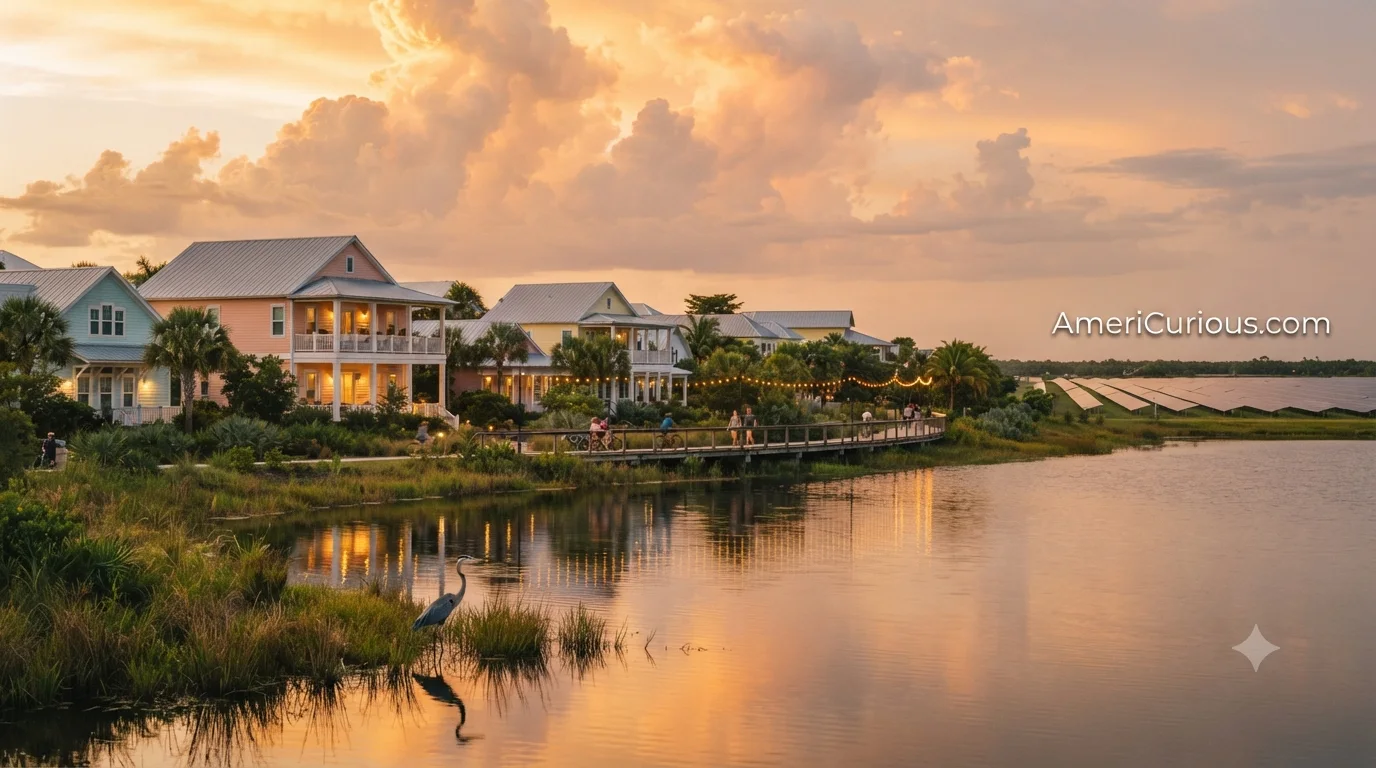
Babcock Ranch never lost power in Hurricane Ian. Now America’s first solar-powered town has robot-built homes, a living lab, and a new luxury district. Here’s what it’s really like to visit.
Syd Kitson had the Weather Channel on, and it was not saying what he wanted to hear.
He was sitting in his own living room, in the town he’d spent a decade building out of scrub palmetto and cattle pasture northeast of Fort Myers, and the forecaster on TV had just pointed at his house. Hurricane Ian — a Category 4 monster, one of the strongest storms to ever hit the U.S. mainland — wasn’t just aiming for Babcock Ranch. It was going to track along the eastern wall of the eye, the worst possible side, the side that catches the storm’s full right hook.
Kitson stayed anyway. So did about 5,000 of his neighbors. For roughly eight hours on September 28, 2022, the eye of Ian sat almost directly over Babcock Ranch, throwing gusts north of 150 mph at a town that, at the time, had never been tested by anything worse than a stiff afternoon squall. Everybody in it was finding out, in real time, whether ten years of engineering theory actually held up when the wind stopped being theoretical.
It held. When the sun came up the next morning, Babcock Ranch hadn’t lost power. Hadn’t lost water. Hadn’t lost internet. Meanwhile, a few miles away, Fort Myers and Fort Myers Beach were shredded, and Florida’s governor was reporting more than two million power outages across the southwest part of the state. Kitson later told 60 Minutes something that’s become the closest thing this town has to a motto: “We are the first solar-powered town in America… We have a solar field that’s 150 megawatts.”
That’s the story everyone already knows, or thinks they know, about Babcock Ranch. What most people haven’t caught up on is what’s happening there right now, in 2026 — a year when the “hurricane-proof solar town” case study has quietly turned into one of the hottest master-planned communities in the entire country, robots are laying block for actual homes, a university is about to build a research campus in the middle of it, and — in the plot twist nobody saw coming — it’s getting its first true luxury neighborhood. So let’s talk about what you’d actually find if you drove out there this weekend.
What “Future-Proof” Actually Means Out Here
Before we get to what’s new, it’s worth understanding why Babcock Ranch didn’t just get lucky with Ian — because the town’s whole existence is basically a bet against luck.
Start with elevation. The community sits at least 25 feet above sea level, well clear of coastal storm surge, on land that used to be part of a 91,000-acre cattle ranch. Kitson sold roughly 73,000 of those acres to the state of Florida for conservation — one of the largest land preservation deals in the state’s history — and built the town on the remaining 18,000 acres, with roughly half of that footprint kept as lakes, greenways, and preserved wetland. Those lakes aren’t just pretty. They’re stormwater engineering: when a hurricane dumps a foot of rain in an afternoon, the water has somewhere to go that isn’t your living room.
Every power and phone line in town runs underground, so there’s no grid of wooden poles for 150-mph gusts to turn into javelins. Every structure is built to withstand winds up to 145 mph — essentially a mid-range Category 4. And then there’s the signature move: the solar field. Florida Power & Light built and operates an array that’s grown to nearly 700,000 solar panels spread across roughly 870 acres, generating 150 megawatts — more than the town actually uses on a given day, with battery storage banks (among the largest in the country) to carry the load overnight. FPL engineers and researchers have studied the array’s performance after storms, and the headline finding has held steady since 2022: not a single panel got knocked loose by Ian’s winds.
None of this is secret sauce anymore — it’s been written up by NPR, 60 Minutes, and pretty much every sustainability outlet in America. What most of those pieces missed is that the “storm-proof” experiment kept running long after Ian left the news cycle, and it’s about to get graded by a much bigger institution than a news crew.
What’s New in 2026 (That No One Else Has Written About Yet)
Here’s where the story gets interesting, because the version of Babcock Ranch you’ll find if you Google it is already a year or two stale.
Robots are building the houses now — no, really. In February 2025, PulteGroup rolled out a construction robot called Hadrian X onto a job site in the TerraWalk neighborhood — one of only three of these machines in the world at the time, built by the Australian firm FBR. Instead of a crew of masons laying block by hand, Hadrian X can lay walls at a rate of roughly 280 to 320 blocks an hour, about twice the pace of a good mason working a full day. It finished the structural walls of its first Babcock Ranch home in about a day. This isn’t a gimmick tucked away somewhere — it happened inside Innovation Way, a stretch of the community Kitson & Partners has basically turned into a live testing ground for the future of homebuilding, where builders have also experimented with panelized framing and, going back further, an all-electric F-150 wired up to bank surplus solar power for the house it’s parked at.
A university is about to build its research home here. In August 2025, Florida Gulf Coast University and Babcock Ranch announced $21.7 million in state funding — the first phase of a project expected to run closer to $89.8 million — for FGCU’s 11th academic building: a 125,000-square-foot facility going up in the town’s MidTown district. FGCU President Aysegul Timur has called it a hub for studying renewable energy, water management, mobility systems, and sustainable building practices — essentially formalizing what Babcock Ranch has been doing informally since it broke ground: using itself as a living laboratory. This isn’t a satellite classroom. It’s a research institute built specifically because a real hurricane-tested town happened to already exist next door.
The town just got a bona fide luxury district. For its first several years, Babcock Ranch’s whole pitch was accessible sustainability — starter homes, coach homes, villas in the mid-to-high $300s. That’s changing. In summer 2026, Kitson & Partners unveiled Sawgrass Lakes, a gated 138-homesite enclave built by Toll Brothers and Pulte, with lakefront and preserve views, priced from the upper $600,000s up to about $1.5 million, and floor plans ranging from roughly 1,850 to 4,494 square feet. As Kitson put it when the project launched, Babcock Ranch has been seeing rising demand from more affluent buyers who still want the trail system, the lake life, and the town’s broader amenity package — they just want it behind a gate with a bigger primary suite. Sales are expected to open this fall.
And Founder’s Square is finally getting a rival. Across the street, a walkable new district called B Street has been rising in phases through 2026 — eight to ten buildings totaling more than 100,000 square feet of retail, dining, office space, and residential units, designed, according to Kitson & Partners commercial VP Matt Buehler, to feel like an actual downtown for locals rather than a drive-to strip center. Tenants have been trickling in through the year, from a boutique popcorn-and-soda shop opened by two Babcock Ranch residents to a ramen counter, alongside a 42,000-square-foot office building.
Put those four things together — construction robots, a university research campus, a luxury enclave, and a new downtown — and you’ve got a town that’s not resting on its Hurricane Ian laurels. It’s actively remodeling its own identity in real time, in 2026, while you’re reading this.
A Day in the Town of Tomorrow
Okay, so say you actually drive out there — Babcock Ranch sits about 25 minutes northeast of Fort Myers and roughly 45 minutes from Naples, close enough for a day trip, far enough that it feels like its own weather system.
You’d probably start at Founder’s Square, the town’s original town center, where a splash pad, a lakeside amphitheater, and a rotating cast of food trucks turn most weekend evenings into an impromptu block party. Grab a coffee, watch some kids get soaked in the splash pad, and you’ll notice something: almost nobody’s in a hurry. That’s on purpose. Roughly half the town’s acreage is greenway, park, and lake, and there’s a trail system pushing past 100 miles that laces through all of it, so golf carts and bikes genuinely compete with cars for right-of-way.
From there, walk (or golf-cart) over to Lake Babcock itself — the big one, the one you’ve probably seen in aerial photos — and rent a kayak, or just watch the sunset do its thing over the water while an alligator minds its own business near the bank. Swing by The Shoppes at Yellow Pine, a newer lakefront retail plaza that opened in 2025 with restaurants, national and local retailers, and — coming in early 2026 — an urgent care clinic backed by Tampa General Hospital, which tells you something about how “master-planned” this place really is; even the ER wait is on the master plan.
If you time your visit right, you can also poke around the early tenants opening at B Street, or just stand on the sidewalk and watch the construction cranes work, because half the fun of visiting Babcock Ranch right now is that it still very much feels like a town being built in front of you rather than one that’s finished and waiting for you to admire it.
So — is Babcock Ranch actually worth visiting if you don’t want to buy a house? Short answer: yes, and it’s one of the few master-planned communities in Florida where that’s true. Most planned communities are built purely for residents, with nothing for a day-tripper to actually do. Babcock Ranch has public trails, a lake with paddle rentals, a rotating farmers-market-and-live-music calendar at Founder’s Square, and now B Street’s dining scene — enough to fill a genuine afternoon, whether or not you have any interest in the real estate listings.
The Honest Catch
Here’s the part your realtor friend might gloss over, but a well-traveled buddy won’t.
First, the cost of entry has moved. This started as an attainable-sustainability town; today it’s a top-tier seller nationally, and pricing has climbed with the momentum. Babcock Ranch posted 1,066 net home sales in 2025, a 34% jump from the year before, making it the nation’s fourth best-selling master-planned community even as the broader Southwest Florida housing market limped through one of its roughest stretches in years — nearby Punta Gorda saw the sharpest home-value decline in the country over the same period. That’s a remarkable divergence, and it didn’t happen because Babcock Ranch got cheaper. Entry-level product still exists, but the center of gravity is shifting upward, and Sawgrass Lakes’ $600K-plus starting point is the clearest signal yet of where the town wants to go next.
Second, this is still a planned community, and it can feel like one. The landscaping is uniform. The HOA culture is real — there are design guidelines, and the whole town has a curated, slightly scrubbed quality that some visitors find charming and others find a little too on-brand. If you’re the type who wants a wild, organic Florida town with mismatched architecture and a dive bar that’s been there since 1974, this isn’t that. Babcock Ranch knows exactly what it is, and it’s not embarrassed about it.
Third — and this is the fair question skeptics keep asking — how much of the “resilience” story is really about the solar array, versus just really good, boring civil engineering? Multiple reporters who’ve toured the town post-storm have pointed out that the buried lines, elevated grading, and stormwater lakes probably did as much heavy lifting as the panels did. The solar farm makes for a better headline. The drainage engineering is arguably the real hero. Both things can be true, and the town’s marketing leans harder on the sexier one.
None of that erases what actually happened during Ian, or what’s happened in the two hurricane seasons since. It just means “hurricane-proof” is doing a little more branding work than pure literal accuracy — a fair trade, most residents will tell you, for a house that didn’t lose power.
Should You Visit or Move Here?
If you’re weighing a weekend trip: absolutely, go. It’s one of the only new-build communities in Florida where you can spend a full day without owning property there, and watching a town mid-construction — cranes over B Street, a robot laying block a few streets over — is genuinely more interesting than it sounds.
If you’re weighing a move: it depends what you’re optimizing for. If storm resilience, walkability, and a strong sense of planned community matter more to you than character and quirk, Babcock Ranch delivers on its promise in a way few new towns do — it’s been storm-tested, not just storm-marketed. If you want charm that came from decades of accident rather than design, look elsewhere in Southwest Florida — Naples’ Old Naples district, or the funkier corners of Fort Myers, will scratch that itch better. Compare Babcock Ranch to Naples directly and the split is pretty clean: Naples sells you coastline, history, and old-money polish; Babcock Ranch sells you a hedge against the next Category 4 and a town that’s still writing its own story.
One Last Thing
There’s a version of the American dream that’s always been about betting on a place before anyone else does — homesteaders, boomtowns, the whole nine yards. Babcock Ranch is that same bet, just running on lithium batteries instead of gold fever. Whether it pays off at the scale Kitson’s imagining — 19,500 homes, a full university research campus, a genuine downtown — is still an open question. But eight hours inside a Category 4 eyewall already answered the question that mattered most.
Thinking about Southwest Florida as a relocation option more broadly, not just this one town? That’s exactly the kind of decision our Relocation Life series is built for — check out our deep dives on the Knoxville and DFW migration booms for the bigger picture on where Americans are actually moving, and why.
Discover more from AmeriCurious
Subscribe to get the latest posts sent to your email.