
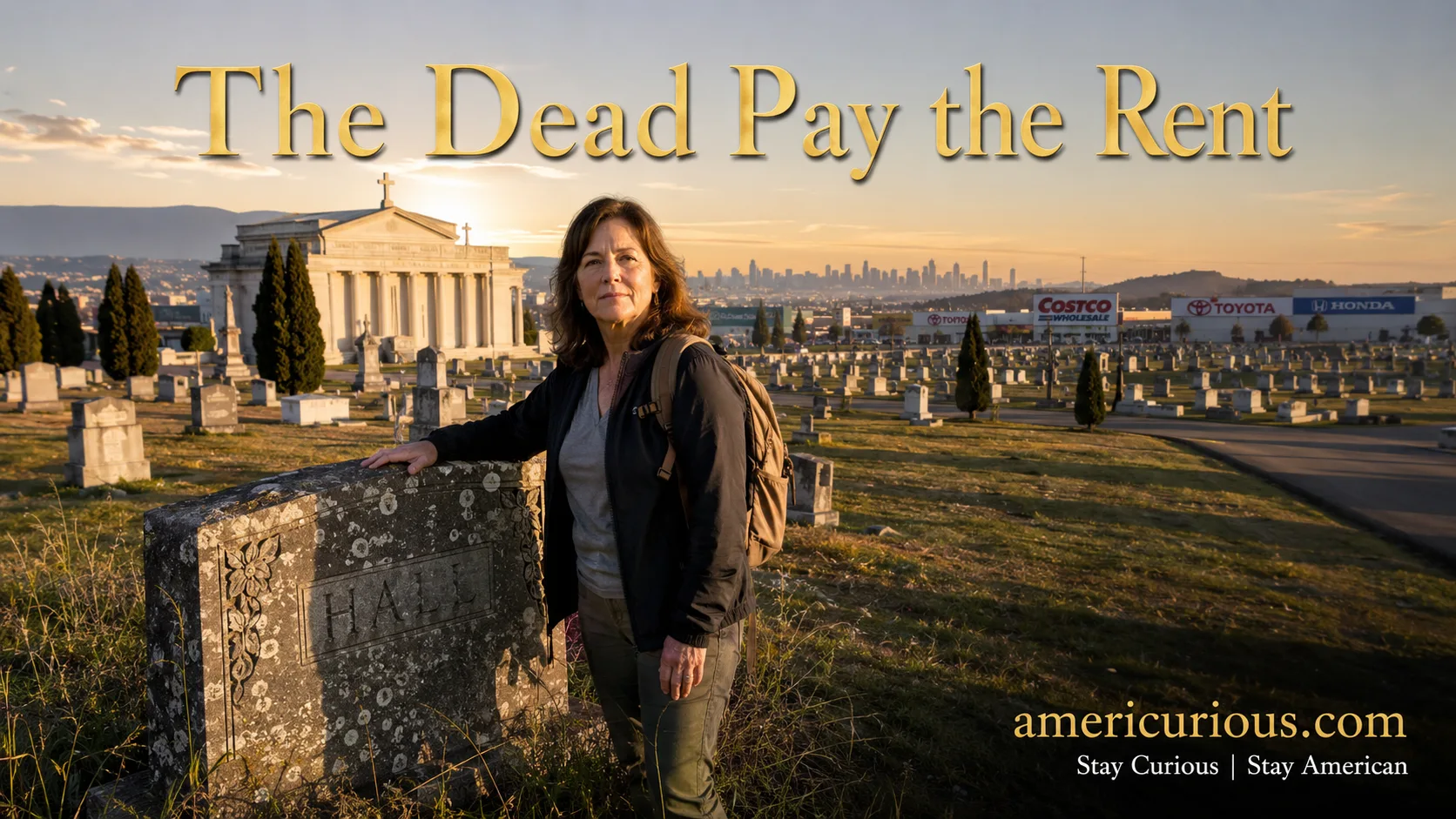
Colma California has 1.5 million dead residents vs 1,507 living. Discover this unique necropolis, 16 cemeteries, pet cemetery & dark tourism guide. Visit today.
🪦 The Math That Breaks Your Brain Before You Cross the Town Line
Here’s the opening stat, and it’s the kind you double-check because it can’t be right: in Colma, the dead outnumber the living by roughly a thousand to one. The 2020 census counted 1,507 living residents; the underground population is estimated at about 1.5 million. That’s not a metaphor, a marketing angle, or a Halloween pitch — it’s a demographic fact printed on the town’s own government pages.
And the town leans into it. The official (and gloriously deadpan) motto is “It’s great to be alive in Colma,” which is either the driest municipal branding in America or the most honest — probably both.
⚰️ How San Francisco Turned Its Neighbor Into a Necropolis
The whole thing started in 1900, when San Francisco — running out of prime real estate and increasingly nervous about public health after plague scares — passed an ordinance banning all new burials inside city limits. Twelve years later, the city went further and evicted the cemeteries themselves. Somebody had to take the bodies, and Colma, sitting in the Merced Valley just south of the city line, drew the short straw and the long-term contract.
Between roughly 1920 and 1941, about 150,000 bodies were exhumed and shipped down El Camino Real for reburial at $10 a head — coffin, marker, and all. The remains whose families couldn’t be found (or wouldn’t pay) got dumped into mass graves. Their headstones got recycled — literally — as gutter linings at Buena Vista Park and breakwater rubble near the St. Francis Yacht Club, still visible at low tide on Ocean Beach. It’s the darkest municipal recycling program in American history.
🏛️ A Town Incorporated by Its Landlords (Who Happened to Own Cemeteries)
Colma got its papers on August 5, 1924, though it was originally called Lawndale — the name Colma was already tied up with the post office, and there was another Lawndale down in L.A. County, so the town swapped names back to Colma in 1941. “Colma” itself is likely Ohlone — most sources translate it as “springs” or “many springs,” though the town’s own history page floats “moon” as a possibility.
The incorporation wasn’t a grassroots swell. It was pushed primarily by cemetery owners who wanted zoning protection and a friendly local government — essentially a real estate play, if you consider a plot a piece of real estate, which the cemeteries very much do. From day one, this was a town run for and by the death-care industry, and it’s been that way ever since.
🌳 The 17 Tenants Who Never Leave
Colma’s got 17 cemeteries occupying about 73% of its 1.89 square miles, and each one is essentially its own gated ethnic or religious neighborhood. There’s Italian, Serbian, Greek Orthodox, Chinese (three of them), Japanese, several Jewish, Catholic, non-sectarian, and one — Pet’s Rest — reserved for cats, dogs, and one presumably very good parrot.
The heavyweight of the bunch is Cypress Lawn, founded in 1892 by Hamden Holmes Noble after a carriage ride past San Francisco’s derelict Laurel Hill Cemetery convinced him the city needed a landscaped, dignified alternative. Cypress Lawn now sprawls across 148 acres — its own arboretum, catacombs, and 36,000 square feet of stained glass — and runs regular trolley tours, walking tours, and themed history events through its Heritage Foundation that are honestly better curated than a lot of paid museums.
Locals-Only Tip: The Cypress Lawn Stained Glass Walking Tour with docent Terry Hamburg walks you through the catacombs under 36,000 square feet of ceiling glass — book ahead through Eventbrite, seats go fast, and it costs less than a decent sandwich in San Francisco.
💰 The Second Business: Turning Grief-Adjacent Land Into a Sales-Tax Machine
Here’s the twist that separates Colma from every other cemetery town in America: it didn’t stop at bodies. In 1986, developers opened 280 Metro Center on top of the shuttered Junipero Serra Landfill — a project widely credited as the world’s first “power center,” meaning a cluster of big-box retailers built for car-driving suburbanites. Home Depot, Target, and a wall of chain restaurants moved in. Then came Auto Row.
Serramonte Boulevard is now a nearly unbroken corridor of dealerships — Ford, Honda, Toyota, Lexus, and about a dozen more — and the numbers are eye-popping for a town this small. According to the town’s own budget documents, sales tax makes up roughly 70% of Colma’s general fund revenue, and 11 cents of every dollar of sales tax paid in Colma goes straight to the municipal government. In other words, the town discovered that if you can build an economy on burying people, you can absolutely build a second one on selling them a Ford F-150. That’s the Point Pleasant, West Virginia playbook — turn your weird identity into a business plan — except Colma ran it twice.
🥃 The One Bar That Predates Basically Everything
If you want to drink somewhere with a longer résumé than most of Colma’s cemeteries, Molloy’s Tavern on Mission Road is the only real answer. The building’s been standing since 1883 — it was a hotel, a stagecoach stop, reputedly a brothel, and now a proudly divey Irish pub — and it became Molloy’s in 1937, making it the oldest commercial establishment in continuous operation in town. It’s been the traditional stop for mourners heading home from Holy Cross across the road for the better part of a century. Order a Guinness. Nobody’s in a rush.
🌟 The Guest List Nobody Else Can Match
Colma’s celebrity register is the kind of thing biographers just accept and stop questioning. Levi Strauss (the denim guy) is at Home of Peace. His mausoleum, per one Wyatt Earp pilgrim, is visible from Earp’s own gravesite — because yes, Wyatt Earp of O.K. Corral fame is buried at Hills of Eternity, the Jewish cemetery next door, thanks to his Jewish common-law wife Josephine Marcus. The West’s most famous gunfighter has been resting in a Jewish plot in a San Francisco suburb since 1929. History’s weirder than fiction.
Then there’s Joe DiMaggio at Holy Cross, William Randolph Hearst at Cypress Lawn, rock promoter Bill Graham at Eternal Home, Peanuts composer Vince Guaraldi at Holy Cross, Giants slugger Willie McCovey at Cypress Lawn, and — the one that always gets a smile — Emperor Norton, self-declared Emperor of these United States and Protector of Mexico, at Woodlawn. Also at Cypress Lawn: Phineas Gage, the railroad worker who survived a tamping iron through his skull in 1848 and became the most famous case study in neuroscience.
| Famous “Resident” | Cemetery | Why You’ve Heard the Name |
|---|---|---|
| Wyatt Earp | Hills of Eternity | O.K. Corral, 1881 |
| Levi Strauss | Home of Peace | Blue jeans, still on your legs |
| Joe DiMaggio | Holy Cross | 56-game hitting streak, Marilyn’s ex |
| William Randolph Hearst | Cypress Lawn | The newspaper baron behind Citizen Kane |
| Emperor Norton | Woodlawn | The Bay’s most beloved 19th-century eccentric |
| Bill Graham | Eternal Home | The Fillmore, Woodstock-era rock |
| Phineas Gage | Cypress Lawn | Neurology’s most famous patient |
🐶 The Small Cemetery That’ll Wreck You Emotionally
Tucked between the human plots is Pet’s Rest, opened in 1947, a five-acre cemetery holding over ten thousand cats, dogs, birds, and at least one goat. Its most-visited grave belongs to Tina Turner’s dog, though attorney Melvin Belli’s canines are in there too. Go for the novelty and leave misty-eyed — the hand-carved messages on some of those tiny stones will do more damage than any of the marble angels next door.
🏛️ The Museum Nobody Talks About (And Should)
The Colma Historical Museum sits at 1500 Hillside Boulevard, spread across four buildings that include the old Olivet Cemetery office and the historic Colma train depot — the same rail line, incidentally, that once shuttled coffins down from San Francisco. Inside you’ll find blacksmith gear, mourning-hair jewelry (Victorians made jewelry out of the deceased’s hair, and yes it’s as unsettling as it sounds), and photographs of the mass exhumations. The Colma Historical Association also runs walking tours of specific cemeteries — Japanese, Italian, Jewish — several times a year, and they’re often followed by a free picnic buffet, which is either wildly on-brand or wildly off, depending on your mood.
🌫️ The Weather Report: A Fog That Knows Its Assignment
Colma sits in the Merced Valley at the highest point of the gap between San Bruno Mountain and the Santa Cruz foothills, which means it catches the same cool marine layer that keeps San Francisco famously chilly. Temperatures typically bounce between 45°F and 69°F year-round — you’re rarely below 38° or above 78°. The warmest, driest month is September; the foggiest stretch is that classic Bay Area “June Gloom” through August.
The sweet spot: September and October — the fog eases, the light goes golden, and if you’re timing a cemetery visit, the low-angle sun through the cypress trees is what Instagram was invented for. Avoid: June mornings unless you like your marble angels shrouded in gray.
🎃 The One Event You Plan a Trip Around
Every year in early November, the town hosts its Día de los Muertos celebration at the Colma Community Center — the 2025 edition was scheduled for November 8, noon to 3 p.m. at 1520 Hillside Boulevard. Check the town’s official events page for the 2026 date before booking; a town this specific about death takes the holiday seriously, and it’s the single most Colma-appropriate afternoon on the American calendar.
🚗 Getting There Without Getting Lost
BART’s Colma Station sits right on the northern edge of town — from downtown San Francisco you’re about 25 minutes on the yellow line. If you’re driving, El Camino Real (Highway 82), I-280, and Junipero Serra Boulevard all cut through, and parking is the one gift Colma gives freely: it’s an inversion of San Francisco’s parking hell, mostly free and mostly available. SamTrans buses handle the rest. SFO is a 10-minute drive south.
Fair warning: Colma is not walkable in the pedestrian-scenic sense. The cemeteries themselves are enormous — Cypress Lawn alone is 148 acres — and El Camino Real is a fast, wide arterial. Bring a car, or plan to Uber between stops.
🏘️ Where the 1,500 Living People Actually Live (and What Their Houses Cost)
The residential slice of Colma — old Colma, up along Mission Road and Hillside — is a tight little grid of modest single-family homes on cobblestone-paved streets, with an old-world Italian and Irish working-class heritage still legible in the architecture. It’s small: only 526 housing units in the entire town as of 2020. The demographic is majority Latino (about 41%) and Asian (about 31%), with a median household income around $121,488.
Housing prices are, unsurprisingly for the Bay Area, absurd. Zillow currently pegs the average home value around $1.1 million; Redfin’s median sale price for early 2026 sits at roughly $1.0 million. It’s cheaper than San Francisco proper but not by the margin you’d hope. What you get for the money: less fog than the Sunset, better parking than anywhere in the city, and the world’s quietest neighbors.
🏈 The High School Question Nobody Expects
Here’s a small oddity: Colma doesn’t have its own high school. Kids here go to Westmoor High School, technically in Daly City, in the Jefferson Union High School District — the Rams, blue and gold. So the traditional “Friday night lights” civic identity most American small towns organize around simply doesn’t exist here in the usual form. The nearest thing to a shared civic ritual is the way locals swap stories about which cemetery has the best autumn light. Different town, different sacraments.
👻 Ghost Stories in a Town Made of Ghosts
You’d think a town this saturated with the dead would be crawling with hauntings, but Colma’s ghost lore is oddly restrained — maybe because when everyone’s a ghost, nobody’s a ghost. The most persistent lore centers on Emperor Norton’s grave at Woodlawn, where the drag activist José Sarria (buried nearby, having styled himself “The Widow Norton”) is said to keep spectral company with the old Emperor. Locals will also tell you that Cypress Lawn’s catacombs get chilly in ways that can’t quite be explained by ventilation, but nobody’s going to sell you a T-shirt about it — this isn’t Eureka Springs, Arkansas, where the ghost tours are the actual GDP. Colma’s dignified about its dead.
🎬 The Screen Time Nobody Notices
Colma keeps a lower Hollywood profile than you’d expect for a place this cinematic. The 2006 indie film Colma: The Musical — yes, a musical about three teenagers coming of age in a town of graveyards — was actually shot here and got a respectable Sundance run, and it remains the definitive on-screen document of what life feels like for the town’s actual living residents. Beyond that, the cemeteries occasionally show up as backdrop for Bay Area productions, but the town has never gone full Point Pleasant about it.
🪦 The Souvenir Test: What You Actually Take Home
Two answers, both legit. The first is the Colma Historical Association’s cemetery walking maps — they cost basically nothing and they’re the only guide that treats the town’s 17 cemeteries as a coherent cultural document rather than a spooky curiosity. The second is a piece of engraved stone from one of the local artisan monument shops — Art in Stone Monuments at 1174 El Camino Real and Acme Memorial both do custom granite and marble work by hand. A small engraved keepsake from a Colma stonemason isn’t just a souvenir; it’s a piece of the same craft tradition that carved every marker in town. Nobody else in America makes what Colma makes.
🎯 The One Sentence That Explains the Whole Town
Colma took the thing every other city treated as an inconvenience — its dead — and turned it into a zoning strategy, a tax base, a tourist draw, and an identity. Then, when the cemetery business plateaued, the town quietly built a second economy on top of it, one Ford dealership at a time. That’s not morbid. That’s audacious municipal accounting.
In a town where the dead pay the rent and the living sell the cars, “It’s great to be alive in Colma” isn’t a joke — it’s a bookkeeping entry.
— AmeriCurious
Discover more from AmeriCurious
Subscribe to get the latest posts sent to your email.