
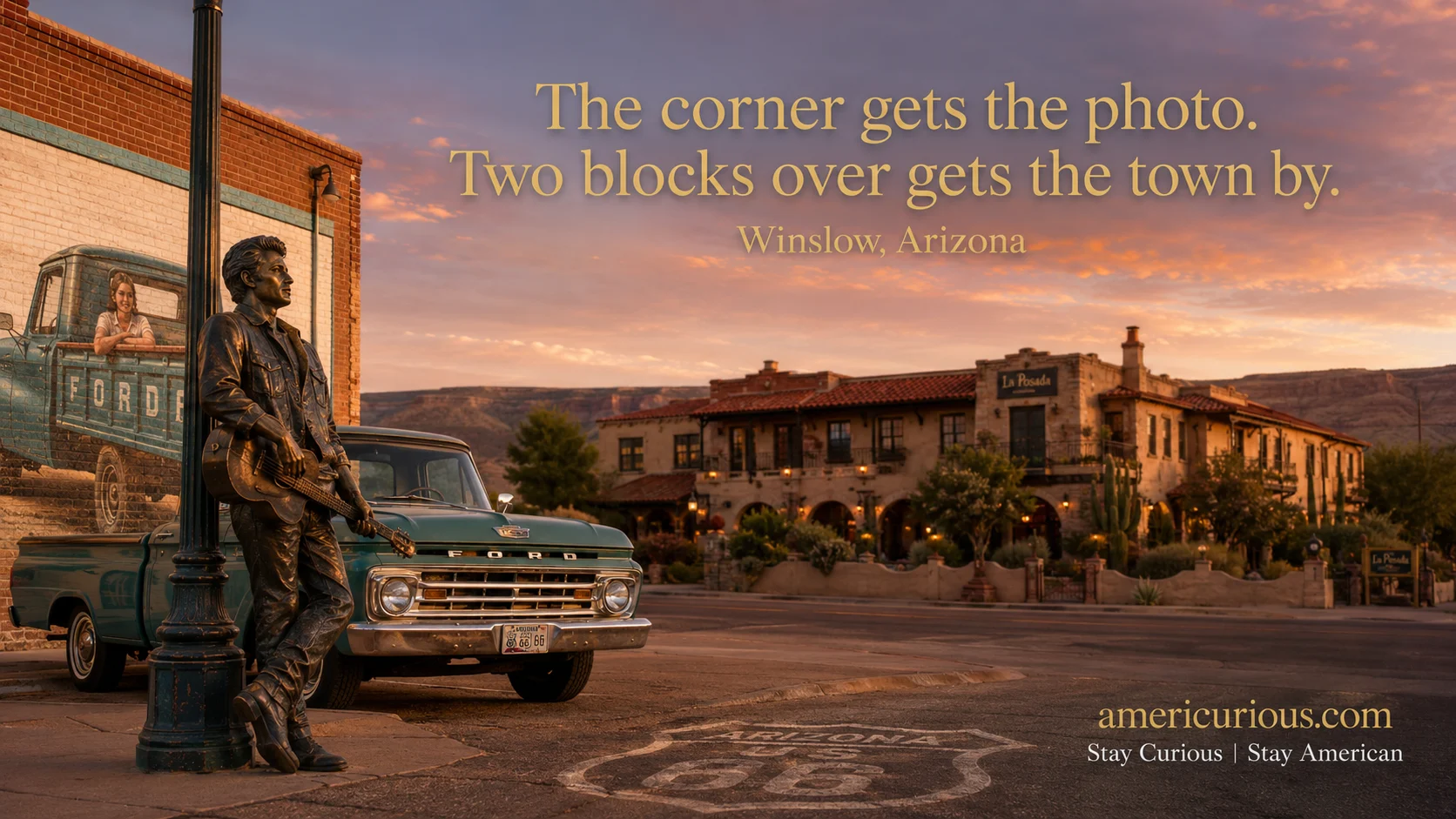
Winslow’s population is 9,000. Its restored La Posada Hotel pulls 100K visitors a year. Here’s the honest Route 66 Centennial guide — crowds, cost, timing.
Here’s what happens at exit 253 off I-40, roughly a hundred times a day this year. A minivan, a rental sedan, sometimes a whole tour bus, pulls off the interstate. Everybody piles out, walks two blocks to the corner of Kinsley Avenue and 2nd Street, takes a picture next to a bronze fellow with a guitar, maybe buys a magnet, and gets back on the road. Fifteen minutes, tops. Then they’re gone, chasing the next dot on the map.
Which is a shame, honestly, because two blocks the other direction sits the real reason Winslow, Arizona is still standing at all: a $4.5 million hotel that almost nobody stopping for the corner photo bothers to walk over and see.
That’s not a knock on the corner. It’s earned its fame fair and square. But if you’re planning a Route 66 Centennial trip through northern Arizona this year, you deserve the fuller story, crowds, costs, dates, and all, not just the postcard version.
The Corner Everyone Photographs (And Drives Past Two Blocks Too Fast)
Quick answer, since you’re probably wondering: is Winslow, Arizona worth visiting in 2026? Yes, especially this year. Route 66 turns 100 in 2026, dated to its official designation on November 11, 1926, and Winslow sits near the heart of Arizona’s 385-mile stretch of the Mother Road. The town is small (about 9,000 people), the main attractions cluster within a five-minute walk of each other downtown, and it’s an easy 57-mile detour off I-40 if you’re already headed toward Flagstaff or the Grand Canyon.
Now, about that corner. Standin’ on the Corner Park opened in September 1999, and here’s the part most Route 66 blogs gloss right over: the real-life moment that inspired the “Take It Easy” lyric about a girl in a flatbed Ford probably didn’t even happen in Winslow. By Jackson Browne’s own account, the incident behind the song took place while his car broke down over in Flagstaff, not Winslow. When a reporter later asked him about it, Browne told the Los Angeles Times, simply, “It was always Winslow.” Meaning: the name scanned better, the rhyme worked, and Winslow got the immortal shout-out whether the fender-bender happened there or not.
Winslow didn’t invent that ambiguity. It just capitalized on it, smartly. By the late 1990s, downtown was hurting badly, and a group of locals formed the Standin’ on the Corner Foundation to build something around the one thing the whole country already associated with their town’s name. Sculptor Ron Adamson cast a life-size bronze busker (using his own son Dustin as the model) leaning against a lamppost, artist John Pugh painted a two-story trompe-l’œil mural of a girl driving by, and a real flatbed Ford got parked nearby to finish the tableau. After Glenn Frey died in 2016, two Phoenix classic-rock DJs helped raise money for a second statue of Frey himself, added in 2017. Today the corner draws roughly 100,000 photo-stops a year, according to longtime coverage of the site. It’s a manufactured landmark, built specifically to be Instagram bait before Instagram existed. And it worked exactly as planned.
So take the picture. It’s fun, it’s free, and it’s genuinely a fine sight to see, my Lord. Just don’t let it be the whole visit.
From Railroad Boomtown to Bypassed: How Winslow Nearly Disappeared After I-40
Before there was a corner to stand on, there was a railroad to run. Winslow got its start as a Santa Fe Railway hub in the 1880s, and by the early 20th century it was, by several accounts, the largest town in northern Arizona, bigger than Flagstaff. Route 66 rolled through in 1926 and layered a second economy right on top of the first: motels, diners, and gas stations serving cross-country drivers instead of freight cars.
Then, in 1979, Interstate 40 bypassed downtown Winslow. It’s the same gut-punch that hit dozens of Route 66 towns up and down the corridor: the highway that made you gets rerouted a half-mile away, and suddenly the traffic that kept Main Street alive just… stops turning off. Storefronts emptied. The railroad’s own crown jewel, a Fred Harvey hotel called La Posada, had already closed in 1957 and gotten gutted for office space in 1961. By the time the Eagles song made the town a punchline-slash-pilgrimage-site, Winslow was a town running almost entirely on nostalgia and not much else.
It’s a story that keeps repeating itself across small-town America, just with different props. We’ve told a version of it over in Mansfield, Ohio, where a dying Rust Belt town found its second act on a movie screen instead of a record album, and in Point Pleasant, West Virginia, where a cryptid legend got turned into an actual business plan. Winslow’s version just happens to have a soundtrack.
The $4.5 Million Hotel Holding the Town’s Tourism Economy Together
Now for the part the corner photo doesn’t show you.
Two blocks south sits La Posada Hotel, designed by architect Mary Colter and opened by the Fred Harvey Company in 1930 as, by most accounts, the last of the great Harvey House railroad hotels. It closed in 1957, and the Santa Fe Railway spent the next few decades using the gutted building as office space, stripping out nearly everything Colter had designed. In 1994, with the railroad ready to tear it down, a former Winslow mayor named Allan Affeldt bought the building instead. He and artist Tina Mion spent years, and a genuinely staggering amount of sweat, restoring it room by room. Today all 54 rooms are named for people who once stayed there, the on-site Turquoise Room restaurant serves a “Signature Soup” recipe that dates back to the original Fred Harvey dining room, and the whole property functions as a working art museum as much as a hotel.
Here’s the number that almost nobody writing about Winslow’s centennial year bothers to mention: in 2025, Clearinghouse CDFI provided a $4.5 million loan to refinance La Posada and secure its long-term future. According to Clearinghouse CDFI’s own impact reporting, the hotel now draws more than 100,000 visitors a year and supports 80 full-time jobs in a town of roughly 9,000 people. Run that math for a second. That’s one job at this single hotel for every 112 residents of Winslow. For a town this size, La Posada isn’t a nice-to-have boutique stay. It’s closer to the load-bearing wall of the entire local tourism economy, the thing that turns a fifteen-minute photo stop into an overnight (and a dinner reservation, and a gift-shop purchase, and a gas-station fill-up).
The corner gets you here. La Posada is what keeps Winslow’s downtown lights on after the corner crowd drives off toward Flagstaff for the night.
The Full 2026 Centennial Calendar
Route 66’s hundredth birthday isn’t a single-day party; it’s a yearlong rolling one, and Arizona’s stretch (all 385 miles of it, including 158 unbroken original miles between Topock and Crookton Road) is throwing its share of the bash. Here’s what’s actually confirmed for Winslow and the surrounding corridor, not just rumored:
- January 10, 2026 – The Old Trails Museum debuted its new exhibit, 100 Years of Route 66 in Winslow, at the Winslow Visitor Center, funded by a grant from the Historic Route 66 Association of Arizona.
- April 30–May 2, 2026 – The national Centennial kickoff celebration takes place in Springfield, Missouri, where Route 66 was officially named back in 1926.
- June 6, 2026 – Flagstaff hosts its own Centennial street party at Heritage Square, about an hour up the road from Winslow.
- September 25–26, 2026 – The Standin’ on the Corner Festival in Winslow, two days of live music, food, and drinks built right around the town’s signature landmark.
- November 7, 2026 – The Old Trails Museum closes out its 2026 speaker series with a final talk at the Winslow Visitor Center, timed just before the actual designation anniversary.
- November 11, 2026 – The exact 100th anniversary of Route 66’s official designation.
The Arizona Office of Tourism has developed marketing plans across the whole corridor, from Oatman to Holbrook, and preservation dollars keep flowing in alongside the events. The National Trust for Historic Preservation’s Preserve Route 66 program recently announced a fresh grant round, and the National Park Service’s own Route 66 Corridor Preservation Program has funneled more than $6.5 million in combined public and private investment into projects along the road since 2001. None of that is marketing copy. It’s the actual money keeping vintage neon signs, gas stations, and hotels like La Posada standing long enough for the centennial to matter.
Who Should Time Their Trip for Festival Weekend, and Who Shouldn’t
Not every visit needs to happen on September 25th and 26th, and honestly, for some of you, it probably shouldn’t. Here’s the breakdown, by who you are.
The die-hard Route 66 completionist, in it for the atmosphere. You want live music, a packed downtown, strangers striking up conversations about their road trip, the whole festival buzz. Book the Standin’ on the Corner Festival weekend, and book your room the moment you decide to go. Verdict: go for it, but reserve early.
The quiet-week explorer who wants La Posada to itself. You’d rather wander the hotel’s gardens, linger over lunch at the Turquoise Room, and actually hear yourself think at the corner instead of waiting in line for a photo. Pick a Tuesday through Thursday in October, after the festival crowd clears and before the holiday season ramps up. Verdict: this is your window. Take it.
The neighboring small-business owner scouting the scene, not the tourist. This is you, Dana, if you’re weighing whether that festival weekend is worth the drive over from Flagstaff to scope out vendor opportunities. Here’s the honest read: Winslow’s downtown core is small, and La Posada has only 54 rooms. On a festival weekend, that inventory fills fast, day-trip parking gets tight around the corner, and restaurant waits stretch out. It’ll be genuinely busy, but it’s a “busy small town,” not a “busy big city.” If you’re scouting foot traffic and vendor energy, festival weekend is exactly when you want eyes on the ground. If you’re hoping for a relaxed, low-key scouting trip with time to actually talk to shop owners, come the week before or after instead. Verdict: scout on festival weekend, negotiate and plan on a quiet one.
The Honest Catch: What the Postcard Doesn’t Show You
A few things nobody selling you the centennial dream wants to say out loud.
First, the corner itself is, by design, a manufactured attraction. It’s a genuinely fun stop, and Winslow leaned into the ambiguity of the “Take It Easy” lyric with a lot of civic hustle, not blind luck. But if you’re expecting some deep, verified historical site, temper that expectation. Even the folks in Flagstaff have their own corner they’ll claim as the “real” one.
Second, lodging in Winslow is limited, full stop. This isn’t a town with a hotel corridor of a dozen national chains to absorb a surge. La Posada’s 54 rooms and a handful of other small properties are essentially it downtown. On festival weekend, or really any high-traffic centennial event, book weeks ahead, not days.
Third, and this is the one that matters most for a town of 9,000 people: Winslow’s tourism economy is thinner than it looks from the corner. Strip away La Posada’s 80 jobs and its six-figure annual visitor count, and a lot of downtown’s foot traffic goes with it. That’s not a criticism. It’s just the honest math behind a town that got bypassed once already and rebuilt itself, twice over, on a song lyric and a preservation loan. Respect that when you’re there. Buy the meal, book the room, tip well.
A Day in Winslow Beyond the Corner
If you’ve only got a few hours, here’s how to actually use them. Start at the corner early, before the tour buses show up, for a photo without a line. Walk two blocks to La Posada and just wander; the gardens, the artist-in-residence gallery, the small on-site museum of railroad and hotel artifacts are worth an hour on their own, even if you’re not staying the night. Grab lunch at the Turquoise Room (breakfast runs 7 to 10:45 a.m., lunch 11 to 2, dinner starts at 5) and order the signature soup if it’s on the menu that day.
From there, swing by the Old Trails Museum, housed in a 1921 former bank building a short walk from the corner, for the deeper history the statue doesn’t tell you. If you’ve got a car and an extra hour, Homolovi State Park sits just over a mile north of town: 4,500 acres preserving more than 300 Ancestral Puebloan archaeological sites, plus genuinely dark-sky stargazing once the sun goes down. And if meteorites are more your speed than pueblos, Meteor Crater is about 20 miles west, a straight shot on the way back toward Flagstaff.
None of it requires more than a day. Most of it requires slowing down enough to actually get out of the car.
Should You Book September 25–26, or Skip It?
Answer these five, honestly:
- Do you want festival energy: crowds, live music, a packed downtown?
- Are you comfortable booking your room weeks in advance, not days?
- Is your main goal the photo, or the fuller story behind the town?
- Are you flexible enough to shift your trip a week either direction if festival dates don’t work?
- Do you care more about atmosphere than elbow room?
Mostly yes: Book the Standin’ on the Corner Festival weekend, September 25–26, 2026, and reserve now. Mostly no: Aim for a quiet October weekday instead, when La Posada, the corner, and the Turquoise Room are all yours to enjoy at an actual human pace.
Either way, go. Route 66 doesn’t turn 100 twice. Winslow spent nearly fifty years turning a highway bypass, a shuttered hotel, and one lucky rhyme into a town that’s still standing, still cooking, and still worth the detour. Take the photo on the corner. Then walk the two blocks. That’s where the real story’s been waiting the whole time.
Read next: how Point Pleasant, West Virginia turned a legend into a business plan, how Mansfield, Ohio found its second act on a movie screen, and how Galena, Illinois is riding its own once-in-two-centuries anniversary year.
Sources for the numbers in this piece: the $4.5 million La Posada Hotel refinancing comes from Clearinghouse CDFI’s own impact reporting; centennial event dates and grant programs are drawn from the Arizona Office of Tourism’s Route 66 Centennial page and the Historic Route 66 Association of Arizona’s event calendar; preservation funding figures come from the National Trust for Historic Preservation’s Preserve Route 66 program and the National Park Service’s Route 66 Corridor Preservation Program.
Discover more from AmeriCurious
Subscribe to get the latest posts sent to your email.