
Why do Americans tip? Trace tipping from post-Civil War railroads and the $2.13 wage law to 2026’s no-tax-on-tips rule, plus how much to tip at restaurants today.
Why Do Americans Tip? The History and Etiquette Explained
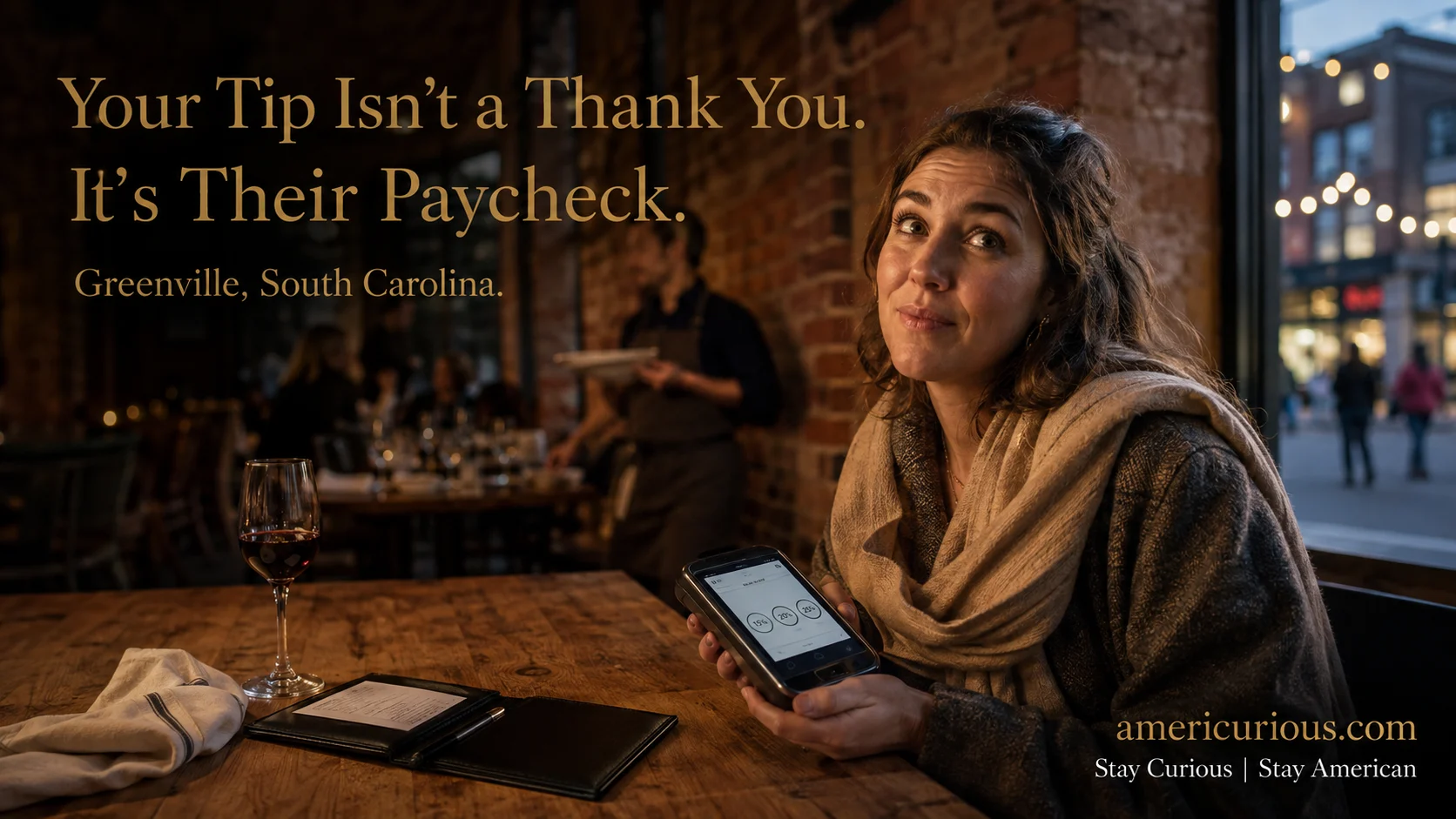
The bill lands face-down on the table at Soby’s, tucked into a converted 1880s shoe warehouse on Greenville, South Carolina’s Main Street — the building that’s widely credited with kicking off the city’s downtown restaurant boom back in the late ’90s. Before you’ve even looked at the total, the little screen swivels around asking you to choose between 18%, 20%, and 22%. No blank line. No “other.” Just a decision, presented as if it were already made.
That screen is doing something most diners never stop to question: asking you, the customer, to personally close a wage gap your server’s employer created on purpose.
Quick answer: Americans tip because federal law still lets employers pay tipped workers as little as $2.13 an hour — a rate frozen since 1991 — as long as tips bring total pay up to the $7.25 federal minimum wage. The custom took hold after the Civil War, when railroads and restaurants shifted wage costs onto customers rather than absorbing them. In 2026, restaurant tips run 18–20%, and a new federal deduction lets many tipped workers exclude up to $25,000 in tips from income tax.
Here’s how a European habit for the wealthy became an American wage system nobody voted for — and exactly what it means for your wallet this year.
Where Did Tipping in America Actually Come From?
Tipping didn’t start here. Historians trace it to medieval England, where wealthy landowners handed servants small extra sums called “vails” — a reward, not a wage, according to a 2024 National Geographic history of the practice. By the 18th century, English servants at country houses had come to expect vails from every guest, and hosts complained bitterly about the cost.
Wealthy Americans picked up the habit while touring Europe in the 1850s and 1860s and brought it home as a mark of sophistication. It did not land well. Critics called tipping aristocratic and un-American, and a handful of states briefly outlawed it outright in the early 1900s. Author William R. Scott’s 1916 anti-tipping book The Itching Palm argued the practice was fundamentally at odds with a democratic society, a sentiment echoed across newspapers of the era, per the Richmond Fed’s economic history review. And no, “tip” is not an acronym for “To Insure Promptness” — that’s a persistent myth; the word’s roots trace to 18th-century slang, unrelated to any acronym.
How Tipping Got Tangled Up With Low Wages and the Pullman Porters
The backlash didn’t win. After the Civil War, formerly enslaved people entered the workforce in large numbers through railroads, hotels, and restaurants — industries that saw an opportunity. Rather than pay a living wage, employers hired Black workers at minimal or no base pay and let customers cover the rest through tips, a pattern documented in CBS News’s history of tipping in America. The Pullman Company, which ran luxury railcars nationwide, became the most visible example: it hired Black porters at low wages on the assumption that wealthy passengers would tip generously to make up the difference.
It’s a different story, but a structurally familiar one. In the same era, roughly 300 miles north in Greenville, textile mills were running their own version of cost-shifting: workers paid via deduction envelopes that listed wages, then subtracted rent, utilities, and company-store charges — sometimes leaving nothing but a hand-drawn squiggle mill workers called “drawing the worm,” a detail preserved in AmeriCurious’s own dig into Greenville’s textile history. Different industries, different centuries of aftermath, same underlying move: let the worker’s pay depend on someone else’s discretion instead of a guaranteed wage.
Congress didn’t close that loophole when it created the first federal minimum wage. The 1938 Fair Labor Standards Act set a wage floor of 25 cents an hour but excluded restaurant and hotel workers entirely. Those jobs weren’t brought under minimum-wage protection until 1966 amendments — and even then, lawmakers carved out a lower “tipped minimum wage” instead of a single standard, cementing the tip-dependent system rather than replacing it.
Why Does the $2.13 Tipped Wage Still Exist in 2026?
It exists because Congress hasn’t touched it. The federal minimum wage has held at $7.25 an hour since 2009, and the federal tipped cash wage has sat at $2.13 an hour since 1991 — the longest stretch without an increase in either figure since the FLSA was written, according to a 2026 minimum-wage tracking guide. Employers can claim a “tip credit” of up to $5.12 an hour, but only if tips genuinely close the gap; if they don’t, the employer legally owes the difference.
States aren’t required to follow the federal floor, and most don’t. As of 2026, seven states — Alaska, California, Minnesota, Montana, Nevada, Oregon, and Washington — ban the tip credit entirely and require the full state minimum wage before a single tip is counted, per a 2026 employer compliance guide from Rippling. Washington, D.C. is phasing out its own tip credit by 2027. Everywhere else, including most of the South and Midwest, $2.13 is still the legal floor a server’s paycheck can start from.
Tipping isn’t a thank-you note. It’s a subsidy with a tip jar for a receipt.
What Changed With the “No Tax on Tips” Law?
Here’s the part most tipping explainers haven’t caught up to yet. On July 4, 2025, President Trump signed the One Big Beautiful Bill Act, which created a temporary federal deduction of up to $25,000 a year for “qualified tips” — voluntary cash or card tips, not automatic service charges — for tax years 2025 through 2028, according to the IRS’s official guidance. The deduction phases out above $150,000 in income for single filers and $300,000 for joint filers, and workers still owe Social Security and Medicare tax on every dollar of tips.
The catch: it helps a smaller group than the headlines suggest. The Budget Lab at Yale estimates roughly 4 million people — about 2.5% of the entire U.S. workforce — actually work in tipped occupations, and more than a third of them already owed no federal income tax before the deduction existed, since their earnings were too low to begin with, per Yale’s Budget Lab analysis. Translation: the law changes what tipped workers keep, not why tipping exists in the first place. The $2.13 wage floor is untouched.
How Much Should You Actually Tip in 2026?
Norms have crept upward for decades. A 2025 longitudinal study by Cornell’s Michael Lynn found U.S. restaurant tipping has risen from roughly 15% in the 1970s to a 19–20% average today, and Toast’s Q1 2025 point-of-sale data confirmed a 19.4% average at full-service restaurants, according to Toast’s tipping analysis. Here’s where that lands across everyday situations.
📋 Quick reference: 2026 tipping norms
| Situation | Typical Tip | Notes |
|---|---|---|
| Sit-down restaurant | 18–20% | 20–25% for exceptional service; check for auto-gratuity on large parties |
| Counter or quick-service | 10–15% | Optional but increasingly prompted |
| Food delivery | 15–20%, $3–5 minimum | Higher in bad weather or for small orders |
| Rideshare / taxi | 15–20% | Cash or in-app |
| Hair salon / barber | 15–20% | Up to 25% for a longtime stylist |
| Hotel housekeeping | $3–5/night | $5–10/night at luxury properties; tip daily, not just at checkout |
| Hotel bellhop | $2–3 per bag | |
| Bartender | $1–2 per drink, or 15–20% of tab |
Ranges reflect 2026 consensus guidance from restaurant industry, hospitality, and travel-etiquette sources; treat the low end as the floor for adequate service, not the default.
Is “Tipping Fatigue” Actually Real?
Yes — and the data backs it up. A Pew Research Center survey of nearly 12,000 U.S. adults found 57% would tip 15% or less for an average sit-down meal, including 2% who’d leave nothing at all — even as 92% of restaurant diners say they always or often tip in that setting at all. Both things are true at once: tipping remains near-universal, but generosity is softening.
Bankrate’s 2025 survey found only 35% of Americans typically tip at least 20% at sit-down restaurants, down from 37% the year before, per Bankrate’s tipping report. The generational split is sharp: 84% of boomers always tip at sit-down restaurants, versus 43% of Gen Z.
📊 By the numbers
- 92% of U.S. restaurant diners always or often tip their server (Pew, 2023)
- 35% typically tip 20%+ at sit-down restaurants, down from 37% a year earlier (Bankrate, 2025)
- 58.5% of a waitstaff’s hourly earnings, on average, comes from tips (Restroworks, 2026)
- ~4 million Americans work tipped jobs — about 2.5% of the workforce (Yale Budget Lab)
Part of the fatigue is technological. Point-of-sale tablets now prompt tips at coffee counters, ice cream windows, and self-checkout kiosks — situations that had no tipping custom a decade ago — and a 2025 industry survey found 66% of consumers feel pressured by those on-screen prompts, per Restroworks’ 2026 tipping data roundup.
So Why Do Americans Still Tip?
Two forces, working together. The first is structural: as long as federal and most state law lets a server’s base pay legally sit below minimum wage, tipping isn’t really optional generosity — it’s the mechanism that gets a paycheck to legal size. Skip it, and you haven’t just been stingy; you’ve effectively underpaid someone below the wage the law assumes they’re owed.
The second force is social. Pew found 77% of Americans say service quality is their biggest factor in whether and how much to tip, suggesting the ritual is genuinely tied to appreciation, not just obligation. It’s a familiar kind of shell game: the sticker price isn’t the real cost, and the difference only shows up once you’re standing at the register — the same dynamic AmeriCurious found in how “low-tax” boomtown suburbs hide real costs in bond debt that surfaces years after closing.
None of that makes the ritual simple. It makes it explainable — a 19th-century cost-shifting decision a 2025 tax law updated without ever reconsidering.
Quick Quiz: Test Your Tipping IQ 🧠
- What is the current federal tipped minimum cash wage?
- True or false: “Tip” is an acronym for “To Insure Promptness.”
- About what share of the U.S. workforce holds a tipped job?
(Answers at the bottom.)
Frequently Asked Questions
Is tipping legally required in the United States?
No. Tipping is voluntary, but in states allowing a tip credit, skipping it can mean a server’s actual hourly pay falls below the legal minimum. Automatic service charges on large parties are treated as mandatory once disclosed.
Why do servers get paid less than minimum wage in most states?
Federal law allows a “tip credit,” letting employers pay as little as $2.13 an hour in cash wages as long as tips cover the rest, up to the $7.25 federal minimum. Seven states ban this and require the full state minimum wage regardless of tips.
Do I still need to tip if a service charge is already added?
If a receipt shows “service charge” or “gratuity” already included, an additional tip isn’t expected for standard service — though it’s worth confirming whether that charge legally reaches the worker, since service charges function differently than tips under the new tax law.
Does the “No Tax on Tips” law mean I should tip more?
Not directly — it changes what a worker keeps at tax time, not the wage structure or standard percentages. 18–20% remains the 2026 sit-down restaurant norm regardless.
How much should I tip if I can’t afford the “standard” amount?
Etiquette guidance favors tipping within your budget over skipping entirely — even 10–15% acknowledges the service, and choosing more affordable venues may beat consistently under-tipping wherever you go.
One Last Thing About That Table at Soby’s
Pay the bill, tap 20%, and walk back out onto Main Street, and the history is still standing all around — mill buildings a few blocks over now hold breweries and lofts instead of spinning frames, the same city that once handed workers empty pay envelopes now running a restaurant scene where the tip line does something eerily similar, just with better lighting. If you’re planning a trip through the Upstate and want the fuller picture of how Greenville got here — cotton warehouses, textile fortunes, and all — AmeriCurious’s local guide to what residents actually do beyond Main Street is worth the detour.
The tip jar isn’t going anywhere in 2026. But at least now you know exactly what you’re funding when you drop something in it.
Quiz answers: 1) $2.13 an hour. 2) False — it’s a myth; “tip” is not an acronym. 3) About 2.5% (roughly 4 million workers).
5. Further Reading
- National Geographic — “Americans have hated tipping almost as long as they’ve practiced it”: https://www.nationalgeographic.com/history/article/tipping-history-united-states
- Richmond Fed — “Tipping: From Scourge of Democracy to American Ritual”: https://www.richmondfed.org/publications/research/econ_focus/2024/q1_q2_economic_history
- CBS News — “The disturbing history of tipping in the U.S.”: https://www.cbsnews.com/news/tipping-jobs-history-slave-wage-cbsn-originals-documentary/
- AmeriCurious — “Greenville, SC History: The Untold Local Lore Behind the Textile Capital”: https://americurious.com/greenville-sc-untold-local-lore-behind-textile-capital/
- Employsome — “Minimum Wage in the United States 2026”: https://employsome.com/hire/united-states/minimum-wage-united-states/
- Rippling — “Minimum Wage for Tipped Employees: Employer Guide (2026)”: https://www.rippling.com/blog/minimum-wage-for-tipped-employees
- IRS — “What the ‘No Tax on Tips’ deduction means for you”: https://www.irs.gov/newsroom/what-the-no-tax-on-tips-deduction-means-for-you
- The Budget Lab at Yale — “The ‘No Tax on Tips Act’: Background on Tipped Workers”: https://budgetlab.yale.edu/news/240624/no-tax-tips-act-background-tipped-workers
- Toast — “Restaurant Tipping: What’s the Average Tip Percentage?”: https://pos.toasttab.com/blog/on-the-line/what-is-the-average-tip-percentage
- Pew Research Center — “Tipping Culture in America – Public Sees a Changed Landscape”: https://www.pewresearch.org/2023/11/09/tipping-culture-in-america-public-sees-a-changed-landscape/
- Pew Research Center — “What services do Americans tip for, and how much?”: https://www.pewresearch.org/2023/11/09/services-americans-do-and-dont-tip-for-and-how-much/
- Bankrate — “Survey: ‘Out of control,’ ‘Pay employees better’ and other things Americans say about tipping”: https://www.bankrate.com/credit-cards/news/tipping-culture-survey/
- Restroworks — “Restaurant Tipping Statistics – Data & Trends on Tipping in Restaurants”: https://www.restroworks.com/blog/restaurant-tipping-statistics/
- AmeriCurious — “Greenville Insider Tips 2026: 28 Verified Things Locals Actually Do”: https://americurious.com/greenville-insider-tips-28-verified-things-locals-do/
- AmeriCurious — “Suburban Infrastructure Deficit: Why Boomtowns Hide a Tax Trap”: https://americurious.com/suburban-infrastructure-deficit-why-hide-tax-trap/
Discover more from AmeriCurious
Subscribe to get the latest posts sent to your email.