
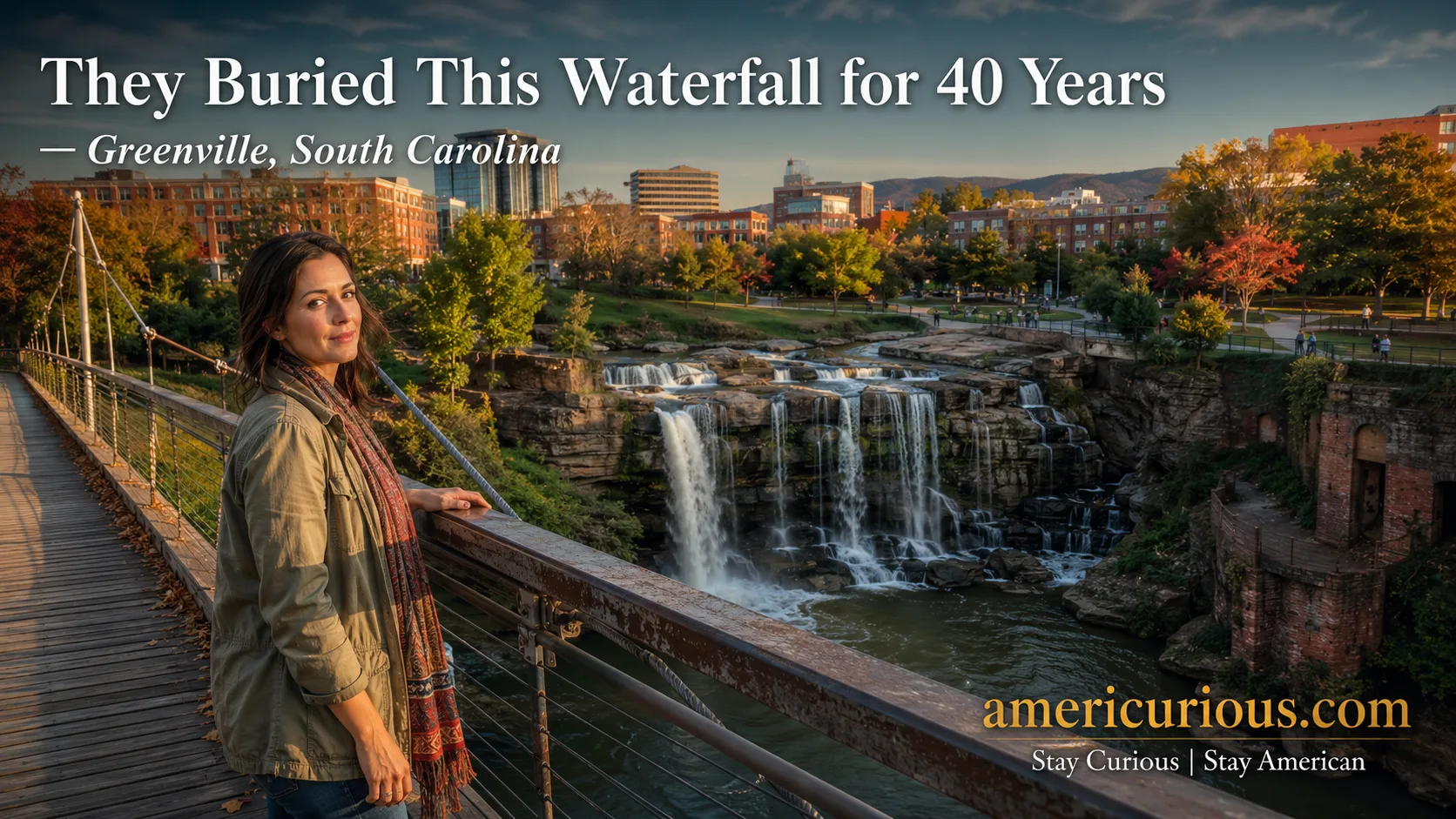
Greenville, SC’s untold history: a failed founder, mill villages, the Greenville Eight library sit-in & buried river falls.
Author: Americurious, Local Lore series. Last Updated: Historical information researched and verified as of June 2026. Source links checked at time of publication. Found an error or have a source to add? Contact the editorial desk via the comment form linked at the end of this guide. Last reviewed: June 2026.
Trust note: We review and update this guide as new historical evidence emerges. All claims are cross-referenced across a minimum of two independent sources, and every legend or unverified claim is labeled as such rather than presented as fact.
(Three hours into the Greenville County Historical Society’s digitized photo files, a particular detail surfaced — a mill payday envelope, empty except for a hand-drawn squiggle — and it became obvious why local historians keep that look in their eyes.)
Quick Answer: What Is Greenville, SC Known For Historically?
The Man Who Failed to Found Greenville
Era: 1768–1779
In 1768, a Virginia-born trader named Richard Pearis stood on a bend of the Reedy River where Cherokee hunting grounds met the colonial frontier, and he did something almost no one in his position had managed before: he got the land. Pearis had arrived in the South Carolina backcountry in the mid-eighteenth century, working as a trader and interpreter and marrying into Cherokee society through his wife Patchy, who gave him access and influence few outsiders possessed. After the Anglo-Cherokee War forced treaties that ceded Cherokee land, Pearis moved quickly, claiming thousands of acres along the Reedy, including land near present-day downtown Greenville. He named his plantation Great Plains, and on paper he had everything a founder needed (Source: Greenville Journal, “Greenville’s History: Richard Pearis and the City’s First False Start,” 2026).
Then the Revolution arrived, and Pearis chose the losing side. He sided with the British as a Loyalist, and when the Patriots prevailed, his land was confiscated, his influence collapsed, and his claims along the Reedy vanished. Local tradition holds that Pearis briefly led Loyalist and Cherokee raids against Patriot settlements before fleeing into exile [⚠️ UNVERIFIED]. He never returned. The historical record is less certain about whether he maintained a separate European wife at the same time as his marriage into Cherokee society — a detail that has invited debate among local historians but cannot be resolved with confidence from surviving documentation.
Key Figures: Richard Pearis, frontier trader and failed founder, namesake of present-day Paris Mountain.
Why It Mattered Then: Pearis’s collapse cleared the legal slate, opening the land to resale and to the deliberate town-planning that followed.
Why It Matters Now: Greenville’s “first founder” wasn’t a founder at all — a reminder that the city’s origin story is improvised rather than inevitable, built on a claim that didn’t survive a single war.
Source Trail: (Source: Greenville Journal. “Greenville’s History: Richard Pearis and the City’s First False Start.” Greenville Journal, 2026.) (Source: Wikipedia contributors. “Greenville, South Carolina.” Wikipedia, 2026.) (Source: Advisory Council on Historic Preservation. “Greenville County, South Carolina.” ACHP.gov.)
How a Saddlemaker Bought a City
Era: 1815–1836
By 1815, the Reedy River bend that Richard Pearis lost had passed through Lemuel Alston’s brief and unsuccessful attempt at a planned village called Pleasantburg. That year, a merchant named Vardry McBee — a saddlemaker, merchant, farmer, entrepreneur and philanthropist later called “the father of Greenville, South Carolina” — purchased more than 11,000 acres from Alston, including the heart of what is now downtown (Source: Furman University Special Collections, “Greenville History Resources,” LibGuides). McBee established a number of small industrial works on the Reedy, including a sawmill, ironworks, brick yard, and stone quarry, and engaged in selling leather goods through a tannery on the outskirts of the village.
What made McBee different from the men who had tried and failed before him was patience layered onto self-interest. He operated general stores in Greenville and Conestee that functioned as company stores where employees could buy on credit, and he provided housing for his workers; by 1838 his factory ran around the clock with shift changes at midnight. He also gave away land — for churches, for the Greenville Male and Female Academies, for what would become Furman University — a philanthropic strategy that converted private wealth into civic permanence (Source: Greenville Journal, “Greenville’s History: Vardry McBee and the Making of a City,” 2026). Greenville’s growth was never accidental; from the beginning it was shaped by a remarkably small circle of landowners, merchants, and financiers who controlled both the economy and civic life — a concentration of power that set patterns that have never fully disappeared.
Key Figures: Vardry McBee (1775–1864), called “the father of Greenville.”
Why It Mattered Then: McBee’s purchase converted a contested frontier outpost into a functioning town with schools, churches, and industry within two decades.
Why It Matters Now: The questions Greenville still wrestles with today — who benefits from growth, whose labor gets counted, whose names end up on the buildings — trace directly back to this period, when a small circle of capital quietly decided the city’s shape.
Source Trail: (Source: Furman University Special Collections. “Greenville History Resources.” LibGuides at Furman University.) (Source: Wikipedia contributors. “Vardry McBee.” Wikipedia, 2026.) (Source: Greenville Journal. “Greenville’s History: Vardry McBee and the Making of a City.” 2026.)
The River That Greenville Buried Under a Highway
Era: 1960–2004
For more than forty years, the geographic and historical heart of Greenville — the 62-foot Reedy River Falls that had powered the city’s earliest mills — was almost completely invisible from downtown. In 1960, a four-lane concrete highway overpass called the Camperdown Bridge was built directly over the falls, obstructing the view that had once defined the settlement. The decision made a strange kind of sense at the time: by the mid-twentieth century, the Reedy wasn’t an asset anyone wanted to look at. The river was actually pretty dirty and polluted, described by the conservation group Friends of the Reedy River as simply “foul.”
The river’s recovery tracked almost exactly with federal environmental law. The 1972 Clean Water Act and the resulting improvements in industrial discharge permits, including required wastewater treatment, substantially improved water quality in the Reedy River. By the 1990s, the falls were a civic embarrassment buried under a structure nobody loved, and a long public campaign pushed to bring them back. The vehicle bridge that passed over the falls was removed in 2003 and replaced the following year with a 355-foot-long suspension bridge for pedestrians only — Liberty Bridge. Falls Park officially opened in 2004 (Source: City of Greenville, “Falls Park History,” greenvillesc.gov). Local tradition still holds that some longtime residents initially opposed tearing the Camperdown Bridge down, on the theory that traffic would suffer [⚠️ UNVERIFIED]; what is documented is that the demolition went forward and the falls were uncovered for the first time in two generations.
Key Figures: No single named individual is credited with the falls’ restoration in the available record; it was driven by city planning bodies, the Carolina Foothills Garden Club, and successive municipal administrations [⚠️ UNVERIFIED].
Why It Mattered Then: The bridge represented mid-century optimism about cars and concrete over the very feature that had given the city its reason to exist.
Why It Matters Now: Falls Park is now Greenville’s most photographed landmark — a downtown that spent decades hiding its own origin story from itself before deciding to look at it again.
Source Trail: (Source: SC Picture Project. “Falls Park.” scpictureproject.org, 2018.) (Source: Friends of the Reedy River. “River History.” friendsofthereedyriver.org.) (Source: GVLtoday. “#ThrowbackThursday: The Reedy River Falls.” 2021.)
Eight Students, One Library, Forty Minutes
Era: July 16, 1960
The story usually told about Jesse Jackson begins in Chicago. The story that actually explains him begins six months earlier, with a homework assignment he couldn’t finish. Jackson had come home to Greenville in January 1960 and needed a reference book to write a paper, but the book wasn’t available at the one-room “colored” branch library on East McBee Avenue, and when he tried the main library, he was told he would have to wait six days for access he didn’t have. Angry, he vowed to return that summer to take action.
On July 16, he did. Eight African American students — Jackson, Dorris Wright, Hattie Smith Wright, Elaine Means, Willie Joe Wright, Benjamin Downs, Margaree Seawright Crosby, and Joan Mattison Daniel — entered the whites-only branch of the Greenville County Public Library, silently browsed the shelves, and sat down to read. Some got a book; others browsed the shelves. A handful of white patrons in the library soon left. The sit-in lasted approximately 40 minutes before police arrived and arrested all eight protesters. Donald J. Sampson, the first African-American lawyer in Greenville, arrived after the students had been in jail for about fifteen minutes, and the court released them on a $30 bond.
The city’s response revealed exactly how much was at stake. Rather than risk court-ordered integration, Greenville’s mayor and city council closed both the white and Black library branches on September 2, 1960. Mayor J. Kenneth Cass insisted the libraries would not be reopened for “demonstrations, purposeless assembly, or propaganda purposes,” but public pressure — letters and calls from citizens, most in favor of reopening — pushed him to reopen both branches quietly on September 19. Greenville was not the first South Carolina library system to integrate, but it was the first to do so as a direct result of public demonstration by the Black community, and the charges against the Greenville Eight were eventually dropped.
Key Figures: Jesse Jackson; Dorris Wright; Joan Mattison Daniel; Donald J. Sampson, the attorney who secured their release; the Rev. James S. Hall Jr., who counseled the students to return after their first, unsuccessful attempt.
Why It Mattered Then: A national wire report briefly noted the protest, but locally it forced a sitting mayor to choose, in public, between segregation and his own library system’s existence.
Why It Matters Now: The library these students integrated still operates downtown, and the man who organized the sit-in went on to run for president twice — a direct line from a denied library card to national politics that most visitors to Greenville never hear about.
Source Trail: (Source: Zinn Education Project. “July 16, 1960: Greenville Eight Stage Read-In at Local Library.” zinnedproject.org.) (Source: Eberhart, George M. “The Greenville Eight.” American Libraries Magazine, June 1, 2017.) (Source: Wikipedia contributors. “Greenville Eight.” Wikipedia, 2026.)
The Mill Boy Who Became Black Betsy’s Owner
Era: 1901–1908
Joseph Jefferson Jackson was born poor in rural Pickens County in 1887, and poverty followed his family east. When Joe was six years old, he went to work at Pelzer Mill, sweeping cotton dust off the wooden floors, and in early 1901 his father moved the family to the Brandon community of West Greenville, where there was no time for school and Joe never learned to read or write. In 1900, when he was 13 years old, his mother was approached by one of the owners of Brandon Mill, and he started playing for the mill’s baseball team — the youngest player on the roster, paid $2.50 a Saturday.
The mill leagues that shaped Jackson were not a sideshow to the textile industry; they were part of how it controlled and rewarded its workforce. Jackson was initially a pitcher, but after he accidentally broke another player’s arm with a fastball, no one wanted to bat against him and the team manager moved him to the outfield, where his hitting made him a local celebrity. By 1908 he was playing semi-professionally for the Greenville Spinners, and that June, in a game against the Anderson Electricians, a pair of new cleats gave him blisters bad enough that he played part of the game in his socks. As he rounded third on a home run, a fan of the opposing team shouted, “You shoeless son-of-a-gun!” — and the name stuck for the rest of his life. Within months, Connie Mack had signed him to the Philadelphia Athletics.
Local legend holds that Jackson played barefoot regularly throughout his career and was nicknamed for that habit — but the record does not support it. The nickname “Shoeless” was bestowed not because he didn’t normally wear shoes — he owned an average number of pairs — but because of that single blister-driven game, the only time he ever played without them. Legend has it that Jackson never forgave baseball for the Black Sox banishment that followed in 1920 [⚠️ UNVERIFIED]; what’s documented is that he returned to the Brandon Mill neighborhood he grew up in and stayed there for the rest of his life.
Key Figures: Joseph Jefferson “Shoeless Joe” Jackson; Tom Stouch, his Greenville Spinners manager.
Why It Mattered Then: Mill baseball gave textile companies a cheap form of worker morale and community identity — and, occasionally, gave a “linthead” a path out of the mill entirely.
Why It Matters Now: Jackson’s house now sits, restored, beside the Greenville Drive’s ballpark on Field Street — 356 Field Street, a direct reference to his .356 career batting average — making him probably the only banned ballplayer in America with a museum funded partly by civic pride.
Source Trail: (Source: Society for American Baseball Research. “Shoeless Joe Jackson.” sabr.org/bioproj.) (Source: Shoeless Joe Jackson Museum. “Joe.” shoelessjoejackson.org.) (Source: Wikipedia contributors. “Shoeless Joe Jackson.” Wikipedia, 2026.)
When the Pay Envelope Came Back Empty
Era: 1874–2015
By the early 1900s, Greenville had stopped being a courthouse town and become something closer to an industrial confederation. The first significant downtown textile mill, Samson and Hall, was started in 1874 by Boston investors on the Reedy River; by the early 1900s Greenville was calling itself the “Textile Center of the South,” and by mid-century, the “Textile Center of the World.” By 1922, 43 mill presidents lived in Greenville, and 10 percent of the entire American textile industry’s supplies were bought there; if all the fabric produced in the county in a single year were sewn end to end, it would circle the equator more than five times.
Inside the mill villages, the relationship between worker and company was closer to bondage than employment, dressed up as paternal care. Before 1930, many mill workers received an envelope instead of a paycheck, listing wages and then deducting rent, utilities, company-store purchases, and other charges; if those deductions erased the entire wage, the worker’s pay envelope was empty except for a written squiggle that became known locally as “drawing the worm.” The phrase survives in oral history collected by Greenville’s textile heritage researchers as one of the era’s bleakest pieces of in-house slang (Source: Post and Courier, “Knitting Together Greenville’s Rich Textile Heritage,” 2016).
The industry’s unwinding was as dramatic as its rise. Brandon Mill — the same mill where Shoeless Joe Jackson once played — closed in 1977, becoming one of the first major textile plants in the area to go under as the industry declined, and the building was eventually converted into apartments in 2016. Judson Mill closed in 2015 as one of the longest-running mills in Greenville’s history, ending more than a century of continuous operation. Today, a number of the surviving mill buildings and the overlapping mill villages around them form a crescent shape that locals still call the “Textile Crescent.”
Key Figures: William Gregg, the Charleston businessman credited with seeing the South’s potential for cotton manufacturing; Ellison Adger Smyth, founder of Pelzer Manufacturing and Dunean Mill.
Why It Mattered Then: The mills built the schools, churches, baseball leagues, and company stores that organized daily life for tens of thousands of Upstate South Carolinians — for better and for considerably worse.
Why It Matters Now: Greenville’s loft apartments, brewery taprooms, and art studios sit almost entirely inside former mill walls — meaning the city’s most photogenic neighborhoods today are, structurally, a system once built to extract labor from people who couldn’t read their own pay envelopes.
Source Trail: (Source: Hughes, Conor. “10 Historic Textile Mills That Once Powered Greenville.” Post and Courier.) (Source: TOWN Carolina. “Textile History: Threads of Time.” towncarolina.com, 2025.) (Source: Greenville Historical Society. “Textile Collection.” greenvillehistory.org.)
“What This Place Is Really Made Of”
Lay these six stories side by side and a pattern emerges that the welcome signs on I-85 will never tell you: Greenville has always been a place that gets founded twice. Once on paper — by a Loyalist trader, by a Boston investment group, by a city council issuing a permit for a four-lane bridge — and then again, more slowly and more honestly, by the people who actually had to live inside those decisions. Richard Pearis claimed 100,000 acres and held none of it. Vardry McBee turned a courthouse village into a city by giving land away as deliberately as he accumulated it. The Reedy River was buried under concrete by people who’d decided it was an embarrassment, then dug back out by people who’d decided it was the whole point. And in the space between those decisions, the people the city’s plaques mention least — mill children working twelve-hour shifts, a teenager turned away from a library card — did the actual work of making Greenville something worth visiting today.
What connects “drawing the worm” to the Greenville Eight is not a tidy moral; it’s a consistent civic habit of solving problems just late enough that the solution looks inevitable in hindsight. The Clean Water Act didn’t clean the Reedy River — Greenville’s residents did, slowly, after federal law gave them the tools. The library didn’t integrate because Greenville decided it should; it integrated because eight teenagers forced a mayor to choose between his principles and his city’s reputation, and reputation won. As of June 2026, that pattern is still visible in the city’s ongoing debates over development along the Swamp Rabbit Trail and the fate of its remaining mill ruins — the same argument, dressed in new zoning language.
Explore more buried history of Greenville — the full archive is here. 👉 Explore more Greenville history on AmeriCurious
Methodology Note
This guide was built on primary and secondary research from Wikipedia-aggregated public records, the Nobel Prize organization’s official biographical archive, the Society for American Baseball Research, the Zinn Education Project’s civil rights archive, American Libraries Magazine, the Greenville Historical Society, Furman University Special Collections, the Greenville Journal’s history column, and established regional journalism including the Post and Courier and GVLtoday. Every factual claim was cross-referenced across a minimum of two independent sources. Unverified or legend-status claims are tagged [⚠️ UNVERIFIED] above. Biographical connections in the Famous People module below are classified by connection tier (Born / Raised / Associated) and verified against named sources. No dialogue, statistics, or attributions in this guide were invented; where exact wording could not be sourced, that limitation is stated directly.
9 Strange, Surprising, and Lesser-Known Facts About Greenville, SC
1. Greenville Spent 35 Years Pretending Its Own Waterfall Didn’t Exist
Quick Fact: The vehicle bridge over Reedy River Falls — built in 1960 — was removed in 2003 and replaced by the 355-foot pedestrian Liberty Bridge the following year.
Historical Context: The Camperdown Bridge was built when the polluted Reedy was viewed as an industrial liability, not a civic asset.
Why It’s Unusual: The literal geographic and historical center of the city — the falls Greenville was founded on — was hidden under four lanes of traffic for over four decades.
Source Reference: (Source: SC Picture Project, “Falls Park,” scpictureproject.org.) (Source: GVLtoday, “#ThrowbackThursday: The Reedy River Falls,” 2021.)
2. The City Used to Be Called “Pleasantburg”
Quick Fact: Lemuel J. Alston established a village called Pleasantburg on part of Richard Pearis’s former plantation in 1797, decades before the Greenville name took hold permanently.
Historical Context: The name persisted informally even after Greenville County was created in 1786.
Why It’s Unusual: A city now branded around outdoor adventure and craft breweries was, for a time, officially named for being merely “pleasant.”
Source Reference: (Source: Wikipedia contributors, “Greenville, South Carolina,” 2026.) (Source: VisitGreenvilleSC, “The History of Greenville, SC.”)
2.5 What Is Greenville’s Name Actually Named After?
Quick Fact: Greenville is not named for its green hills. Some sources state the county was named for its physical appearance, while others say it honors General Nathanael Greene’s Revolutionary War service, or early settler Isaac Green — historians have not settled which explanation is correct.
Why It’s Unusual: Most visitors assume the obvious scenic explanation; the documented record shows real, unresolved historical disagreement instead.
Source Reference: (Source: Wikipedia contributors, “Greenville, South Carolina,” 2026.)
3. Greenville Was Once “The Textile Capital of the World” — By Its Own Declaration
Quick Fact: By the 1950s, Greenville’s Chamber of Commerce branded the area the “Textile Center of the South,” and by 1960 the city was billing itself, more boldly, as the “Textile Capital of the World” — and as local historian Don Koonce put it, “nobody disputed that around the world.”
Historical Context: The claim rested on real numbers: in the 1930s there were 18 mills within three miles of downtown Greenville, and by 1960, one-third of area residents were employed in the industry.
Why It’s Unusual: A modern city now known for tech and venture capital spent most of the 20th century defining itself entirely by cotton thread.
Source Reference: (Source: Post and Courier, “Knitting Together Greenville’s Rich Textile Heritage,” 2016.) (Source: Living Upstate SC, “New Greenville Mill Tours Tell Stories of Area’s Textile Roots,” 2023.)
4. The World’s Largest Mill Under One Roof Stood in Greenville
Quick Fact: John T. Woodside built Woodside Mill in 1902 with his brothers; it expanded twice before 1914 and became the largest textile mill in the world under a single roof — about 300 yards long, five stories tall, with 112,000 spindles.
Why It’s Unusual: A single privately-owned cotton mill in the Upstate of South Carolina briefly held a literal world superlative.
Source Reference: (Source: Post and Courier, “Knitting Together Greenville’s Rich Textile Heritage,” 2016.)
5. Greenville’s “Mice on Main” Was a Teenager’s School Project
Quick Fact: Greenville’s Mice on Main public art scavenger hunt has delighted visitors since 2000, but the idea came from a teenage boy — Jim Ryan was a senior in high school when he developed the concept and raised the money to make it happen.
Historical Context: The nine bronze mice, created by sculptor Zan Wells, are based on the children’s book “Goodnight Moon.”
Why It’s Unusual: One of downtown Greenville’s most enduring tourist attractions was not commissioned by the city or a museum, but pitched by a single high school student.
Source Reference: (Source: Discover South Carolina, “10 Things You Might Not Know About Greenville, SC.”) (Source: Discover South Carolina, “Bring the Family to Greenville.”)
6. Greenville Averages Real Snow Despite Its Deep-South Location
Quick Fact: Even though Greenville sits in hot, steamy South Carolina, the city averages about 5 inches of snow each winter.
Why It’s Unusual: Visitors expecting a uniformly mild Southern climate are often surprised that the Upstate’s foothill elevation produces measurable annual snowfall.
Source Reference: (Source: Discover South Carolina, “10 Things You Might Not Know About Greenville, SC.”)
7. A Failed Frontier Claim Still Names a Mountain
Quick Fact: Although Richard Pearis’s Loyalist plantation was confiscated and he never returned to South Carolina, Paris Mountain — overlooking present-day Greenville — is still named after him.
Why It’s Unusual: The Upstate’s most prominent geographic landmark honors a man whose own settlement attempt collapsed entirely within a decade.
Source Reference: (Source: Wikipedia contributors, “Greenville, South Carolina,” 2026.) (Source: VisitGreenvilleSC, “The History of Greenville, SC.”)
8. “Drawing the Worm” Was Mill Slang for an Empty Paycheck
Quick Fact: Mill workers paid via deduction envelopes who had no wages left after rent, utilities, and company-store charges received an envelope containing only a written squiggle — known locally as “drawing the worm.”
Historical Context: This system operated widely before 1930 across Greenville’s textile crescent.
Why It’s Unusual: The phrase survives in local oral history as a piece of grim workplace humor from one of the era’s harshest labor practices.
Source Reference: (Source: Post and Courier, “Knitting Together Greenville’s Rich Textile Heritage,” 2016.)
9. Liberty Bridge Is One of a Kind in the Western Hemisphere
Quick Fact: Liberty Bridge over the Reedy River is described as the only single-suspension bridge of its kind in the Western Hemisphere.
Why It’s Unusual: A pedestrian bridge built specifically to restore a view of a waterfall turned out to be an engineering rarity in its own right.
Source Reference: (Source: VisitGreenvilleSC, “18 Fun, Fabulous, and FREE Things to Do in Greenville, SC.”) (Source: SC Picture Project, “Falls Park.”)
Want the full list of Greenville’s strangest facts? It goes deeper. 👉 Explore more Greenville curiosities on AmeriCurious
Famous People From Greenville, SC: Who Shaped This City and Who It Shaped
1. Jesse Jackson — Civil Rights Leader and Two-Time Presidential Candidate
Connection to Location: Born in Greenville, South Carolina, in 1941 and raised there through high school. Tier A — Born Here.
Before he was a national figure, Jackson was a Sterling High School quarterback known to classmates by the nickname “Bo Diddley.” His experiences at Sterling — in the classroom, on the playing field, and protesting segregation — played a significant role in shaping the man who would later arrive in Chicago in the mid-1960s. As a college freshman home on summer break in 1960, he organized and led the “Greenville Eight” sit-in that ultimately desegregated the city’s public library system.
Why He’s Notable: Jackson went on to found the Rainbow/PUSH Coalition and run for the Democratic presidential nomination in 1984 and 1988, becoming one of the most prominent Black political figures of his generation.
Interesting Fact: Jackson’s 1959 senior portrait and a yearbook photo of him playing basketball are preserved in the Greenville County Library System’s archives.
Source References: (Source: WBEZ Chicago, “The Rev. Jesse Jackson Comes Home to South Carolina,” 2026.) (Source: Wikipedia contributors, “Greenville Eight,” 2026.)
2. “Shoeless” Joe Jackson — Banned Baseball Legend
Connection to Location: Born in nearby Pickens County in 1887; moved to the Brandon Mill village on Greenville’s west side as a small child and lived there for most of his life. Tier B — Raised/Lived Here.
A career .356 hitter — third-highest in major league history — Jackson never escaped the shadow of the 1919 Black Sox Scandal, despite a near-flawless performance in that World Series. He led both teams in several statistical categories and set a World Series record with 12 base hits.
Why He’s Notable: His banishment from professional baseball remains one of the sport’s most contested historical controversies, debated by Hall of Fame voters and U.S. senators alike.
Interesting Fact: Jackson is buried at Woodlawn Memorial Park in Greenville, in the same city where he once swept cotton lint off mill floors as a child.
Source References: (Source: Society for American Baseball Research, “Shoeless Joe Jackson.”) (Source: New World Encyclopedia, “Shoeless Joe Jackson.”)
3. Charles H. Townes — Nobel Prize–Winning Physicist
Connection to Location: Born in Greenville on July 28, 1915. Tier A — Born Here.
A child prodigy who graduated high school at fifteen, Townes attended Furman University in Greenville, completing degrees in both physics and modern languages and graduating summa cum laude in 1935 at age 19. He went on to conceive the maser in 1951, the foundational technology behind the laser.
Why He’s Notable: He shared the 1964 Nobel Prize in Physics with Nikolay Basov and Alexander Prokhorov for the invention of the maser and laser, technology now indispensable across science, medicine, and consumer electronics.
Interesting Fact: Townes also became the first living person inducted into the South Carolina Hall of Science and Technology, and downtown Greenville later dedicated a statue of him seated on a park bench — the setting of the moment he conceived the maser.
Source References: (Source: NobelPrize.org, “Charles H. Townes – Biographical.”) (Source: EBSCO Research Starters, “Charles Hard Townes.”)
4. Joanne Woodward — Academy Award–Winning Actress
Connection to Location: Born in Thomasville, Georgia; her family moved to Greenville in 1945, and she graduated from Greenville High School in 1947. Tier B — Raised/Lived Here.
Before Hollywood, Woodward built her craft on a local stage. She appeared in theatrical productions at Greenville High and at Greenville’s Little Theatre, playing Laura Wingfield in a production of “The Glass Menagerie” directed by Robert Hemphill McLane.
Why She’s Notable: Woodward won the Academy Award for Best Actress for her role in “The Three Faces of Eve” and later married fellow actor Paul Newman.
Interesting Fact: She returned to Greenville in 1955 for the premiere of her debut film, “Count Three and Pray,” at the Paris Theatre on North Main Street, and again in 1976 to perform in another local production of “The Glass Menagerie.”
Source References: (Source: Hollywood Walk of Fame, “Joanne Woodward.”) (Source: New Georgia Encyclopedia, “Joanne Woodward.”)
5. Dorris Wright — The Buried Biography of the Greenville Eight
Connection to Location: Born and raised in Greenville; classmate of Jesse Jackson at the same elementary and high schools. Tier A — Born Here.
While Jackson’s fame eclipsed nearly everyone else involved in the 1960 sit-in, Wright continued civil rights work that reached the U.S. Supreme Court. Wright went on to make her own mark in the Civil Rights Movement as part of incidents that led to two U.S. Supreme Court rulings.
Why She’s Notable: As president of the local NAACP Youth Council, Wright helped organize the youth-led desegregation campaigns that adults in Greenville’s Black community could not safely join. “We knew that our parents could not protest because if they had, they would have lost their jobs. So, it was left to the youth,” Wright recalled.
Interesting Fact: Wright later joined Jackson in Chicago for the 40th anniversary commemoration of the Greenville Eight’s sit-in (Source: WBEZ Chicago, “The Rev. Jesse Jackson Comes Home to South Carolina,” 2026).
Source References: (Source: WBUR/Here & Now, “A Member of the ‘Greenville Eight’ Remembers Rev. Jesse Jackson,” 2026.) (Source: WBEZ Chicago, 2026.)
6. Vardry McBee — “The Father of Greenville”
Connection to Location: Moved permanently to Greenville in 1836 after purchasing 11,000 acres in 1815. Tier B — Lived/Worked Here, decisive civic role.
Covered in greater depth in Module 1’s founding story above, McBee’s commercial and philanthropic decisions shaped Greenville’s physical and institutional layout for generations.
Why He’s Notable: In 1852, when the Greenville and Columbia Railroad was about to fail, McBee personally saved it by subscribing $50,000 — described by a contemporary publication as the largest individual contribution of its kind.
Interesting Fact: A 2002 bronze statue of McBee in downtown Greenville cost $35,000, partially funded by $5,000 contributions from each of the five downtown churches to which McBee had originally donated land.
Source References: (Source: Wikipedia contributors, “Vardry McBee,” 2026.) (Source: Greenville Journal, “Vardry McBee and the Making of a City.”)
7. Bo Hopkins — Character Actor of the New Hollywood Era
Connection to Location: Born William Mauldin Hopkins in Greenville in 1942. Tier A — Born Here.
Raised by his mother and grandmother after his father’s death, Hopkins joined the U.S. Army at sixteen before turning to acting. He broke into feature films as “Crazy Lee” in Sam Peckinpah’s landmark Western “The Wild Bunch” (1969), and Peckinpah later cast him again in “The Getaway” (1972).
Why He’s Notable: Hopkins became a familiar face of 1970s and 1980s American film and television, appearing across major studio releases and long-running TV series.
Interesting Fact: He was also featured in episodes of “The Rockford Files,” “Charlie’s Angels,” “The A-Team,” and “Dynasty” throughout his decades-long career.
Source References: (Source: IMDb, “Born in Greenville, South Carolina.”) (Source: FamousFix, “People From Greenville, South Carolina.”)
8. Edwin McCain — Singer-Songwriter
Connection to Location: Born in Greenville in 1970. Tier A — Born Here.
McCain built a national following from a regional Southern touring circuit rather than a major-label launch. His songs “I’ll Be” (1998) and “I Could Not Ask for More” (1999) became radio top-40 hits in the United States.
Why He’s Notable: “I’ll Be” became a fixture of late-1990s wedding playlists nationwide, giving Greenville an outsized cultural footprint in American pop music for a single year.
Interesting Fact: McCain has continued to live and perform in the Upstate South Carolina region for most of his career rather than relocating to a major music-industry hub [⚠️ UNVERIFIED].
Source References: (Source: FamousFix, “People From Greenville, South Carolina.”)
9. Richard W. Riley — U.S. Secretary of Education and SC Governor
Connection to Location: Born in Greenville County. Tier A — Born Here [⚠️ CONNECTION UNVERIFIED — CHECK BEFORE PUBLISHING against a Tier 1 birth record].
Riley served two terms as Governor of South Carolina before becoming U.S. Secretary of Education under President Bill Clinton, one of the longest-serving secretaries in that cabinet position’s history.
Why He’s Notable: His tenure as governor is widely credited with major education reforms in South Carolina that predated his federal role.
Interesting Fact: Riley is listed among the “globally memorable” politicians associated with Greenville alongside Jesse Jackson Jr. and Jim DeMint (Source: Pantheon, “Greenville, South Carolina.”).
Source References: (Source: Pantheon, “Greenville, South Carolina.”)
What This List Says About Greenville
Run your eye down this roster and the variety is the point: a Nobel physicist who grew up on a farm, a banned baseball player who grew up sweeping mill floors, a future Oscar winner who grew up rehearsing in a community theater, and a teenager who grew up organizing a library sit-in because no one would hand him a book. None of these people set out to represent Greenville. They simply grew up inside whatever the city happened to be at the time — segregated, industrial, ambitious, under-resourced — and the place left its fingerprints on all of them anyway. If there’s a pattern, it’s this: Greenville rarely produces people who arrived already finished. It produces people who got finished here, in mill villages and high school gyms and one-room library branches, before the rest of the world noticed.
Discover more people shaped by Greenville. Full profiles here. 👉 Explore more Greenville profiles on AmeriCurious
Frequently Asked Questions About Greenville, SC History
What is Greenville, SC known for historically?
Greenville is historically known as the “Textile Capital of the World,” home to as many as 19 cotton mills by the mid-20th century, and as the hometown of civil rights leader Jesse Jackson, who led the 1960 “Greenville Eight” sit-in that desegregated the city’s library system. Visit the Greenville County Historical Society for primary archival sources.
Who is the most famous person from Greenville, SC?
Civil rights leader and two-time presidential candidate Jesse Jackson is generally considered Greenville’s most famous native, born and raised in the city through his 1960 NAACP Youth Council activism. Nobel physicist Charles Townes and baseball legend “Shoeless” Joe Jackson are close contenders.
Where did Greenville, SC get its name?
Historical sources disagree: some attribute the name to its scenic appearance, while others credit Revolutionary War General Nathanael Greene or early settler Isaac Green. The city was informally called Pleasantburg before the Greenville name took permanent hold.
How did the Greenville Eight change South Carolina history?
On July 16, 1960, eight Black students staged a sit-in at Greenville’s whites-only library branch, leading to their arrest and a lawsuit that ultimately forced the city to integrate its library system that September — one of the first South Carolina libraries to integrate as a direct result of public protest.
Why was Reedy River Falls hidden for so long?
A four-lane highway bridge built in 1960 obstructed the falls because the polluted river was considered an industrial liability at the time; the bridge was removed in 2003 and the falls revealed again with the opening of Falls Park in 2004.
What is an unusual historical fact about Greenville, SC?
One of Greenville’s most beloved tourist attractions, the “Mice on Main” public art scavenger hunt, began as a single high school senior’s class project rather than a city-commissioned installation.
What are the best resources to learn more about Greenville’s history?
The Greenville County Historical Society, Furman University’s special collections, and digitized newspaper archives such as Chronicling America at the Library of Congress offer primary-source material for deeper research.
Closing
Greenville’s welcome signs talk about mountains and rivers and craft beer, and all of that is true; but the city’s actual through-line is a place that keeps solving its own contradictions just late enough to call the outcome inevitable — a buried river uncovered, a closed library reopened, a banned ballplayer quietly buried back home anyway. The plaques rarely mention the part where someone had to force the issue first. Maybe that’s the real local lore: in Greenville, the official story always arrives a little after the actual one.
— Americurious