
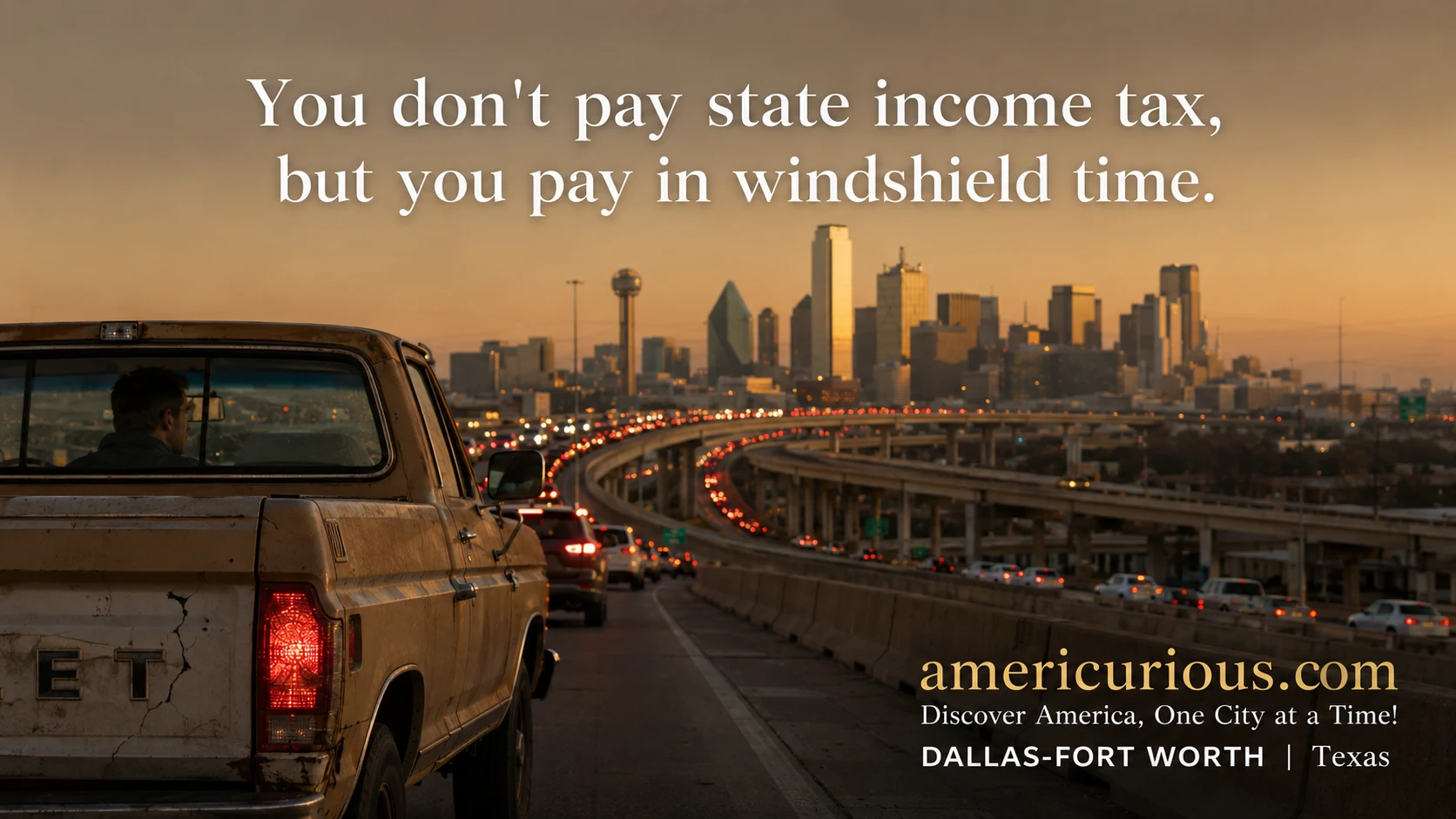
Discover why moving to DFW in 2026 is a massive trend. Learn the hidden costs, traffic realities, and job market truths before you relocate to Dallas-Fort Worth.
Listen, I’ve spent half my life deciphering academic jargon and the other half eating my weight in regional diner specials. But nothing prepares you for the sheer velocity of the Lone Star State. If you’re reading this, you’re probably one of the thousands packing a U-Haul right now. Moving to DFW isn’t just a change of address; it’s an economic migration of epic proportions. I drove the Mixmaster during rush hour so you don’t have to. (You still will, though.) Let’s talk about the jobs, the sprawl, and the hidden tax bills before you sign that lease.
Quick Answer: The 2026 DFW Migration Explained
Moving to DFW in 2026 means stepping into America’s most aggressive economic engine. The Dallas-Fort Worth metroplex leads the nation in population growth and corporate relocations, fueled by zero state income tax, a business-friendly climate, and massive job creation. However, what nobody tells you is that this explosive growth brings creeping property taxes, severe infrastructure bottlenecks, and sprawling commutes that demand a car. You are trading coastal housing prices for Sun Belt sprawl. To thrive here, you must understand the micro-economies of the suburbs, the reality of the Texas heat, and the hidden costs of this boomtown. This guide breaks down the unvarnished truth about relocating to North Texas.
Real estate sites will gladly tell you about the barbecue and the sunshine. They won’t tell you why your auto insurance is about to skyrocket, or why “30 minutes away” means something entirely different here. Finding reliable, boots-on-the-ground answers about DFW is tough because the region is changing faster than the data can update. This article delivers the hyper-local truth. We’re cutting through the marketing fluff to give you actionable, verified data on the economics, housing, and culture of Dallas-Fort Worth.
The Unspoken Economics of Moving to DFW
Summary: DFW’s explosive growth is driven by corporate relocations and a tax-friendly environment, but the economic benefits vary wildly depending on your county and industry.
What is the DFW Corporate Relocation Boom?
The DFW corporate relocation boom is the ongoing migration of Fortune 500 headquarters and major regional offices to the Dallas-Fort Worth metroplex, driven by favorable tax structures, a massive labor pool, and relatively affordable real estate compared to coastal hubs.
You don’t need a PhD in urban planning to see the economic shift, but it helps. Texas doesn’t have a state income tax. That alone acts as a gravitational well for high earners fleeing California and New York. But the secret sauce is corporate welfare—er, economic incentives. Cities like Frisco, Plano, and Irving routinely offer massive tax abatements to lure big business. The Dallas Regional Chamber reports billions in capital investment over the last few years.
When U.S. Census Bureau data confirms DFW as the top growth metro, they aren’t just counting babies. They’re counting incoming CEOs. You aren’t just moving to a city; you’re moving to a hyper-competitive job market that heavily favors tech, finance, and logistics.
Major Corporate Moves Fueling the Boom
Look at the landscape. Goldman Sachs is building a massive new campus in Dallas. Schwab has cemented its footprint in Westlake. Toyota Motors North America planted its flag in Plano. These aren’t just PR stunts; they are multi-billion-dollar bets on the region’s infrastructure and workforce. This influx creates a ripple effect of secondary jobs, meaning service and construction industries are also booming.
But don’t just take my word for it. The Texas Workforce Commission consistently tracks record-breaking employment figures in the region. The jobs are here. The question is whether you can afford the lifestyle.
The Housing Reality Check: Moving to DFW in 2026
Summary: While cheaper than San Francisco, DFW housing prices have surged. The real shock for new residents is the property tax trade-off that offsets the lack of state income tax.
What is the Texas Property Tax Trade-off?
The Texas property tax trade-off is the fiscal reality where residents pay no state income tax but face some of the highest property tax rates in the United States, fundamentally altering the true cost of homeownership.
Everyone hears “no income tax” and immediately starts doing backflips. Slow down. The state still needs to fund schools, roads, and that massive football stadium in Arlington. They do it through property taxes. The Texas Comptroller of Public Accounts outlines how these rates are assessed locally, meaning your tax burden depends entirely on your county, city, and school district.
I’ve seen folks move from the Midwest, buy a gorgeous four-bedroom in McKinney, and nearly faint when the annual tax bill arrives. You trade a 6% state income tax for a 2.3% property tax hit on an appraised value that seems to rise every time the wind blows. According to data from the Federal Reserve Bank of Dallas, home price appreciation in DFW has consistently outpaced national averages over the last decade. You’re getting a deal compared to San Jose, but DFW is no longer a bargain bin.
| Metro Area | Median Home Price (Est. 2024/2025) | State Income Tax | Effective Property Tax |
|---|---|---|---|
| Dallas-Fort Worth | $395,000 | 0% | 1.8% – 2.3% |
| Los Angeles, CA | $850,000+ | Up to 13.3% | 0.7% |
| Chicago, IL | $340,000 | 4.95% | 2.1% |
Actionable Checklist: Calculating Your DFW Housing Budget
- Check the CAD: Always look up the specific address on the local Central Appraisal District (CAD) website (e.g., Dallas CAD or Collin CAD) to see the exact current tax rate and appraised value.
- Factor in Homestead Exemptions: If this is your primary residence, apply for the homestead exemption. It knocks a chunk off your appraised value.
- Anticipate Appraisal Creep: Don’t budget for year one’s taxes. Budget for year three’s, because the value will go up.
- Compare Rent vs. Buy: Given interest rates and property taxes, renting in areas like Uptown or Las Colinas might make more fiscal sense for your first year while you learn the geography.
Surviving the Concrete Maze: DFW Infrastructure
Summary: DFW is a car-dependent metroplex. The highway system is massive but heavily congested, and relying on public transit is not a viable option for most commuters.
Here is the biggest thing nobody tells you: “Dallas-Fort Worth” is not a city. It’s a collection of fiefdoms connected by a ferocious web of concrete. Unlike Chicago, where you can Walk the Chi and hit a dozen neighborhoods on foot, DFW demands four wheels. You will measure your life in highway minutes.
The Texas Department of Transportation (TxDOT) is constantly expanding highways, but traffic still multiplies daily. The LBJ Express (I-635) and the Dallas North Tollway are lifelines, but they are also parking lots during rush hour. If you live in Prosper and work in Downtown Dallas, you are signing up for a daily psychological trial.
Advanced Insight: The Suburban Sprawl Matrix
Choosing where to live in DFW requires a strategic matrix. North Dallas (Plano, Frisco, Allen) offers top-tier schools and massive corporate parks, but heavy traffic. East Dallas (Lakewood, Lower Greenville) offers charm and walkability, but at a premium price. Fort Worth offers a slower, friendlier pace with incredible cultural institutions, but a longer commute to the Dallas tech corridors. You must align your housing choice with your office location.
You might see towns like Princeton and Georgetown topping the fastest-growing lists in the country, but DFW is the anchor holding them up. People buy cheap homes in exurbs an hour out and commute in. It’s brutal. The Dallas Area Rapid Transit (DART) system exists, but its reach is limited. Unless you live and work directly on a rail line, you’re driving.
The Culture Shock of the Metroplex
Summary: DFW offers a hyper-local culture that blends Southern hospitality with massive wealth, fierce regional loyalty, and a surprisingly deep arts and dining scene.
People assume Texas is just cowboy hats and brisket. DFW is far more complex. It’s Southern hospitality meets ruthless capitalism. You’ll find some of the most aggressive drivers in the nation sharing the road with someone who will absolutely hold the door open for you and call you “sir” or “ma’am.”
The food scene is an embarrassment of riches. I ate a bowl of pho in Arlington that rivaled anything I’ve had in Saigon, followed by a kolache in West that made me question my life choices. (The good kind of questioning.) The DFW International Airport keeps the region hyper-connected, meaning the cultural diversity here is expanding as fast as the tollways.
Common Mistake: Ignoring the “Metroplex” Divide
Newcomers often treat Dallas and Fort Worth as the same city. They are not. Fort Worth has a distinctly Western heritage, a slower pace, and a tighter-knit community feel. Dallas is fast-paced, corporate, and flashy. If you move to Fort Worth but take a job in Plano, you will hate your life. Do the drive once before you commit.
Key Takeaways
- Zero income tax has a catch: DFW compensates with high property taxes and appraised values that rise annually. Always verify rates with the local CAD.
- The job market is massive but centralized: Corporate hubs are clustered in specific suburbs (Plano, Frisco, Las Colinas). Align your housing with your office to save your sanity.
- DFW requires a car: Public transit is limited. You will measure your life in highway minutes, and you need to understand the tollway system.
- Dallas and Fort Worth are different: Do not treat them interchangeably. The cultural and logistical divide is real, and commuting between them is a grind.
- Housing isn’t cheap anymore: DFW is a value play compared to California or New York, but it is no longer a bargain basement. Budget for competitive offers on homes.
- Growth is exponential: The infrastructure is constantly playing catch-up. Expect continuous road construction and shifting traffic patterns.
Frequently Asked Questions (FAQ)
Is moving to DFW a good idea in 2026?
Yes, if you want career advancement and no state income tax. The metroplex offers a lower cost of living than coastal cities and boasts a massive corporate job market. However, you must budget for high property taxes and prepare for car-dependent, sprawling commutes.
What is the property tax rate in DFW?
Property tax rates in DFW vary by county and school district but generally range from 1.8% to 2.3% of the appraised home value. Collin and Denton counties often have slightly different rates than Dallas or Tarrant counties, so always check the specific Central Appraisal District.
Do I need a car in Dallas-Fort Worth?
Yes. DFW is a sprawling, car-dependent metroplex. While DART (Dallas Area Rapid Transit) offers some rail and bus services, it does not cover the entire region efficiently. You will need a reliable vehicle to commute, shop, and socialize.
How bad is the summer heat in DFW?
Summers are brutal. Temperatures routinely exceed 100 degrees Fahrenheit from June through September, and the heat index is higher due to humidity. You will experience “convection oven” heat where the air itself feels hot. Your electric bill will also spike significantly.
Which DFW suburb is best for families?
Frisco, Plano, and Allen are consistently ranked among the best for families due to top-rated public schools and master-planned communities. However, housing costs here are higher. Southlake and Keller are also excellent, though they lean more toward the Fort Worth side.
Is DFW really the fastest-growing metro?
Yes. According to the U.S. Census Bureau, the Dallas-Fort Worth metroplex leads the nation in numeric population growth. The region adds hundreds of thousands of new residents annually, driven by domestic migration and corporate relocations.
What is the DFW Mixmaster?
The Mixmaster refers to the massive, complex interchange of Interstate 35E, Interstate 30, and US 75 near Downtown Dallas. It is notorious for severe traffic congestion and construction. You will likely encounter it if commuting from the southern or southwestern suburbs to the city center.
Are there state income taxes in Texas?
No. Texas is one of the few states with no state income tax. This is a major draw for high earners and businesses. However, the state relies heavily on property and sales taxes to generate revenue, which impacts the overall cost of living.
How diverse is the DFW food scene?
Incredibly diverse. DFW offers exceptional Tex-Mex and BBQ, but also boasts massive Vietnamese, Indian, and Korean populations. The Asian districts in Richardson and Carrollton, plus the taquerias in Oak Cliff, offer some of the best authentic dining in the country.
What are the hidden costs of living in DFW?
Beyond high property taxes, newcomers often face expensive homeowners association (HOA) fees in master-planned communities, high electricity bills during summer, and surprisingly steep auto insurance rates due to heavy traffic and frequent hail storms.
Conclusion: The Final Verdict on Moving to DFW
Summary: Moving to DFW offers unparalleled economic opportunity, but requires strategic planning regarding housing, taxes, and commuting to avoid the common pitfalls of rapid growth.
Moving to DFW in 2026 is a bit like riding a mechanical bull—exhilarating, a little dangerous, and entirely dependent on your grip. The economic opportunities are real, the culture is fiercely unique, and the tacos are elite. But you have to go in with your eyes open. Budget for the property taxes. Map the commute before you pick a neighborhood. And for the love of all that is holy, learn how to merge on I-35.
If you do it right, DFW will reward you with a quality of life that coastal cities simply can’t match anymore. Just keep your AC maintained and your boots ready.