
Georgetown Texas doubled to 100,000 residents in four years. Discover the real cost of living, commute times, and whether this Austin suburb can keep its soul while growing fast.
Georgetown Stopped Being Austin’s Bedroom and Nobody Told You
What the fastest-growing city in America looks like once the moving trucks clear out.
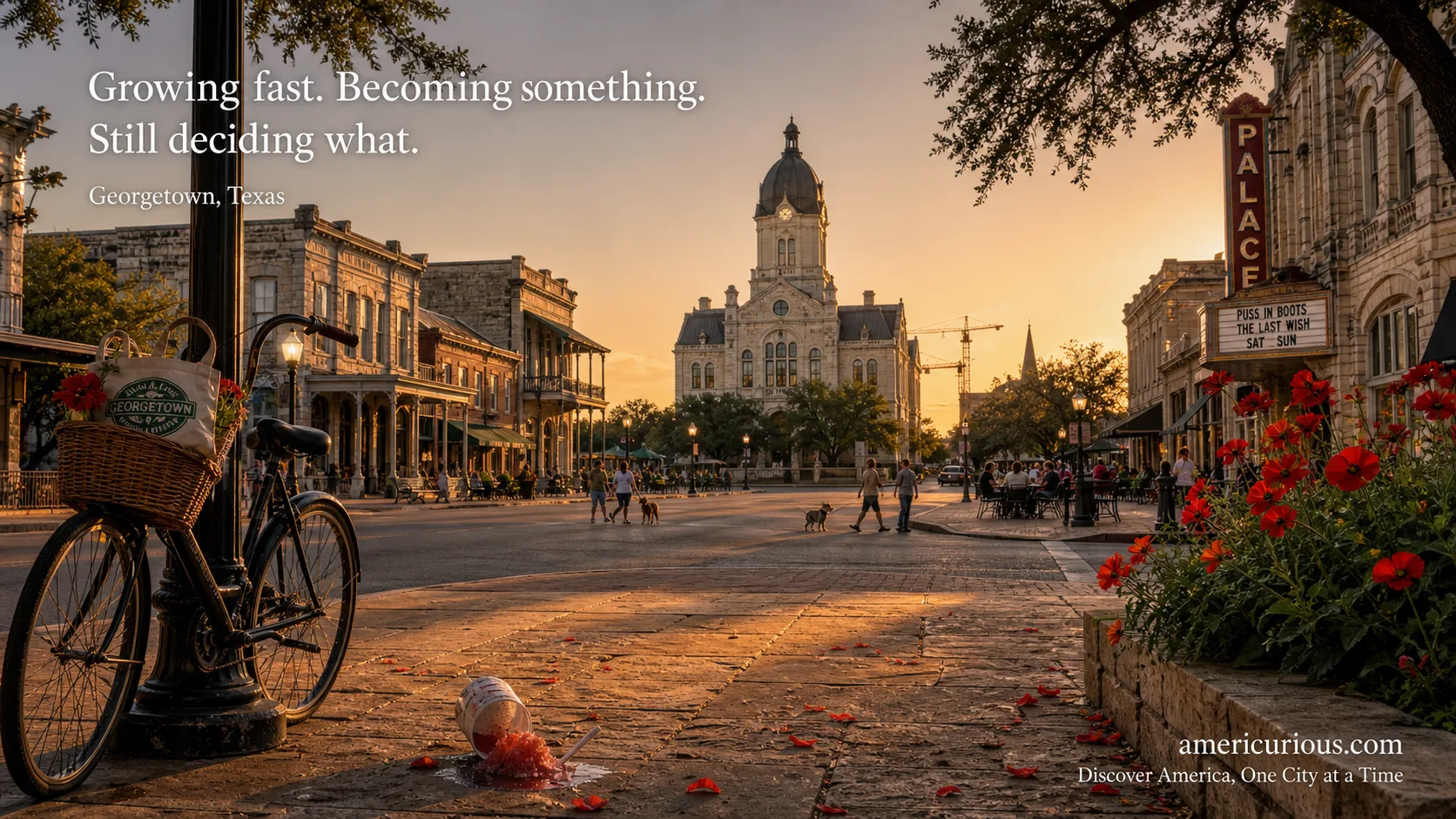
Every April, the square smells like funnel cake and cut grass, and somewhere near the courthouse a kid is crying because she dropped her snow cone on the limestone sidewalk and nobody warned her the poppies were going to be this red. That’s the image people carry out of Georgetown, Texas — a postcard from a small town that knows it’s pretty. What they don’t carry out is the full story: a city of 101,000 that roughly doubled its population in a decade, that’s in the process of becoming something genuinely interesting, and that still hasn’t fully decided what it wants to be when it grows up.
That tension is the real Georgetown. Not the festival, not the Victorian courthouse, not the Sun City retirees who’ve been here since the ’90s and are very clear about the zoning process. The real city is the one underneath — growing fast, arguing with itself, accidentally developing a serious food scene, and trying very hard not to ruin a square that people drive 30 miles from Austin just to walk around.
Where It Actually Sits
Georgetown sits 30 miles north of Austin on I-35, the county seat of Williamson County, and firmly inside the Austin–Round Rock metropolitan area. You fly into Austin-Bergstrom International Airport — Southwest, American, Delta, and United all serve it — rent a car, and drive north. SH-130 is the faster toll-road option to the southeast side; I-35 through the middle is your daily reality. Round Rock is 15 minutes south, and once you’re past that you’re in Georgetown proper, where the Hill Country limestone starts asserting itself and the strip malls start looking slightly more deliberately designed.
The Numbers That Tell the Real Story
Georgetown’s growth story is almost embarrassing to say out loud. The city’s own planning department confirmed it surpassed 100,000 residents in 2024 — up from 67,176 in the 2020 census, roughly a 50-percent jump in four years. The U.S. Census Bureau named it the fastest-growing city in the nation among cities over 20,000 for both 2022 and 2023 consecutively. That’s not a typo. It’s also not comfortable.
The economy driving that growth leans on healthcare, manufacturing, education, and Austin tech spillover. AirBorn, a 100-percent employee-owned manufacturer of specialized connectors for aerospace and defense, is headquartered here. So is Loram Technologies — rail track inspection and maintenance equipment, not glamorous, thoroughly recession-proof. In October 2025, PEGATRON, a major Taiwan-based tech manufacturer, publicly considered Georgetown for its first U.S. facility, signaling that the growth story isn’t purely residential. The median household income landed at $91,857 in 2023, and the city’s municipal utility has run on 100-percent renewable energy since 2017 — a move that made national headlines when it was announced and still comes up in every economic development pitch.
What It’ll Actually Cost You
Redfin clocked the median home sale price at around $395,000 as of early 2026, down about 6 percent year-over-year as the post-pandemic spike cools. RentHop puts two-bedroom apartments at roughly $1,600 per month as of April 2026, with rents falling meaningfully from their 2022 peak. Both numbers sound manageable until you notice that the overall cost of living index runs about 17 percent above the national average, driven almost entirely by housing. Groceries track close to average. Healthcare actually costs slightly less than the national rate. Transportation runs about 13 percent higher, which is just the mathematical consequence of needing a car to do literally anything.
What the index doesn’t capture: Texas property taxes are notorious, and Georgetown is no exception. Expect an effective rate around 1.8 percent on assessed value annually. Dinner for two at a mid-range local spot on the Square runs $45–$65 before drinks and tip — city pricing for a city that has mostly stopped pretending it isn’t becoming a city.
Who’s Hiring
The biggest employers are Georgetown ISD, St. David’s Georgetown Hospital, Southwestern University — the oldest university in Texas, founded in 1840 — and AirBorn. The City of Georgetown and Williamson County government together form another substantial employment block. On the manufacturing side, Chatsworth Products makes IT infrastructure components with over 250 local employees, and Loram Technologies has been a Georgetown anchor for decades. For the full current list, the Georgetown Chamber of Commerce maintains an updated employer directory.
The more important employment story is the commuter layer underneath all of that. A significant slice of Georgetown residents drive or telecommute to Dell in Round Rock, Apple and Amazon in The Domain, and Tesla’s Gigafactory east of Austin. Hybrid and remote work has made the cost arbitrage here genuinely compelling: you get a house 30 miles north of the chaos, and when office days are Tuesday and Thursday only, I-35 becomes manageable.
The Neighborhood Breakdown
The historic core — what people just call downtown or Old Town — is the reason Georgetown ends up on anyone’s shortlist. Victorian limestone buildings surround a proper courthouse square on the National Register of Historic Places, and the walkability feels almost provocative in Central Texas. Housing runs from restored century-old bungalows to two-stories with wraparound porches. You pay a premium, and you accept that festival weekends mean parking four blocks away and walking. It’s worth it.
Sun City Texas on the southwest side operates essentially as a self-contained city for adults 55 and older. Three championship golf courses, 86,000 square feet of indoor amenities, and a trail network that sun-city residents treat as their personal marathon training ground. The political opinions at the HOA meeting will make you reach for your sweet tea, but the infrastructure and property value stability are genuinely hard to argue with.
Berry Creek is the established golf-course community eight miles north of downtown where homes have mature trees, larger lots, and the social orbit of Berry Creek Country Club. Older, quieter, and reliably well-maintained. Wolf Ranch is the newer master-planned community on the east side — fresh construction, resort pool, a GreatSchools-linked elementary built into the development — where families with young kids dominate the demographic and everyone knows everyone’s dog. Cimarron Hills is gated, expensive, and anchored by a Jack Nicklaus Signature course. If a zip code can have a personality, Cimarron Hills’ personality is a really nice watch worn somewhere you don’t need one.
The Food Scene
Georgetown’s food scene has gotten good enough to stop needing qualifiers. City Post Chophouse occupies the building that was the city’s main post office from 1931 — wood-grilled steaks, a solid wine list, and service that makes you feel like a regular by dessert. For breakfast, Sweet Lemon Kitchen operates out of a converted house two blocks off the square, makes everything from scratch, and sells out of its cinnamon rolls before 9 a.m. on Saturdays. Do not test this.
Monument Cafe has been the community’s institution since 1995, built as an ode to the Texas roadside diners of the 1930s — classic American, farm-to-table long before that was a selling point. 600 Degrees Pizzeria & Drafthouse handles the Square’s Friday night energy with craft beer and North Beach-style pizza in a space that’s too small for the demand but always worth the wait. Dos Salsas is the family-run Tex-Mex standby where the Mexican Martini has its own reputation and people drive from Austin specifically for it. Roots Bistro in the Historic District does craft beer and American food with live music nearly every night of the week, which is a different proposition in Georgetown than it is anywhere else — walk there, walk home, feel like you live somewhere real.
Getting Outside
Georgetown’s outdoor infrastructure is better than almost any comparable-sized Texas city, and it’s concentrated in two places. Blue Hole Park on the South Fork of the San Gabriel is a genuine swimming hole — limestone cliffs, clear water, turtles on the rocks — sitting inside a city that keeps building around it. The San Gabriel River Trail connects downtown to Lake Georgetown in eight-plus miles of mostly paved river path, good for runners, cyclists, and anyone whose dog needs a long walk badly.
At the reservoir itself, the Good Water Trail is the main event — a 26.5-mile loop around Lake Georgetown, rated 4.6 stars from nearly 1,200 AllTrails reviews, mixing rocky cedar woods, lakeshore overlooks, and creek crossings. It gets crowded on weekend mornings; arrive before 8 a.m. or bring headphones and patience. Garey Park on the west side adds seven miles of equestrian and hiking trails in terrain that still feels genuinely wild, which is increasingly rare at this latitude.
What Makes It This City
Georgetown’s identity rests on two things: the square and the poppies. The square is anchored by the 1911 Romanesque courthouse, surrounded by Victorian commercial blocks that the community fought for in the 1970s when building owners were covering them in aluminum siding. The result was becoming the first Great American Main Street city in Texas, and the Georgetown Palace Theatre on the square produces live performances year-round and functions as the neighborhood’s living room in a way most Texas cities can only describe in planning documents.
The Red Poppy Festival every April — 26 years running, drawing 75,000 people over a long weekend — is the community’s biggest collective exhale. It’s free, it takes over the square with 150-plus artisan vendors and live music on three stages, and it features a pet parade that Georgetown takes entirely too seriously in the best possible way. Two Step Inn, a separate country music festival held each spring at Lake Georgetown, draws bigger national acts to an outdoor venue where the Hill Country sunset is part of the ticket price. Both are worth calendaring.
Schools and Families
Georgetown’s school picture requires a zip code check before anything else. The west side, generally west of Ronald Reagan Boulevard, falls into Leander ISD or Liberty Hill ISD — both of which rate significantly higher than Georgetown ISD, with Leander ISD’s Stiles Middle School earning a 10/10 GreatSchools rating and Rouse High School an 8/10. Georgetown ISD, which covers the majority of the city, has Georgetown High School at a 7/10 on GreatSchools, a 99-percent graduation rate, and a Niche B overall. Southwestern University adds a genuine four-year liberal arts presence with a campus three blocks from the square. District boundaries genuinely determine your school assignment here, and it’s worth mapping your target neighborhood against all three ISDs before signing anything.
Safety: The Honest Version
CrimeGrade.org gives Georgetown a B overall — safer than 63 percent of U.S. cities, with a violent crime rate of 2.38 per 1,000 residents that sits below both the national average and the Texas state average. The western and southwestern parts of the city consistently rank as the safest areas. Property crime runs more active than violent crime, and pockets around busier commercial corridors see more incidents than quiet residential blocks. Georgetown’s 2024 crime rate ran about 1.9 times lower than the U.S. average according to City-Data figures — not crime-free, but meaningfully calmer than most comparably sized Texas cities. Every neighborhood has its own variation, as is true anywhere.
Weather: Truth in Advertising
If you have spent time in Central Texas, none of what follows is news. If you haven’t: summers run from 72°F at night to a consistent 95–96°F through July and August, and the humidity pushes real-feel temperatures well past 105°F on plenty of afternoons. You will run your air conditioning from May through October. The electricity bill is the cost of admission. Winters are genuinely mild — January temperatures range from 39°F to 60°F — and the two inches of annual snow are treated by long-term residents as a minor civic emergency.
Georgetown receives around 36 inches of rain annually, mostly concentrated in spring and fall. The spring rains are the reason the Red Poppies reseed every year without anyone planting them. Georgetown sits near the southern edge of tornado alley, severe thunderstorms arrive with genuine speed in spring, and flash flooding in the San Gabriel watershed is a real seasonal hazard. The other 300 or so days are legitimately beautiful — clear skies, warm evenings, the kind of weather that makes you understand why people keep moving here.
Getting Around
Georgetown is car-dependent, and there’s no version of that sentence that softens it. Walk Score reflects what everyone who lives here already knows: the historic downtown is walkable within its own few blocks, and the rest of the city requires a vehicle. CARTS launched a new commuter bus route connecting Georgetown and Round Rock directly to downtown Austin in March 2026 — genuine progress, but transit-optional living in Georgetown is still not a realistic option for most residents. Austin-Bergstrom International Airport sits 35–40 miles south via SH-130 (faster, tolled) or I-35 (slower, free).
The Austin commute math is straightforward: off-peak, you’re looking at 35–45 minutes to central Austin. Peak hours on weekday mornings and evenings, that trip stretches to 55–90 minutes on I-35. SH-130 cuts time meaningfully for anyone headed to east or south Austin. Hybrid schedules have completely changed the calculation for residents who only need to be in the office two or three days a week — which is a larger share of Georgetown’s workforce than you might expect.
Real Talk From People Who Live There
Ask someone who’s been here two years and they’ll tell you Georgetown turned out to be more than they expected. The food scene surprised them. The trail system surprised them. The fact that they stopped going to Austin on weekends surprised them most of all. Niche.com reviews and relocation forums consistently surface the same mix: the Square and the community feel are genuine, the I-35 commute is the single biggest point of friction, and rapid growth is outpacing the infrastructure — roads, schools, and city services are visibly running behind the housing starts.
Longer-term residents add a quieter frustration: the city they moved to keeps changing around them. New subdivisions appear overnight. The restaurant that was everyone’s spot closes because the rent went up. Traffic patterns shift without warning. That’s not exclusive to Georgetown, but it hits harder when the whole reason you came here was the small-town feel that’s now under construction.
The Honest Trade-Off
Georgetown’s genuine strengths are specific and verifiable. The historic downtown square is the real thing — not a simulation of Main Street but a preserved Victorian streetscape with a functioning cultural calendar that earns its reputation. The outdoor infrastructure is legitimately excellent: 74 city parks, 22 miles of urban trails, and direct access to the Good Water Loop around Lake Georgetown. The 100-percent renewable utility is a genuine distinction. And proximity to Austin means access to a world-class food, music, and healthcare corridor without Austin property prices — though the gap has narrowed considerably.
The drawbacks are equally real and worth naming directly. I-35 is not a commute, it’s a time tax that compounds with every new resident who makes the same calculation you just made. Property taxes run high enough to meaningfully erode the sticker-price advantage over Austin. The school district situation demands genuine due diligence before you pick a neighborhood — your school assignment can vary dramatically depending on which side of a boulevard your house sits on. And the pace of suburban development has imported a lot of generic construction that grates against the historic identity the city worked hard to preserve. The square is still beautiful. The approach roads to it, less so.
So Who’s This Place Actually For?
Georgetown works best for remote or hybrid workers with families who want space, community, and a genuine downtown to walk around on weekends — without needing Austin’s pulse every night. It works for retirees who want the full amenities package with solid medical infrastructure nearby and weather that’s manageable nine months out of twelve. It works for outdoor people who’ll use the trail system constantly, for Southwestern students and their parents, and for anyone who values a city that takes its own history seriously enough to have actually fought for it.
It’s a harder argument for people who don’t own a car, for anyone whose job requires daily peak-hour Austin driving, and for people who measure quality of life primarily by walkability or late-night culture. Georgetown is moving steadily toward the city it intends to be — building density, adding culture, and drawing enough talent and investment that the trajectory is clear. Whether it gets there before the growth overwhelms the original thing people came to find is the most interesting question in Williamson County right now.
Discover more from AmeriCurious
Subscribe to get the latest posts sent to your email.