
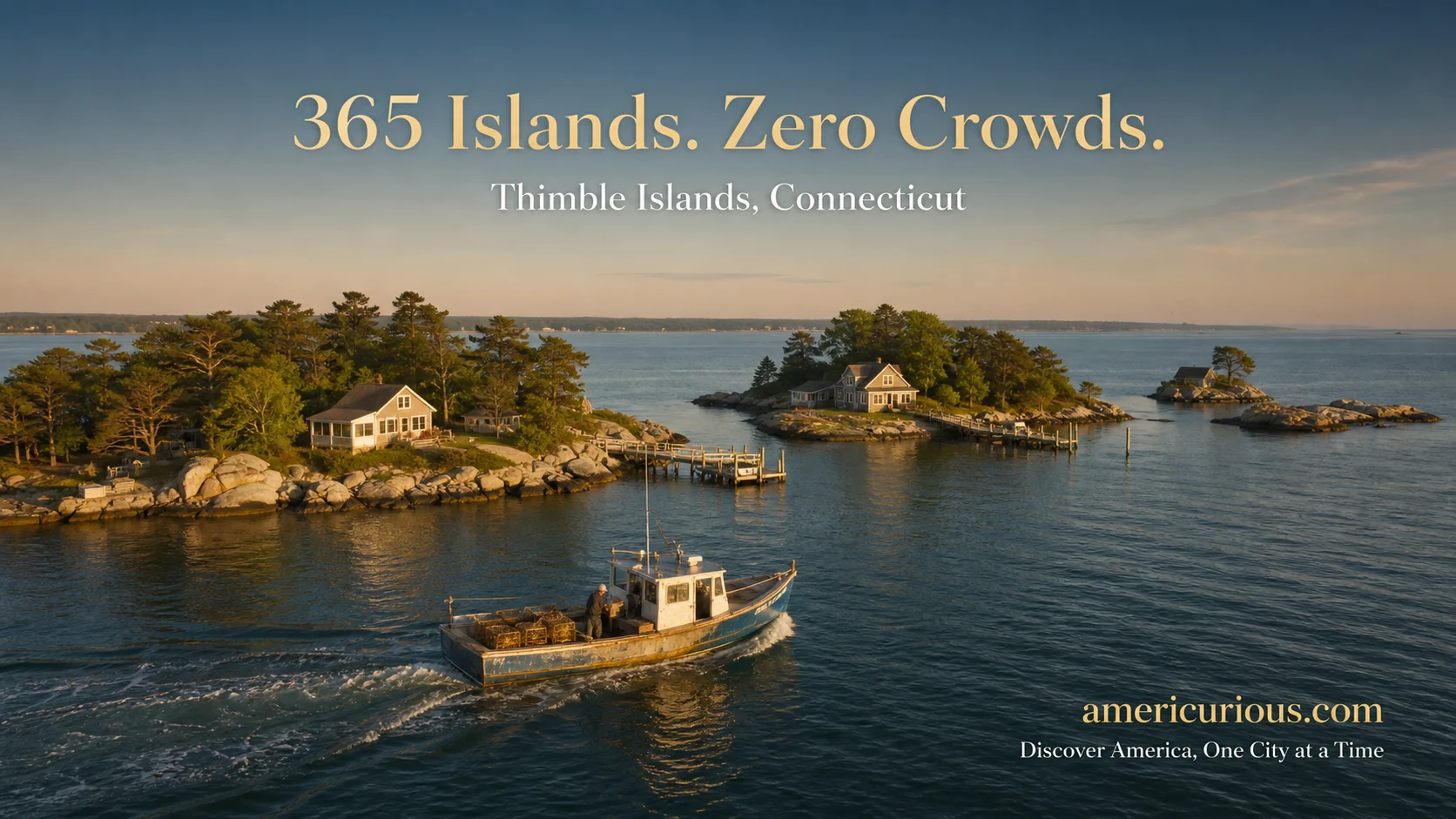
Discover Thimble Islands Connecticut, 365 hidden islands offering Hamptons-level beauty without crowds. Plan your coastal escape to this secret archipelago today.
Everyone who summers in New England seems to follow the same magnetic pull toward the Hamptons or the Cape. The traffic is punishing, the prices are brutal, and the crowds have long since consumed whatever charm those places once possessed. Meanwhile, tucked just two miles off the Connecticut shore near Branford — barely a two-hour drive from Manhattan — a chain of pink granite islands sits in Long Island Sound doing exactly what it’s always done: quietly getting on with being extraordinary, almost entirely without your knowledge.
That’s the Thimble Islands. And in 2026, while everyone else is stuck in I-95 weekend gridlock heading to the Hamptons, you could be floating past a 32-house island that has its own library.
Rock Older Than the Roman Empire, Shaped by Ice
The Thimble Islands are an archipelago made up of pink Stony Creek granite bedrock — the exposed hilltops of a landscape that existed before the last ice age. When the glaciers retreated roughly 15,000 years ago, they left these mounds of stone poking stubbornly above the rising waters of Long Island Sound. This matters more than it sounds: unlike the other islands in the Sound, which are terminal moraines of loose rubble deposited by retreating glaciers, the Thimble Islands are remarkably stable formations of solid rock. They aren’t eroding into the sea. They were built to last.
The Mattabeseck people, who used the area as a summer camp for thousands of years before any European arrived, had already named them well. They called the islands Kuttomquosh — “the beautiful sea rocks.” Dutch explorer Adrian Block became the first European to record them in 1614, though earlier maps show them labeled simply the “Hundred Islands.” The name “Thimble Islands” came later, from the thimbleberry bushes — a type of wild black raspberry — that grow throughout the area. The name is not, as most people assume, a reference to their petite size.
Where Gilded Age Money Ran Out of Land and Took to the Water
By the mid-1800s, America’s newly wealthy were running out of places to build their summer estates on the mainland. The Thimbles offered something more exclusive: you couldn’t even get there without a boat. In 1846, local resident William Bryan built the Thimble Island Hotel on Pot Island, deliberately trading on the legend that the pirate Captain Kidd had buried his treasure somewhere in these waters. The story wasn’t subtle marketing — Pot Island was promptly renamed Kidd’s Island, and nearby formations were renamed Kidd’s Harbor, Kidds Lane, and Money Island. It worked magnificently. Within years, steamboat excursions were landing day-trippers by the boatload. By the turn of the century, the islands had become a playground for the Gilded Age’s upper tier.
President William Howard Taft established what he called his “Summer White House” on Davis Island for two years — though local legend insists, with evident satisfaction, that he actually only spent one night there. General Tom Thumb, the famous circus performer, came to Cut-in-Two Island to court Miss Emily, the similarly statured daughter of the island’s owner, though P.T. Barnum is said to have broken up the romance. The same pink granite that built the islands also built the nation: Stony Creek granite from the quarries here was used in the construction of the Lincoln Memorial, the Brooklyn Bridge, Grant’s Tomb, and the base of the Statue of Liberty. You’re not looking at a quiet Connecticut backwater. You’re looking at one of the geological and historical engines of the 19th-century American story.
The 1938 hurricane punished the islands severely. The storm swept entire residences into the sea and killed seven people. Hotels never reopened, and ferry service dwindled. By the 1940s, the Thimble Islands had become a quiet summer community for those few who could still afford it. That quietude has never really left — and in the age of overtourism, it’s the islands’ single greatest asset.
How to Experience the Thimbles Like Someone Who Actually Knows What They’re Doing
Step 1: Skip the big boat on your first pass. The Sea Mist is the well-known option — large, double-decker, with a full bar — and it’s perfectly fine. But if you want the version that feels like you have a friend who grew up here, book the smaller Islander boat instead. Captain Dave grew up on Kidd Island itself, and his 14-passenger boat can navigate the inlets that the bigger vessels can’t reach. Fourteen people versus forty-four changes everything about how the tour feels.
Step 2: Park at the Stony Creek Firehouse/Museum on School Street, not at the dock. That free parking lot is a 3/4-mile walk from the Town Dock, but it threads you through the actual village — past the Stony Creek Depot’s antiques, the Legacy Theater, the library, and the waterfront. It’s the difference between arriving as a tourist and arriving as someone who took the time to read a map.
Step 3: Time your visit for a weekday morning in late May or early September. Summer weekends fill the boats and clog the village. Go on a Tuesday in September when the light sits lower across the water and the crowds have gone back to school. The tour boats run through early October, and the Sound in early autumn has a particular quality — the air sharp, the granite even pinker against a gray-blue sky.
Step 4: After the tour, find Outer Island by kayak. Branford River Paddlesports offers a three-hour kayaking tour out to Outer Island — the only island in the archipelago with genuine public access — where you can land, walk the cobblestone beach, and eat lunch among the nesting habitat of shorebirds. Almost everyone takes the boat tour. Almost no one does this. The paddlesports operation reopened for the 2026 season on May 18th.
Step 5: End at Stony Creek Market. It’s the kind of place where locals actually eat. The chicken curry salad reportedly warrants the trip on its own.
May 2026 Logistics Block
Status: Verified Open. Boat tours are operating for the 2026 season. The Islander has confirmed 7-days-a-week operation. Branford River Paddlesports reopened May 18, 2026.
Price: Sea Mist narrated tour — Adults $18, Seniors (65+) $17, Children (4–12) $12. Volsunga IV — Adults $18, Seniors $15, Children $13. The Islander runs at $18 general admission. Kayak tours through Branford River Paddlesports run approximately $50–$65 per person for a guided 3-hour outing (confirm directly with the operator, as 2026 pricing was not listed at time of publication).
Pro-Tip: The bar on the Sea Mist operates on a cash-only honor system, so bring small bills — and book the Sea Mist or Volsunga IV online in advance on summer weekends, because these tours sell out faster than the dock signage would have you believe.
Reference Links
For the most current schedules and online booking, visit the Sea Mist official site, Volsunga IV via CTvisit, and The Islander. For kayak access to Outer Island, check Branford River Paddlesports. Connecticut’s official tourism portal, CTvisit.com, carries updated seasonal listings for the Branford area.
If you’re building out a broader New England coastal itinerary with historical and cultural depth, the Americurious guide to Sitka, Alaska offers a similar frame — places where American history was made quietly, off the main road, and is still worth going out of your way to find.
Disclaimer: The 2026 Branford River Paddlesports pricing was not confirmed on their official site at the time of publication and should be verified directly before booking. All boat tour prices are sourced from official operator websites and Connecticut’s Office of Tourism and were current as of May 2026.
Discover more from AmeriCurious
Subscribe to get the latest posts sent to your email.