
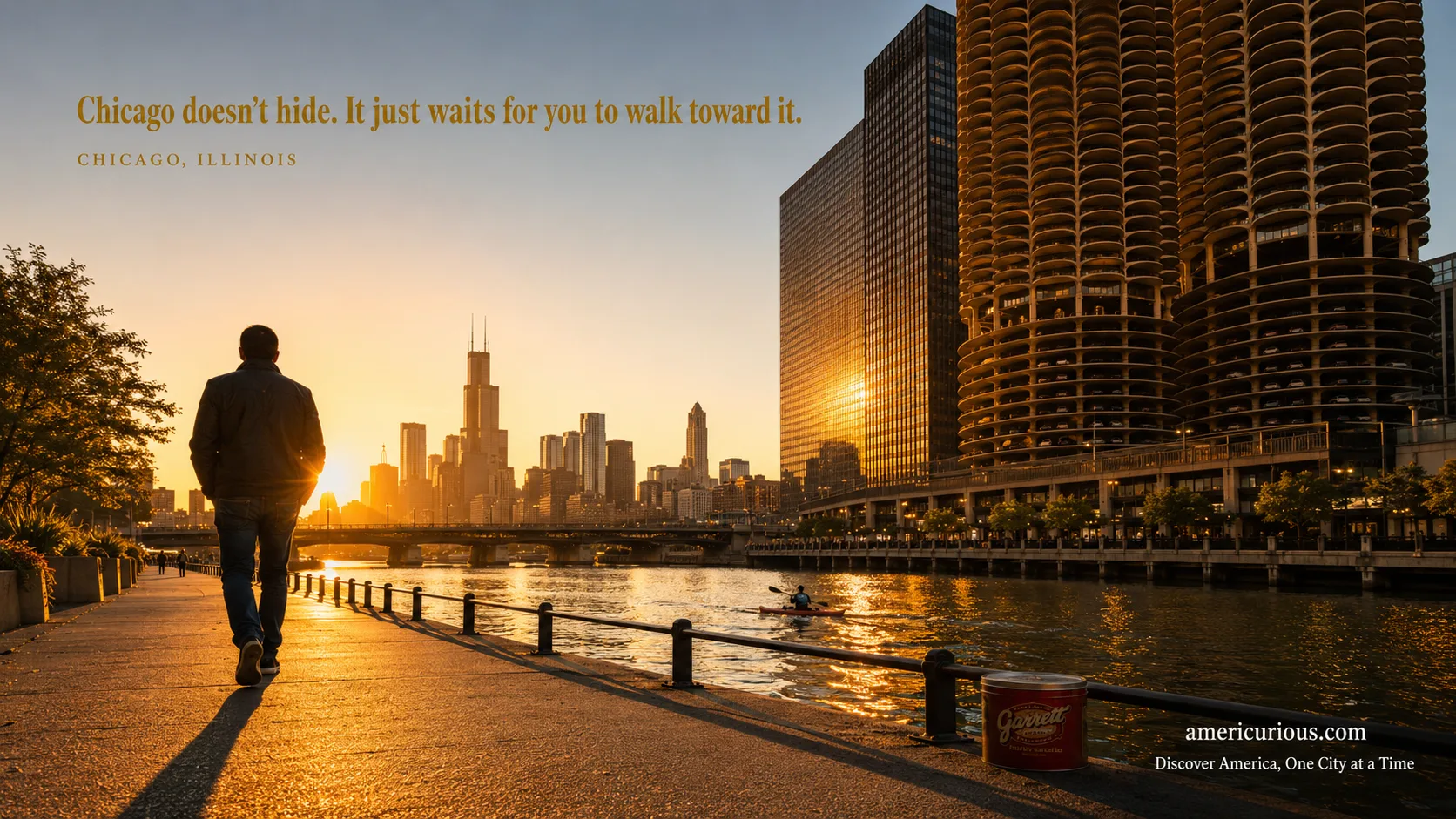
Lace up your gym shoes — this is Chicago’s ultimate walking route. A 4-mile, neighborhood-by-neighborhood guide from Gold Coast to Grant Park, covering the Magnificent Mile, Chicago Riverwalk, Millennium Park, and everything worth eating along the way.
A 4-mile love letter to the greatest lakefront city in America
Ope — you’ve arrived in Chicago. Welcome to the city where the architecture’ll knock your hat off, the lake’ll take your breath away, and the deep dish’ll take your diet hostage.
Here’s the thing about Chicago that visitors miss every single time: they take an Uber when they should be walking. This city was built to be walked. The grid is intuitive, the lakefront is on your doorstep, and every block on Michigan Avenue is basically a free open-air architecture museum. No museum ticket required. Just a good pair of gym shoes and a willingness to put the phone in your pocket every now and then.
This is that walk. Four miles. Five neighborhoods. One iconic arc from the edge of Lake Michigan all the way to the grandest fountain in America. Whether you’re a first-timer or a born-and-raised Chicagoan doing a proper tourist lap of your own city — this one’s for you.
The Basics Before You Step Outside
Start: Oak Street Beach, 1000 N Lake Shore Drive
End: Buckingham Fountain, 301 S Columbus Drive, Grant Park
Total Distance: ~4 miles
Walking Time: 1.5–2 hours of active walking
Total Time (all stops, food, photos): 5–6 hours — plan a full day
Terrain: Completely flat. Fully paved. Entirely accessible.
Best Starting Time: 9:00 AM — beat the tourist rush on the Mag Mile, get the morning light on the lake, and have a table at Gino’s before the lunch line forms.
Route Map
Stop 1: Oak Street Beach — The City Says Hello
Where: 1000 N Lake Shore Drive | Time here: 20 minutes
Before you even think about turning south onto Michigan Avenue, stand here for a second and just look.
Oak Street Beach is rated 4.8/5 by tens of thousands of visitors, and it deserves every star. This is the walk’s opening argument — a freshwater beach with the entire Chicago skyline rising directly behind the sand. No salt, no surf, no ocean vibe — just cold, impossibly clear water and one of the most dramatic urban skylines on the planet framing it from behind.
There’s an underground pedestrian tunnel that connects the beach to the Gold Coast sidewalk, which is extremely Chicago — the city just casually built a tunnel under Lake Shore Drive like it was nothing. Classic “I Will City” energy.
Get your photos. Take the deep breath. Then turn south.
Stop 2: The Magnificent Mile — Chicago’s Most Famous Walk Before This Walk
Where: Michigan Avenue, Chicago River to Oak Street | Distance: 0.9 miles | Time here: 30–45 minutes
The Magnificent Mile — or “the Mag Mile” to every Chicagoan who’s ever said it — is arguably the most beautiful commercial street in the United States. And yes, we know New York has Fifth Avenue. We also know the Bean exists and they don’t, so let’s move on.
The Mag Mile is a 13-block stretch of Michigan Avenue containing 460+ stores, 275 restaurants, 60 hotels, and a combined 3.1 million square feet of retail space — all lining one of the most architecturally diverse avenues in the world. It draws over 22 million visitors a year. In 2025 and into 2026, it’s been on a comeback arc with major new openings including the world’s third Harry Potter flagship store at 676 N. Michigan Ave., an Aritzia flagship, and Uniqlo — vacancy on the avenue has dropped below 25%, the best it’s been in years.
Walk south and keep your chin up — literally. The architecture is the show.
What to look for as you walk:
Tribune Tower at 435 N. Michigan is a Neo-Gothic marvel completed in 1925, with gargoyles, pointed arches, and — this is the best part — chunks of famous buildings embedded in its base. Pieces of the Parthenon, the Berlin Wall, the Taj Mahal, and the moon are literally built into the lower walls. Go look. Run your hand along them.
The Wrigley Building at 400 N. Michigan is the glowing white anchor at the foot of the Mag Mile. Completed in 1924, faced entirely in white terra cotta, it was designed to be visible from miles away — and it is, especially at night when it’s lit up against the river.
At 875 N. Michigan, 360 CHICAGO offers a 360-degree view from the 94th floor of the former John Hancock Center — and a glass-floored “TILT” experience for those who need a little adrenaline with their architecture. Adults from $28; book ahead, especially in summer.
The Chicago Water Tower at 806 N. Michigan is one of the only structures that survived the Great Chicago Fire of 1871 — which burned for two days in October of that year and leveled nearly 3.5 square miles of the city. Standing here, you’re looking at a building that survived a catastrophe that killed 300 people and left 100,000 homeless. It now houses a free public art gallery. Walk in for a second.
Snack Break #1: Garrett Popcorn — The Smell Will Find You First
Where: 173 N Michigan Ave | Cost: ~$7–12 per bag | Don’t skip this.
You’ll smell Garrett Popcorn before you see it. That intoxicating mixture of warm caramel and sharp cheddar drifting out onto Michigan Avenue is not an accident — it’s been doing that since 1949. Order the Garrett Mix. That’s the signature combo of caramelcrisp and cheesecorn in one bag, and yes, it sounds weird and yes, it’s one of the best things you’ll eat in Chicago. The tins also make a genuinely good souvenir that doesn’t scream “tourist trap.”
Stop 3: The DuSable Bridge — Where Chicago Begins
Where: Michigan Avenue at the Chicago River | Time here: 10 minutes
Pause at the DuSable Bridge — the double-deck bascule bridge at the foot of the Mag Mile — and look at the bas-relief sculptures on the bridge towers. They tell the story of early Chicago, including Jean Baptiste Point DuSable, a Black fur trader of Haitian descent who established the first permanent settlement near the mouth of the Chicago River in the 1780s. The bridge was renamed in his honor in 2010, recognizing Chicago’s actual founding story. It’s a quiet, powerful moment most people walk right past.
This is also the moment you should look west along the river. You’ll see Marina City — the famous “corncob towers” from the Wilco album cover, completed in 1964 — and the Trump Tower, and a canyon of skyscrapers lining both banks. Take the photo. Then descend the stairs.
Chicago Grand Walk: Oak Street Beach → Buckingham Fountain
| Place | Time | Notes | Address | Map |
|---|---|---|---|---|
| Oak Street Beach (START) | 9:00 AM | Your first taste of Lake Michigan with the entire Chicago skyline as a backdrop. This is where Gold Coast meets the water. | Open | |
| The Wrigley Building / DuSable Bridge | 9:30 AM | The official southern gateway of the Magnificent Mile. Stop here for the iconic view of the river framed by Tribune Tower and the Wrigley Building’s gleaming white terra cotta. | Open | |
| Gino’s East — Deep Dish Pit Stop | 12:00 PM | One block off the Mag Mile. A Chicago institution since 1966 — deep dish takes 45 minutes to cook, so order early and settle in. The walls are covered in decades of patron graffiti. | Open | |
| Chicago Riverwalk (Water Plaza) | 1:45 PM | Descend from street level at Michigan Ave & Wacker Dr. Walk the 1.25-mile promenade west, with boat tours, kayak rentals, riverside bars, and unobstructed views of the canyon-like skyline. | Open | |
| Garrett Popcorn — Michigan Ave | 3:00 PM | A Chicago snack rite of passage. Get the ‘Garrett Mix’ — cheddar and caramel together. You’ll smell it from half a block away. | Open | |
| Cloud Gate (The Bean) — Millennium Park | 3:30 PM | The 24.5-acre rooftop park above a parking garage. Walk under The Bean, catch the Crown Fountain, and catch a free show at the Jay Pritzker Pavilion if timing allows. | Open | |
| Buckingham Fountain, Grant Park (END) | 4:30 PM | One of the world’s great urban fountains. Dedicated in 1927, inspired by Versailles. The hourly water display runs May–October. Stay for the evening light show if you can. | Open |
Stop 4: The Chicago Riverwalk — The City’s “Second Lakefront”
Where: South bank of the Chicago River, Michigan Ave to Lake Street | Distance: 1.25 miles | Time here: 60–90 minutes
Down the stairs on the southeast corner of the DuSable Bridge and you’re in a completely different Chicago. The street noise disappears. The river is right there. The buildings rise around you in a canyon, and suddenly you’re walking through one of the most architecturally stunning corridors in any American city at eye level.
The Chicago Riverwalk is 1.25 miles long, runs along the south bank of the Chicago River from Lake Shore Drive to Lake Street, and is entirely free to walk. Hours are 6 AM to 11 PM. On weekends in summer it buzzes — on a weekday morning, it’s blissfully quiet.
The Riverwalk is organized into six distinct “rooms,” each with its own character. Moving west from Michigan Avenue: the Civic District (boat tour docks, the McCormick Bridgehouse & Chicago River Museum — worth a stop to watch the massive bridge gears up close), then the Marina Plaza (restaurants, outdoor seating, the best views of Marina City), the Cove (kayak rentals, human-powered watercraft), the River Theater (an amphitheater carved into the riverbank), the Water Plaza (a zero-depth splash area, good for kids and hot days), and the Jetty and Boardwalk sections as you approach Lake Street.
Pro tip: Walk the Riverwalk west to the midpoint (around State Street), then work your way back east rather than going the full length — this keeps your legs fresh for Millennium Park. Alternatively, if the weather is perfect and you’re feeling ambitious, do the whole mile-and-a-quarter and exit at State Street back up to street level.
Lunch Stop: Gino’s East — Chicago’s Most Graffiti-Covered Deep Dish Institution
Where: 162 E Superior St, one block off the Mag Mile | Open: 11 AM–9 PM Mon–Thu & Sun, until 10 PM Fri–Sat | Cost: ~$22–30 for a small deep dish
This is not a debate. You’re eating deep dish.
Gino’s East has been at it since 1966, when two cab drivers and a friend opened the original location one block off the Magnificent Mile. The interior walls are covered floor to ceiling in decades of patron graffiti — signatures, declarations of love, birthday wishes, restaurant recommendations from 1987. You get a Sharpie with your order if you want to add to the legend.
Order the Gino’s Supreme: sausage, peppers, onions, mushrooms, and giardiniera. A reminder: in a Chicago deep dish, the cheese goes on the bottom, toppings go in the middle, and the chunky tomato sauce goes on top. This is law. Deep dish pizzas take about 45 minutes to cook — order immediately upon being seated and thank yourself later. Get the antipasti salad to start; it’s better than it sounds.
One Chicago food law to note on the side: a Chicago-style hot dog is an all-beef frank in a steamed poppy seed bun, topped with yellow mustard, relish, chopped onions, sliced tomatoes, sport peppers, a pickle spear, and celery salt. You do not put ketchup on it. This is not a preference. This is a covenant.
Stop 5: Millennium Park — Bean There, Done That (But Actually Go)
Where: 201 E Randolph St (enter from Michigan Ave) | Admission: Free | Open: 6 AM–11 PM daily | Time here: 45–60 minutes
Exit the Riverwalk at Wacker and Michigan, walk south on Michigan Avenue about four blocks, and you’re at the entrance to Millennium Park — a 24.5-acre public park built on a rooftop over a parking garage and railroad tracks, attracting more than 4 million visitors every year.
Cloud Gate — aka “The Bean” — was created by Indian-born British artist Anish Kapoor and is made from 168 polished stainless steel plates welded seamlessly together, weighing 110 tons. Walk underneath it. The omphalos (the concave underside) distorts your reflection in genuinely disorienting ways. Rated 4.7/5 with nearly 39,000 Google reviews. Yes, people still have opinions about it. No, that doesn’t stop it from being magnificent.
The Jay Pritzker Pavilion, designed by Frank Gehry, is the park’s concert stage — a 120-foot stainless steel headdress with a steel trellis extending over the 10-acre Great Lawn that carries the sound system above the audience. Free concerts run here all summer through the Grant Park Music Festival. If you happen to be here on a Tuesday or Monday night in July or August — check the schedule. Sitting on the lawn with the skyline lit up behind the stage is one of Chicago’s great free pleasures.
Crown Fountain — two 50-foot glass-block towers flanking a shallow black granite reflecting pool — projects the faces of 1,000 different Chicagoans and periodically streams water from the mouth of whichever face is displayed. Kids go absolutely feral for it. Adults pretend they wouldn’t stand in it if it were socially acceptable.
From Millennium Park, cross the BP Pedestrian Bridge (also a Gehry design, a twisting stainless steel walkway) to Maggie Daley Park if you have kids in tow — the climbing walls and seasonal skating ribbon are genuinely excellent.
The Home Stretch: Grant Park and Buckingham Fountain
Where: 301 S Columbus Drive | Fountain season: May–October | Time here: 20–30 minutes
Head south through Grant Park — established in 1844 as “Chicago’s front lawn” — and you’ll pass the eastern edge of the Art Institute of Chicago on your left (one of the world’s great art museums; dedicated tickets start at $25 for adults, free for Chicago residents under 14 and all CPS students). The Art Institute’s two bronze lion sculptures at the Michigan Avenue entrance have been Chicagoans’ favorite sports mascot stand-ins since 1894.
Then: Buckingham Fountain.
The Clarence F. Buckingham Memorial Fountain was dedicated in 1927, funded by philanthropist Kate Sturges Buckingham in memory of her brother. It was inspired by the Latona Fountain at the Palace of Versailles. At 280 feet in diameter, with 134 jets capable of shooting water up to 150 feet into the air, it was one of the largest fountains in the world when it was built — and it’s still one of the most impressive in the United States. The four seahorse groupings symbolize the four states bordering Lake Michigan: Illinois, Wisconsin, Indiana, and Michigan.
The water display runs from mid-April to mid-October, every hour on the hour from 8 AM to 11 PM. After dark, a choreographed light, water, and music show runs nightly. If you time your walk to arrive here at dusk and catch the evening show with the lit-up Chicago skyline behind it — you’ve done this city right.
Sit on the edge, take your shoes off (metaphorically — it’s a fountain, not a wading pool), and just be here for a few minutes. You’ve walked four miles through one of the most alive, walkable, genuinely human-scaled stretches of American urban landscape. You earned the rest.
Drink Stop You Earned: City Winery Riverwalk
Where: 11 W Riverwalk South (if you want to end with wine instead of fountain — a legitimate choice) | Open: May–October seasonally
If you’d rather end the day with a glass of rosé watching boats on the Chicago River than standing by a fountain — and look, no judgment, it’s Chicago — backtrack slightly to City Winery’s Riverwalk wine garden. Riverside patio, retractable glass panels for breezy days, their own wines on tap, live music, lamb meatballs with tzatziki. They also run heated River Dome igloos through November — reservable, see-through dining pods right on the riverfront. Very “only in Chicago.”
The Practical Stuff (Don’t Skip This Section)
Getting there: Take the CTA Red Line to the Chicago/State stop (800 N State St) — a 5-minute walk to the Mag Mile’s north end. Or the Metra Electric or South Shore Line to Millennium Station to start from the south. Every segment of this walk is within a few blocks of multiple CTA “L” stops. No rental car needed. No Lyft needed. That’s the whole point.
Parking: Millennium Garages under the park can be reserved in advance via SpotHero.
CTA single ride: $2.50. A 1-day unlimited pass is $5. Worth it even just for peace of mind on the commute in.
Best time of year: Late September is the single best date. Temperatures hover around 65–72°F, the summer crowds have thinned, Riverwalk restaurants and boat tours are still running, and the fall light on Michigan Avenue is genuinely beautiful. May is the strong second choice — spring flowers on the Mag Mile, lighter crowds, and the city humming back to life after winter.
Avoid: Deep summer weekends if you hate crowds. January and February if you enjoy having a face.
Rainy day version: The Art Institute (on the route), the Chicago Architecture Center (just off the Riverwalk at Illinois Center), and the Chicago Cultural Center (free, incredible Tiffany glass dome, one block from Millennium Park) are all world-class indoor options along or adjacent to this walk.
The Chicago Walk, Summarized
This is not a walk you take to get from Point A to Point B. This is a walk you take because Chicago deserves to be felt at street level — not seen from a cab window, not scrolled through on Instagram, not condensed into a two-hour bus tour. The city’s entire character — its architecture, its swagger, its weird love of giardiniera and opinions about ketchup — reveals itself to you step by step, block by block.
The Mag Mile will impress you. The Riverwalk will slow you down in the best possible way. The Bean will make you take seventeen more photos than you planned. And Buckingham Fountain — especially at night, especially with the skyline behind it — will make you understand why Chicagoans are the way they are about this place.
Sweet home Chicago. Lace up and get out there.
Route at a Glance: Oak Street Beach → The Magnificent Mile → DuSable Bridge → Chicago Riverwalk → Gino’s East → Millennium Park / Cloud Gate → Buckingham Fountain
Total distance: ~4 miles | Total time: 5–6 hours | Cost to walk: Free
Have you done this walk? Got a better deep dish rec? A Riverwalk bar we missed? Drop it in the comments — Chicagoans, be generous with the locals tips.