
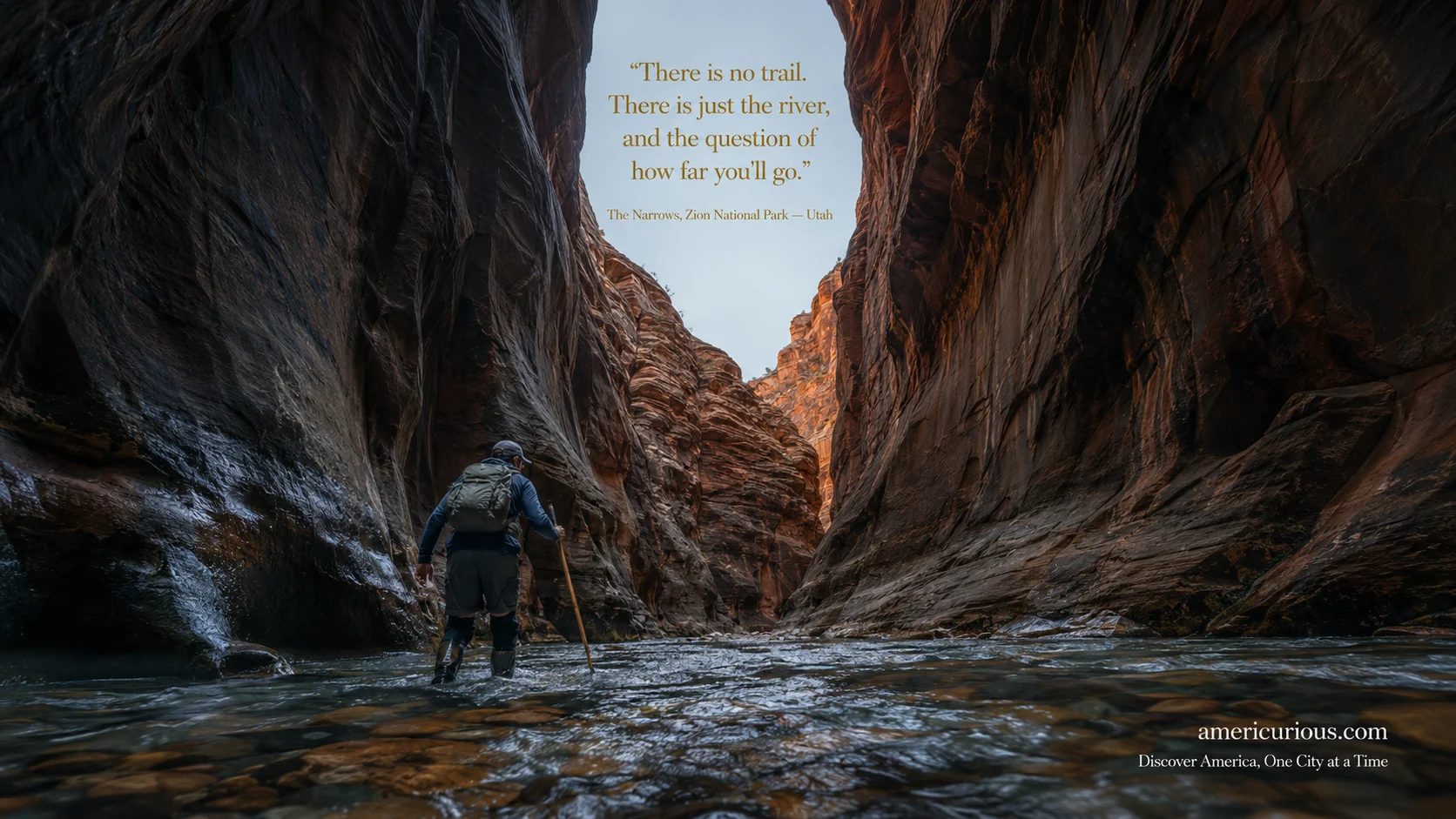
The Narrows at Zion National Park puts you inside the canyon, not above it. 2026 guide: permits, gear costs, flash flood tips, and the mile-2.5 secret most hikers miss.
The Lede: Forget the Rim. Go Inside.
Most Americans who talk about canyon hiking are describing the same experience: standing at the edge of something enormous and staring down. The Grand Canyon’s South Rim. Angels Landing’s famous chains trail. Bryce Canyon’s amphitheater. All spectacular. All fundamentally the same — you’re the viewer, the canyon is the painting, and you’re separated by a guardrail and a thousand feet of air.
The Narrows at Zion National Park breaks that formula entirely. Here, you don’t look at the canyon. You step into it. You wade upstream through the cold pull of the Virgin River with 1,000-foot walls of burnt-orange Navajo sandstone pressing in from both sides, sometimes just 20 feet apart overhead. There’s no trail. There’s no paved path. There’s just you, the current pushing back at your knees, and the slot canyon opening and tightening around you like the earth is breathing. It is, without question, the most physically immersive hike in the American Southwest — and in May 2026, it is open, permit-free for the bottom-up day hike, and still vastly underestimated by casual visitors who settle for Angels Landing and go home.
The Deep Context: How a River Carved a Cathedral
About a million years ago, Zion Canyon was only half as deep as it is today — and The Narrows, as we know it, had yet to form. What you’re walking through now is the result of the Virgin River systematically dismantling the Colorado Plateau, exploiting vertical joint fractures in the Navajo Sandstone to cut a slot canyon so narrow that sunlight only hits the water directly for a few minutes each day near the canyon floor. The landscape of Zion is experiencing a sustained rate of erosion — down-cutting 1,300 feet in the past 1 million years — meaning The Narrows is not finished. It is still being sculpted, which is both humbling and slightly unnerving when a flash flood warning siren echoes off those walls.
The human history of this gorge is just as gripping as the geology, and significantly less talked about. The Narrows got its name in 1872 from geologist and explorer Grove Karl Gilbert, who was part of the Wheeler Survey. His team traveled through the entire corridor on horseback, all the way from Navajo Lake to Zion Canyon and then to Springdale. That’s right — what is now a knee-deep wade through boulder fields was once a horseback route. From when Zion became a National Park in 1919, guided horseback tours through The Narrows continued well into the 1960s. The modern era of through-hiking the full 16-mile corridor only took hold in the late 1960s. So the experience most visitors consider the “classic” Narrows hike is, historically speaking, barely 60 years old.
The Secret Sequence: How to Do The Narrows Like a Local in 2026
Most visitors treat The Narrows like a casual river walk — rental shoes on, shuttle ridden, photo snapped at the first bend, turned around by 10 AM. That version is fine. But there’s a deeper read to this hike, and it requires a bit of strategy.
Step 1: Arrive at the Visitor Center by 6:30 AM. The shuttle fills ferociously fast. In summer, your day should start no later than 5:00 AM to be on the very first shuttle. Parking inside the park at the Visitor Center lot is free but typically gone by 7–9 AM on busy days. If you’re arriving during shuttle season (March 7 through November 28 in 2026), Springdale’s three-zone paid parking system operates from 6 AM to 5 PM daily, with Zone A nearest the park at $25, Zone B at $20, and Zone C on Lion Boulevard at $15. Zone C is your friend if you want to stretch your legs before the hike.
Step 2: Pick up gear the night before. Zion Outfitter allows equipment pickup from 3–6 PM the evening prior at no extra charge. Do this. The riverbed is like walking on greased bowling balls, and regular sneakers will not survive — this advice, reported repeatedly by recent visitors, is not hyperbole. The warm weather footwear package (river shoes, neoprene socks, trekking pole) runs about $32–33 per person. If you’re visiting in cooler months, the spring and fall dry bib package runs $59–65, and full dry suits cost $79–85 — worth every cent when water temperature is hovering near 50°F.
Step 3: Don’t turn around at the first bend. Most day-hikers stop at Mystery Falls, roughly a quarter mile in, snap a photo, and consider themselves done. Push to the 2.5-mile mark. That’s where Orderville Canyon opens on your right — a narrow side slot that most visitors walk right past. Slip into it even 50 feet and you’re in near-darkness, with water-sculpted walls so smooth they look machine-made. Beyond Orderville lies the Wall Street section, named for its sheer cliff walls, where the canyon squeezes to its most dramatic width and the sky becomes a thin ribbon of blue far above your head. This is the photograph. This is the moment.
Step 4: Check the flow gauge before you leave your car, not before you leave your house. Conditions change overnight. The Narrows closes when the Virgin River exceeds 150 cubic feet per second. The USGS gauge is live at waterdata.usgs.gov and takes 30 seconds to check. Rangers at the Visitor Center post the flash flood potential rating daily — look at the board before heading to the shuttle stop, not after.
Step 5: Be out of the canyon by noon. This applies especially May through September. Afternoon thunderstorms can roll in with little warning, and a storm miles away can send a wall of water through The Narrows in minutes. The canyon walls offer zero escape routes for long stretches. Locals who hike this repeatedly are always back at the shuttle stop by 12:30 PM. There’s no shame in it — there is genuine danger in ignoring it.
One additional heads-up that official brochures tend to bury: toxic cyanobacteria blooms in the Virgin River have been a recurring issue. The park officially advises hikers to avoid submerging in the water and not to drink it, even filtered. Hikers have continued to enjoy the route safely by following these guidelines, but this is not the kind of footnote you want to discover while you’re already waist-deep.
The May 2026 Logistics Block
Status: ✅ Verified Open (bottom-up day hike from Temple of Sinawava — no permit required). Top-down through-hike from Chamberlain’s Ranch requires a wilderness permit.
Price: Park entrance is $35 per private vehicle (covers 7 consecutive days). The popular bottom-up day hike from the Temple of Sinawava to Big Springs is free and requires no permit. The top-down through-hike from Chamberlain’s Ranch requires a wilderness permit at $6 plus $10 per person for a day hike, or $20 plus $7 per person per night for an overnight. The America the Beautiful Annual Pass ($80/year) covers the entrance fee and is worth it if you’re doing more than one national park this year.
Cyanobacteria Advisory: Active and ongoing — avoid submerging, don’t drink the water. Check nps.gov/zion for updated alerts before your visit.
Pro-Tip: Fill your gas tank in Hurricane, Utah on the way in — gas there runs about $3.38–$3.39 per gallon compared to $3.80–$4.20 at the single Shell station in Springdale, and there are no stations inside the park.
Reference Links
For everything from current water flow levels to permit booking, bookmark the official Zion National Park Narrows page at nps.gov — it’s updated in near real-time and far more reliable than any third-party booking site.
If The Narrows has your appetite for remote, genuinely wild American landscapes running hot, the same spirit of deep-wilderness immersion exists in coastal Alaska. The Americurious guide to Sitka, Alaska captures exactly that — a community where the terrain is the experience, not just the backdrop.
And if you find yourself drawn to hikes that require a bit of luck and a permit lottery alongside The Narrows, the Americurious guide to The Wave in Arizona is the natural next read — another Southwest slot-canyon landscape that rewards patience and planning in equal measure.
⚠️ Fact Audit Note: Parking prices, gear rental rates, and permit costs reflect verified March–May 2026 reporting from zion.travel and zionoutfitter.com. Flash flood conditions and cyanobacteria advisories are dynamic — always cross-reference with the live NPS alerts page at nps.gov/zion before your visit date. One logistical claim — that Springdale parking is “cash only” — could not be independently confirmed and has been omitted from this post pending verification.