
Discover what’s driving Princeton, Texas’s explosive 30.6% growth. Honest guide to housing costs, traffic, schools, and why families are moving here.
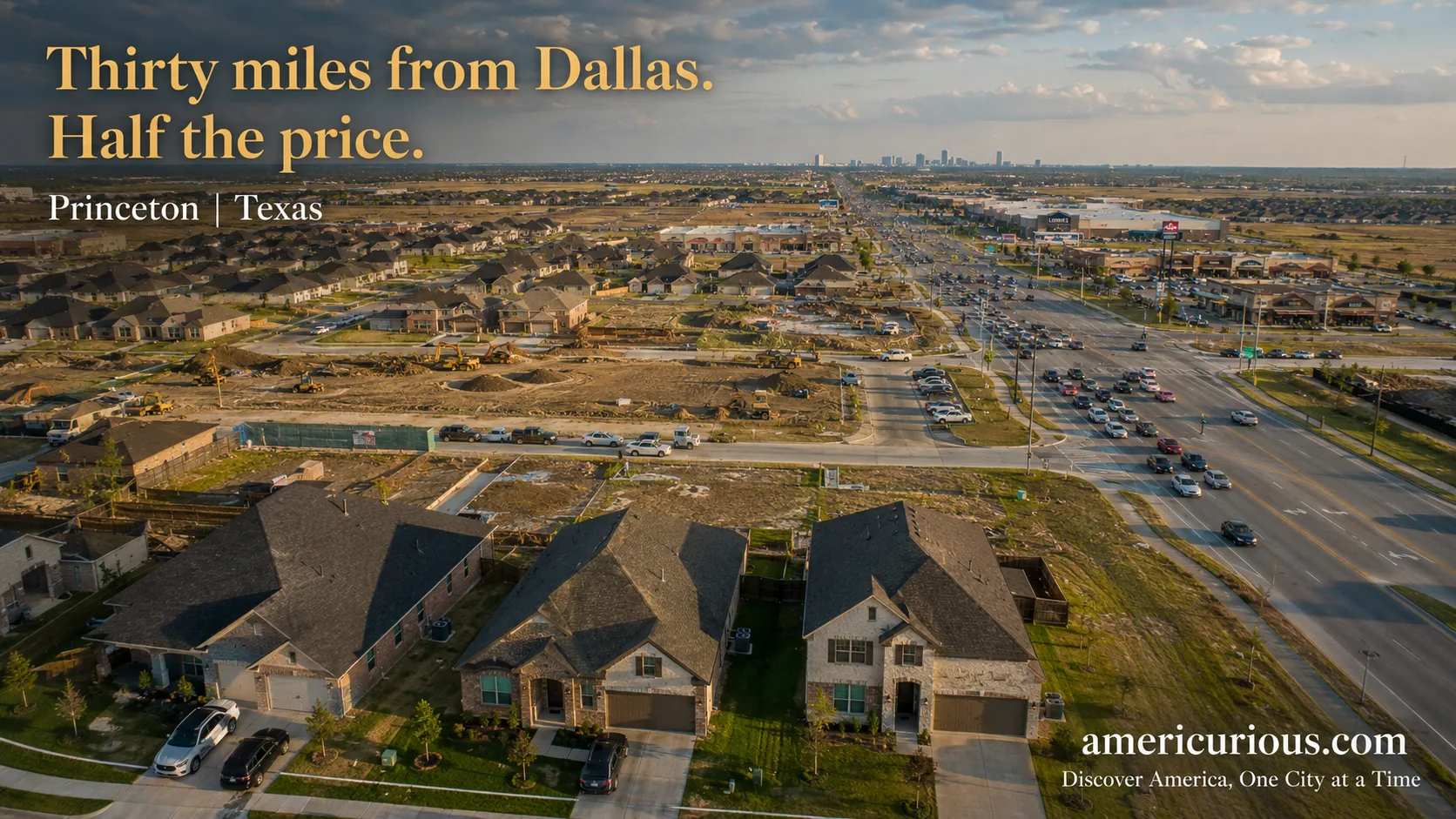
The traffic light at Highway 380 and Princeton Drive blinks through its cycle for the fourth time while the driver ahead of you debates whether to turn left or just keeps going. The Dunkin’ on the corner already has a line out to the access road. This is Princeton at rush hour—and if you’re new here, you need to understand exactly what you’ve signed up for.
Princeton, Texas is a city that doesn’t apologize for what it is: a rapidly expanding Collin County bedroom community where the infrastructure is racing to catch up with the people flowing in. It’s not yet a place with a distinguished downtown or cultural depth. What it is, is close to Dallas, cheaper than McKinney, and growing so fast the Census Bureau gave it an award. If you’re a young family priced out of Plano, a remote worker who wants square footage for what you’d pay for a Dallas closet, or someone who just needs to be near Collin County without the Collin County price tag, keep reading. This is the real breakdown.
Where It Actually Sits
Princeton sits in the northeastern corner of Collin County, sandwiched between McKinney to the west and the rural sprawl stretching north toward Farmersville. If you’re driving from Dallas, you’re coming up US-75 or the Sam Rayburn Tollway (SH-121), and it’s roughly 35 miles door to downtown Dallas on a good day—which rush hour isn’t. The city incorporated back in 1912 and was once known for onion farming, a fact the local Lions Club still honors with the annual Onion Festival. You can get the full municipal picture at the City of Princeton official website.
The Numbers That Tell the Real Story
Princeton just did something no city in America did: it grew by 30.6% in a single year, going from about 28,000 residents to over 37,000 between July 2023 and July 2024, per the U.S. Census Bureau. That’s not a rounding error. That’s a town that doubled in a few years. The Princeton EDC confirms the 37,019 figure and a 30.6% growth rate, making it officially the fastest-growing city in the country.
The dominant industries are healthcare and social assistance, education, and retail—standard suburb stuff. The Princeton EDC major employers page lists government, construction, and education as key sectors. The city landed three large companies at its new EDC Business Park: Texas Star Pharmaceuticals, Buff and Shine, and Princeton Storage. If you’re looking for job signals, the healthcare and logistics sectors are where it’s at.
What It’ll Actually Cost You
Here’s where it gets complicated. The Princeton EDC puts median home cost at $284,300, with a cost of living index of 97.5 (slightly below the national average). But check Zillow or Realtor.com right now and you’ll see active listings pushing higher—the market moved fast. Average 2BR rent runs around $1,647 per month according to RentHop data, though you can find smaller units cheaper and larger homes more. A dinner for two at a mid-range local spot like Jocy’s or Las Rocas will run you $35-45 before drinks. Overall, you’re paying Dallas-lite prices for a town that’s still figuring itself out—which is exactly the trade-off.
Who’s Hiring
The top employers are Princeton Independent School District, healthcare facilities, retail operations, and manufacturing. The city is drawing remote workers in waves, mostly because you’re getting 2,500 square feet instead of 1,200 for the same Dallas money, and the commute to major employment centers in Richardson or Plano is manageable if you time it right. The EDC is actively recruiting in logistics and light manufacturing. If you need a local job, the school district and healthcare are your safest bets.
The Neighborhood Breakdown
Bridgewater is the neighborhood people mention when they want to sound like they know Princeton. Master-planned with a community pool, playgrounds, and walking trails, it’s where you’ll find the newer construction and the families who’ve been here long enough to remember when it wasn’t the fastest-growing city in America.
Winchester Crossing sits in a similar vein—suburban, newer, decent lot sizes. It’s the part of Princeton that looks like what people imagine when they picture Texas suburb life.
Waterstone is for when you want the acre lots and the higher price tag. It’s pricier, which tells you something about the demand even in a town known for relative affordability.
The northwest parts of the city trend toward higher home prices and more established master-planned communities. The east side, particularly closer to Lake Lavon, has more affordable options and a slightly more rural feel. If you want to dig into neighborhood specifics, Knox Realtors has a breakdown that goes deeper than the Chamber of Commerce version.
The Food Scene
Look, Princeton isn’t going to make any foodie destination lists. But for a town this size, it’s got a few spots worth knowing.
Jocy’s Restaurant is the local Tex-Mex anchor. The enchiladas are what you’d expect, the fajitas sizzle when they hit the table, and it’s where you’ll see half the town on a Friday night. This is the place.
Las Rocas Mexican Cocina brings solid Mexican food in a casual setting. Good for when Jocy’s line is out the door.
For something different, Kub Kao Thai Restaurant has a devoted following—Thai in Princeton sounds unlikely, but the people who know, know.
Bombay Kitchen Indian Cuisine gets consistent praise for its consistency. When you need something other than Tex-Mex, this is your spot.
Scrambler Cafe Princeton covers the breakfast-and-lunch casual territory well. Locals recommend it without hesitation.
If you’re willing to drive the 15 minutes to McKinney, The Stix Icehouse is worth the trip—good food, solid vibe, actual outdoor space.
Getting Outside
Princeton itself isn’t exactly an outdoor destination. But it’s got more than you’d think. The city parks department maintains over six miles of hike and bike trails, and Sister Grove Park offers biking and hiking trails that draw people from surrounding towns. For anything more serious—longer trail runs, access to water, proper nature—you’re 15-20 minutes from Lake Lavon or Oak Point Park in Plano. The Erwin Park trail system in McKinney is also close enough for a weekend morning run. The honest version: Princeton is a launching pad for outdoor recreation, not a destination. But if you need to walk the dog on actual pavement without traffic, the city trail system will do.
What Makes It This City
The Princeton Onion Festival is the annual event that defines the community calendar. Run by the Lions Club, it’s been going for over two decades and centers on hometown pride, carnival games, bull riding, and the kind of small-town community event that feels increasingly rare as the population doubles. The city’s community events page lists seasonal gatherings throughout the year.
Beyond the Onion Festival, you’re looking at standard suburban community programming—park gatherings, holiday events, school functions. There’s no art house cinema or dedicated music venue. What you have is a community that’s still forming its identity, which means if you’re the type who wants to show up and shape that, the opportunity is genuinely there.
Schools and Families
The Princeton Independent School District covers 60 square miles and is the primary district serving the city. The GreatSchools ratings tell a mixed story: Harper Elementary and Clark Middle both score 8/10, Lowe Elementary scores 7/10, and Lovelady High School scores 7/10. Princeton High School sits at 4/10, which is below average. Niche ranks Princeton ISD as #12 in Best School Districts in Collin County with an overall grade of B+.
The district is growing as fast as the city, which means new schools are in various stages of planning and construction. If school quality is your non-negotiable, you should be looking at the boundary maps carefully before you buy— Lovelady and Harper zones are generally where the higher-rated schools are concentrated. Families like the district because it’s smaller and more personal than some of the massive Collin County districts, even if the ratings don’t always reflect that.
Safety: The Honest Version
Princeton gets a B grade from CrimeGrade.org, placing it in the 64th percentile for safety. NeighborhoodScout’s data puts your chance of being a victim of violent crime at 1 in 507—better than the national average. Property crime is 1 in 165. Niche’s safety statistics show assault, murder, rape, and robbery rates all below national averages.
The newer subdivisions tend to report the fewest incidents. The areas around the older established neighborhoods and the eastern parts of the city see slightly more property crime, which is typical for any growing suburb. As with any city, there’s variation block by block— Princeton’s not uniformly safe or unsafe, but the overall numbers are favorable compared to similar-sized Texas cities.
Weather: Truth in Advertising
Summers in Princeton are no joke. The temperature ranges from 35°F in January to 95°F in July, per WeatherSpark’s climate data. Humidity makes the 95°F feel like 105°F from roughly June through September. You will sweat walking to your car. You will run the air conditioning from May to October and wonder why your electric bill is what it is.
Winters are mild by most standards—snow is rare, maybe an inch if that. January lows around 35-40°F mean you need a jacket but not a parka. Annual precipitation sits around 39 inches according to BestPlaces, which is slightly above the national average. Spring brings the kind of severe weather you’d expect from North Texas: thunderstorms, occasional tornado risk, and that specific anxiety of watching weather apps in April and May. If you’ve lived in Dallas proper, none of this surprises you. If you’re coming from somewhere with actual winters, trade your snow shovel for a weather radio and get used to “marginal risk” being your default summer outlook.
Getting Around
Princeton has a Walk Score in the 35-67 range depending on which neighborhood you’re in, but the city-level score of 67 is generous—some errands can be done on foot, most cannot. Transit options are essentially nonexistent. This is car country, through and through.
Commuting to Dallas or Plano means timing matters. SH-121 and US-75 are your arteries, and 380 is the main artery through Princeton itself. The drive to Richardson or Plano is 25-35 minutes outside of rush hour and 45-60 minutes during it. The DFW Airport is roughly 35-40 minutes away, and Dallas Love Field is about the same distance. McKinney National Airport is closer and is transitioning to commercial service, though for now it serves general aviation. If you work remote, this geography is fine. If you commute to Dallas five days a week, factor that drive into your quality-of-life calculation honestly.
Real Talk From People Who Live There
Ask someone who’s lived here a year and they’ll tell you the traffic is worse than they expected. The growth came fast, and the roads didn’t keep up. Highway 380 through Princeton is perpetually under construction and perpetually congested.
They’ll also tell you the home appreciation is real. People who bought two years ago are sitting on significant equity. That’s the flip side of the growth story.
The common themes in resident discussions on Reddit and local forums: the school district is fine but not exceptional, the parks system is better than they anticipated, and the food scene is improving but still limited. People who moved for the affordability relative to McKinney or Plano tend to feel they got a fair deal. People who expected Princeton to feel like an established suburb feel like something’s always under construction—which, literally, it is.
The Honest Trade-Off
Princeton’s genuine strengths are real: housing costs that are accessible compared to the rest of Collin County, strong population growth that signals investment and infrastructure development, proximity to major employment centers without the full Collin County price tag, and a crime rate that sits comfortably below national averages. The city landed on the Census Bureau’s fastest-growing list for legitimate reasons—people are choosing it, and the EDC is actively working to attract jobs alongside residents.
The drawbacks are equally real and specific: the traffic situation on 380 and through the main interchange is a daily frustration that won’t resolve overnight, the school district ratings are inconsistent (with Princeton High School notably underperforming), the food and cultural scene is limited, and the city’s identity is still being formed—which means some amenities you’d expect from a city of 37,000 simply don’t exist yet. You’re also rolling the dice on infrastructure investments catching up to population growth.
So Who’s This Place Actually For?
If you’re a young family or remote worker looking for maximum square footage and affordability within daily driving distance of major DFW employment centers, Princeton is genuinely built for you. The research shows a city that’s attracting exactly this demographic—people priced out of closer suburbs, people who want space for the money, people willing to tolerate some growing pains for the value proposition.
If you need walkable neighborhoods, diverse dining and nightlife options, transit access, or schools that consistently rank in the top tier, Princeton will frustrate you. The city is solving for a different set of priorities right now.
The trajectory is clear: Princeton is heading toward 50,000 residents within a few years. The question is whether the infrastructure, amenities, and services scale with it. Right now, the bet on Princeton is a bet on potential—and that’s exactly what it is, a bet. The people who thrive there will be the ones who understood what they were signing up for from day one.