
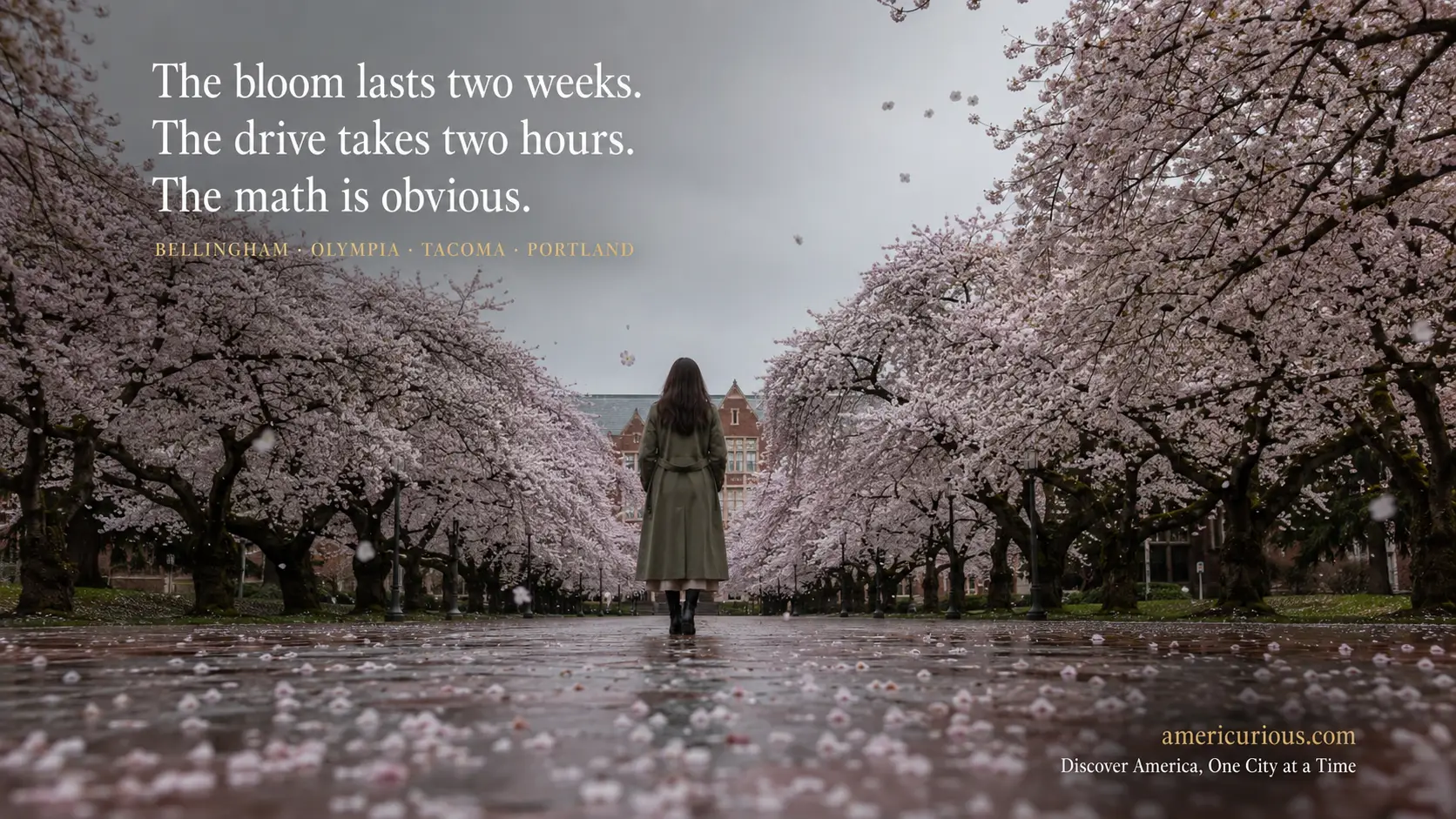
Skip the UW Quad crowds this spring. These four Pacific Northwest cherry blossom spots — from Bellingham to Portland — offer the same bloom, zero selfie sticks.
Tags: cherry blossoms Pacific Northwest, spring travel Washington State, Oregon cherry blossoms, Bellingham spring, Olympia cherry blossoms
The spring window runs from late March through early May across the PNW — here’s where to find it without a crowd.
The Quad Is Wonderful. You Already Know That. Let’s Talk About Somewhere Else.
The University of Washington’s cherry blossom season is genuinely beautiful. Twenty-nine Yoshino trees — genetic clones, all of them, which is why they bloom as one synchronized wave rather than a staggered trickle — arch over the brick walkways of the central Quad in late March and produce one of the most photographed scenes in the Pacific Northwest. On a clear morning, with the tower of Suzzallo Library rising at the far end, it looks exactly like the photos. The problem is the photos. The UW now publishes a live bloom webcam and real-time peak predictions at washington.edu/cherryblossoms, and that infrastructure — as thoughtful as it is — functions like a starter pistol for crowds. By the third week of March, you’re navigating photo shoots, bloom-watch news segments, and a wait for parking that can stretch 45 minutes on a weekend morning.
None of that is a reason to skip the Quad. It’s a reason to know about everything else.
The Pacific Northwest’s spring bloom runs along a 265-mile corridor from Bellingham to Portland, and much of it unfolds without a single news crew present. What follows are four places where you can stand under a canopy of pink petals in late March or April and, if you want, hear them fall.
🌸 Bellingham, Washington — The Other Campus, 90 Miles North
Most people driving to Bellingham for a weekend are heading toward the San Juan Islands ferry, the Chuckanut Drive, or Mount Baker. Almost none of them stop at Western Washington University’s main campus — which is precisely why, in late March and early April, the cherry trees near WWU’s central quad and along the walkways by Old Main feel like something a friend tipped you off about rather than a destination.
The bloom here typically runs late March to early April, roughly in sync with Seattle’s Yoshino trees. On a sunny morning, petals catch the angle of light coming off Bellingham Bay and drift across the grassy areas between the old brick buildings — the same quiet, late-morning drift you might get at the UW Quad at 6 a.m., except here it lasts until noon without the crowd catching up to you.
After the campus walk, drop down to Boulevard Park on Bayview Drive (open 6 a.m. to 10 p.m., free), where a small stand of cherry trees sits above the water. Pick up a coffee from Woods Coffee, which has a location right at the park, and walk the waterfront path along Bellingham Bay while the cherries bloom behind you and the North Cascades are still white in the distance.
One detail worth holding: Bellingham was formed by the 1903 merger of four separate towns — Whatcom, Sehome, Bellingham, and Fairhaven — and the city’s old-neighborhood streets still carry that layered, slightly-different-grid quality. A walk down State Street or Magnolia in the downtown core turns up cherry trees framed by historic storefronts, the kind of incidental beauty that no park guide maps and no bloom tracker predicts.
Practical note: Bellingham is 90 miles north of Seattle on I-5. No fees or reservations required at WWU or Boulevard Park. Bloom watch for Bellingham does not have an official tracker — watch Seattle’s UW bloom predictions as a leading indicator, and plan for Bellingham to follow within roughly the same window.
🌸 Olympia, Washington — A Capitol Lawn That’s Been Doing This for Nearly 100 Years
There is something almost absurd about the fact that the Washington State Capitol campus has a two-species cherry blossom program that extends the bloom window into May, and yet most spring travel lists don’t mention it. The campus offers two waves: the Yoshino cherry trees, which bloom first in late March with pale pink-to-white flowers in a grove south of the Legislative Building, and the Kwanzan trees along Cherry Lane — the street just east of the building — which follow one to two weeks later with flowers that are a deeper, more saturated pink.
The Kwanzan trees on Cherry Lane were planted in 1932, four years after the Legislative Building’s completion. The Yoshino grove came later, gifted by a Japanese businessman in 1984 to honor the state’s close relationship with Japan. The Department of Enterprise Services prunes both sets annually. This is not a garden maintained for tourism; it is a working state campus that happens to have nearly a century of cherry tree cultivation written into its bones.
The official Capitol Campus Bloom Watch page is updated with photos during the season and is the most reliable way to time a visit. Access is free. Parking is available on campus. For 2026, the Yoshino trees began blooming in late March and the Kwanzan trees are expected through mid-April to early May.
What most visitors miss: If the building is open, walk inside. The Legislative Building’s interior — with its domed rotunda and the State Reception Room — is worth twenty minutes on its own. It was designed by the same architects as the Pennsylvania State Capitol, and standing beneath the dome with cherry blossom light coming through the windows is one of those accidental combinations that makes a trip feel larger than what you planned.
Practical note: Olympia is about 60 miles south of Seattle on I-5, roughly an hour’s drive. No fees or reservations. Check capitol.wa.gov for current-season bloom updates.
🌸 Tacoma, Washington — A Japanese Garden That Was a Gift From 6,000 Miles Away
The Japanese Garden at Point Defiance Park sits on a bluff above Puget Sound inside a 700-acre park, and it came into being through one of the stranger diplomatic gestures in Pacific Northwest history. In 1959, the Consul General of Japan and the city of Kitakyushu — Tacoma’s sister city — gave cherry trees to the garden as part of an ongoing exchange between the two cities. A stone shrine, originally gifted by Kokura/Kitakyushu in 1961, still stands in the garden. As of 2026, Parks Tacoma is working with Kitakyushu on a new shrine and an updated garden design reflective of Japanese landscaping traditions — so what you see this spring may look somewhat different in future years.
The garden is free and accessible from the park’s visitor center, and the cherry trees bloom in roughly the same late-March-to-early-April window as the rest of Western Washington. After the garden, walk the Point Defiance road loop — the park has 5 miles of forest roads winding through old-growth Douglas fir — or, if you want a second helping of cherry trees, walk or drive to North Proctor Street near the University of Puget Sound campus, from Sixth Avenue to North 21st, where neighborhood trees line the sidewalks above a block of cafes and independent shops. That walk feels nothing like a park — it feels like borrowing someone’s spring afternoon.
Practical note: Point Defiance Park is at 5400 N. Pearl St., Tacoma, about 35 miles south of Seattle. The park is free and open year-round. Parking is free throughout the park. No reservations required.
🌸 Portland, Oregon — 100 Trees and the Weight of the Story Behind Them
The Japanese American Historical Plaza at the north end of Tom McCall Waterfront Park doesn’t look like a typical cherry blossom destination, and that’s because it isn’t one. One hundred Akebono cherry trees line a stretch of park between the Burnside and Steel bridges along the Willamette River. The trees were donated in 1990 by the Japanese Grain Traders Import Association to mark the dedication of the Plaza, which was designed by landscape architect Robert Murase — himself a third-generation Japanese American — to tell the story of Japanese immigrants in Oregon and the forced incarceration of Japanese Americans during World War II. The site features thirteen engraved stones of basalt and granite, carrying poetry by Hisako Saito, Lawson Inada, and others, and it sits in the neighborhood once known as Nihomachi — Portland’s Japantown — where many of the families whose stories are carved into those stones once lived and worked before the war.
Standing under the Akebono trees in full bloom while reading those stones is a different experience than standing under almost any other cherry canopy in the Pacific Northwest. The beauty is not incidental. It was placed here deliberately, as a form of witness.
Peak bloom runs mid-March through early April in most years, and 2026 was no exception — the trees hit their peak around the third week of March. The Japanese American Museum of Oregon offers guided tours during bloom season, and in 2026 ran a cherry blossom bazaar on the weekend of April 10–12. Several nearby Old Town institutions — including the museum, Lan Su Chinese Garden, and the Portland Chinatown Museum — offer BOGO admission during the bloom season when you show a selfie with the blossoms. Portland Saturday Market, the oldest continuously operating outdoor arts and crafts market in the country, kicks off its season in March and runs adjacent to the park every weekend through December.
Practical note: The Plaza is free and open year-round. Portland is approximately 175 miles south of Seattle — a 3-hour drive. No permits or reservations required at the park. For guided tour availability, check jamo.org.
Plan Your Trip 🗓️
Optimal timing window:
The Yoshino and Akebono trees across the PNW corridor typically peak between the third week of March and the second week of April. Bellingham, Olympia, and Tacoma generally track with Seattle’s late-March window. Portland, further south, often blooms a few days earlier. Olympia’s Kwanzan trees on Cherry Lane can run through mid-April to early May, providing a secondary window if you miss the Yoshino peak.
What to book ahead:
No admission reservations are required at any of the four destinations listed here. However, if you plan to stay overnight in Portland, Tacoma, or Bellingham during peak bloom weekends in late March, book accommodations at least three to four weeks out — spring weekends fill quickly. For Tacoma, consider a stay at the Hotel Murano downtown, a local independent hotel built around a rotating collection of Pacific Northwest glass art.
What most visitors forget:
A waterproof layer with a hood — not just a rain shell but something with a hood, because a PNW drizzle during peak bloom turns a jacket into a hood-up or a ruined afternoon. Also: the best cherry blossom light is overcast-sky diffused light, not direct sun. A gray morning in Olympia will photograph better than a bright noon in Seattle.
Where to eat:
In Bellingham, Camber Coffee on Cornwall Avenue is the local roaster of choice — sit-in or takeout, and worth starting the day there before heading to WWU. In Olympia, Gardner’s Restaurant on 4th Avenue has been a local institution since 1973 and does a proper Pacific Northwest breakfast. In Tacoma, Red Hot on North Proctor Street — a block from the cherry-lined UPS campus walk — is the local counter-service spot for post-walk lunch. In Portland, the Luce wine bar in Old Town, two blocks from the waterfront Plaza, pours a thoughtful Oregon Pinot and opens for lunch on weekends.
Permits and fees:
None required at any of the four destinations in this guide. All access is free. Point Defiance Park in Tacoma has free parking throughout. The Washington State Capitol campus has free public parking.
The Thing About Coming Back Every Year
Cherry blossom season has a faintly irrational pull — rational people rearrange travel schedules around a two-week window for flowers that will be gone before the month is out. But there’s a word for what they’re really chasing, and it isn’t the flowers. The Japanese call it mono no aware, loosely translated as the bittersweet awareness that beautiful things don’t last, and that their impermanence is part of what makes them beautiful. The Pacific Northwest version of this is watching petals on Bellingham Bay water, or reading a carved stone under a Portland cherry tree while the blossoms fall on the name of someone who was forced from this exact block eighty years ago. These aren’t just pretty trees. They’re the ones a city put here on purpose, in the spring, so people would slow down and feel something. That’s worth a three-hour drive. That’s worth coming back for.
📋 Note:
Four facts in this post will require verification before each spring reissue.
First, the Olympia Capitol Campus bloom window should be re-confirmed each February at capitol.wa.gov/our-story/news-updates/plan-your-visit-cherry-blossoms, as the state campus updates this page seasonally with current-year photos and timing estimates.
Second, the Point Defiance Japanese Garden redesign and new Shinto shrine from Kitakyushu are an active project as of 2026 — check parkstacoma.gov/place/japanese-garden/ annually, as the garden layout and access may shift once the renovation is complete.
Third, the Portland Japanese American Museum’s cherry blossom bazaar dates change year to year; verify at jamo.org each February and update the April dates given in the post.
Fourth, the BOGO admission deal at Portland’s Old Town institutions (JAMO, Lan Su, Chinatown Museum) during bloom season should be re-confirmed directly with those venues each winter, as partnership promotions may change or expand.