
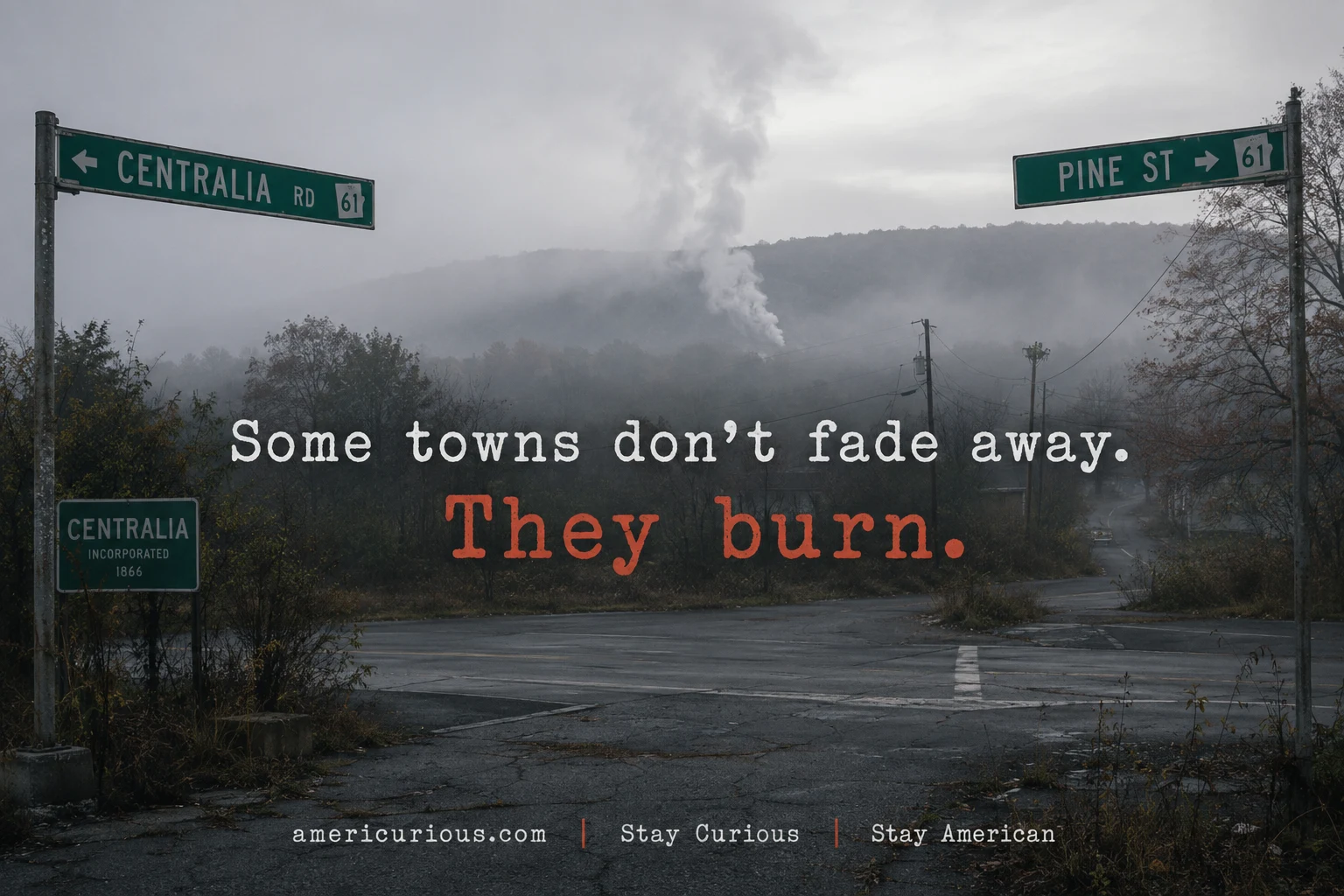
Centralia, Pennsylvania: an underground coal fire has burned here since 1962. Here’s the ghost town America abandoned — and the few who refused to leave.
The street signs are still standing. That’s the thing that gets you first — clean Pennsylvania green highway signs marking intersections where no traffic will ever come. Streets branch off in careful grids, leading to nothing but overgrown lots and open sky. The lawns are gone. The houses are gone. What’s left is a borough-shaped outline pressed into the earth, a few headstones in a well-kept cemetery, and somewhere beneath your feet, a coal seam that has been on fire since John F. Kennedy was in the White House.
Section 1 — The Story Begins Here
A Town Built on Black Gold
Centralia, Pennsylvania sits in Columbia County, roughly 60 miles northeast of Hershey, deep in the anthracite coal belt that powered American homes and factories for the better part of a century. By the late 19th century, it was a real, functioning boomtown — a place where immigrant miners from Ireland, Wales, Ukraine, and Eastern Europe arrived with nothing and built something, block by block. At its peak, the town held more than 2,000 residents, with churches, hotels, and every ordinary comfort of a working American community. The coal estimated beneath it stood at 25 million tons [opens in new tab] — enough to keep a town prosperous for generations.
The Day the Fire Started
In May 1962, Centralia’s borough council made a decision so routine it barely merited a meeting agenda item: burn the trash in an old abandoned strip mine pit before the Memorial Day celebration. The fire was set, it appeared to go out, and life continued [opens in new tab]. It hadn’t gone out. It had crept into an exposed vein of anthracite coal, found the labyrinth of old mine tunnels beneath the town, and started moving. Attempts to smother it, flood it, and excavate it failed in sequence. By the late 1970s, carbon monoxide was seeping into basements, and gasoline tanks beneath a local filling station were running 100 degrees hotter than normal.
The Moment Everything Changed
On Valentine’s Day, 1981, a twelve-year-old boy named Todd Domboski was cutting through his grandmother’s backyard on Locust Avenue when the ground opened beneath him. The sinkhole was four feet wide and 150 feet deep, with steam laced with lethal carbon monoxide rising from the bottom [opens in new tab]. Domboski grabbed a tree root and held on; his cousin Eric Wolfgang hauled him to safety. The story went national overnight. Within three years, Congress had appropriated $42 million to buy out and relocate Centralia’s residents — most of the approximately 1,100 people still living there at the time. Around 500 structures were eventually demolished.
Section 2 — Why This Is More American Than You Think
Every Boomtown Has an Expiration Date
Here’s the countercultural truth about Centralia: it is not exceptional. Its population had already been falling for years before the fire turned fatal — demand for anthracite coal had been declining since the 1950s, and the town that once held 2,000 people had already thinned to roughly 1,100 by the time the fire began. The fire just accelerated a story already in motion: the slow economic withdrawal from communities built on extraction. Centralia is unusual only in the drama of its ending. The quiet version of the same story is playing out in dozens of American towns right now.
The Countercultural Clarity Moment
The story Americans usually get about Centralia frames it as a freak anomaly — a ghost town with a gimmick, best suited to a cable documentary or a horror game tie-in. What that framing consistently misses is the real community that came before: real people, real churches, real neighbors who had planted deep roots in a specific piece of Pennsylvania ground. When did we start treating these communities as background noise in someone else’s story?
“Centralia isn’t the story of a town that burned. It’s the story of a town that was already being left behind — the fire just gave everyone a reason to look.” — AmeriCurious
The Pattern You’ll Notice
In practice, Centralia rhymes with a hundred other American places — coal towns, timber towns, mill towns — where an economic anchor dissolved and the population followed it out the door. What Centralia offers that those places don’t is a visual: empty lots in a clean grid, signs marking intersections with nowhere to go, a cemetery full of people who built something here. That’s what makes it worth the drive.
🗳️ Quick Poll: What Draws You Most to a Place Like Centralia? ○ The history — what this town was before the fire ○ The atmosphere — eerie, end-of-the-world stillness ○ The human stories — those who stayed, those who left ○ The science — how does underground coal burn for 60+ years? (Share your answer in the comments!)
Section 3 — The Details That Make It Real
What Centralia Looks Like Today
Walk the borough today and you’ll find a grid of roads — some maintained, some cracked — leading to lots where houses once stood. [Personal touch: I drove in on a Tuesday morning in October, when the fog hadn’t lifted and the empty intersections had that particular silence you only find in places where people used to be. I sat with that for a long time before I took a single photo.] St. Ignatius Cemetery sits at the north end of the grid, green and well-maintained, still receiving burials from families long relocated. St. Mary’s Ukrainian Catholic Church still stands nearby — a rare survivor of the demolitions — offering an incongruously intact anchor at the edge of all that absence.
📌 Fast Fact: The Centralia mine fire has burned for over 63 years, roughly 300 feet underground. Fueled by an estimated 25 million tons of anthracite coal, it could burn for another 250 years. Experts now estimate the cost of extinguishing it at over $660 million — making controlled burn-out the de facto policy.
The Road That Made Itself Famous
For years, the most photographed stretch of road in Pennsylvania was a closed section of Route 61 south of Centralia — a bypassed highway that buckled, cracked, and steamed as the fire worked beneath it [opens in new tab]. Visitors began painting it. More visitors came to paint over the first visitors. By 2017, it was anecdotally cited as the sixth-most-visited attraction in the state. In April 2020, the property owner had it buried under truckloads of fill dirt to deter trespassing. The graffiti, the cracks, the whole visual feast — gone. The internet mourned it like a friend.
Centralia At a Glance
| Detail | Information |
|---|---|
| Location | Columbia County, Pennsylvania |
| Distance from Philadelphia | ~2.5 hours (~140 miles) |
| Peak population | 2,000+ (early 20th century) |
| Population at fire start (1962) | ~1,100 |
| Population today (2025–2026) | ~5 residents |
| Fire ignition | May 1962 |
| Federal relocation funds | $42 million (appropriated 1984) |
| Structures demolished | ~500 |
| Zip code (17927) | Revoked by USPS, 2002 |
| Estimated fire duration remaining | Up to 250 years |
| Estimated extinguishing cost | $660 million+ |
Table 1: Key facts about Centralia, Pennsylvania — the underground mine fire that created America’s most haunting ghost town.
Section 4 — Hidden Layers (What Most People Miss)
The Residents Who Refused to Leave
The popular narrative about Centralia ends with everyone gone. It doesn’t [opens in new tab]. When Pennsylvania invoked eminent domain in the early 1990s, a group of holdouts filed a federal lawsuit and fought back. Some argued their corner of the borough wasn’t threatened by the fire; others suspected the state’s real interest was in the billions of dollars worth of coal rights sitting beneath the ground. After years of legal battles, the Commonwealth settled in 2013, granting remaining residents lifetime tenancy — after which their properties revert to the state. As of 2026, around five people still call Centralia home.
The Cost of Waiting
[Personal touch: The fire probably could have been contained in the 1960s. Early engineering estimates put the cost at roughly $4.5 million. Nobody prioritized it. By the 1980s, the relocation program alone cost $42 million — and extinguishing the fire was now officially classified as beyond practical reach.] That’s not a Centralia story in isolation. That’s a pattern in how America handles slow-moving problems in small communities: defer, delay, then pay a price no one wanted to.
The Silent Hill Connection — Confirmed and Otherwise
Centralia is widely cited as the visual inspiration for the Silent Hill franchise — both the 1999 video game series and the 2006 horror film. The game’s Japanese developers never formally confirmed Centralia as a direct source. What is confirmed: screenwriter Roger Avary publicly cited Centralia as a creative reference for the film, and the movie’s atmosphere of burning, fog-drenched desolation maps closely onto the real borough. [Personal touch: I’ll say this without hedging — when you stand in that morning fog, with steam curling from the earth and not a sound beyond wind in bare branches, the word “Silent Hill” arrives in your head completely unbidden. Some places feel like their own metaphor.]
🧠 AmeriCurious Quiz: How Well Do You Know Centralia?
Q1: What triggered the Centralia mine fire in May 1962? A) A lightning strike in an open coal shaft B) A trash-burning operation in an abandoned strip mine pit C) An underground gas leak near the main extraction tunnel D) Spontaneous combustion during a summer heat wave
Q2: Who pulled twelve-year-old Todd Domboski from the sinkhole on Valentine’s Day, 1981? A) A passing miner B) His father C) His cousin Eric Wolfgang D) A state emergency responder
Q3: What happened to Centralia’s zip code (17927)? A) It was reassigned to nearby Mount Carmel, PA B) It was archived as a historically significant designation C) It was officially revoked by the U.S. Postal Service D) It was never formally registered to begin with
✅ Answers: Q1-B | Q2-C | Q3-C
Section 5 — The Human Story
What a Hometown Actually Means
The holdouts who refused to leave Centralia have been characterized, variously, as stubborn, deluded, or quietly heroic — sometimes all three in the same article. There’s a simpler frame: they were people who had a home, and they didn’t want to give it up because a government program told them to. The grief Centralia’s displaced residents carry isn’t about coal geology or relocation payments. It’s about the diner where everyone knew your order, the corner where your kids learned to ride bikes, the neighbor who checked on your parents when you couldn’t.
A Cemetery That Refuses to Forget
St. Ignatius Cemetery, maintained at the north end of the borough, tells the full immigrant story of Centralia more clearly than any timeline can. Headstones span generations — Poles, Irish, Lithuanians, Ukrainians — the human archaeology of a coal-country immigration story that was profoundly American before it was anything else. Families who left Centralia decades ago still bring their dead back here. What does it tell you about home when people have given up the house, the street, the zip code — but not the burial ground? That’s not nostalgia. That’s identity.
“The town is gone. But people are still burying their parents here. That’s what home means — not a place you live, but a place that holds you.” — AmeriCurious
The Same Impulse, a Different Landscape
The spirit that pulls someone toward an otherworldly American landscape like The Narrows at Zion [opens in new tab] — that need to stand in a place that feels larger than yourself — operates in Centralia too. It just lands differently here. This isn’t awe at natural grandeur. It’s a quieter reckoning: with what we built, what we lost, and what we owe the places that made us.
Section 6 — Your Move, America
What You Need to Know Before You Go
A practical note first, and an honest one: the Pennsylvania Department of Environmental Protection maintains an official Stay Out — Stay Alive advisory for Centralia, citing real risks from carbon monoxide vents, unstable ground, and sinkholes. The surface is generally accessible on paved roads, but this is not a place for wandering off-trail. The same preparedness mindset that serves hikers entering permit-controlled terrain like The Wave in Arizona [opens in new tab] applies here — know what you’re walking into before you walk into it.
What Still Remains — and Why It’s Worth It
Visiting is free, requires no permit, and takes roughly 60 to 90 minutes on foot. [Personal touch: Give yourself more time than you think you need. This is a place that earns silence. Don’t Instagram and leave.] The contrast between Centralia and a still-thriving American small town — the kind of intact, walkable community you find along Telluride’s Colorado Avenue [opens in new tab] — is more instructive than any textbook comparison. Both are small American towns. One survived. And the difference between them had everything to do with what was — or wasn’t — underneath the ground.
🗺️ Your Centralia Visit Checklist
- 🚗 Getting there: ~2.5 hours from Philadelphia via I-76 W to I-81 N; ~3 hours from New York City
- ⛽ Nearest services: Mount Carmel, PA (3 miles east) — gas, food, coffee
- ⛪ See: St. Ignatius Cemetery and St. Mary’s Ukrainian Catholic Church — both worth time and respect
- 🌫️ Best season: October through February — steam vents are most visible in cool weather; fall foliage adds contrast
- 👟 What to wear: Sturdy shoes; terrain is uneven off paved roads
- ⚠️ Safety first: Stay on paved surfaces; heed PA DEP advisories; do not approach steam vents, fissures, or unmarked ground
- 📷 Photography: Overcast mornings produce the most atmospheric shots — skip the golden hour for once
- 🤝 Respect: People still live here. Treat Centralia as someone’s hometown — because it still is
❓ Frequently Asked Questions
Q: Is it safe to visit Centralia, Pennsylvania?
A: The Pennsylvania Department of Environmental Protection maintains a formal “Stay Out — Stay Alive” advisory for Centralia, citing risks from carbon monoxide vents, sinkholes, and unstable ground. Walking on paved borough streets carries lower risk, but visitors should stay on established roads at all times, avoid steam vents and ground fissures, and never probe or walk on unmarked terrain. Short visits on paved surfaces are generally considered manageable risk — extended exploration is not recommended.
Q: Is Centralia, PA completely abandoned?
A: Not entirely. As of 2025–2026, approximately five residents remain in Centralia under a 2013 settlement granting lifetime tenancy. After their passing, properties revert to the Commonwealth. St. Mary’s Ukrainian Catholic Church still stands, and St. Ignatius Cemetery remains active and maintained — families still hold burials there.
Q: How long will the Centralia underground fire keep burning?
A: Multiple estimates project the fire could burn for another 250 years, fueled by an estimated 25 million tons of anthracite coal burning roughly 300 feet underground. The estimated cost of extinguishing it now exceeds $660 million — which is why Pennsylvania’s de facto approach is to monitor and wait.
Q: Did Centralia really inspire Silent Hill?
A: The Japanese developers of the original Silent Hill video game (1999) have not formally confirmed Centralia as a direct source. However, screenwriter Roger Avary publicly cited Centralia as a creative influence on the 2006 Silent Hill film, and the movie’s visual atmosphere — fog, abandoned infrastructure, ground that vents smoke — clearly echoes the real borough.
Q: Can you still walk on Centralia’s Graffiti Highway?
A: No. The cracked, spray-painted section of old Route 61 — once anecdotally the sixth-most-visited attraction in Pennsylvania — was buried under fill dirt in April 2020 by the property owner to stop trespassing. It no longer exists as a walkable or visible feature. Visitors can walk the empty borough streets and observe the landscape from paved roads, but Graffiti Highway is gone.
Sign-Off
What’s your relationship with forgotten American towns? Have you ever driven through one that got under your skin and wouldn’t let go? Drop the name in the comments — someone reading this needs to know about it.
Save this for your next East Coast road trip, or send it to a friend who thinks Pennsylvania begins and ends in Philadelphia.
If stories like this are your kind of American geography, there’s plenty more where this came from — subscribe to americurious.com and we’ll keep finding the roads that matter.
— AmeriCurious americurious.com Stay Curious | Stay American 🇺🇸
📚 Sources & Further Reading
[1] Joan Quigley, The Day the Earth Caved In, Random House, 2007. [2] Pennsylvania Department of Environmental Protection, Centralia Mine Fire Program, PA.gov [opens in new tab]. [3] David DeKok, Fire Underground: The Ongoing Tragedy of the Centralia Mine Fire, Globe Pequot Press, 2009. [4] U.S. Census Bureau, Decennial Census historical data, Columbia County, Pennsylvania. [5] Atlas Obscura, “The End of Centralia’s Abandoned, Colorful, Anarchic ‘Graffiti Highway,'” 2020 [opens in new tab]. [6] Associated Press / Yahoo News, “Pa. residents living above mine fire free to stay,” 2013 [opens in new tab].
Discover more from AmeriCurious
Subscribe to get the latest posts sent to your email.