
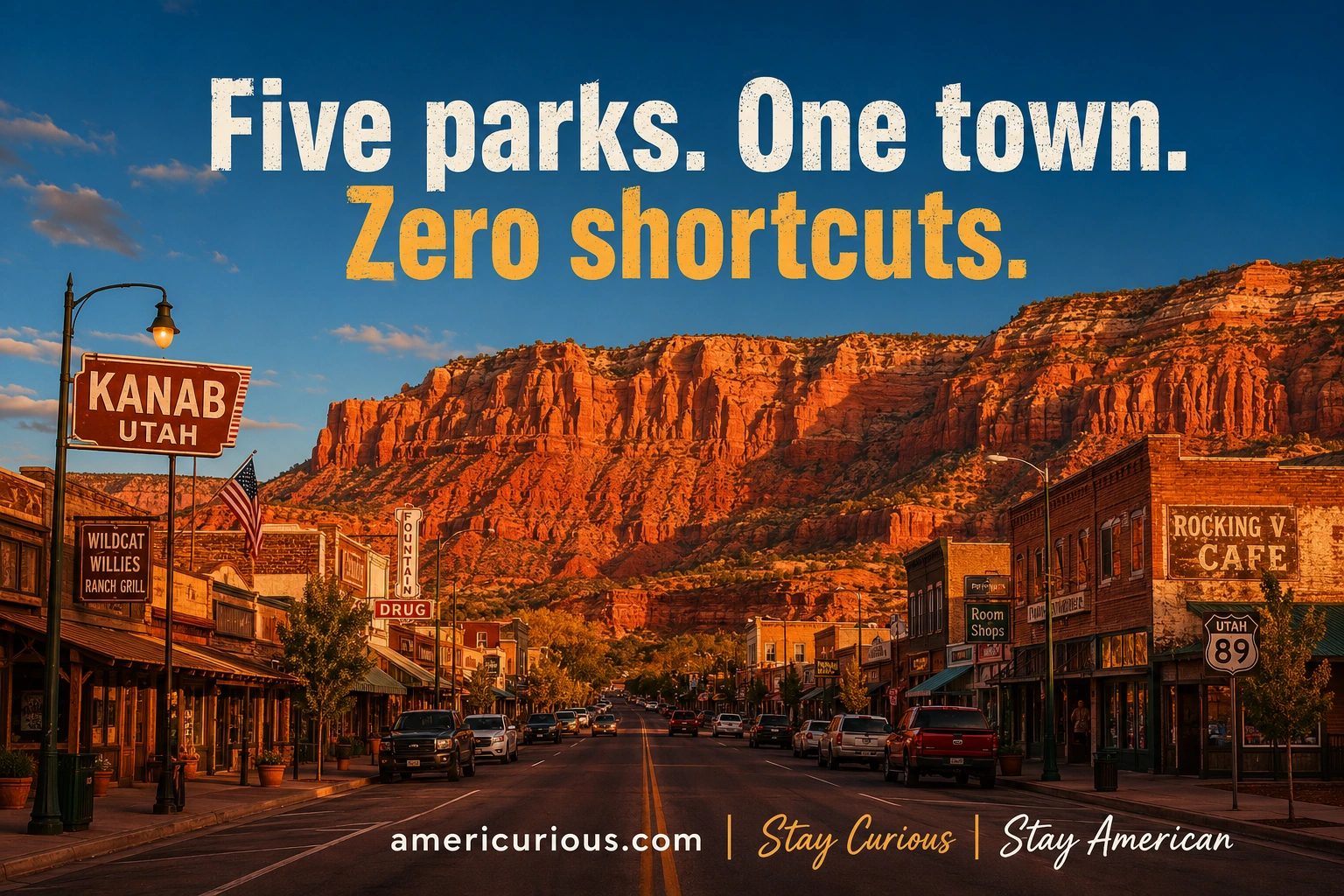
You step out of your car on Center Street, and the first thing you notice is the sky — an impossible blue bowl pressing down on a modest row of Western storefronts, all of it backed by vermilion sandstone cliffs that rise right out of the town like a backdrop nature spent millennia perfecting. Kanab, Utah — population 4,683 — sits at the geographic heart of America’s wildest landscape, within 80 miles of five national parks, the quiet launchpad for canyon country adventures and the unlikely home of Hollywood legend, the country’s largest no-kill animal sanctuary, and a culinary scene that has absolutely no business being this good. Most Americans have never heard of it. That is the first problem — and it is precisely why you should go this summer.
Section 1 — The Story Begins Here
The Center of Everything. The area around Kanab is known among geographers and serious road-trippers as the “Grand Circle” — a rough ring of national parks, monuments, and protected wilderness in the Four Corners region that constitutes the greatest concentration of public land in the continental United States. From downtown Kanab, Zion National Park [opens in new tab] is 40 miles to the west, Bryce Canyon 70 miles north, the Grand Canyon’s quieter North Rim 80 miles south, and Lake Powell 60 miles east. Grand Staircase-Escalante National Monument begins practically at the edge of town — a 15-minute drive to its boundary. That is five major destinations within 80 miles of one traffic light.
A Name Older Than the Town Itself. The area was home to the Southern Paiute people for at least 1,000 years before European settlement. The Paiute word kanab is believed to mean “place of the willows” — a reference to the cottonwood and willow trees lining Kanab Creek, which flows south to eventually meet the Colorado River deep in the Grand Canyon. Fort Kanab was built in 1864 for defensive purposes, but early attempts at settlement failed. It wasn’t until 1870 that ten Mormon families, sent by Brigham Young, put down roots that held — digging irrigation canals by hand and building log homes in one of the most remote inhabited places in the American West.
From Isolation to Intersection. For decades, Kanab’s isolation was its defining fact. The town sat at the end of dusty roads, growing slowly around cattle ranching and agriculture, unreachable by any convenient route. What turned the corner was an accident of geography so cinematic it seems scripted: Navajo sandstone cliffs, wide desert vistas, that peculiar quality of high-altitude desert light. Hollywood, in the 1920s, was desperately searching for authentic Western landscapes it hadn’t already filmed to death. Kanab had exactly what they needed, and a local entrepreneur with excellent timing knew it.
Summer Is When Kanab Makes Its Case. June through September is peak season, and the town earns every visitor. I’ve arrived in Kanab at every hour of the day and the light is never bad. The canyon country does something particular to late-afternoon sun that no photograph fully captures — you just have to stand in it. Kanab averages 256 sunny days per year, summer temperatures hit the 90s with cool nights in the mid-50s, and the summer monsoon season from July onward adds brief, theatrical afternoon thunderstorms that turn the canyon walls amber-dark and the sky electric.
Section 2 — Why This Is More American Than You Think
The Gateway Town Problem — and Why Kanab Solves It. The standard Southwest road trip routes people directly into the national parks and right past the towns in between. Zion and Bryce Canyon are extraordinary, but their closest gateway towns are single-road tourist strips built entirely for throughput. Kanab is different: a real town with a hardware store, an agricultural heritage, a working rodeo tradition, and 150 years of community identity that has quietly accumulated Hollywood history, an artist colony, and outdoor adventure culture on top of itself without losing any of the original character. Most Americans spend more on national park parking than they’d spend on a full day in Kanab. That isn’t a critique of the parks — it’s an honest argument for slowing down between them.
The Countercultural Clarity of the In-Between. There is a particular American restlessness that treats the open road as a delivery system — a means of getting from one famous landmark to the next. Kanab is quietly, stubbornly resistant to that logic. What the town offers isn’t a single attraction. It’s a vantage point: a place grounded enough in its own layered history that the surrounding wilderness makes more sense from inside it. When did we start measuring a place by its proximity to something else rather than by what it actually is? Kanab — sitting at the geographic middle of more public land than most countries contain — has the rare quality of being entirely itself.
The Best Base Camp on the Continent. Hikers who push through the dripping narrows of Zion and visitors who wander the hoodoo forests of Bryce Canyon often don’t realize that 40 minutes from their trailhead is a town with a free Hollywood film museum, the country’s most celebrated animal sanctuary, and a restaurant helmed by a chef who previously cooked at one of America’s most expensive desert resorts. [Personal touch: I once drove through Kanab three separate times telling myself I’d stop “next time.” The fourth time, I finally pulled over. I still owe myself those first three.] That is not a small town coasting on its neighbors’ reputations — that is a small town pulling its weight.
🗳️ Quick Poll: What would bring you to Kanab first? ○ The national parks access — I want to hike everything ○ The Little Hollywood film history ○ Best Friends Animal Sanctuary ○ Honestly, I just want to sit somewhere with good food and big sky
(Share your answer in the comments!)
Section 3 — The Details That Make It Real
“Little Hollywood” Is More Than a Nickname. In 1924, a local entrepreneur named Whit Parry persuaded filmmakers to come to Kanab to shoot Deadwood Coach, a silent Western starring cowboy legend Tom Mix and his famous horse, Tony. The landscape became an immediate obsession for Hollywood directors who’d exhausted their California backlots, and within a decade, Parry’s three brothers had established Parry Lodge [opens in new tab] as the base camp for visiting productions — a modest inn that would eventually host John Wayne, Clint Eastwood, Ronald Reagan, Gregory Peck, Maureen O’Hara, and Frank Sinatra. More than 100 films and television shows were shot in Kane County between the 1920s and the 1970s. Kanab’s sandstone cliffs played the American West for generations of moviegoers who had no idea they were watching a town of 4,700 quietly stand in for an entire nation’s idea of itself.
The Shows You’ve Already Seen. Gunsmoke — which ran from 1955 to 1975 and clocked more than 635 episodes as one of the longest-running primetime dramas in American television history — shot many of its outdoor scenes in Johnson Canyon, just ten miles outside Kanab. The weathered wooden buildings of that set still stand, accessible from the road, slowly losing their argument with the desert; bring a telephoto lens and the patience to feel history dissolving in real time. The Lone Ranger, El Dorado, Billy the Kid, The Outlaw Josey Wales — Kanab stood in for the frontier for decades. More recently, John Carter, Gravity, and Transformers: Age of Extinction all used the surrounding landscape, proving that the red rock doesn’t care what century the story is set in.
📌 Fast Fact: Frank Sinatra, while filming Sergeants 3 near Kanab in the early 1960s, personally funded the construction of a swimming pool at Parry Lodge and donated football uniforms to Kanab High School. The Rat Pack, as it turns out, had manners.
Kanab’s Inner Circle: The Grand Circle at a Glance
| Destination | Distance from Kanab | Drive Time | Notes |
|---|---|---|---|
| Zion National Park | 40 miles west | ~45 min | East entrance closest |
| Bryce Canyon NP | 70 miles north | ~1.5 hrs | Year-round access |
| Grand Canyon N. Rim | 80 miles south | ~1.5 hrs | Seasonal (May–Oct); check NPS for closures |
| Lake Powell / Glen Canyon | 60 miles east | ~1 hr | Houseboating, kayaking, photography |
| Grand Staircase-Escalante | 15 min east | ~15 min | Monument on the doorstep |
| Vermilion Cliffs NM | ~20 min | ~20 min | Wave lottery, White Pocket |
| Coral Pink Sand Dunes SP | ~15 min | ~15 min | 3,700 acres of salmon-pink sand |
Caption: Kanab’s position within the “Grand Circle” makes it the most versatile base camp in the American Southwest — more national parks and monuments within 80 miles than almost anywhere else on the continent.
The Little Hollywood Museum. The Little Hollywood Museum [opens in new tab] sits behind a gift shop on 297 West Center Street, admission by donation, open March through December. The museum preserves actual movie sets relocated from their original filming sites, including structures used in The Outlaw Josey Wales (1976, starring Clint Eastwood) and One Little Indian (1973, featuring a young Jodie Foster). A Josey Wales homestead built from fiberglass and Old West storefronts transported from Johnson Canyon now sit under the open Utah sky — authentically artificial, which is its own kind of American achievement.
📌 Fast Fact: Kanab averages 256 sunny days per year — more than Miami, more than Los Angeles. The canyon country’s famous light quality, which pulls photographers from around the world, is a product of altitude, low humidity, and those relentless clear skies.
Section 4 — Hidden Layers (What Most People Miss)
The World’s Most Unusual Neighbor. Five minutes north of downtown Kanab, tucked into a red-rock chasm called Angel Canyon, sits Best Friends Animal Sanctuary [opens in new tab] — the largest no-kill animal shelter in the United States. The sanctuary spans nearly 5,800 acres and on any given day houses up to 1,600 animals: dogs healing from abuse, cats with medical needs, horses, rabbits, pigs, parrots, and rehabilitating wildlife across areas named Dogtown, Cat World, Horse Haven, and Marshall’s Piggy Paradise. Made famous nationally by a National Geographic TV series called DogTown, the sanctuary now draws more than 30,000 visitors per year — not to hike, not to see the parks, but to walk dogs named by their caretakers, to sit with animals in recovery, to volunteer a few hours to creatures that have had harder years than most people. What does it tell you about a place that the town most perfectly positioned for wilderness adventure is also America’s most compassionate address for animals?
Buckskin Gulch and the Slot Canyon That Gets Undersold. While The Wave gets all the permit-lottery conversation (and our complete Wave permit guide is worth reading before you enter that lottery), Kanab sits at the threshold of something equally extraordinary and considerably less crowded. Buckskin Gulch is one of the longest continuous slot canyons in the world — a narrow corridor carved through Navajo sandstone where the walls close in until you’re shuffling through passages lit only by a crack of sky overhead. Day permits are available, the walls reach 15 stories tall in some sections, and the experience of walking a slot canyon that extends for miles — rather than the hour-long curated versions — is the kind of thing that recalibrates your sense of scale.
Peek-A-Boo Slot Canyon and the Gentler Option. Red Slot Canyon, locally known as Peek-a-Boo (not to be confused with the Escalante version), offers a guided slot canyon experience accessible via sandy desert roads from Kanab. The hike is just 0.7 miles long, achievable for most ability levels, and the crimson-orange walls of compressed sandstone glow in a way that makes every visitor reach for their camera and then quietly put it away. [Personal touch: I’ve hiked slots in Arizona, New Mexico, and Utah. The particular warm red of Navajo sandstone — almost auburn, like something baked rather than eroded — gets to you differently than other rock. Kanab is surrounded by it on every side.]
🧠 AmeriCurious Quiz: How Well Do You Know Kanab, Utah?
Q1: What does the Paiute word “Kanab” mean? A) Red canyon B) Place of the willows C) Land of the sun D) Tall cliffs
Q2: Which classic TV Western filmed many of its outdoor scenes in Johnson Canyon near Kanab? A) Bonanza B) The Rifleman C) Gunsmoke D) Rawhide
Q3: How many animals does Best Friends Animal Sanctuary house at any given time? A) Up to 500 B) Up to 800 C) Up to 1,200 D) Up to 1,600
✅ Answers: Q1-B | Q2-C | Q3-D
Section 5 — The Human Story
The Pool Sinatra Built. The relationship between Kanab and Hollywood was never purely transactional. When Frank Sinatra came to film Sergeants 3 near Kanab in the early 1960s, he didn’t treat the town as a location — he treated it as a community. He had a swimming pool constructed at Parry Lodge for the cast and crew. He bought football uniforms for the local high school. The stories that survive in small towns are rarely the big ones; they’re the ones that reveal whether the visitors saw the locals as real people or as scenery. By all accounts, the Hollywood crowd that cycled through Parry Lodge saw Kanab as real — John Wayne fished the streams, Ronald Reagan was a cordial guest, Sammy Davis Jr. and the Rat Pack were good houseguests who tipped well and remembered names.
The Woman Who Came to Volunteer and Never Left. More recently, a San Francisco woman named Katherine Van Hagan took a volunteer trip to Best Friends Animal Sanctuary expecting a few days with some dogs and left knowing she was going to rearrange her entire life. She eventually moved to Kanab. Her story — replicated in dozens of variations by people from crowded, expensive cities who came for the animals and stayed for everything else — tells you something essential about what this town does to people. Some places make you ask the question you’ve been avoiding: What would it actually cost to live somewhere that felt like this every single day?
The Chef Who Came Back. Chef Shon Foster grew up in Kanab, trained in serious kitchens around the country, and eventually helmed the culinary program at Amangiri — the ultra-high-end desert resort in Canyon Point, Utah, known for its otherworldly architecture and its position on every list of America’s most extraordinary lodging experiences. Then he came back to Kanab and opened Sego Restaurant. The fact that Kanab can support a chef of that caliber says something about how the town has matured. The fact that a chef of that caliber chose to return says something about the town that won’t change.
“Every small town is either becoming something or becoming a memory. Kanab keeps deciding — and keeps deciding to stay.” — AmeriCurious
[Personal touch: A good small town always has a restaurant that has no business being as good as it is. Kanab has Sego. It also has Wild Thyme Cafe and Kanab Creek Bakery and Big Al’s Burgers. For a town of 4,700, that’s an embarrassment of culinary riches.]
Section 6 — Your Move, America
Make Kanab the Hub, Not the Detour. The classic mistake is treating Kanab as something you pass through on the way to Zion or Bryce. Use it as a base camp for three to five days and the math works out better than almost any other strategy in canyon country — you avoid premium lodging costs inside the parks, you sleep in a town with its own genuine character, and you can reach different wilderness areas each morning from the same front door. It shares that rare quality with places like Telluride — both are Western towns transformed by what surrounds them, both manage to be more than their most famous feature — but Kanab has more elbow room and a sky that still surprises you every evening. The town earns its place on the itinerary. It doesn’t just host yours.
Your Kanab Starter Plan:
🗺️ Day 1 — Get your bearings: Walk Center Street from end to end, visit the Little Hollywood Museum (free, 297 W Center St), pick up gear at Willow Canyon Outdoor Co., dinner at Wild Thyme Cafe or Sego Restaurant
🏜️ Day 2 — Go deep on the canyon: Book a guide for Buckskin Gulch or Peek-a-Boo Slot Canyon — advance booking is essential in summer; East Zion Experiences and Kanab Tour Company both run reliable half-day and full-day options
🐾 Day 3 — Best Friends Animal Sanctuary: Morning guided tour (book online well in advance at bestfriends.org), afternoon at Coral Pink Sand Dunes State Park — 3,700 acres of salmon-pink sand that adults pretend to visit for the children
🏔️ Day 4 — National park day: East entrance of Zion is 40 minutes west — tackle the Narrows with water shoes and trekking poles, or the Canyon Overlook Trail for sweeping views in under an hour
🌄 Day 5 — Vermilion Cliffs: Apply for the Wave lottery at recreation.gov months in advance; if the draw doesn’t go your way, White Pocket requires no permit and rewards the 4WD drive in with geological drama on equal footing
📸 Every single evening: Position yourself anywhere on the east side of town around an hour before sunset and watch the light hit the cliffs — it is free, it is reliable, and it is the kind of thing that turns people into return visitors
A Few Practical Notes Before You Go:
- Summer temperatures peak around 90°F; plan canyon hikes for early morning, before 10 a.m.
- Willow Canyon Outdoor Co. on Center Street combines outdoor gear with strong coffee, which is the correct philosophy
- Download offline maps before leaving town — cell service in the backcountry is genuinely unreliable
- Best Friends Sanctuary requires advance booking for guided tours; unannounced visits to animal care areas are not permitted
❓ Frequently Asked Questions
Q: How far is Kanab, Utah from Zion National Park? A: Kanab is approximately 40 miles from the east entrance of Zion National Park — roughly a 40 to 45 minute drive. The east entrance routes you through the Zion–Mt. Carmel Tunnel and into the park’s less-crowded eastern section, a dramatic approach that many visitors find more memorable than the main south entrance.
Q: Is Kanab, Utah worth visiting for more than just park access? A: Without reservation. Kanab carries its own distinct identity as “Little Hollywood” — the filming location for over 100 movies and TV shows since the 1920s — as well as Best Friends Animal Sanctuary (the largest no-kill shelter in the U.S.), legitimate dining anchored by a chef who previously cooked at Amangiri, and access to slot canyons and wilderness areas that most canyon country visitors skip entirely.
Q: What is Best Friends Animal Sanctuary in Kanab? A: Best Friends Animal Sanctuary is the largest no-kill animal shelter in the United States, located five minutes north of Kanab in Angel Canyon. It spans nearly 5,800 acres and houses up to 1,600 animals on any given day. The sanctuary is open daily except Christmas from 8 a.m. to 5 p.m.; guided tours depart every 90 minutes and must be booked in advance at bestfriends.org.
Q: How close is Kanab to The Wave permit lottery area? A: The Wave (Coyote Buttes North, Vermilion Cliffs National Monument) is roughly a 45-minute to one-hour drive south from Kanab toward the Arizona state line. Permits are required and awarded through a competitive online lottery at recreation.gov. White Pocket, in the same monument, requires no permit but does require a high-clearance 4WD vehicle and is comparably stunning.
Q: What is the best time of year to visit Kanab, Utah? A: Spring (April–May) and fall (September–October) offer the most comfortable temperatures for extended hiking. Summer is entirely viable with early starts — peak daytime temperatures reach around 90°F but nights drop to the mid-50s. Kanab averages 256 sunny days per year. The summer monsoon season from July through October brings brief afternoon thunderstorms that create spectacular photography conditions while occasionally making dirt backcountry roads temporarily impassable.
What’s your Kanab story? Have you driven through and kept going — or stopped and found yourself rearranging your whole itinerary? Drop it in the comments. These are exactly the stories worth collecting.
If you’re planning a Southwest road trip this summer, save this post and send it to the person in your group who’s doing all the logistics. They’ll thank you.
And if you want more of this — the towns that don’t wait around to be discovered, the places that carry more history than they advertise — subscribe for new posts every week.
— AmeriCurious americurious.com Stay Curious | Stay American 🇺🇸
📚 Sources & Further Reading
[1] Visit Southern Utah, “Kanab,” visitsouthernutah.com, accessed June 2026. https://www.visitsouthernutah.com/kanab/
[2] Visit Utah, “Little Hollywood Museum in Kanab,” visitutah.com, accessed June 2026. https://www.visitutah.com/places-to-go/cities-and-towns/kanab/little-hollywood-museum
[3] Best Friends Animal Society, “Best Friends Animal Sanctuary — Plan Your Visit,” bestfriends.org, accessed June 2026. https://bestfriends.org/sanctuary
[4] Wikipedia, “Kanab, Utah,” en.wikipedia.org, updated April 2026. https://en.wikipedia.org/wiki/Kanab,_Utah
[5] Good News Utah, “‘Little Hollywood’ Kanab: From Frontier Town to Filmmaking Paradise,” goodnewsutah.com, January 2026. https://goodnewsutah.com/little-hollywood-kanab/
[6] Visit Southern Utah, “Little Hollywood Museum,” visitsouthernutah.com, accessed June 2026. https://www.visitsouthernutah.com/little-hollywood-museum/
Discover more from AmeriCurious
Subscribe to get the latest posts sent to your email.