
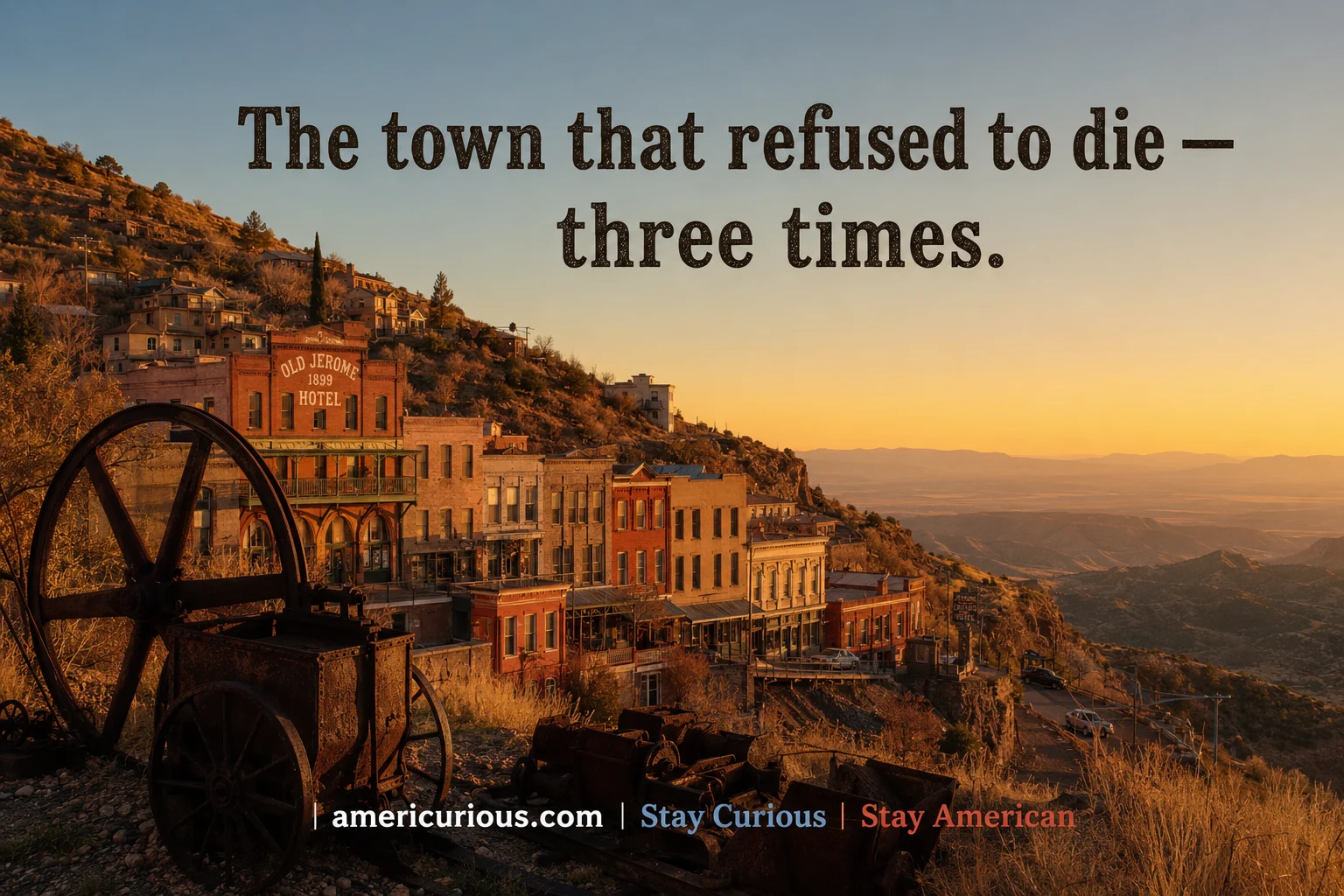
Copper boomtown, ghost town, artist colony — Jerome, Arizona has lived three wild lives on one cliff. Here’s the story most visitors never hear.
There’s a jail in Jerome, Arizona, that decided it had done enough time in one spot. Sometime in the 1930s, years of mine blasting and unstable earth sent it sliding roughly 225 feet across the road from where it was originally built. Nobody moved it. Nobody stopped it. It just went. That jail is still there today — crooked, displaced, and slightly defiant — and it may be the most honest metaphor in American small-town history. Jerome itself has never stayed put either. This place has been a vice-soaked copper boomtown, a ghost town down to fifty souls, and a fiercely independent artist colony, all within one century and all on the same cliff in northern Arizona. Not many American towns can say that. Not many survive long enough to try.
Section 1 — The Story Begins Here
An Ore Body That Waited Two Thousand Years
The copper deposit buried under Cleopatra Hill had been there for millennia before anyone with capital figured out what to do with it. The Hohokam people mined its colorful copper-bearing minerals for pigment as far back as 700 CE. Spanish conquistadors arrived in 1585, assessed the situation, and left — their government had sent them for gold, and copper wasn’t worth the trouble yet. It took the age of electricity, and the industrial hunger that came with it, to change that calculation entirely.
A New Yorker’s Name on an Arizona Mountain
In 1883, with backing from eastern financiers including a New York lawyer and investor named Eugene Jerome, the United Verde Copper Company [opens in new tab] established formal operations on Cleopatra Hill, and the mining camp took his name. The man never once visited the place named for him. Apparently some people invest in the future without needing to see it. What history books often gloss over is that it was actually Eugene’s wife, Paulina Von Schneidau Jerome, who raised the $200,000 in development capital that got the operation moving — according to the Jerome Historical Society Archives, Eugene was reportedly not even interested in the venture. The town was named for the family, not really the man. That’s a small correction with a certain American symmetry.
The Churchill Connection Nobody Follows Through On
Eugene Jerome was a cousin of Jennie Jerome — the Brooklyn-born woman who married Lord Randolph Churchill and became the mother of Winston Churchill, prime minister of Great Britain. It’s a fact most Jerome articles mention in a single sentence and then drop. But consider what it actually represents: a copper deposit on an Arizona hillside, financed partly by a family whose American-born daughter would raise one of history’s most consequential statesmen. There’s a straight line from Cleopatra Hill to the Battle of Britain, drawn through a family name and a financial transaction most Americans have never heard of. That’s American history doing what it does best — connecting improbable things across impossible distances. I find myself thinking about that whenever I look at a place that seems small and remote. Nothing stays disconnected for long.
Fifteen Thousand People on a Hillside
By the early 1900s, Jerome’s population had climbed toward 15,000 people [opens in new tab] — making it one of the largest cities in Arizona at the time. Miners arrived from Ireland, Italy, Poland, Croatia, Germany, Mexico, and beyond, representing more than 30 nationalities working side by side on Cleopatra Hill. The San Francisco Examiner called it “the wickedest town in America” in 1899, a reputation built on saloons, gambling houses, and brothels packed into a town where the infrastructure couldn’t keep pace with the population. It wasn’t only wickedness, though. It was raw, multiethnic, immigrant American vitality poured into a hillside and left to sort itself out.
Section 2 — Why This Is More American Than You Think
A Story Most Americans Don’t Know They Already Know
Here’s the countercultural clarity moment: most Americans have never heard of Jerome, Arizona. And yet the arc of its existence maps almost perfectly onto the American experience of place — the rush in, the extraction, the abandonment, and then, improbably, the reinvention. It’s the story of Appalachian coal towns, Texas oil patches, California gold rush settlements, and Great Plains homesteads, all compressed into three square miles on one cliff. Jerome just happened to survive every act. What does it mean that we don’t already know this place?
The Part Nobody Tells You
When the copper prices fell after World War I and crashed again during the Depression, Jerome’s fortunes followed. The mines finally closed for good in 1953 when Phelps Dodge exhausted the ore deposits. What most travel articles skip past is what came next: the same mining company that owned most of the land and buildings began bulldozing the town. Local kids were paid a penny per brick to knock mortar off reclaimed building blocks for reuse. Jerome was being erased, methodically, one wall at a time. That’s not a ghost town story — that’s an erasure story, and it’s an American story too: the moment when “what’s left” gets weighed against “what’s useful,” and the scales tip toward demolition.
The People Who Said No
A handful of residents who hadn’t left — fewer than a hundred, by some accounts as few as fifty — formed the Jerome Historical Society in 1953 and halted the demolitions in 1956. They had no special authority. They had no federal backing. They had the stubbornness particular to people who’ve watched a place get built from nothing and refuse to watch it disappear the same way. That stubbornness earned Jerome National Historic Landmark designation in 1967. It also kept the buildings standing long enough for something none of them likely anticipated: the counterculture.
“Not every American landmark was saved by a federal act. Some were saved by a handful of people too stubborn to pack up and leave.” — AmeriCurious
🗳️ Quick Poll:
What’s your idea of the most American small-town story? ○ The boomtown that grew too fast and burned out ○ The ghost town that clawed its way back ○ The farming town that held on through everything ○ The place nobody’s heard of but everyone should visit (Share your answer in the comments!)
Section 3 — The Details That Make It Real
What Jerome Looks Like When You Get There
Jerome sits at 5,000 feet on the northeastern slope of Cleopatra Hill, roughly 100 miles north of Phoenix and 45 miles southwest of Flagstaff [opens in new tab] along State Route 89A. The drive up is intentionally disorienting — the road switchbacks steeply, the Verde Valley falls away below, and suddenly there are buildings clinging to angles that shouldn’t support buildings. The town is essentially vertical. Main Street runs roughly horizontal on a hillside where horizontal is an ongoing negotiation. Everything here looks like it’s simultaneously hanging on and leaning into something.
Three Buildings Worth Your Full Attention
The Jerome Grand Hotel — formerly the United Verde Hospital, built in 1926 — broods over the upper town and has earned its haunted reputation through decades of ghost tours and genuinely unsettling history. The Douglas Mansion, built in 1916 of adobe brick and now housing Jerome State Historic Park [opens in new tab], is the largest adobe structure in Arizona and sits just above the old Little Daisy Mine with a panoramic view of the Verde Valley. And then there’s the Sliding Jail — the 1905 jailhouse that began its slow migration down Hull Avenue after mine blasting destabilized the ground beneath it, finally settling 225 feet from where it started. I’ve stood in front of that jail and genuinely felt like the ground was giving me a look.
📌 Fast Fact: Jerome’s Audrey Shaft Headframe, built in 1918, is the largest wooden headframe still standing in Arizona — a towering remnant of the mine infrastructure that once ran 24 hours a day, every day, for decades. It still dominates the skyline above State Park Road.
The Three Lives of Jerome, Arizona
| Era | Approximate Years | Peak Population | Defining Character |
|---|---|---|---|
| Copper Boomtown | 1883–1953 | ~15,000 | Multinational, industrial, “wickedest in the West” |
| Ghost Town | 1953–late 1960s | Fewer than 100 | Silent, half-demolished, stubbornly surviving |
| Artist Colony | Early 1970s–present | ~400–444 | Eclectic, independent, fiercely local |
Table: Jerome, Arizona’s three distinct identities across one century of American history. Sources: Town of Jerome official records, Jerome Historical Society, Western Mining History.
Section 4 — Hidden Layers (What Most People Miss)
The Labor Revolt That History Barely Mentions
In July 1917, armed vigilantes — many of them aligned with the mining companies — rounded up roughly 60 to 75 members of the Industrial Workers of the World (IWW), the labor union organizing Jerome’s miners for better wages and safer conditions. They loaded them at gunpoint onto cattle cars and shipped them out of town. It was illegal. It was brutal. And it was part of a pattern of anti-labor violence that swept Arizona’s mining towns that summer — nearly identical deportations happened in Bisbee the very same month. This was a genuine confrontation between organized labor and industrial capital, played out at altitude in the American West. It is almost entirely absent from Jerome’s tourism literature. How many town histories leave out the part about the workers?
The Bisbee Parallel Most Visitors Don’t Know
Jerome and Bisbee, Arizona, are rarely discussed together, but their parallel arcs are striking — both were copper boomtowns with multiethnic workforces, both endured violent labor suppression in 1917, both became ghost towns in the mid-20th century, and both were saved by artists and independent-minded residents who moved in when real estate was cheap and character was abundant. That’s not a coincidence. That’s a pattern — a specific kind of American place that industrial capitalism built and then abandoned, and that a specific kind of American person later chose to preserve. Jerome is one of the best surviving examples of what that choice looks like in practice.
The Billion-Dollar Calculation
Over roughly 70 years of active mining, the ore body under Cleopatra Hill produced an estimated one billion dollars in copper, gold, and silver [opens in new tab]. That’s not an abstraction. That’s electricity in American homes, telephone wires across the country, and artillery shell casings in World War I. The wealth came from the hill, flowed to company shareholders in distant cities, and left the town with a handful of brick buildings and a population too stubborn to follow the money out. What the billionaires left behind, the broke artists moved into. That’s a recurring American story too.
🧠 AmeriCurious Quiz: How Well Do You Know Jerome, Arizona?
Q1: What notorious nickname did the San Francisco Examiner give Jerome in 1899? A) The Copper Capital of the West B) The Wickedest Town in America C) The Ghost City on the Hill D) The Billion-Dollar Camp
Q2: Roughly how far did Jerome’s famous jail slide from its original location? A) 50 feet B) 100 feet C) 225 feet D) Half a mile
Q3: What organization halted the demolition of Jerome’s historic buildings in 1956? A) The Arizona State Historic Preservation Office B) The National Park Service C) The Jerome Historical Society D) Phelps Dodge Corporation
✅ Answers: Q1-B | Q2-C | Q3-C
Section 5 — The Human Story
The People Who Got in the Bus and Kept Driving
In the early 1970s, as the counterculture movement sent a particular kind of American wanderer looking for cheap places with character and open sky, some of them found Jerome. [Personal touch: I know the type. There’s something about a steep road, an abandoned building, and a view that pulls a certain kind of person up and in, and holds them there.] They moved into crumbling mining executives’ houses and empty storefronts, set up pottery wheels and easels, and mixed with the remaining old-timers who’d watched the whole arc of the place and weren’t leaving under any circumstances. “People were getting into VW buses and looking for a cheap place to live,” local historian Diane Rapaport observed. “Jerome began to have an influx of really wacked-out migrating hippies.”
What Happened After the Pottery Wheels Came Out
What’s remarkable about the counterculture chapter in Jerome’s history isn’t the romance of it — it’s the practicality. Artists drafted Jerome’s zoning ordinances. Painters served on the town council. Musicians organized fundraisers for sick neighbors and children’s Christmas parties. They got involved not because governance was glamorous but because they understood that if you don’t shape the place you love, someone else will shape it into something you won’t recognize. The result was a community that actively, consciously chose its own character — eclectic, fiercely local, historically serious, and completely unbothered by the idea that small things should look normal. Locals call themselves “Jeromaniacs” — maniacal about their independence, as one longtime resident put it, rather than Jeromians. The distinction matters to them.
Jerome as a Road Trip Anchor
On a summer weekend in Jerome, the temperature runs about 20 degrees cooler than in the Verde Valley below — a genuine gift if you’re routing through Arizona in June. The streets fill with motorcycles, art-seekers, ghost tour groups, and the kind of traveler who deliberately drove past Sedona to find something less curated. If you’re already planning a Southwest adventure — the kind that includes the permit-only lottery landscape of The Wave in Arizona or the full-body immersion of Zion’s Narrows — Jerome earns its own day on the itinerary. It rewards curiosity and punishes rushing.
“Jerome doesn’t ask you to love it. It just stands there on its hill, slightly tilted, slightly defiant, and waits for you to figure out why you can’t leave.” — AmeriCurious
The Kinship With Telluride
There’s a kind of small mountain town in the American West that gets under your skin in a specific way — vertical, weather-worn, impossibly beautiful, and alive with people who made a conscious choice to be somewhere most people drive past. If you’ve ever walked Telluride’s Colorado Avenue toward Bear Creek Falls and felt that particular combination of altitude, scrappy history, and hard-earned beauty, Jerome will feel familiar. Different mountain, different mineral, same American impulse: find the place the world wrote off, and make it worth remembering.
Section 6 — Your Move, America
How to Spend a Day in Jerome (And Why One Day Isn’t Quite Enough)
You can technically see Jerome in three hours. But the town rewards people who slow down, look up at the facades, and talk to whoever’s sitting outside a gallery. Here’s how to do it right:
- 🏛️ Start at Jerome State Historic Park — The Douglas Mansion opens at 10 a.m. The 3D model of the underground mine system alone justifies the stop. Budget 45 minutes minimum.
- 🔩 Walk to Audrey Headframe Park — The largest wooden headframe still standing in Arizona looms above the hillside. It’s free, it’s outside, and it resets your sense of scale immediately.
- ⚖️ Find the Sliding Jail — It’s on Hull Avenue. It will not be where you expect it. That is entirely the point.
- 🏚️ Walk the full length of Main Street slowly — Not just to shop, though you might. Every facade is a timestamp. Read the buildings.
- 🍷 Stop at a Jerome tasting room — Verde Valley wine country is the real deal. The views from the tasting rooms are staggering.
- 👻 Book the evening ghost tour — Even skeptics find the history of the Jerome Grand Hotel genuinely unsettling. It earns its reputation.
- 🌅 Stay for sunset from Cleopatra Hill — You’re 5,000 feet up, looking over the Verde Valley. The light turns everything copper. That’s not just a metaphor — it’s also literally what’s in the ground.
- 🛏️ Consider staying overnight — Jerome has several inns and B&Bs. The town after the day-trippers leave is a completely different place, quieter and stranger in the best way.
Getting There
- From Phoenix or Scottsdale: ~2 to 2.5 hours north via I-17 to AZ-260, then AZ-89A up the mountain
- From Sedona: ~40 minutes west on scenic AZ-89A through Cottonwood — one of the better drives in northern Arizona
- Best seasons: Spring (March–May) and fall (September–November) for the clearest skies and most comfortable temps; summer brings welcome cool air at elevation but also afternoon thunderstorms
- Parking tip: Arrive before 10 a.m. on summer and fall weekends — the lots fill fast and the streets are steep
❓ Frequently Asked Questions
Q: Is Jerome, Arizona worth visiting?
A: Yes — particularly if you want more than a postcard stop. Jerome is a designated National Historic Landmark with three distinct historical layers: copper boomtown, near-ghost town, and active artist colony. The combination of intact 19th-century architecture, working galleries, and sweeping Verde Valley views makes it genuinely unlike most historic sites in the Southwest.
Q: How far is Jerome, Arizona from Sedona?
A: About 40 minutes by car heading west on AZ-89A through Cottonwood. The drive itself is worth the trip — the Verde Valley unfolds below you and the ascent up Cleopatra Hill is steep, scenic, and slightly theatrical, as Jerome approaches.
Q: Why is Jerome called a ghost town if people still live there?
A: When the copper mines closed in 1953, Jerome’s population collapsed from a wartime high near 15,000 to fewer than 100 residents. The term “ghost town” stuck from that near-abandonment. A core of residents refused to leave and ultimately preserved the buildings — Jerome became a National Historic Landmark in 1967 and now has a population of roughly 400 to 444.
Q: What is there to do in Jerome, Arizona?
A: Jerome State Historic Park (housed in the 1916 Douglas Mansion), the Jerome Mine Museum on Main Street, Audrey Headframe Park, the Sliding Jail, dozens of working art galleries and artisan shops, Verde Valley wine tasting rooms, and guided ghost tours of the Jerome Grand Hotel are the main draws. The entire historic district is walkable from the main parking areas.
Q: When is the best time to visit Jerome, Arizona?
A: Spring (March through May) and fall (September through October) offer the most comfortable temperatures and clearest skies. Summer visits are very doable — Jerome runs roughly 20 degrees cooler than Phoenix — but afternoon thunderstorms arrive reliably from July onward. Weekday visits at any season mean far less competition for the limited parking and a noticeably different (better) atmosphere on Main Street.
What’s your small town that refused to die?
Every American seems to know at least one — a place that should have disappeared and didn’t, and is somehow better for the stubbornness that kept it here. Drop it in the comments. I read every one.
Send this to someone who thinks Arizona is just Phoenix and the Grand Canyon. They need it more than they know.
If you want more stories like this — towns with genuine character, roads with actual history, and places that make America feel bigger and stranger than you thought — subscribe. We find these places so you know where to go looking.
— AmeriCurious americurious.com Stay Curious | Stay American 🇺🇸
📚 Sources & Further Reading
[1] Town of Jerome, “Jerome: Then and Now,” jerome.az.gov. jerome.az.gov/jerome-then-and-now
[2] Western Mining History, “Jerome, Arizona,” westernmininghistory.com. westernmininghistory.com/towns/arizona/jerome
[3] Jerome Historical Society, “Eugene Jerome and Winston Churchill,” jeromehistoricalsociety.com. jeromehistoricalsociety.com/eugene-jerome-and-winston-churchill
[4] Arizona State Parks, “Jerome State Historic Park,” azstateparks.com. azstateparks.com/jerome
[5] True West Magazine, “That Would Be Mrs. Jerome, Thank You,” truewestmagazine.com. truewestmagazine.com/article/that-would-be-mrs-jerome-thank-you
[6] Wikipedia / Jerome Historical Society cross-reference, “List of Historic Properties in Jerome, Arizona,” en.wikipedia.org. en.wikipedia.org/wiki/List_of_historic_properties_in_Jerome,_Arizona
Discover more from AmeriCurious
Subscribe to get the latest posts sent to your email.