
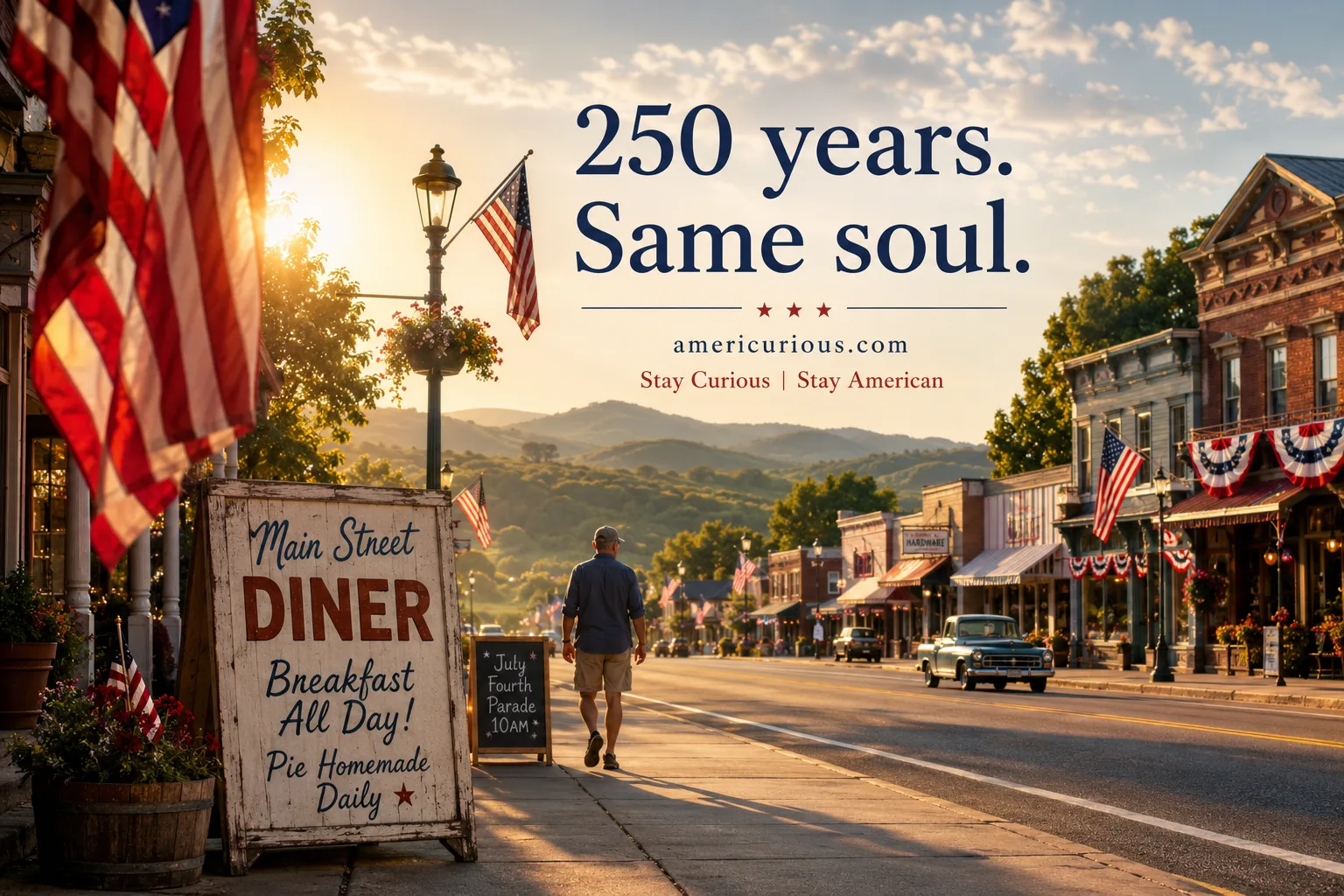
What defines the American character at 250? Explore the five enduring traits — optimism, reinvention, neighborliness, stubbornness, and curiosity — that have always made us who we are.
On July 5, 2026 — the day after America turns 250 — millions of people across all fifty states will do something that has no official sponsor, no corporate logo, and no dress code. They will carry food to a neighbor’s table and sit down together. The America250 commission calls it America’s Potluck. But Americans have always called it Tuesday.
The Story Begins Here
A Birthday Worth Pausing For
Two hundred and fifty years is an extraordinary run for any nation — let alone one that started as a philosophical argument on parchment. The United States Semiquincentennial is not just a party; it is an invitation to ask the question Americans rarely slow down long enough to ask: What are we, exactly? Not the political answer, not the textbook answer — the lived, practiced, Tuesday-morning answer.
The Noise Around the Question
Spend five minutes online and you’ll get competing theories about American identity, most of them loud and most of them partial. The critics say we’ve lost our way. The cheerleaders say we never had a flaw. Neither version is particularly useful to someone sitting in a diner in Laramie or a front porch in Savannah, trying to place their thumb on what actually connects them to the person in Bangor or Bakersfield. Here’s what consistently holds: the American character is not a set of beliefs. It is a set of practiced behaviors. And those behaviors are older than the republic itself.
What History Keeps Telling Us
Since 1776, America has survived a civil war, two world wars, economic collapses, cultural upheavals, and a pandemic that reshaped daily life for every person on the continent. What didn’t change — despite all the noise — are five specific traits that show up in New England town halls and Louisiana fish fries alike, in Appalachian hollows and Silicon Valley offices, in the way a Minnesotan waves you into traffic and the way a Texan insists you eat something before you leave. These traits don’t belong to any party. They predate every flag. And at 250, they’re worth naming.
Why This Is More American Than You Think
The Countercultural Truth About American Character
Here’s what the loudest voices on both sides of every debate tend to miss: the deepest American values aren’t ideological, they’re behavioral. You can’t find them in a manifesto. You find them at barn raisings. You find them in the moment a stranger’s truck breaks down on a rural highway in Kansas and four cars stop within minutes — not because there’s a law, but because that’s what you do. A 2025 study by the Archbridge Institute found that roughly 70% of Americans believe they have achieved or are on their way to achieving their version of the American dream — across income levels, zip codes, and political affiliations. The dream, it turns out, is more durable than the discourse.
The Seasonal Charge of This Moment
There is something particular about where we are right now, two weeks out from July 4, 2026. The America250 events aren’t just fireworks — they’re a rare national moment of collective reflection. Tall ships in New York Harbor. A time capsule buried at Independence Mall in Philadelphia, sealed to be opened in 2276. Reenactments, concerts, oral history projects, school programs — the whole country is being asked, gently and simultaneously, what do you love about this place? That question deserves a real answer. So let’s give it one.
“The American character isn’t in the monuments. It’s in the moment before the welcome mat gets worn out.” — AmeriCurious
🗳️ Quick Poll:
Which American character trait do you think is most underrated?
○ Optimism — the belief that tomorrow can be better ○ Neighborliness — showing up for strangers ○ Stubbornness — refusing to quit on a good idea ○ Curiosity — the hunger to see what’s over the next hill (Share your answer in the comments!)
The Details That Make It Real
Five Traits, Fifty Expressions
The five traits below aren’t a comprehensive list of everything Americans are — they’re the five that keep showing up, verified across history, sociology, and the kind of field research that involves ordering the blue plate special and staying for the pie. They look different in different places. That’s the point.
| Trait | What It Looks Like in the South | In the Midwest | In the West | In New England |
|---|---|---|---|---|
| Optimism | “It’ll work out” — said with complete sincerity | “We’ll figure it out” — usually over a casserole | “Why not try it?” — often while building something | “Could be worse” — which, from a Vermonter, is high praise |
| Reinvention | Small towns rebuilding as arts communities | Rust Belt cities pivoting to tech and food culture | Ghost towns reborn as tourism destinations | Fishing ports becoming boutique harbor towns |
| Neighborliness | Front-porch visits, casseroles after funerals | Block parties, snow removal without being asked | Helping strangers on trailheads | Town meeting participation |
| Stubbornness | Keeping recipes unchanged for generations | Family farms held through three recessions | Homesteaders and fire survivors rebuilding | Lobstermen fishing the same waters as their great-grandparents |
| Curiosity | Roadside markers read, not passed | County fair attendance taken seriously | National park trails walked at dawn | Historical society memberships running deep |
Caption: Five enduring American character traits and how they express themselves differently across four major regions. Same roots, entirely different flower.
📌 Fast Fact:
The Pew Research Center has found in multiple surveys that Americans remain among the most individually optimistic populations of any country studied — including wealthier European nations — consistently reporting belief that hard work leads to success and that their best days remain ahead.
Optimism: America’s Most Stubborn Export
Optimism isn’t naivety — it’s a technology. Americans developed it the way you develop anything useful: out of necessity, in conditions that rewarded forward-thinking over catastrophizing. The original settlers who survived their first winters weren’t optimistic because the math was good. They were optimistic because the alternative was paralysis. That trait calcified into culture and passed down through two-and-a-half centuries of people who moved west, started over, built things, lost things, and started again. What kind of people keep doing that? American people.
Reinvention: The Nation’s True National Sport
No country has elevated starting over to a cultural art form quite like America has. Jerome, Arizona once called itself the “wickedest town in the West” — a copper-boom hellion perched on a mountainside — and today it’s a living arts colony and one of the Southwest’s most fascinating destinations. That is reinvention as a civic identity. You see it in the migration data too: Americans are still moving — to mountain towns, Gulf Coast cities, and Sun Belt metros — chasing something newer, warmer, or truer to who they’re becoming.
[I once spent a night in a former brothel turned bed-and-breakfast in a Colorado mining town. The breakfast was extraordinary. The irony was not lost on anyone.]
Hidden Layers (What Most People Miss)
The Potluck Problem Nobody Talks About
Every article about American character gets around to “diversity” and “freedom” and leaves it at that. But the mechanism — the actual social machinery — that makes American communities work is something far more specific and far less Instagram-ready. It is the potluck. Not as metaphor. As fact. The word “potluck” dates to 16th-century England, meaning food provided for an unexpected guest. The American version — a communal meal where everyone brings a dish — solidified during the Great Depression, when sharing what you had wasn’t a lifestyle choice, it was the only way anyone ate.
Why the Potluck Encodes All Five Traits
Think about what a potluck actually requires. You have to be optimistic enough to believe the table will be full even though you can’t see everyone’s contribution yet. You have to be curious enough to try the dish from the family down the street whose background differs from yours. You bring what you have — a form of stubbornness about your own contribution’s worth. You show up for people you may not know well, which is pure neighborliness. And when the casserole you brought gets replaced next year by a family that moved in from a different region with a different recipe, that’s reinvention at the kitchen level. The America250 organizers were paying attention: they scheduled America’s Potluck for July 5, 2026 — the day after the big bang, the quiet morning after, when the real America shows up with its Tupperware.
📌 Fast Fact:
America250’s nationwide potluck event on July 5, 2026 was adopted across all 50 states and Puerto Rico, organized as a community meal the day after the 250th Independence Day celebration — a deliberate nod to neighborliness as the enduring engine of American civic life.
The Stubborn Americans Who Keep the Smallest Things Alive
There are people in this country who have been making the same molasses candy every October for forty years. Who still call their county fair the social event of the year and mean it without irony. Who run the only diner in a town of 800 and have never once considered a rebrand. These are the load-bearing walls of American culture — largely invisible to the people not paying attention, foundational to everyone who is. What they share is not nostalgia. It is the conviction that what they do matters, compounded daily.
[A diner cook in rural Mississippi once told me she’d been making the same cornbread recipe since 1987 and saw no reason to change it. She was right. I’ve never had better.]
🧠 AmeriCurious Quiz: How Well Do You Know the American Character?
Q1: The word “potluck” originally meant what in 16th-century England?
A) A communal feast for a village B) Food provided for an unexpected guest C) A lottery for land distribution D) A harvest-time tradition
Q2: Which American trait did the Archbridge Institute’s 2025 survey find most Americans still believe in, despite widespread pessimism in media coverage?
A) The right to bear arms B) The separation of church and state C) The American Dream D) Manifest Destiny
Q3: What event did America250 schedule for July 5, 2026 — the day after the nation’s 250th birthday?
A) A national parade B) America’s Potluck C) A national moment of silence D) The Great American State Fair
✅ Answers: Q1-B | Q2-C | Q3-B
The Human Story
The Welcome You Didn’t Ask For
Most Americans who’ve traveled their own country have a version of this story. You pull into a town you’ve never heard of — maybe because your GPS rerouted, maybe because the exit looked interesting, maybe because you saw the name on a map and it made you laugh. You’re a stranger. The place has no reason to care about you. And then something happens. Someone at the counter tells you the pie is on them because it’s their birthday. A couple at the next table overhears where you’re headed and spends twenty minutes drawing you a better route on a paper napkin. The gas station attendant waves off your thanks as if you’re being weird about it.
What Those Moments Are Actually Saying
These aren’t random acts of kindness. They’re expressions of something structural — a cultural default setting that runs deeper than hospitality as performance. When you walk the four miles of New Orleans neighborhoods that most tourists never reach, the way a slow walk through the real city reveals itself, you feel it: the practiced art of making space for whoever shows up. It is not unique to the South, though the South has perfected the aesthetics. It runs through Midwestern communities that organized their entire social calendars around church suppers. Through Western ranching towns where you wave at every truck because you might need each other before the day is out. Through New England villages where “town meeting” is not a quaint civic relic but still the actual mechanism by which decisions get made.
The Thing That Doesn’t Transfer
Foreigners who love America always notice the same thing: the friendliness is real. It is not performance. The confusion comes when they try to import it and find it doesn’t work without the underlying architecture — the shared belief that a stranger is a neighbor you haven’t met yet, that tomorrow is worth investing in, that your dish at the potluck table belongs there even if no one asked you to bring it. That architecture is not taught. It’s caught — from the people around you who practice it without naming it, generation after generation, in towns you’ll never see on a map.
[I once got a flat tire outside a small town in eastern Colorado. Before I’d finished calling for help, two trucks had stopped. Neither driver knew each other. Neither wanted anything except to get me back on the road. That’s not a story. That’s Tuesday.]
“We’ve been arguing about what America is for 250 years. Meanwhile, we’ve been quietly being it the whole time.” — AmeriCurious
Your Move, America
How to Actually Celebrate 250 Years of American Character
The grandest celebrations happen in Washington and Philadelphia. The real ones happen at your table. Here’s a living list of ways to practice what these 250 years have built:
- 🍽️ Host or join a potluck this July 4th week — make something from scratch, bring something from your family’s tradition, and eat something you’ve never tried before
- 🚗 Take one road trip this summer with no itinerary — stop at the diner, the roadside marker, the county fair — trust that Americans are good at welcoming strangers
- 📖 Read something about the founding of your own town — the local library’s history shelf is one of the most underrated portals in America
- 🗣️ Learn the name of one neighbor you don’t know yet — the Pew Research Center found that 23% of adults under 30 don’t know a single neighbor; the cost of closing that gap is a wave
- 🏛️ Visit one historical site in your own state this summer — not the famous one, the quiet one; it will teach you something the famous one won’t
- 🌄 Start the next 250 years with an act of stubborn optimism — make the thing, fix the thing, plant the thing, start the conversation — America was built by people who started without guarantees
❓ Frequently Asked Questions
Q: What are the defining traits of the American character?
A: Historians, sociologists, and cross-cultural surveys consistently identify five core behavioral traits in Americans: optimism (a belief that effort shapes outcomes), reinvention (a cultural comfort with starting over), neighborliness (a default toward helping strangers and community), stubbornness (persistence on ideas and traditions worth keeping), and curiosity (a restless interest in what lies beyond the familiar). These traits express themselves differently across regions but appear across all of them.
Q: What is America250 and why does it matter in 2026?
A: America250 is the nonpartisan commission established by Congress in 2016 to coordinate the United States’ 250th anniversary celebrations around July 4, 2026 — the Semiquincentennial. It encompasses events across all 50 states, including historical reenactments, oral history projects, a national time capsule burial in Philadelphia, and the July 5 “America’s Potluck” community meal initiative. It matters because it’s one of the rare moments when Americans are collectively invited to reflect on national identity rather than just defend it.
Q: How does American character differ by region?
A: The same core traits appear everywhere but take on different forms. Southern hospitality is warm and front-porch-facing. Midwestern neighborliness is practical and show-up-at-6am-with-a-shovel. Western independence tends toward self-reliance with a side of trail camaraderie. New England’s version is quieter, expressed through civic participation and long institutional memories. The differences are real and worth exploring — they make America more interesting, not less coherent.
Q: Is the American Dream still alive in 2026?
A: According to a December 2025 study by the Archbridge Institute, approximately 70% of Americans believe they have achieved or are on their way to achieving their version of the American dream. The study also found that 76% of Americans value their culture’s emphasis on optimism and possibility — suggesting that the dream, however strained in the headlines, remains remarkably durable in the lived experience of most Americans.
Q: What is the best way to experience American culture on a road trip?
A: Skip the Instagram highlights and go granular: county fairs, local diners, small-town historical societies, state parks at dawn, and conversations with people who’ve lived somewhere for thirty years. The lived culture of America is in its practiced daily behaviors — its potlucks and porch conversations and roadside generosity — more than in its landmarks. Slow down, eat the special, and ask the person next to you where they’re from.
What’s Your American Moment?
Every person reading this has a story — a moment when the country surprised them with its warmth, its stubbornness, its baffling generosity, its refusal to give up on itself. What’s yours? Drop it in the comments. I read every one.
If you’re planning something for the Fourth this year — a road trip, a potluck, a visit to a town you’ve never been to — share this with someone who’d appreciate the reminder that there’s always more of this country left to love.
And if you want more of this — the stories behind the places, the people, the dishes, and the habits that make America what it is — follow along. A new one drops every week.
— AmeriCurious americurious.com Stay Curious | Stay American 🇺🇸
📚 Sources & Further Reading
[1] America250.org, “America’s Semiquincentennial,” America250 Foundation, 2026. https://america250.org/
[2] Wikipedia contributors, “United States Semiquincentennial,” Wikipedia, 2026. https://en.wikipedia.org/wiki/United_States_Semiquincentennial
[3] Clay Routledge, “American Optimism Proves Its Resilience,” Archbridge Institute, December 2025. https://www.archbridgeinstitute.org/american-optimism-proves-its-resilience/
[4] Andrew Kohut and Michael Dimock, “Resilient American Values,” Pew Research Center, 2013. https://www.pewresearch.org/2013/05/08/resilient-american-values/
[5] National Park Service, “250th Commemoration,” NPS.gov, 2026. https://www.nps.gov/subjects/npscelebrates/usa-250.htm
[6] Arts N’ Blends, “From Farm to Feast: The Rise of the American Potluck,” 2025. https://www.artsnblends.com/the-blend-blog/from-farm-to-feast-the-rise-of-the-american-potluck
Discover more from AmeriCurious
Subscribe to get the latest posts sent to your email.