
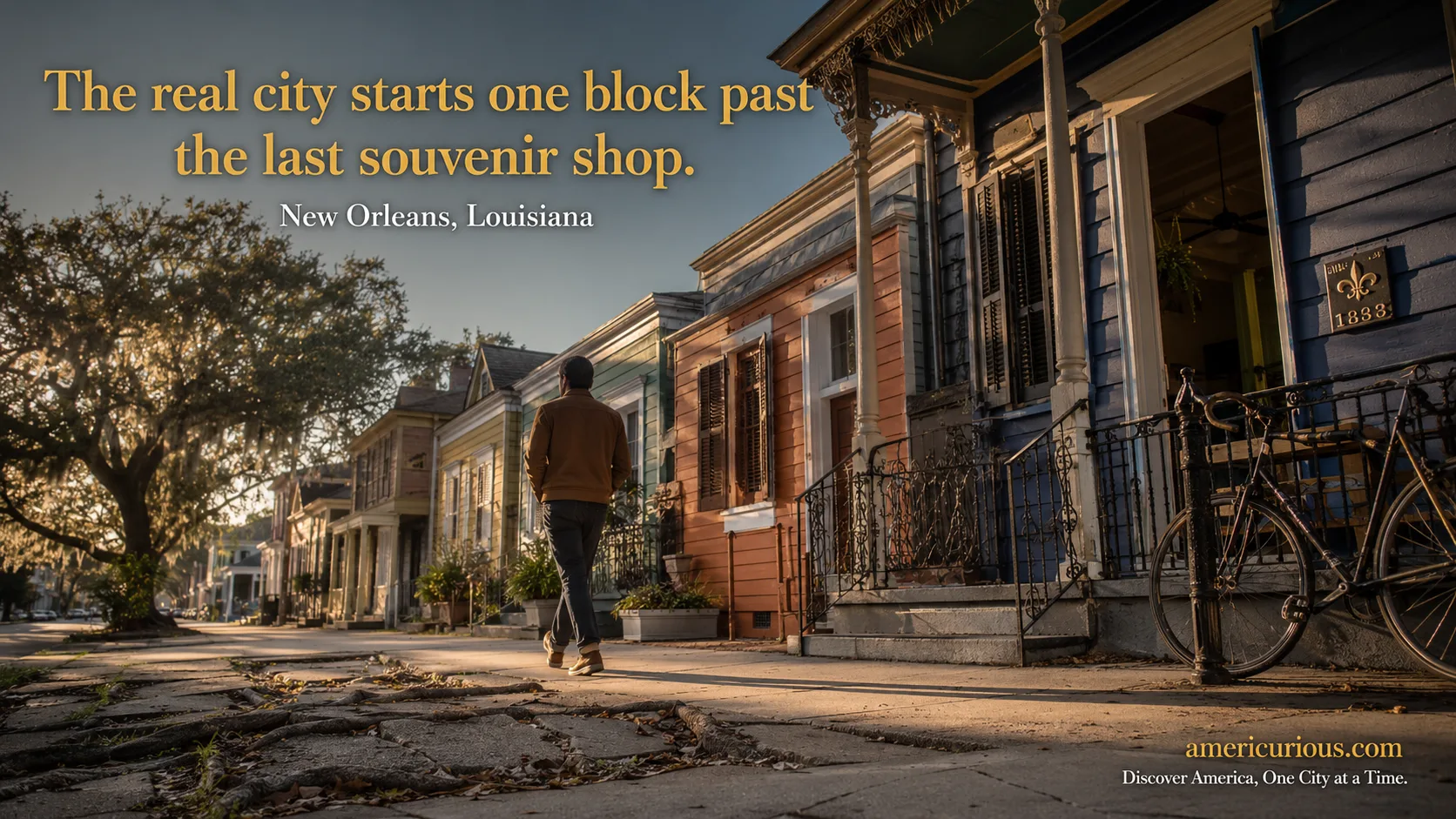
This New Orleans walking guide takes you 4 miles through the Faubourg Marigny and Bywater — where the real city lives. Every stop verified, every caveat honest. Plan your walk.
| Quick Facts | |
|---|---|
| Route distance | Approximately 4 miles — to Crescent Park via Frenchmen Street and the Marigny/Bywater neighborhoods (verified via Google Maps, May 2026) |
| Estimated walk time | 2 hours at a moderate pace; plan 3 hours with stops |
| Difficulty | Easy |
| Terrain | Paved sidewalks (uneven in places); smooth asphalt trail in Crescent Park |
| Best time to walk | Early morning (7–9am), October–April; avoid midday June–September |
| Dog-friendly | Yes — Crescent Park has a dedicated off-leash dog run |
| Stroller/wheelchair accessible | Partial — Marigny and Bywater sidewalks are often cracked and root-heaved; Crescent Park’s Elysian Fields entrance is ADA-compliant with elevator |
| Public transit access | Rampart–Loyola Streetcar (Line 46) terminates at Elysian Fields Ave, near the route’s end |
| Parking near start | Multiple lots within 0.3 miles of 800 Decatur St; approximately $10–25/day |
| Restrooms on route | Crescent Park (confirmed via AllTrails); limited on streets — budget a café stop |
| Food and coffee stops | 4 along or adjacent to the route |
| What makes it worth it | The city’s actual sound, color, and architecture — two neighborhoods deep and not a souvenir shop in sight |
The Walk, in Brief
You’ll start at a table covered in powdered sugar and end standing on a steel bridge over railroad tracks with the Mississippi River filling the frame in front of you and the Bywater rooflines behind. In between, you’ll cross Esplanade Avenue — the hard, physical boundary between the tourist city and the one people actually live in — walk Frenchmen Street before the crowds arrive, move through the shotgun-house blocks of the Faubourg Marigny past a church built in 1853 for German immigrants that’s now a contemporary ballet venue, cross a street named for a man who lost a Supreme Court case in 1896 and deserved better, and pass through the Bywater’s warehouse-art corridor before arriving at one of the most underused public parks in America.
The route is approximately 4 miles from Café Du Monde to the far end of Crescent Park. It’s flat, it’s walkable, and it’s the version of New Orleans that most travel content manages to edit out entirely.
Route Snapshot — Café Du Monde to Crescent Park, New Orleans
| Stop | Landmark or Point of Interest | Distance from Start | Notes |
|---|---|---|---|
| Start | Café Du Monde, 800 Decatur St | 0.0 mi | Cash only; takeout window on far side moves faster than the main line |
| Stop 1 | Esplanade Avenue at Decatur St | 0.4 mi | The actual dividing line between the French Quarter and the Marigny — cross it |
| Stop 2 | Frenchmen Street at Chartres St | 0.6 mi | Art market most evenings; music from open doors at almost any hour on weekends |
| Stop 3 | Washington Square Park, 700 Elysian Fields Ave | 1.0 mi | Shady oaks, chess games, dogs — good reason to slow down for ten minutes |
| Stop 4 | Marigny Opera House, 725 St. Ferdinand St | 1.4 mi | Built 1853 for German immigrants, closed 1997, reopened 2011 as a performance space |
| Stop 5 | Homer Plessy Way crossing at Royal St | 2.0 mi | Named in 2021 for the plaintiff in Plessy v. Ferguson, who lived near this intersection |
| Stop 6 | Studio BE, 2900 Royal St | 2.2 mi | Brandan “BMike” Odums’ warehouse murals — exterior always viewable; check hours for interior |
| Stop 7 | Satsuma Café, 3218 Dauphine St | 2.5 mi | Open 8am–3pm daily; arrive before 10am on weekends for a table |
| End | Crescent Park, Piety Street entrance (~3360 Chartres St) | ~3.2 mi (+1.4 mi through the park) | Enter via the Piety Street Arch bridge; walk to the Rusty Rainbow for the river views |
The Route, by Map
This is a point-to-point walk running roughly east-southeast from the edge of the French Quarter through Faubourg Marigny and into the Bywater, tracing the inside curve of the Mississippi River’s crescent bend. It begins at Café Du Monde, crosses into the Marigny at Esplanade Avenue, threads through Frenchmen Street and down Royal Street, crosses Homer Plessy Way into the Bywater, and ends at Crescent Park — a 1.4-mile linear park reclaimed from old railroad and industrial land directly on the riverfront. There are no loops. You’ll end a considerable distance from where you started, which means planning for a rideshare back or the Rampart–Loyola Streetcar.
Open this route in Google Maps and select Walking as your directions mode. The most direct walking path is shorter than 2 miles, but this article’s route moves through Frenchmen Street and meanders several Marigny and Bywater blocks that are the entire point — the real distance is approximately 4 miles total, including the park.
Route in Google Maps
From Beignets to the Other Side of Esplanade
The walk begins at Café Du Monde, 800 Decatur Street, which has operated continuously at this location since 1862 and earns its reputation through consistency rather than spectacle: beignets arrive hot under a drift of powdered sugar, the café au lait is chicory-blended and better than it has any obligation to be, and the whole operation runs 24 hours a day, cash only. Order at the takeout window on the far side of the building if the seating line looks long. Get a table facing the river if you can. Then walk northeast along Decatur Street, past the French Market stalls, until you reach Esplanade Avenue.
This crossing is not subtle. On the Decatur Street side: souvenir shops, daiquiri vendors, tour buses idling. Step across Esplanade and within half a block the architecture changes, the foot traffic thins, and the city stops performing for visitors. Esplanade itself is worth a moment’s pause — this was once the city commons, a grand boulevard along which wealthy Creole families built their mansions on the high ground of what frenchquarter.com, in an April 2025 feature on the faubourgs, describes as a ridge reflecting the city’s “heritage of French-style framing.” The street now runs as a dividing line, as it has for two centuries, between the Quarter and the Marigny.
Turn onto Frenchmen Street and head toward the river. Between Chartres and Royal, Frenchmen is a few compact blocks of music venues, a regular outdoor art market, and neighborhood bars with open doors. At almost any hour on a weekend, you can hear live music drifting out of those doors without paying a cover. On weekday mornings, the street is quieter and you get the architecture: Creole cottages and shotgun houses painted in colors that would require a permit variance in any city that had normalized restraint. Walk slowly. There’s no reason to rush.
The Marigny Proper: A Neighborhood Reading Its Own History
Continue from Frenchmen Street south along Chartres, then pick up Royal Street heading east into the heart of the Marigny. This is not Royal Street as the French Quarter visitor knows it. It’s narrower, residential, and lined with the housing stock that the Preservation Resource Center of New Orleans describes as “bright Creole cottages, shotguns and Classical Revival houses” — the homes of working chefs, musicians, and artists in the actual sense, not the marketing-brochure one.
Washington Square Park at 700 Elysian Fields Avenue is where you stop moving for a few minutes. It’s a shady, oak-shaded square surrounded by shotgun houses, and on any given morning you’ll find chess games at the picnic tables, dogs on leashes, and neighborhood residents going about their Tuesday. Faubourg Marigny was subdivided beginning in 1806 when Bernard de Marigny, a Creole landowner who inherited his family’s plantation at age 15, began selling 60-foot lots to builders. Those early residents included free people of color, Irish and German immigrants, and Haitian refugees from Saint-Domingue, all building homes along streets that extend the French Quarter’s grid at a slight angle. The neighborhood’s DNA was multiracial and multilingual from the beginning.
At 725 St. Ferdinand Street, the Marigny Opera House earns a long look even if you walk past it. The building was designed by architect Theodore Giraud and opened in 1853 as Holy Trinity Catholic Church — built specifically for the neighborhood’s German immigrant community — and was rebuilt after an 1851 fire destroyed the original structure. The Archdiocese closed it in 1997. After renovation, it reopened in 2011 as a performing arts center and now houses the Marigny Opera Ballet and Opera Créole. The facade is brick and spare, not grand. But knowing what the building has been — immigrant parish, abandoned structure, arts venue — makes it a more interesting building than any well-preserved landmark designed to be impressive.
A note on street names: when Bernard de Marigny subdivided his plantation, he reportedly named several streets to reflect his personality. One was called Rue de l’Amour. Another was called Rue des Bons Enfants (Good Children Street). One was named after the dice game he helped popularize in America — a name the city later changed to Burgundy because city planners had their limits. Burgundy Street still runs through the neighborhood today, carrying its backstory invisibly.
Where the Neighborhood Changes Its Name
Cross Homer Plessy Way — formerly Press Street, renamed in 2021. Homer Plessy was a New Orleans shoemaker of Creole descent who in 1892 deliberately boarded a whites-only railroad car near this neighborhood to challenge Louisiana’s Separate Car Act. He lost, famously, in the Supreme Court’s Plessy v. Ferguson ruling of 1896, which established the “separate but equal” doctrine that wouldn’t be formally overturned until Brown v. Board of Education in 1954. Plessy lived within a few blocks of this intersection. The street renaming was a form of the city settling an old debt. There’s no monument, just a street sign — which is somehow better.
You’re now in the Bywater, and the shift in register is real. The Marigny carries a carefully preserved residential quality; the Bywater runs more industrial, more painted-over, more experimental in its relationship with vacant lots and reclaimed buildings. At 2900 Royal Street, Studio BE is the warehouse art space created by New Orleans artist Brandan “BMike” Odums. The exterior alone stops foot traffic: large-scale murals cover the building’s walls, including an image of an African American girl painted with what looks like radiant light, accompanied by a poem by Cleo Wade. Inside — hours vary, check before you go — the floor-to-ceiling murals address Black resilience, social justice, and cultural pride using a scale that a standard gallery can’t accommodate. Whether or not the interior is open, the exterior is the most concentrated public art experience on this entire route, and it belongs to the neighborhood in a way that feels correct.
Where to Eat and Drink Along the Way
Flora Gallery & Coffee Shop
(2600 Royal St, Marigny) opens at 6:30am every day and stays open until midnight — which is its own kind of statement about what a neighborhood coffee shop can be. Local art rotates on the walls, there’s a vintage piano in the back room, and the shop cats have long since determined the seating arrangements. The dark roast drip coffee and whatever’s on the pastry board are the move. More than the food, this place rewards sitting still: it’s the kind of local institution where the staff knows everyone’s name and you can sense a long, ongoing conversation that paused when you walked in and will resume when you leave.
Satsuma Café
(3218 Dauphine St, Bywater) is open daily 8am–3pm — confirmed from the café’s own website as of 2026. After a day or two in New Orleans eating things that were fried before they were sauced, Satsuma’s cold-pressed juices, avocado toast with whipped feta and chili oil, and fresh salads hit differently than they would anywhere else. The patio is pleasant for watching the Bywater go by. Arrive before 10am on weekends if you want an outdoor seat; after that, the place fills with people who live nearby and have strong feelings about which table is theirs.
Bacchanal Wine
(600 Poland Ave, Bywater) is a short detour south of the main route but worth building around. The wine shop opens at 11am daily, with the backyard garden available Friday through Sunday from noon per Bacchanal’s own website. The model is simple and surprisingly civilized: you browse the wine shop, pick a bottle, take it outside to the mismatched backyard furniture, and order small plates while live jazz plays. The setting looks like it was assembled with no particular plan and turned out perfect. Bacchanal has been a Bywater anchor since before the neighborhood was widely known — it survived Katrina as an impromptu feeding operation when guest chefs showed up and cooked for anyone who came — and the place feels like it knows exactly what it is.
What Most People Walk Straight Past
The Marigny Opera House at 725 St. Ferdinand has a small plaque most walkers ignore. The original 1851 structure was destroyed in a fire. In the late 1860s, yellow fever killed two of the rebuilt church’s priests. The building then sat unused for fourteen years before its current renovation. All of this happened within three blocks of where people are currently discussing brunch plans.
On the murals: Studio BE’s exterior at 2900 Royal is widely photographed, but the mural on the former Frankie & Johnny’s Furniture store on St. Claude Avenue — celebrating Social Aid and Pleasure Club leader Ronald Lewis and the second-line tradition — is quieter and doesn’t appear in most walking guides. Social Aid and Pleasure Clubs are a New Orleans institution rooted in the African American community, originally functioning as mutual aid societies that also organized the famous second-line parades. The mural is a neighborhood memorial in a neighborhood that builds memorials on buildings rather than pedestals.
Flora Gallery’s interior contains a long, slowly changing exhibition of local artists’ work. The pieces are for sale and the prices are on the labels, but most people treat it as wallpaper. It isn’t. Spend two minutes actually looking at what’s on those walls.
The Crescent Park’s “Rusty Rainbow” pedestrian bridge — the steel arch over the railroad tracks at the Piety Street entrance — is the route’s best single view. From the top of the bridge, you see the Mississippi in one direction and the Bywater rooflines in the other, with the downtown skyline framing the right edge. Almost everyone crosses the bridge without stopping. Stop on the bridge.
Practical Stuff Worth Knowing Before You Go
Parking:
Multiple lots within three blocks of Café Du Monde on St. Peter, Chartres, and Decatur Streets run approximately $10–25 per day — weekends are higher, as confirmed by user reports from January 2026. If you prefer to park near the end of the route and take transit back, the lot at 400 Elysian Fields offers paid parking adjacent to the Crescent Park entrance.
Transit:
The Rampart–Loyola Streetcar (Line 46) runs from Union Passenger Terminal through the Central Business District and along Rampart Street to its terminus at Elysian Fields Avenue — within easy walking distance of the Marigny and the Crescent Park entrance. A single fare is $1.25; a 24-hour Jazzy Pass is $3. The line reopened June 1, 2025 after extended closures related to the Hard Rock Hotel collapse construction. Verify current schedules on the RTA website before your trip, as this line has had service interruptions.
Crescent Park hours:
In May 2025, management of the park transferred from the French Market Corporation to New Orleans Parks and Parkways — and the transition has been rocky. As of October 2025, posted hours shifted to 6am–7:30pm (Standard Time) and 6am–6:30pm (Daylight Saving Time), shorter than historical norms. In January 2026, a fire broke out from a riverside encampment downstream of the main bridge. Check current status via the Bywater Neighborhood Association’s Crescent Park page before you arrive; hours have not been enforced consistently since the management change.
Footwear:
Wear proper walking shoes. New Orleans sidewalks in the Marigny and Bywater are root-heaved, cracked, and uneven in ways that will find the weakness in any casual footwear. This is not a suggestion.
Restrooms:
Crescent Park has public restrooms (confirmed by AllTrails). On the streets through the Marigny and Bywater, restrooms mean stopping at a café — budget a coffee purchase accordingly.
Season:
October through April is the practical recommendation. Summer heat in New Orleans — 90°F with 80%+ humidity — is real and doesn’t become less real because you’re looking at interesting architecture. If you walk in summer, start before 8am, bring water, and finish before the humidity peaks.
The Honest Caveat
The Marigny and Bywater are among New Orleans’ safest and most walkable neighborhoods during daytime hours. Multiple sources from 2024–2025, including a booknola.com safety overview, note that city-wide crime decreased significantly in 2024 and that these neighborhoods are among the most consistently pedestrian-friendly areas in the city. The main practice that applies here is the same one that applies anywhere in any American city: phone in pocket rather than hand, bag secured, awareness of surroundings.
Some Bywater blocks — particularly south of Crescent Park heading toward Poland Avenue — are genuinely quiet in a way that can read as isolated at certain hours. This is a neighborhood with residential stretches, not a commercial district with constant foot traffic. Walking in pairs is a reasonable call in these sections.
On the park itself: the combination of the management transition, the pathway lighting outage (reported in October 2025 and still apparently unresolved), and the January 2026 fire along the riverbank means that Crescent Park in 2026 is not operating with the consistency it had prior to 2024. Day visits are fine and the views are still the best in Bywater. Evening visits are less reliable given the shortened and inconsistently enforced closing times. The petition from November 2025 to restore longer hours suggests this is an active community concern, not a resolved one.
Finally: the walk passes through neighborhoods where gentrification is ongoing and the tension between longtime residents and newer arrivals is visible, discussed, and felt. The Marigny’s demographics have shifted significantly over the past two decades, as dirtycoast.com’s neighborhood analysis notes. Walking through with awareness of this — spending money at genuinely local businesses, being a considerate presence rather than a performance audience — is not overthinking it. It’s just paying attention.
Who This Walk Is Actually For
This is a walk for the person who has been to New Orleans once and left feeling like they got the show rather than the city — or for someone visiting for the first time who had the sense to ask a local what to actually do on a Tuesday morning. It suits the deliberate walker who reads street signs, the person who can spend twenty minutes in a coffee shop without looking at their phone, and the prospective New Orleans resident trying to understand what a neighborhood actually feels like at 8am on a weekday. It’s a poor match for anyone who needs air conditioning every forty minutes, or who measures a walk by how many attractions they checked off. It’s a very good match for someone who walks a city the way a good reader reads a book — slowly, willing to go back, paying attention to what the thing is actually saying.
Walker’s Checklist
- Wear genuine walking shoes — Marigny and Bywater sidewalks are root-heaved and will expose any weakness in casual footwear within the first half-mile
- Start before 9am on weekends; Frenchmen Street at 8:30am on a Saturday belongs to you; at 11am it belongs to everyone
- Bring cash — Café Du Monde is cash only, and several stops along this route strongly prefer it
- Stop at the Café Du Monde takeout window on the far side of the building if the main seating line is long
- Download the Google Maps route offline before you leave; cell coverage on some Bywater blocks can be unreliable
- Check Crescent Park’s current hours via the Bywater Neighborhood Association website (bywater.org/crescent-park) — they’ve been inconsistently enforced since the May 2025 management transition
- Check Studio BE’s interior hours at studiobe.org before you arrive if you want to go inside; exterior murals are always viewable
- Bring a full water bottle — there are no obvious public water sources on the route until you reach Crescent Park
- Wear sunscreen and a hat from April through November; Crescent Park is almost entirely sun-exposed
- Plan your return trip before you go — this is a point-to-point walk that ends in Bywater, not at your starting point; a rideshare, the Rampart–Loyola Streetcar, or a pre-arranged pickup is your exit
FAQs
How long does the Café Du Monde to Crescent Park walk actually take?
The route covers approximately 4 miles and takes about 2 hours of walking at a moderate pace, not counting stops. Add 45–60 minutes if you’re stopping at Flora Gallery, Satsuma Café, or spending time at Studio BE — and another 30 minutes at minimum for the Piety Street bridge, which everyone underestimates. Plan for 3 hours if you want to do it without rushing anything.
Is the Marigny and Bywater walk safe for solo travelers?
Yes, during daytime hours. The Marigny and Bywater are consistently identified as among New Orleans’ most walkable and tourist-friendly neighborhoods, with foot traffic throughout the day and decreased city-wide crime rates in 2024. Standard urban awareness applies: keep your phone in your pocket rather than visible in your hand, keep your bag secured, and use rideshare rather than walking after dark in the quieter residential sections. Solo travelers, including solo women, regularly complete this walk without incident on morning and afternoon visits.
What’s the difference between Frenchmen Street and Bourbon Street?
Frenchmen Street is where working musicians play for audiences who came specifically to hear music; Bourbon Street is where tourists drink to a soundtrack. The clubs on Frenchmen — the Spotted Cat, Snug Harbor, d.b.a. — book nationally recognized artists on a regular basis. The music runs from roughly 9pm late into the night, but even before that, street musicians set up outside and the sidewalk functions as a free outdoor venue. You don’t need to spend anything to hear excellent jazz on Frenchmen; you just need to be there and walk slowly.
Can I bring my dog on this walk?
Yes. Dogs are welcome throughout the Marigny and Bywater, and Crescent Park has a dedicated off-leash dog run confirmed by AllTrails. Most of the coffee shops and bars along the route have outdoor seating that accommodates dogs. Bring water — the heat and humidity hit dogs faster than they hit their owners, and public water sources are sparse until the park.
What are Crescent Park’s current hours?
As of late 2025, Crescent Park is posted to open at 6am daily. Closing times shifted to 7:30pm (Standard Time) and 6:30pm (Daylight Saving Time) after the management transition to New Orleans Parks and Parkways in May 2025 — earlier than the park’s historical hours. These closing times have not been enforced consistently. Check current status via the Bywater Neighborhood Association’s Crescent Park page before you plan your arrival.
Is this walk stroller-friendly?
Only partially. The street sections through the Marigny and Bywater involve historic sidewalks that are cracked, root-heaved, and frequently interrupted by driveways without curb cuts — navigating a stroller through most of this route is genuinely difficult. Crescent Park itself is the exception: it has a smooth asphalt trail and an ADA-compliant entrance with an elevator at the Elysian Fields end, making the park section accessible. The challenge is getting there.
Is there a good time of year to avoid?
Late June through mid-September is the practical answer. The combination of temperatures reliably above 90°F and humidity above 80% turns what should be a 2-hour walk into something that requires real heat preparation. October through April is the sweet spot — cooler, drier, and the afternoon light in winter in New Orleans is extraordinary for photography and for simply looking at buildings.
Why This Walk Is Worth Lacing Up For
Two centuries of improbable history are embedded in the sidewalks of this route — in street names that carry dice-game jokes and civil rights debt, in churches converted into ballet venues, in warehouse walls painted with images that are trying to say something specific and important about the neighborhood they’re in. New Orleans is one of those cities where the past doesn’t stay safely in the past; it keeps turning up in the present tense, on corner signs and building facades, in the way a coffee shop has been open since before Katrina and simply kept going. This walk doesn’t explain New Orleans. It puts you in physical contact with it. It’s waiting for the person who already suspects that the French Quarter, for all its beauty, is not the whole sentence.
Article researched and written with data collected May 2026. Business hours, Crescent Park management details, and RTA service information should be verified before your visit, as these are subject to change. Walking distance estimates based on Google Maps and confirmed route research.
Discover more from AmeriCurious
Subscribe to get the latest posts sent to your email.