
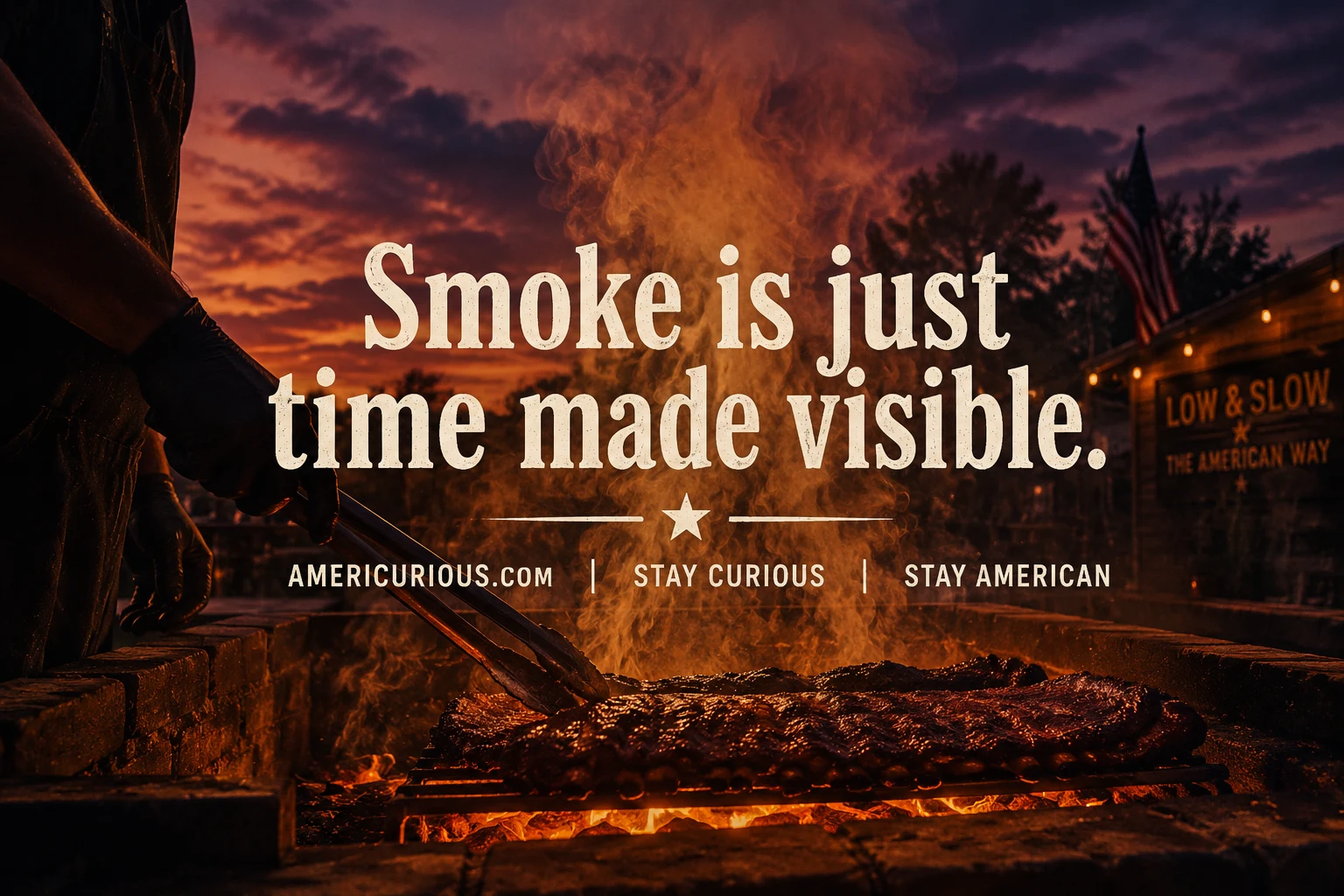
American barbecue regional styles reveal who we really are — from Texas brisket to Carolina whole hog. Here’s the living history behind every rack and rub.
The smoke hits you before the building comes into view. That’s how you know you’re close to something real. Forget the review apps for a second — no algorithm has ever successfully ranked the feeling of pulling off a county road in the Carolinas, following your nose down a gravel lot, and finding a cinderblock building that’s been feeding the same town since before your parents were born. American barbecue isn’t a cuisine so much as a confession — of who settled where, what they raised, what they had, and what they knew how to do with fire and time.
The Story Begins Here: Fire, Time, and Four Hundred Years of Flavor
The roots run deeper than most menus admit. American barbecue is genuinely old — old in the way that makes historians cautious and food writers reach for adjectives. One of the earliest documented accounts of pit-cooked pork on American soil dates to December 1540, when Spanish explorer Hernando de Soto attended a feast with the Chickasaw people in present-day Mississippi. The techniques already in use — low heat, slow time, smoke as both flavor and preservation — were Indigenous knowledge, refined over generations. What followed was centuries of cultural collision and exchange.
Then came the people who were forced here. Enslaved Africans, with their own deep traditions of pit cooking from West Africa and the Caribbean, were the ones who literally worked the pits across the antebellum South. In practice, if not in name, they were the first true pitmasters — managing the fires, judging the heat, perfecting the smoke for events that fed hundreds. As culinary historian Adrian Miller documents in his essential book Black Smoke, the contributions of Black cooks were foundational, frequently celebrated locally, and just as frequently erased from the broader record. Understanding that history doesn’t complicate barbecue. It completes it.
By the early 20th century, regional styles had calcified into identities. German immigrants in the Texas Hill Country had cattle and applied Southern smoking techniques to beef rather than pork, giving rise to what we now call Central Texas BBQ. In Memphis, the city’s position as a Mississippi River port made molasses and tomatoes easy to source, and those ingredients shaped the sauce. What grew from these local conditions wasn’t a unified “American barbecue” — it was a living argument between regions, and that argument has never really stopped.
“Barbecue is the rare American food that carries an entire community’s history in a single bite. The smoke doesn’t lie about where it came from.” — AmeriCurious
Why This Is More American Than You Think: A Nation Built on the Pit
Here’s the countercultural truth about barbecue. Most Americans think of it as a backyard activity — hamburgers on a gas grill, Memorial Day weekend, the usual. That’s barbecue as a verb, not a noun. Real barbecue — pit-smoked, low and slow, hours and hours over hardwood — is something else entirely. It’s an art form with regional dialects, a living tradition that predates the United States itself. And most Americans have never tasted all four of its major regional expressions, let alone the outliers. That’s not a failure. It’s an invitation.
The seasonality here matters. We’re deep into summer 2026 — peak barbecue season by every measure, from backyard cookouts to competitive circuits to the road-trip itineraries Americans are building right now. The National Restaurant Association’s 2026 What’s Hot Culinary Forecast [opens in new tab] found that diners are craving comfort, nostalgia, and authentic regional flavors above all else. Barbecue isn’t just trending. It’s the answer to what people actually want right now.
The argument between regions is, in a way, one of the most American arguments there is. Which state makes better ‘cue — Texas, Missouri, North Carolina, Tennessee? The debate is fierce and permanent and conducted with absolute sincerity. It’s the same pride that makes people argue about college football or claim their city’s pizza is the only real kind. Regional barbecue is one of the few remaining food traditions where the geography genuinely changes the dish, where two states 200 miles apart produce something meaningfully, measurably different. That’s not marketing. That’s culture.
🗳️ Quick Poll: Which BBQ Style Are You Loyal To? ○ Texas — brisket, smoke, and nothing else needed ○ Carolina — whole hog, vinegar sauce, full commitment ○ Kansas City — burnt ends, thick sauce, bring it all ○ Memphis — dry rub ribs, and I’ll fight about it
(Share your answer in the comments!)
The Details That Make It Real: A Region-by-Region Breakdown
Texas BBQ is a philosophy as much as a technique. In Central Texas, the rub is minimal — salt, black pepper, maybe a little paprika — and the focus lands entirely on the quality of the beef and the integrity of the smoke. Post oak wood is traditional. The brisket is the star, cooked for 12 to 18 hours until the bark is near-black and the interior is trembling. Sauce is available but optional, and ordering it without tasting first is quietly judged. East Texas loosens the rules a bit — more sauce, more variety in the cut — but the commitment to smoke remains non-negotiable.
[Personal touch: I drove two hours out of my way in the Texas Hill Country once for a brisket that a gas station attendant said was “probably the best.” She was not wrong. It took 45 minutes of standing in line and cost $22. Every penny.]
Carolina BBQ is the oldest argument in the country. Eastern North Carolina means whole hog — the entire animal slow-smoked over hickory and hardwood coals, then chopped and dressed with a vinegar-and-pepper sauce so thin it looks like it couldn’t do anything and tastes like it does everything. Cross into western NC (Lexington-style), and the cut shifts to pork shoulder and the sauce picks up a little tomato. Head south into South Carolina, and you’ll find Carolina Gold — a mustard-based sauce with German immigrant roots that turns the whole conversation sideways. As the Smithsonian Magazine has noted [opens in new tab], these regional distinctions developed because different immigrant populations brought different livestock, ingredients, and cooking knowledge — and then stayed put long enough for those habits to become traditions.
“The pitmasters who built this country’s barbecue culture worked through the heat and the smoke long before anyone put their name on the menu.” — AmeriCurious
Memphis runs on ribs and a peculiar creative freedom. The signature choice is wet or dry — wet ribs are basted during the smoke and finished with a tangy, tomato-forward sauce; dry ribs are rubbed, smoked, and served with nothing but the bark and the spice crust. Both are correct. Memphis also has a tradition of boundary-pushing that produced genuine oddities: barbecue spaghetti, pulled pork nachos, and BBQ pizza are all real dishes with real local followings. It’s the most experimental of the major regional styles, which makes sense for a city that also gave the world rock and roll.
| BBQ Region | Primary Meat | Sauce Style | Wood of Choice | Signature Dish |
|---|---|---|---|---|
| Central Texas | Beef brisket | None (or light) | Post oak | Salt-and-pepper brisket |
| Eastern NC | Whole hog pork | Thin vinegar-pepper | Hickory | Chopped whole hog sandwich |
| South Carolina | Pork shoulder | Mustard (Carolina Gold) | Hickory or oak | Pulled pork with gold sauce |
| Memphis | Pork ribs | Thick tomato OR dry rub | Hickory | Dry-rub spare ribs |
| Kansas City | Mixed meats, burnt ends | Thick sweet-tomato | Oak and hickory | Burnt ends |
| Alabama | Smoked chicken | White (mayo-vinegar) | Hickory | White sauce chicken |
Caption: The major American BBQ regions, their signature meats, sauces, woods, and must-try dishes. Note that within each region, sub-styles exist — Carolina alone could fill its own table.
📌 Fast Fact: Burnt ends — those gloriously caramelized chunks of brisket point — were originally scraps given away free at Kansas City joints. They became so popular they’re now often the most coveted item on the menu.
Hidden Layers: The Story Most People Miss
The most overlooked regional style in America is probably Alabama white sauce. In 1925, a man named Bob Gibson opened a barbecue restaurant in Decatur, Alabama. For reasons that remain somewhat mysterious — one theory involves the fat in mayonnaise acting as a moisture barrier for long-smoked chicken — he created a sauce unlike anything else in the American BBQ tradition: mayonnaise, apple cider vinegar, black pepper, and spices, blended into something tangy, creamy, and completely distinctive. Big Bob Gibson Bar-B-Q [opens in new tab] has been dunking whole chickens into vats of white sauce ever since. Four generations of the Gibson family have kept the recipe intact, and the restaurant celebrated its 100th anniversary in 2025.
Most Americans outside of northern Alabama have never encountered it. The sauce didn’t go retail until the mid-1990s. It doesn’t travel the way thick Kansas City sauce does. And yet white sauce is, by the testimony of anyone who’s had it on properly smoked chicken, one of the great regional flavor achievements in American food. Chris Lilly, the fifth-generation pitmaster at Big Bob Gibson’s, still cooks on the same wood-fired brick pits. The restaurant has won more than 10 World Championship titles on the competition circuit. And yet it’s probably the last regional BBQ style most Americans would name in a game of word association.
[Personal touch: The first time I had Alabama white sauce, I thought someone had made a mistake. By the third bite, I was rearranging my entire road trip to come back the next day.]
Kansas City’s origin story has its own hidden depth. Henry Perry — born in Memphis in 1874, trained as a cook on Mississippi riverboats from the age of 15 — arrived in Kansas City in 1907 and set up a stand in an alley in the Garment District. He sold cuts of smoked meat wrapped in newspaper for 25 cents to day laborers, jazz musicians, and anyone else who showed up. He called himself the Barbecue King, which was not humility but accuracy. Historians credit Perry as the originator of the Kansas City BBQ style [opens in new tab] — the first person in the city to make a genuine living from smoked meat. When Perry died in 1940, his restaurant passed to his employee Charlie Bryant, and then to Charlie’s brother Arthur. Arthur Bryant’s Barbeque is still in business today. Gates Bar-B-Q, the other legendary Kansas City institution, traces its lineage directly back to Perry’s methods as well.
🧠 AmeriCurious Quiz: How Well Do You Know American BBQ?
Q1: Kansas City BBQ style is credited to which pioneering pitmaster? A) Arthur Bryant B) Henry Perry C) Bob Gibson D) Charlie Vergos
Q2: Alabama white sauce is made with which unusual base ingredient? A) Mustard B) Tomato paste C) Mayonnaise D) Sour cream
Q3: Eastern North Carolina BBQ traditionally uses which sauce style? A) Sweet tomato-molasses B) Thin vinegar-pepper C) Mustard-based D) White mayo sauce
✅ Answers: Q1-B | Q2-C | Q3-B
The Human Story: What Smoke Carries Forward
The pitmasters who shaped American BBQ were rarely the people who got famous for it. Adrian Miller’s book Black Smoke documents a consistent and painful pattern: Black pitmasters — the people who developed the techniques, ran the pits, and created the flavors — were routinely credited to white hosts and business owners in newspaper accounts and cultural memory. At the 1895 Cotton States and International Exposition in Atlanta, as the Atlanta History Center has documented [opens in new tab], the work of Black barbecue cooks was attributed to the white Sheriff John Callaway. That pattern repeated itself across decades and cities.
The correction is underway, though imperfect. Rodney Scott, the Charleston pitmaster and whole-hog specialist, was inducted into the Barbecue Hall of Fame and released the first cookbook by a Black pitmaster in 30 years. The Jones sisters of Jones Bar-B-Q in Kansas City, Kansas — one of the oldest continuously operating barbecue restaurants in the country — have become fixtures on the food television circuit. These are not small things. They’re a reckoning with a long-deferred bill. What’s remarkable is that the pit itself never forgot. The technique, the smoke, the insistence on the whole animal and the slow time — those survived regardless of who got the credit. Some traditions are stubborn enough to outlast the people who tried to erase them.
“The technique survived. The smoke carries everything forward — even the parts of the story that people tried to leave out.” — AmeriCurious
When you’re in Birmingham or heading through Alabama on a road trip, the food tells its own version of this story. The city’s culinary scene reflects generations of Black Southern cooking tradition — something we explore more deeply in our Birmingham heritage and culture guide. And if you’re road-tripping through Texas — through the towns and byways where brisket joints and feed stores share county roads — you’ll find the same layered history in every smoker. Georgetown, Texas, the fastest-growing city most people haven’t caught up with yet, sits near a Hill Country corridor where German immigrant BBQ traditions blended with Southern pork smoking to produce something genuinely Texan.
[Personal touch: I once spent a full afternoon at a church barbecue fundraiser in western Tennessee — $12 for a plate that included pulled pork, three sides, cornbread, and a slice of pie. The pitmaster was 74 years old and had been cooking on the same drum smoker for 40 years. He said the secret was “not rushing the smoke.” I wrote that down and thought about it for about a hundred miles after.]
Your Move, America: How to Actually Explore Regional BBQ This Summer
The best barbecue itinerary is the one you actually take. Here’s a practical framework for exploring American regional BBQ — whether you’re doing a dedicated road trip or just building stops into wherever you’re already headed.
🔥 The AmeriCurious BBQ Road-Tripper’s Action List
🗺️ Start with the four corners: Aim to try at least one classic example of Texas, Carolina, Kansas City, and Memphis style before forming strong opinions about which is best. Ranking without tasting all four is like reviewing a book you’ve only read the back cover of.
🐷 Seek the whole-hog experiences: Eastern North Carolina and South Carolina have genuine whole-hog pitmasters still operating. Skylight Inn BBQ in Ayden, NC and Scott’s Bar-B-Que in Hemingway, SC are historically significant joints worth the detour.
🍗 Don’t skip Alabama: Make Big Bob Gibson Bar-B-Q in Decatur a destination, not an afterthought. Get the smoked chicken with white sauce. Get it twice.
🥩 In Kansas City, get the burnt ends: They’re not a side dish. They’re the point. Arthur Bryant’s and Gates Bar-B-Q both trace their roots directly to Henry Perry’s original stand — that lineage is worth honoring with your appetite.
♨️ Go on a Tuesday: The best barbecue joints sell out, especially on weekends. Weekday visits mean fresher product and less waiting. The locals know this.
📖 Read before you drive: Adrian Miller’s Black Smoke is the most important single book on American barbecue history and belongs in the glove compartment.
🛣️ Let the smoke navigate: If you’re driving a county road and you smell real wood smoke, pull over. That’s the best food GPS there is.
❓ Frequently Asked Questions
Q: What are the four main regional barbecue styles in America? A: The four most recognized American BBQ regions are Texas (beef-focused, minimal seasoning, smoke-forward), Carolina (pork-focused, vinegar-based sauces), Memphis (ribs served wet or dry, with tomato-forward sauce), and Kansas City (variety of meats, thick sweet-tomato sauce, famous for burnt ends). Within each region, particularly the Carolinas, significant sub-styles exist that differ by county or even city.
Q: Who invented Kansas City BBQ? A: Kansas City BBQ style is credited to Henry Perry, a Black entrepreneur born near Memphis, Tennessee, in 1874. Perry arrived in Kansas City in 1907 and set up a barbecue stand in the city’s Garment District around 1908. He is recognized by historians as the first person to commercially sell barbecue in Kansas City and to establish the local style. Two of the city’s oldest and most famous BBQ restaurants — Arthur Bryant’s and Gates Bar-B-Q — trace their roots directly to Perry’s methods.
Q: What is Alabama white sauce and where did it come from? A: Alabama white sauce is a mayonnaise-and-vinegar barbecue sauce created by Bob Gibson at his restaurant in Decatur, Alabama, around 1925. It’s tangy, pepper-forward, and traditionally used on smoked chicken. Big Bob Gibson Bar-B-Q has been making it for over 100 years and began selling it commercially in the mid-1990s. It’s considered the defining characteristic of northern Alabama barbecue and remains one of the most distinctive regional BBQ sauces in the country.
Q: What’s the difference between Eastern and Western North Carolina BBQ? A: Eastern North Carolina BBQ centers on whole-hog smoking, with the entire pig cooked over hardwood coals and dressed with a thin vinegar-and-black-pepper sauce that contains no tomatoes. Western North Carolina (sometimes called Lexington style) focuses on pork shoulder and uses a vinegar-tomato blend that’s slightly sweeter and thicker. South Carolina adds a third tradition: mustard-based Carolina Gold sauce, which reflects the influence of German immigrant settlers in the region.
Q: How did African Americans shape American barbecue? A: Enslaved African Americans were the primary labor force behind Southern barbecue from the colonial era through the antebellum period, developing and perfecting the pit-cooking techniques that define American BBQ today. They drew on West African and Caribbean cooking traditions and created the foundational skills that became regional styles. After emancipation, Black pitmasters opened restaurants and stands that anchored their communities — Henry Perry’s Kansas City stand and Marie Jean’s documented Arkansas cookery in 1840 are two examples. Despite this central role, Black pitmasters were frequently uncredited in public accounts, a history that is currently being more fully recognized and documented.
Join the Conversation
What’s your most memorable barbecue experience — the place, the dish, the moment you thought “this is it”? Drop it in the comments. The more specific, the better.
If you’re building a summer road trip or just want to send someone a reason to get off the highway and follow the smoke, share this one. It’s worth the detour.
And if you want more of this — the real stories behind American food, the places worth the drive, the history no one puts on the laminated menu — subscribe to americurious.com. We don’t rush the smoke, either.
— AmeriCurious
americurious.com
Stay Curious | Stay American 🇺🇸
📚 Sources & Further Reading
[1] Smithsonian Magazine, “The Evolution of American Barbecue,” smithsonianmag.com. https://www.smithsonianmag.com/arts-culture/the-evolution-of-american-barbecue-13770775/
[2] KCUR / Southern Foodways Alliance, “Henry Perry, Kansas City’s ‘Barbecue King,’” southernfoodways.org. https://www.southernfoodways.org/gravy/henry-perry-kansas-citys-barbecue-king/
[3] KCUR, “Meet Henry Perry, the Black entrepreneur who created Kansas City barbecue,” kcur.org, 2021. https://www.kcur.org/arts-life/2021-02-13/kansas-city-barbecue-bbq-henry-perry-gates-arthur-bryants-history
[4] Atlanta History Center, “From Pit to Plate: How We Became a Barbecue Nation,” atlantahistorycenter.com, 2025. https://www.atlantahistorycenter.com/blog/from-pit-to-plate-a-brief-history-of-american-barbecue/
[5] Destination BBQ, “Alabama White Sauce: Origin, Ingredients & Uses,” destination-bbq.com, 2026. https://destination-bbq.com/glossary/alabama-white-sauce-explained/
[6] National Restaurant Association, “2026 What’s Hot Culinary Forecast,” prnewswire.com, November 2025. https://www.prnewswire.com/news-releases/national-restaurant-association-unveils-2026-culinary-forecast-smash-burgers-global-comfort-and-value-top-the-list-302619409.html
Discover more from AmeriCurious
Subscribe to get the latest posts sent to your email.