
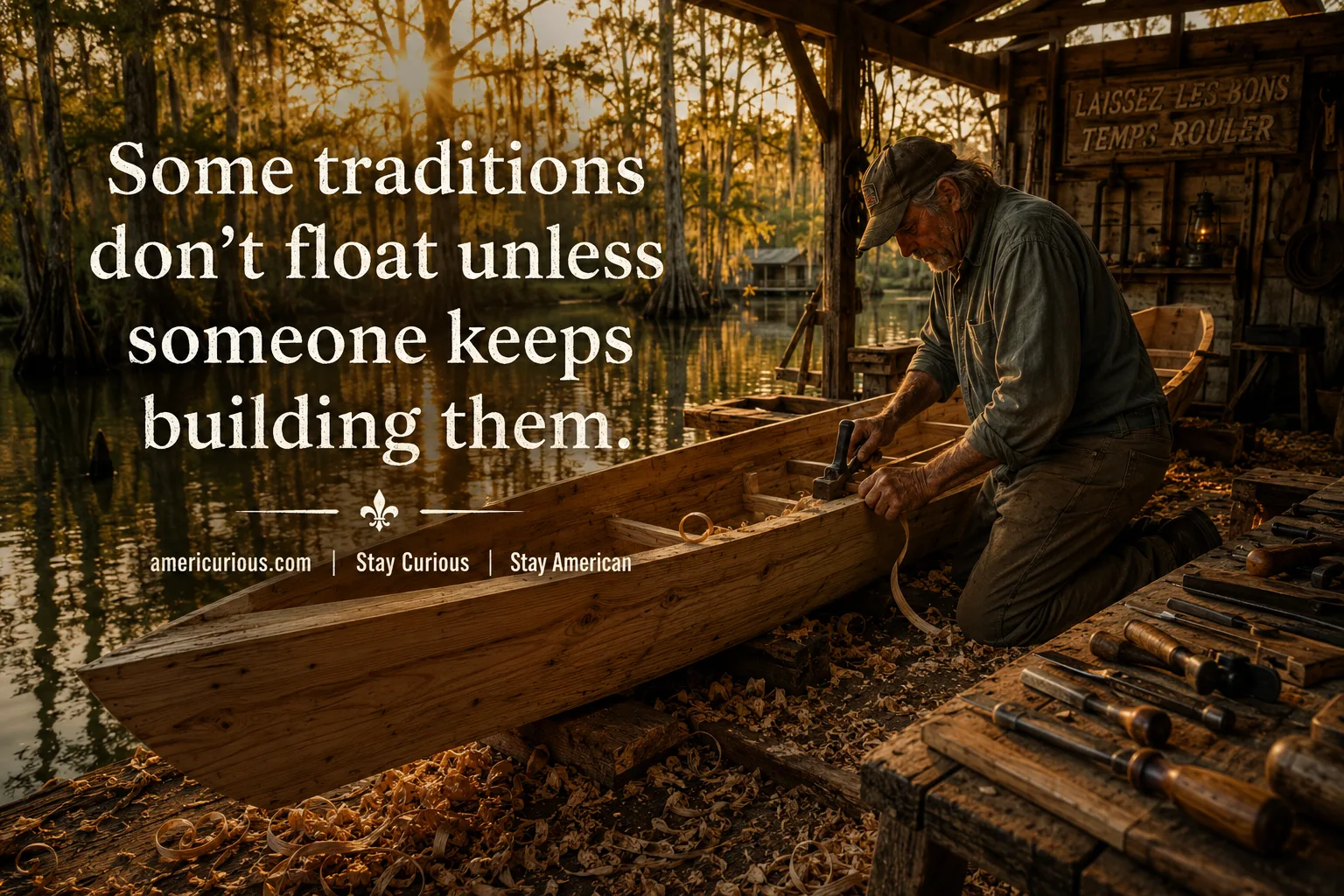
Meet the last Cajun pirogue builders keeping a 300-year Louisiana boatbuilding tradition alive, one cypress log at a time, before it disappears.
The first time I watched a man split a cypress log into a boat, I expected sawdust and noise. What I got instead was silence — the kind that comes from someone who has done a thing ten thousand times and still respects it. Down in Lafourche Parish, Louisiana, that silence is getting rarer every year, and so are the hands that know how to fill it. This is the story of the pirogue, the flat-bottomed little boat that built a culture, and the handful of Cajun craftsmen still racing the clock to keep it alive.
The Story Begins Here
A boat shaped by water, not by blueprint.
Long before French settlers arrived in the bayous of south Louisiana, Indigenous peoples were hollowing cypress logs into narrow, flat-bottomed canoes suited to shallow, marshy water. The French adapted that design, refining the hull with axes, planes, and draw knives rather than fire, producing a lighter, more stable craft known as the pirogue — a small, narrow, flat-bottomed boat pointed on each end. The word itself carries that layered history, an Indigenous concept reshaped by European hands and Cajun necessity.
A working boat, not a showpiece.
For generations, pirogues weren’t built for tourists or trophy cases — they were built because families needed them to fish, trap, and hunt in water too shallow and too narrow for anything bigger. Hundreds of folk boats are built each year without blueprints or plans in backyards and small boatyards scattered throughout south Louisiana, a tradition passed down strictly through watching, doing, and getting corrected by someone older. That’s a detail worth sitting with: no blueprints, ever, just memory and muscle.
A craft that survived because it had to.
The pirogue isn’t a museum piece in spirit, even when it ends up in one. As one Garden & Gun feature on the dwindling number of Cajun boatbuilders put it, the aluminum johnboats that replaced wooden pirogues are too loud for sneaking up on a flock of feeding ducks, and getting into the back swamps still requires a shallow, narrow, nimble hull. In practice, that means the old design never really got obsolete — it got harder to find someone who could build it right.
Why This Is More American Than You Think
We talk about American ingenuity in factories and garages — rarely in swamps.
But the pirogue is as American an invention story as the assembly line, just quieter and wetter. It’s a tool born from watching a landscape closely enough to build the one boat that landscape demanded, then refining it across three centuries and at least two cultures. That sounds simple — but it isn’t. Few crafts ask you to read a swamp the way pirogue-building does.
Here’s the countercultural clarity moment most Americans miss:
we tend to think of “heritage crafts” as decorative — quilts on a wall, pottery on a shelf. The pirogue was never decorative. It was infrastructure, built by hand, for people whose entire livelihood — fishing, trapping, transportation — depended on getting the hull exactly right. That’s not folk art in the soft sense; that’s engineering passed down through families instead of through textbooks. When did we start assuming “traditional” means “ornamental”?
This is small-town American ingenuity at its most honest.
No patents, no franchise, no national brand — just generations of Louisiana families solving the same practical problem better and better. It’s the same impulse that built the first diner counter or the first backyard workshop invention, just rooted in bayou mud instead of a city sidewalk. [I once tried paddling a borrowed pirogue on a calm bayou and capsized it in under four minutes — turns out “easy to maneuver” assumes you’ve done this before.]
“A boat that takes three centuries to perfect deserves more than a glance and a photo.” — AmeriCurious
🗳️ Quick poll:
If you had to learn one vanishing American craft from scratch, which would you choose?
○ Wooden boatbuilding ○ Blacksmithing ○ Hand-quilting ○ Traditional pottery
(Share your answer in the comments!)
The Details That Make It Real
Names matter here, because so few names are left.
Among the dwindling community of traditional builders, Willie Badeaux of Des Allemands is one of the few Louisiana craftsmen to continue making traditional dugout pirogues, while others have adapted the form: Valcour Rodrigue of Lockport specializes in large, inboard motorized pirogues designed for the marsh. Builders like Richard Hayes and Eddy Greig have gone further, blending traditional form with new techniques and materials, proof that this craft is still evolving rather than just being preserved in amber.
The Center keeping the whole tradition afloat.
The nonprofit Center for Traditional Louisiana Boat Building has anchored this culture since it was originally founded on the Nicholls State University campus in 1979, before moving to a larger facility in Lockport in 2007. That Lockport home was badly damaged by Hurricane Ida in 2021, forcing its historic boat collection into storage — a real, recent setback for a culture already running thin on builders.
📌 Fast Fact:
The Center for Traditional Louisiana Boat Building is now raising $2 million to construct a new museum and workshop back on the banks of Bayou Lafourche, near where it started in 1979 — and as of recent reporting, roughly 20 percent of that goal had been raised.
The Center for Traditional Louisiana Boat Building’s journey, from founding to its planned homecoming.
| Era | Where the Center Lived | What Happened |
|---|---|---|
| 1979–2006 | Nicholls State University, Thibodaux | Founded by Tom Butler and Dr. John Rochelle to preserve the craft |
| 2007–2021 | Lockport, LA | Expanded exhibits and hands-on workshops for two decades |
| 2021–2024 | In storage | Hurricane Ida heavily damaged the Lockport facility |
| 2025–present | Returning to Nicholls State, Thibodaux | New $2M museum and workshop campaign launched |
What it actually takes to build one.
A pirogue builder needs an instinct for which cypress tree is straight-grained enough to hollow, how thin the hull can go before it’s fragile, and how to seal every seam tight. None of that comes from a manual — it comes from years standing next to someone who already knows. What consistently works, according to builders interviewed over the decades, is patience measured in seasons, not weekends.
✅ What a traditional pirogue build actually requires:
- 🌲 A mature cypress tree with straight, knot-free grain
- 🪓 Hand tools — axes, draw knives, adzes — not power tools
- 👴 Years of apprenticeship under an experienced builder
- 🪵 A deep, almost instinctive read of wood thickness and balance
- 💧 Patience to seal seams tight enough to be watertight without modern sealants
Hidden Layers (What Most People Miss)
This isn’t just a Cajun story — it’s a multicultural one.
Most people assume the pirogue is purely Cajun, but its lineage runs through Indigenous builders first, then French settlers, and later other immigrant groups entirely. The Isleno culture of Louisiana, descended from Canary Islands immigrants, brought their own boatbuilding traditions and decimas — improvised sung poetry — that wove music and craft together. Even the oyster lugger, a related Louisiana boat style, has a documented connection to the Dalmatian coast, brought over by Slavonian immigrants.
The detail competitors skip: this craft almost has no living memory left.
One recent feature followed Earnie Savoie paddling his great-grandfather’s 140-year-old pirogue on Bayou Lafourche — a single boat carrying four generations of family use. That’s not a museum artifact behind glass; that’s a working object, still on the water, still doing its job a century and a half later. Few American crafts can claim an active heirloom that old.
Why younger Cajuns aren’t picking it up.
It isn’t romantic neglect — it’s economics. Fiberglass and aluminum boats are cheaper, faster to make, and don’t require a decade of apprenticeship. A craftsman in one Garden & Gun profile described how the old-timers could spot the difference instantly when a younger builder cut corners, recalling that they’d look at a boat and shake their heads, knowing exactly which builds were the “real” swamp pirogues. That kind of quality-control memory dies with the generation that holds it.
❓ If the last person who truly knows a craft doesn’t teach it, does the craft still exist — or just the object it left behind?
The Human Story
A teacher who became a board member, not a tourist.
Vickie Eserman is a retired elementary school teacher from Raceland who now serves on the Center’s board, working alongside builder Earnie Savoie to push the fundraising campaign forward. She isn’t a boatbuilder by trade — she’s something arguably more important: someone who decided this culture was worth fighting bureaucracy and budgets for. That’s the quieter American story behind almost every preserved tradition — not the artisan alone, but the neighbor who refuses to let the artisan’s work disappear.
The kind of laughter that tells you everything.
In one documented moment, a writer borrowed Savoie’s 140-year-old heirloom pirogue, lost balance on its slick epoxy-coated hull, and ended up sliding back and forth between port and starboard “like a furious splashing pendulum” while Savoie howled with laughter from the dock. It’s a small scene, but it says something true: these boats still humble people who think a hundred years of design means it’ll be easy. [I’ve capsized more borrowed boats than I’d like to admit, and every single old-timer who watched me do it found it hilarious.]
Why this resonates beyond Louisiana.
Every region has its version of this — a grandparent’s tool, a recipe nobody wrote down, a skill that skipped a generation. The pirogue just happens to be Louisiana’s version, floating on Bayou Lafourche instead of sitting in a kitchen drawer. [My own grandfather’s woodworking tools sat untouched in a garage for fifteen years before anyone in my family picked them back up — I think about that every time I read about crafts like this one.]
“Heritage doesn’t survive on nostalgia. It survives on someone showing up to the workshop on a Tuesday.” — AmeriCurious
🧠 AmeriCurious Quiz:
How Well Do You Know Louisiana’s Pirogue Tradition?
Q1: What group first built dugout boats that became the model for the pirogue?
A) French settlers B) Indigenous peoples C) Spanish explorers D) British colonists
Q2: What wood is traditionally used to build a pirogue?
A) Oak B) Pine C) Cypress D) Maple
Q3: Where is the Center for Traditional Louisiana Boat Building rebuilding its new museum?
A) New Orleans B) Lafayette C) Nicholls State University, Thibodaux D) Baton Rouge
✅ Answers: Q1-B | Q2-C | Q3-C
Your Move, America
This isn’t a craft you can only read about.
Bayou Lafourche runs through Lafourche Parish for roughly twenty miles past Thibodaux and Lockport, and the Center for Traditional Louisiana Boat Building hosts events that put visitors directly in front of working builders, not behind glass. If you’re already road-tripping the Gulf South, this pairs naturally with a swing through Louisiana’s music heritage — the same spirit that built <a href=”https://americurious.com/treme-six-blocks-that-taught-america-how-to-swing/” target=”_blank” rel=”noopener”>six blocks in Treme that taught America how to swing [opens in new tab]</a> runs through this bayou too.
Try This This Week:
- 🛶 Look up the Center for Traditional Louisiana Boat Building’s event calendar — they hold public boat parades and workshops on Bayou Lafourche
- 🍽️ While you’re in the region, pair the trip with a stop at <a href=”https://americurious.com/best-overall-restaurants-in-birmingham-al-2026-msts-verified-guide/” target=”_blank” rel=”noopener”>a verified regional restaurant guide [opens in new tab]</a> to round out the cultural detour
- 🚗 If a longer road trip is on the calendar this summer, this corner of Louisiana fits naturally onto a Gulf South route alongside <a href=”https://americurious.com/route-66-at-100-drive-the-mother-road-before-summer-ends/” target=”_blank” rel=”noopener”>other iconic American driving routes worth doing before summer ends [opens in new tab]</a>
- 📚 Watch the 1949 footage of a Cajun craftsman hand-hewing a cypress pirogue — it’s one of the only surviving records of the old technique done entirely by hand
- 💵 Consider a donation toward the Center’s $2 million rebuild — even small contributions move a 45-year-old institution closer to reopening
❓ Frequently Asked Questions
Q: What is a pirogue?
A: A pirogue is a small, narrow, flat-bottomed boat pointed at both ends, traditionally hand-built from a single cypress log and used throughout Louisiana’s bayous for fishing, trapping, and transportation.
Q: Are pirogues still made today?
A: Yes, but by very few builders. A small number of Cajun craftsmen, along with the nonprofit Center for Traditional Louisiana Boat Building, continue building and teaching the technique, though the number of traditional builders has declined sharply.
Q: What wood is used to build a pirogue?
A: Cypress is the traditional wood of choice because it resists rot in wet, swampy conditions and can be shaped into a lightweight, durable hull.
Q: Where can I see traditional Louisiana boatbuilding in person?
A: The Center for Traditional Louisiana Boat Building, historically based in Lockport and now relocating to Nicholls State University in Thibodaux, hosts public events, boat parades, and workshops along Bayou Lafourche.
Q: Why is the pirogue-building tradition disappearing?
A: Modern aluminum and fiberglass boats are cheaper and faster to produce, and the years-long apprenticeship required to master traditional hand-built techniques has become harder to sustain as fewer young Cajuns take it up.
What’s your family’s version of a skill nobody wrote down? Drop it in the comments. Save this for your next Louisiana road trip, or send it to someone who’s never heard the word “pirogue.” And if stories like this one are your kind of curious, stick around — there’s always more of America worth discovering.
— AmeriCurious americurious.com Stay Curious | Stay American 🇺🇸
📚 Sources & Further Reading
[1] The Advocate, “The Center for Traditional Louisiana Boatbuilding Returns,” 2025. [2] Louisiana Folklife Program, “Louisiana Boatbuilding: An Unfathomed Fortune,” Louisiana Folklife. [3] Smithsonian Institution / Louisiana Folklife Program, “Folk Boats of Louisiana,” Malcolm Comeaux. [4] Garden & Gun, “Swamp Things: A Louisiana Craftsman Keeps a Cajun Tradition Afloat,” 2017. [5] Houma Times, “Center for Traditional Louisiana Boat Building to Return Home to Nicholls State After Hurricane Ida Loss,” 2025. [6] Lafourche Gazette, “Center for Traditional Louisiana Boat Building Sets Course for Nicholls State University,” 2025.
Discover more from AmeriCurious
Subscribe to get the latest posts sent to your email.