
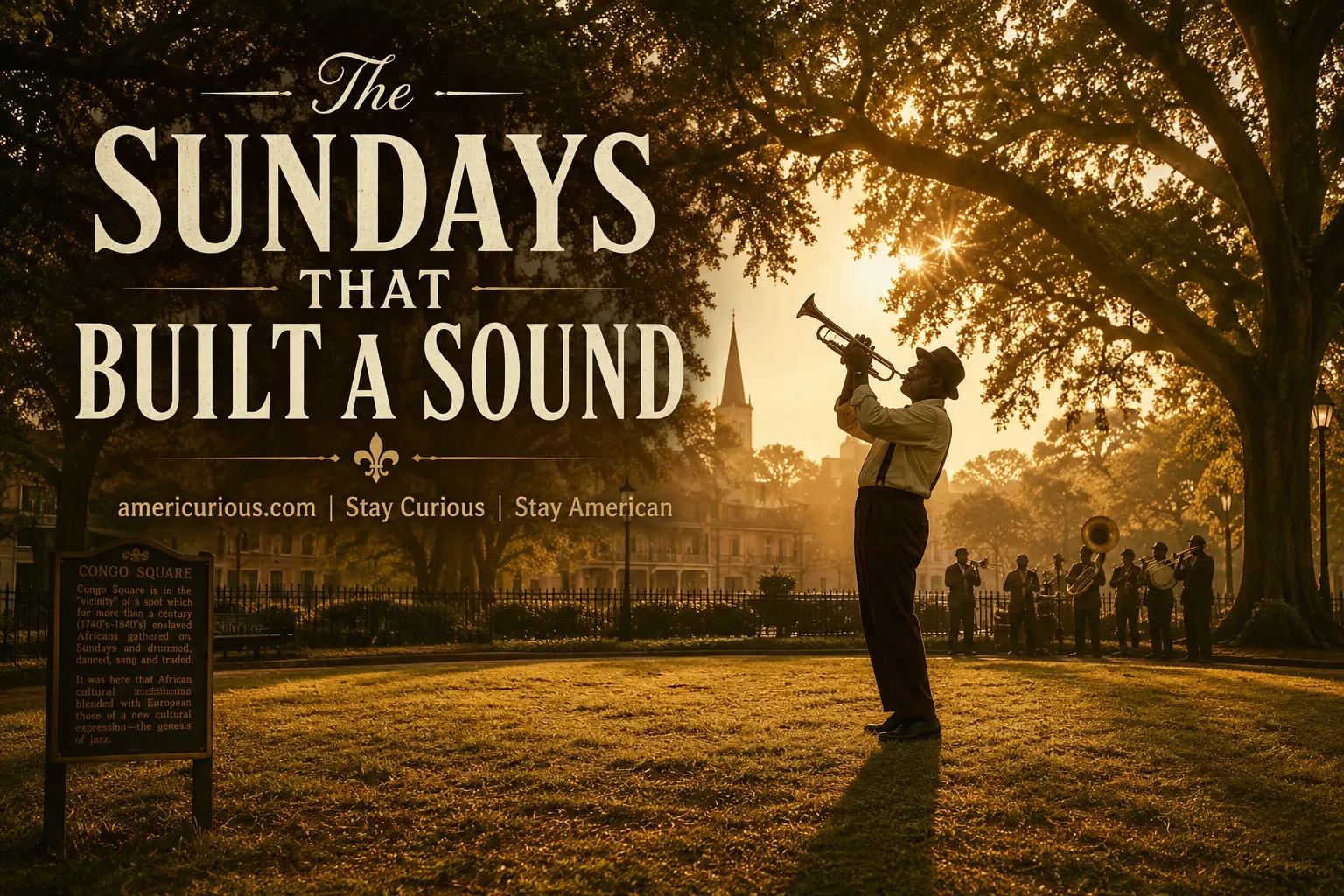
In Tremé’s Congo Square, enslaved Africans’ Sunday gatherings birthed jazz — America’s only homegrown art form. Here’s the ground truth, still echoing today.
Sunday afternoon, sometime in the late 1700s. The drums start low — a heartbeat under live oaks — and build into something with no European name yet, something the world will eventually call jazz. Stand in Congo Square today, in the shade of what’s now Louis Armstrong Park, and you can almost still hear it: a quarter-millennium of rhythm pressed into grass and clay, waiting for someone to pick the thread back up.
The Story Begins Here
A Loophole Wrapped in a Law.
New Orleans’ Black Code, the Code Noir, gave enslaved people something almost no other American colony allowed: Sundays off. Under French and later Spanish rule, that one weekly mercy meant people could gather, trade, and — most importantly — make music on their own terms. By the late 1700s, a stretch of open ground on the city’s northern edge had become the place to do it, eventually known as Congo Square.
What Actually Happened There.
Historians describe Sunday crowds bringing drums, gourds, and marimbas, dancing the Bamboula and the Calinda, and selling goods at an informal market to buy their own freedom in a gathering place that originated in the late-18th century, where enslaved Africans would sing, dance, and play African music, often incorporating traditional instruments such as drums and bells. In 1817, the city went further and formally restricted public gatherings of enslaved people to this single square — codifying, almost by accident, the most important music venue in American history. Few city ordinances have ever had a stranger legacy.
A Place Before the Place.
Long before any of that, the same ground served a different gathering — a detail most “birthplace of jazz” stories skip entirely. The land had been a harvest-celebration site for the Houmas people in the pre-colonial era, meaning Congo Square’s identity as sacred public gathering ground predates the city of New Orleans itself. [I didn’t learn that part until my third trip to the city — proof that even a place you think you know keeps a few cards close.]
“The foundational elements of jazz were in that native music — the call-and-response rhythms, the vocalizations, the syncopations.” — AmeriCurious, paraphrasing the documented record
Why This Is More American Than You Think
One Original Art Form.
Jazz is routinely called the only art form invented in the United States — not adapted, not imported, invented. That claim traces directly back to this one square of grass in Tremé, where African rhythm, Caribbean syncopation, French quadrille, and Spanish melody collided in public, on the record, for anyone to witness. No other American genre has a birth certificate this specific.
The Quiet Part Nobody Says Out Loud.
Here’s the countercultural clarity moment: most Americans can name Louis Armstrong, but very few could point to the patch of ground where the whole thing started. Congo Square gets a fraction of the recognition of Nashville’s Music Row or Memphis’s Sun Studio, even though it predates both by more than a century. That’s not a knock on anyone — it’s just a gap worth closing, gently, one Sunday-afternoon story at a time.
Still Beating, Right on Schedule.
This isn’t ancient history confined to a plaque. Just this week, on June 19, families filled Congo Square for the city’s free Juneteenth Festival — drums and brass carrying on a tradition that’s now pushing 250 years old a free festival held from noon to 7 p.m on the same ground. When did we stop teaching kids that a city park could be a founding document of American culture? Maybe it’s time we started again.
A Different Kind of American Road.
If Route 66 at 100 represents one great American pilgrimage — west, wide-open, paved in asphalt — Congo Square represents another: a single square of ground you can walk in ten minutes that still shaped the whole country’s soundtrack. Both are worth the trip. Only one of them requires a tank of gas.
🗳️ Quick poll:
Which “birthplace” surprises you most as an American music origin point?
○ Congo Square, New Orleans (jazz) ○ The Mississippi Delta (blues) ○ Bristol, Tennessee/Virginia (country) ○ Sun Studio, Memphis (rock and roll) (Share your answer in the comments!)
The Details That Make It Real
Names Worth Knowing.
Composer Louis Moreau Gottschalk, born in New Orleans in 1829, grew up absorbing Congo Square’s rhythms and later wrote them into his piano piece “Bamboula.” Decades after him, pianist Jelly Roll Morton would credit that same Afro-Caribbean syncopation — what he called the “Spanish tinge” — as essential seasoning, reportedly insisting that without it, “it ain’t jazz” “There are several places that are considered the birthplace for jazz,” Fertel says, “But the real roots are at Congo Square, where the enslaved peoples under the French code were allowed to gather on Sundays”. Cornet player Buddy Bolden, working a generation later in the same neighborhood, is widely credited as jazz’s first true bandleader.
📌 Fast Fact:
Between 1796 and 1803 alone, records show more than 700 of the enslaved people baptized at nearby St. Louis Cathedral were specifically of Kongo heritage — a direct thread between the square’s name and the people who built its sound.
From Sunday Rhythm to Jazz Standard.
The line from Congo Square’s drum circles to a modern jazz combo isn’t a metaphor — historians and musicologists trace it fairly literally.
| Congo Square Tradition | What It Sounded Like | Where You Hear It in Jazz Today |
|---|---|---|
| Bamboula & Calinda dances | Layered, polyrhythmic hand-drumming | Swing’s signature offbeat pulse |
| Call-and-response singing | Leader-and-chorus vocal trade-offs | Blues verses; horn “answers” in big-band charts |
| Habanera / “Spanish tinge” | Syncopated two-beat Caribbean bass pattern | Morton’s piano “seasoning”; second-line bass lines |
| Sunday market gathering | Free, public, improvisational space | The jam session itself |
How Congo Square’s Sunday sounds became building blocks of jazz, based on documented histories from 64 Parishes, NPR’s “A Closer Walk” project, and Louisiana State University’s Louisiana Music History archive.
The Neighborhood That Held It Together.
Congo Square sits inside Tremé, widely recognized as the oldest African American neighborhood in the United States — a place where free people of color could legally own property as far back as the late 1700s In the 18th and early 19th centuries, free persons of color and eventually those African slaves who obtained, bought or bargained for their freedom were able to acquire and own property in Tremé. That single legal fact — property ownership inside a slaveholding society — gave Tremé an unusual independence that let its music keep growing indoors once outdoor gatherings were restricted. You can feel the texture of that history walking the same six blocks covered in Tremé: Six Blocks That Taught America How to Swing.
Hidden Layers (What Most People Miss)
The Story Got Romanticized — Then Erased.
Between the 1840s and 1880s, white writers turned Congo Square into something closer to spectacle than history, exaggerating and exoticizing what they’d never personally witnessed. Then, after the Civil War, the city quietly renamed the square for Confederate general P.G.T. Beauregard, and it carried that name for over a century. It wasn’t until 2011 that a city ordinance officially restored the name Congo Square, formally acknowledging the site’s role in the birth of jazz as an American art form.
A Craft Tradition, Not a Coincidence.
This pattern — culture surviving through quiet, stubborn preservation — runs all through Louisiana. The same instinct that kept Congo Square’s rhythms alive indoors after outdoor gatherings were banned shows up today in the dwindling community of Louisiana’s pirogue builders, still shaping cypress boats by hand because someone has to keep the thread going. Music and craft, it turns out, get passed down the same stubborn way.
Repressed but Never Silenced.
Sunday gatherings were restricted on and off starting in the 1830s, then effectively shut down by 1840s legislation tightening control over enslaved and free Black congregations ahead of the Civil War. But the music didn’t stop — it moved indoors, into halls and social clubs, eventually surfacing again as brass bands and second lines by the early 1900s. What does it say about a sound that survived a century of laws specifically designed to silence it?
“Repressed in the streets, the rhythm simply moved indoors — and waited.” — AmeriCurious
The Human Story
A Drum Circle on a Regular Tuesday.
[I once wandered into Congo Square on an ordinary weekday afternoon expecting an empty lawn, and instead found three guys with hand drums, a tourist filming on her phone, and a teenager practicing trumpet scales under a tree like it was the most normal thing in the world. It was, and that’s the point.] That’s the real continuity here — not a museum behind glass, but a public park where the tradition still shows up uninvited.
Faces You’d Recognize From the Family Reunion.
Modern Congo Square Rhythms Festival lineups still lean on names that feel like neighborhood royalty — brass bands, second-line drummers, and performers whose grandparents likely played the same ground. [My favorite kind of New Orleans moment is realizing the band on stage and the family selling gumbo next to it have probably known each other for three generations.] That’s a kind of continuity most American cities lost decades ago.
The Quiet Part That Sticks.
Every Sunday gathering at Congo Square was, at its core, an act of joy carved out of an unjust system — people claiming a few hours that legally belonged to them and turning it into something the whole world would eventually dance to. That’s not a footnote. That’s the whole story, distilled into a single afternoon, repeated for generations.
🧠 AmeriCurious Quiz:
How Well Do You Know Congo Square?
Q1: What law first gave enslaved people in colonial New Orleans Sundays off?
A) The Homestead Act B) The Code Noir C) The Compromise of 1850 D) The Treaty of Paris
Q2: What did the city rename Congo Square to after the Civil War?
A) Liberty Square B) Jackson Square C) Beauregard Square D) Union Square
Q3: What does jazz pianist Jelly Roll Morton’s “Spanish tinge” refer to?
A) A guitar tuning B) A Caribbean habanera rhythm C) A type of brass mute D) A dance step
✅ Answers: Q1-B | Q2-C | Q3-B
Your Move, America
Plan Around the Right Sunday.
Congo Square sits inside Louis Armstrong Park at 701 N. Rampart Street, open to the public and free to walk any day of the week. Time a visit around the city’s biggest music moments — the Congo Square Rhythms Festival each spring, or Satchmo SummerFest in early August, timed to land near Louis Armstrong’s August 4 birthday Satchmo SummerFest is held in early August to coincide with Louis Armstrong’s birthday — and you’ll catch the square doing exactly what it was built to do.
🗺️ Reader’s Action List:
- 🥁 Walk Congo Square at golden hour, when the light through the oaks makes the history feel close
- 🎺 Visit the New Orleans Jazz Museum at the Old U.S. Mint for context before you wander Tremé
- ⛪ Catch a Sunday Jazz Mass at St. Augustine Church, one of the country’s oldest Black Catholic parishes
- 🍲 Pair the trip with a Tremé neighborhood walk past the Backstreet Cultural Museum
- 📅 Check festival calendars before booking — Congo Square Rhythms (spring) and Satchmo SummerFest (August 1–2) both happen on this exact ground
One Sound, Worth Following Home.
Whatever genre you grew up loving — country, rock, hip-hop, gospel — some part of its rhythmic DNA almost certainly runs back through this one square of grass. That’s worth sitting with for a minute next time a song catches you off guard.
❓ Frequently Asked Questions
Q: Where is the birthplace of jazz?
A: Congo Square in New Orleans’s Tremé neighborhood, now part of Louis Armstrong Park, is widely regarded by historians and musicians as the birthplace of jazz, where enslaved and free Black New Orleanians gathered to play African-rooted music on Sundays starting in the late 1700s.
Q: What actually happened at Congo Square?
A: Enslaved and free people of color gathered on their day off to dance, drum, sing, and trade goods, blending West African rhythms with Caribbean and European influences in a way historians credit as the foundation of jazz.
Q: Can you visit Congo Square today?
A: Yes — it’s a free, public section of Louis Armstrong Park at 701 N. Rampart Street, open daily, and it still regularly hosts drum circles, brass bands, and festivals like the Congo Square Rhythms Festival.
Q: Why is Tremé called the oldest African American neighborhood in the U.S.?
A: Tremé is recognized as the oldest African American neighborhood in the country because free people of color were able to legally acquire and own property there as early as the late 18th and early 19th centuries, an unusual right at the time.
Q: What is the “Spanish tinge” in jazz?
A: It’s Jelly Roll Morton’s own term for the syncopated Cuban habanera rhythm he wove into early jazz compositions, a Caribbean influence he considered essential “seasoning” for the genre.
What’s your own “Congo Square moment” — a place you didn’t expect to change how you hear an entire genre? Drop it in the comments. Save this one for your next New Orleans trip, or send it to someone who’s never connected the dots between a city park and the music on their playlist. And if stories like this — the ones hiding in plain sight across this country — are your kind of curious, stick around; there’s a new one every week.
— AmeriCurious americurious.com Stay Curious | Stay American 🇺🇸
📚 Sources & Further Reading
[1] 64 Parishes, “Congo Square,” 2022. opens in new tab [2] NPR, “In New Orleans, There’s A Piece Of Music History Around Every Corner,” 2017. opens in new tab [3] Louisiana State University Libraries, “Congo Square — Louisiana Music History,” Special Collections Research Guide. opens in new tab [4] Atlas Obscura, “Congo Square.” opens in new tab [5] U.S. Civil Rights Trail, “Tremé Neighborhood.” opens in new tab [6] New Orleans Jazz & Heritage Foundation, “2026 Congo Square Rhythms Festival.” opens in new tab
Discover more from AmeriCurious
Subscribe to get the latest posts sent to your email.