
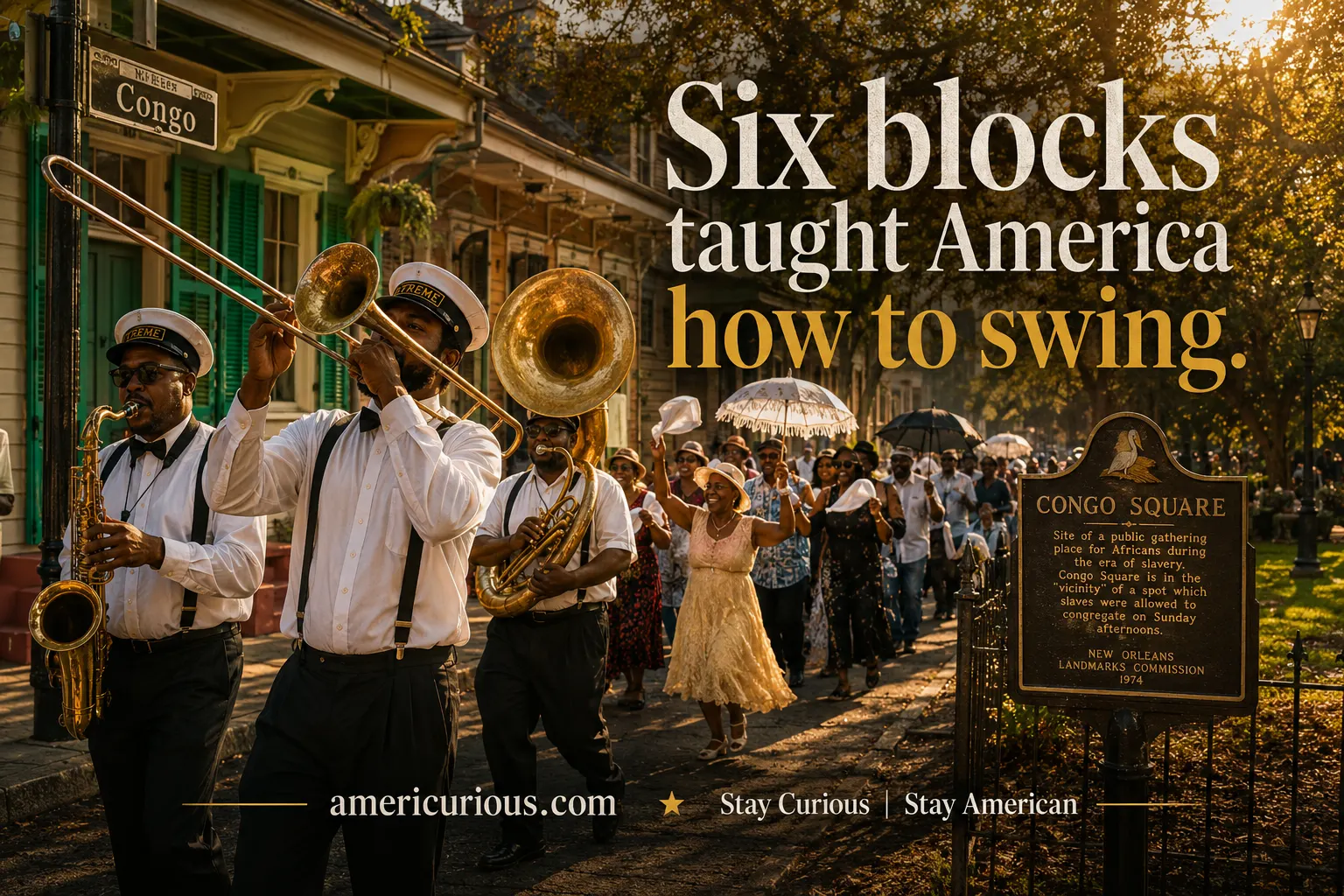
Treme isn’t just America’s oldest Black neighborhood — it’s where jazz, second lines, and Mardi Gras Indians were born. Here’s the real story.
Three blocks north of Bourbon Street, past the souvenir shops and the daiquiri stands, the music doesn’t stop sounding like a performance — it starts sounding like a neighborhood breathing. That’s Treme. Most visitors never cross Rampart Street to find it, which is its own kind of irony, because everything they came to New Orleans for — the brass, the rhythm, the second line strut — started right here. Treme is the oldest Black neighborhood in the United States, and a strong case can be made that it’s the birthplace of jazz itself, a high concentration of the artform’s pioneers having lived here even though the music developed across the whole city. That’s not folklore. That’s a fact with two centuries of receipts.
The Story Begins Here
A Plantation Becomes a Promise Treme started as farmland. The neighborhood takes its name from Claude Treme, a French hatmaker who owned the plantation that was eventually subdivided into city lots, and the timing of that subdivision mattered enormously. Following the Haitian Revolution in the early 1800s, an influx of free people of color, Creoles, and immigrants from Saint-Domingue, Germany, Spain, and Italy settled into these new blocks, and Treme became, in the words of one local historian, a place where “all the things sacred to New Orleans bubbled up” because of that mixture of cultures.
The Numbers Behind the Legend Free people of color began living along Bayou Road as early as 1726, and the neighborhood is widely credited as one of the first integrated communities in the entire country. It produced the first Black homeowners and the first Black newspaper in the United States — not symbolic firsts, but documented, load-bearing ones. By the time Treme marked its bicentennial, it had already outlived plantations, fires, a World’s Fair land grab, and an interstate overpass driven straight through its middle.
Why This Matters Right Now This summer, as cities across the country wrestle with how to honor neighborhoods that shaped them while still protecting the people who live there, Treme is a working case study — not a museum piece. It’s lived history with a pulse you can still hear on a Sunday afternoon.
Why This Is More American Than You Think
The Square That Started It Walk into Louis Armstrong Park and turn toward the southwest corner, and you’re standing in Congo Square — the spot where, beginning in the 1740s, enslaved Africans were permitted to gather on Sundays under the Code Noir to drum, dance, sing, and trade. By 1819, those Sunday gatherings drew as many as 500 to 600 people, and the rhythms played there are now understood by scholars as the root system from which Mardi Gras Indian traditions, the second line, and New Orleans jazz all eventually grew.
The Countercultural Clarity Moment Here’s the part most Americans skip over: we tend to talk about jazz as something that happened in smoky clubs played by men in sharp suits, a tidy origin story for a tidy genre. The truth is rougher and more honest — jazz’s deepest roots are in a public square where enslaved people fought, against enormous odds, to keep their music and their humanity intact one Sunday at a time. That’s not a footnote to American music history. That’s the foundation of it, and it deserves to be said plainly instead of softened into trivia.
A Tradition That Refused to Die What’s remarkable isn’t just that this music was born in Treme — it’s that the neighborhood kept producing musicians for two more centuries. Trombone Shorty grew up there. So did his grandfather, “Ooh Poo Pah Doo” singer Jesse Hill. Percussionist Shannon Powell has lived in Treme his entire life and was performing in neighborhood clubs by age eleven, eventually discovered by guitarist Danny Barker, who helped launch his career.
“A neighborhood doesn’t get to call itself the birthplace of anything unless it keeps giving birth, generation after generation.” — AmeriCurious
When did America start treating its musical birthplaces like tourist backdrops instead of living neighborhoods?
🗳️ Quick poll:
What pulls you toward a neighborhood’s history the most?
○ The music and sound of a place ○ The food and flavors ○ The architecture and streets ○ The people and their stories (Share your answer in the comments!)
The Details That Make It Real
Names Worth Knowing Treme’s roster of cultural landmarks reads like a syllabus nobody assigned you in school. The Tio family taught clarinet to generations of jazz musicians. Armand Piron led one of the city’s most influential dance orchestras. Lionel Ferbos, a trumpeter born in Treme, was still performing regularly at the Palm Court Jazz Cafe well into his hundreds, believed to be the city’s oldest working musician at age 101.
📌 Fast Fact: Congo Square was officially listed on the National Register of Historic Places on January 28, 1993 — recognition that arrived nearly 250 years after the first recorded gatherings there.
| Landmark | What You’ll Find There |
|---|---|
| Congo Square (Louis Armstrong Park, 701 N. Rampart St.) | The drumming and dance grounds considered the wellspring of jazz |
| Petit Jazz Museum | A small, locally-run museum tracing Treme’s musical lineage since 1895 |
| Backstreet Cultural Museum | Mardi Gras Indian suits, second line history, jazz funeral traditions |
| St. Augustine Catholic Church | One of the oldest Black Catholic parishes in the country, founded by free people of color |
Caption: A short list of Treme stops where history isn’t roped off behind glass — it’s still part of daily life.
A Walk-It-Yourself Checklist
✅ Start at Congo Square inside Louis Armstrong Park, entering at 801 N. Rampart Street
🎷 Visit the Petit Jazz Museum for an insider’s rundown of Treme’s musical lineage
🥁 Stop at the Backstreet Cultural Museum to see real Mardi Gras Indian suits up close
⛪ Walk past St. Augustine Church and its Tomb of the Unknown Slave memorial
🍴 Grab lunch nearby and listen for brass spilling out of an open doorway — it happens more than you’d expect
[I once stood in Congo Square at golden hour and heard a single trumpet practicing somewhere out of sight — no audience, no tip jar, just someone working out a riff. That, more than any plaque, is what made the history click.]
Hidden Layers (What Most People Miss)
The Highway That Almost Won What most travel guides leave out is the violence done to Treme in the name of progress. In the 1960s and early ’70s, the city demolished a wide swath of the neighborhood — including cultural landmarks like Perseverance Hall, where jazz had emerged around the turn of the 20th century — to build the Claiborne Avenue overpass. The interstate now shadows a corridor that was once lined with oak trees and home to thriving Black-owned businesses, a loss the neighborhood still openly discusses rather than papers over.
Gentrification Isn’t New Here Either Here’s the layer competitors rarely mention: residents were raising alarms about gentrification and the disappearance of live music venues in Treme back in 1993 oral history interviews — decades before Hurricane Katrina, the disaster most people assume started those conversations. The pressure on Treme’s culture and affordability has been a long, slow tide, not a single storm.
An Unexpected Connection Few people connect Treme to the birth of rock and roll, but the drummer credited with pioneering rock’s signature backbeat, Earl Palmer, grew up near Congo Square and learned rhythm by following street parades as a kid. The line from Congo Square’s Sunday drumming to Little Richard’s backbeat runs straighter than most music history books admit.
🧠 AmeriCurious Quiz:
How Well Do You Know Treme?
Q1: What was Congo Square primarily used for in the 19th century?
A) Horse racing B) A Sunday gathering and market for enslaved and free people of color C) A military parade ground D) A produce auction
Q2: Which New Orleans music star grew up in Treme and is the grandson of singer Jesse Hill?
A) Harry Connick Jr. B) Trombone Shorty C) Dr. John D) Wynton Marsalis
Q3: What 1960s-70s construction project demolished part of Treme?
A) The Superdome B) The Claiborne Avenue overpass C) A shopping mall D) A new courthouse
✅ Answers: Q1-B | Q2-B | Q3-B
The Human Story
Uncle Lionel and the Sound That Stayed
Lionel Batiste — known to everyone in the neighborhood simply as “Uncle Lionel” — played drums and helped lead the Treme Brass Band for decades, becoming one of those local figures whose funeral, when it finally came, doubled as a jazz parade through the streets he’d walked his whole life. That’s not sentimentality. That’s how Treme has always handled both joy and grief: out loud, in public, with a horn section.
Why It Feels Lived-In
There’s a version of American small-c culture that gets performed for cameras, and there’s a version that just happens because that’s what the block has always done on a Sunday. Treme is overwhelmingly the second kind. The brass bands rehearsing on a porch, the second line route announced by word of mouth, the Mardi Gras Indian suits sewn by hand over an entire year for a single morning’s parade — none of it is staged for visitors, though visitors are welcome to witness it.
[A guy outside the Backstreet Cultural Museum once spent twenty minutes explaining the difference between his tribe’s beadwork and a rival tribe’s, with the pride of someone discussing a family heirloom. It was a family heirloom.]
Isn’t it strange that the neighborhoods doing the most cultural heavy lifting are so often the ones tourists drive right past?
[I’ll admit my first trip to New Orleans, I never made it past Bourbon Street — a mistake I didn’t fully understand until I came back years later and finally crossed Rampart.]
If you’re planning a longer Gulf Coast loop this season, Treme pairs naturally with a stop along Route 66 at 100 — drive the Mother Road before summer ends on the other end of a cross-country itinerary, or with a detour to Birmingham, Alabama’s best overall restaurants if you’re road-tripping the Deep South corridor.
Your Move, America
Try This This Week Treme rewards patience more than a checklist, but here’s where to start if you’re heading down or just want to bring a little of its spirit home.
🎷 Visit Congo Square at Louis Armstrong Park and stand where the rhythms started, free to enter
🥁 Catch a second line if your visit lines up with a Sunday — ask locally, schedules travel by word of mouth
🏛️ Tour the Backstreet Cultural Museum to see Mardi Gras Indian suits and jazz funeral history firsthand
🍽️ Eat where the neighborhood eats, not just where the guidebooks point
🎶 Listen for live brass spilling from an open door — it’s the most reliable Treme experience there is
📚 Read up before you go — a little Congo Square history turns a stroll into something closer to a pilgrimage
“Some neighborhoods have a history. Treme has a heartbeat, and it’s still keeping time.” — AmeriCurious
If your travels take you toward festival season elsewhere in the country, Treme’s spirit of full-tilt community celebration has a cousin in places like the Gilroy Garlic Festival — proof that America’s small, fiercely-loved local traditions show up in every region, in every flavor.
❓ Frequently Asked Questions
Q: Is Treme really the birthplace of jazz?
A: Treme is widely credited as a central birthplace of jazz, anchored by Congo Square, where enslaved Africans gathered on Sundays beginning in the 1740s to drum and dance in ways that scholars trace directly to jazz’s roots. Jazz historians note the artform actually developed across multiple New Orleans neighborhoods, but a notably high concentration of its earliest pioneers lived in Treme.
Q: Is Treme safe to visit?
A: Treme is a residential, lived-in neighborhood, and like any urban area it rewards the same common-sense precautions you’d use anywhere — go in daylight for a first visit, stick to known cultural sites, and consider a guided walking tour for deeper context.
Q: What’s the difference between Treme and the French Quarter?
A: The French Quarter sits south of Rampart Street and is New Orleans’ historic tourist core, while Treme lies just north of Rampart and is a quieter, residential neighborhood considered the oldest Black neighborhood in the country.
Q: What is Congo Square and where is it?
A: Congo Square is a 2.35-acre site in the southwest corner of Louis Armstrong Park at 701 N. Rampart Street, historically used by enslaved and free people of color for Sunday gatherings, music, and trade, and now recognized on the National Register of Historic Places.
Q: Is the HBO show “Treme” an accurate portrayal of the neighborhood?
A: The HBO series “Treme” drew significant new attention and energy to the neighborhood after its 2010 premiere, and while it dramatized specific characters and storylines, it was filmed and set in the real neighborhood with deep input from local musicians and culture-bearers.
What’s the neighborhood back home that outsiders drive past without realizing what they’re missing? Drop it in the comments. Save this one for your next Gulf Coast trip, or send it to someone who’s never crossed Rampart Street. And if you want more of America’s overlooked neighborhoods delivered straight to you, stick around — we’re just getting started.
— AmeriCurious americurious.com Stay Curious | Stay American 🇺🇸
📚 Sources & Further Reading
[1] Amistad Research Center, “Preserving the Sounds of Treme,” Treme Oral History Project, 1993. [2] 64 Parishes, “Congo Square,” Louisiana Endowment for the Humanities. [3] Tulane University Music Rising, “Congo Square,” Musical Cultures of the Gulf South. [4] A Closer Walk NOLA, “Treme,” New Orleans Music Map, Tulane University. [5] Fox News, “Historic Treme Neighborhood New Orleans Melting Pot Celebrates 200 Years of Food and Music.” [6] Historical Marker Database, “Congo Square Historical Marker,” National Park Service.
Discover more from AmeriCurious
Subscribe to get the latest posts sent to your email.