Lease renewal due and not sure you’re staying for love or for rent? Find your exit number, the lease clauses that matter, and three ways forward.
Before we start: “Kayla” is a composite. I built her from public Reddit threads, renter surveys and Richmond rent data, and her salary, savings and rent figures are illustrative. The lease details are general information for Virginia. They are not legal or financial advice.
Quick answer: If your lease renewal is due and you’re unsure about the relationship, don’t sign another 12 months by default. First, add up your exit number: first month’s rent, security deposit, application fee and moving costs. Second, ask your landlord in writing about month-to-month or shorter terms. Third, ask yourself: if rent cost the same either way, would I still choose this person?
Key takeaways
- In one survey, nearly half of renters living with a partner had faced the question of staying only because of the shared home. Of those, 55% stayed longer.
- A renewal has more than two answers. Short terms, month-to-month and one-name renewals exist, and you only find out by asking.
- “Can’t afford to leave” turns into a date once you know your exit number and how fast you can save toward it.
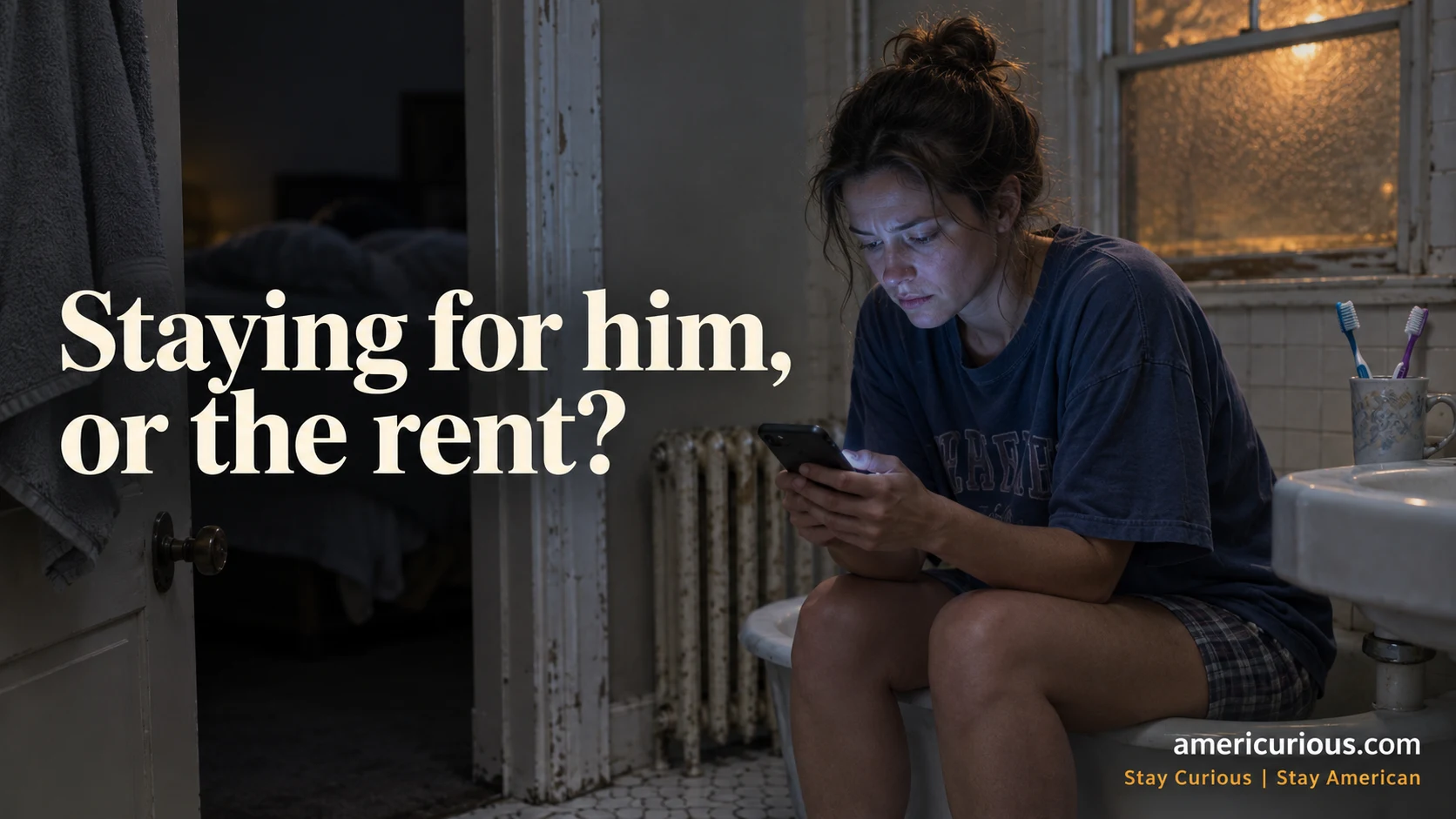
It’s 2:07 AM and your phone brightness is all the way down so it won’t wake him.
One tab is the renewal PDF. Accept by November 25. The other tab is Zillow, one bedroom, under $1,300, and you already know what’s in there because you looked last night too.
If I sign this, I’ve decided without deciding.
He’s asleep. He’s not a bad guy. That’s the whole problem, isn’t it? Nobody cheated. Nobody yells. He Venmos his half on the first with the little house emoji. Thanksgiving at his mom’s is in two weeks. And you’re on the edge of the tub with the calculator app open like it’s gonna tell you whether you love somebody.
We’re fine. We’re fine.
So.
I know this bathroom. I’ve read it over and over, in public Reddit threads posted at exactly this hour and in the renter surveys that keep coming out. I rolled those women into one person so we’d have somebody to do the math with. I call her Kayla.
Kayla’s 31. She does patient billing for a hospital system in Richmond, Virginia, makes about $52,000, and splits a $1,540 one-bedroom in the Museum District with Tyler, a few blocks from the VMFA. Three and a half years together. Two and a half under one roof. No ring, and she’s quit bringing it up because the answer’s always “when we’re more settled.”
Monday, the resident portal sent the offer. $95 more a month. Fourteen days to accept, or it rolls to a pricier month-to-month rate. The lease ends January 31.
She’s got about $1,900 in savings, a student loan and a used car.
If that’s your 2 AM too, pull up a chair.
I’m not going to tell you to leave him. I’m not going to tell you to stay, either. I don’t know, and I don’t think you do yet. What I can do is get you a number, a date and three options before that deadline. Fifteen minutes at a time, because I know that’s about what you’ve got left at night.
You’re not a gold digger, and you’re not the only one
Here’s what it looks like from the outside. Nothing.
From the inside, it’s sitting in your parked car for ten extra minutes before you go upstairs. It’s splitting the Kroger receipt on Venmo down to the oat milk. It’s a Saturday at a Scott’s Addition brewery where y’all talked about the dishwasher. Only the dishwasher.
And under that, the thought you don’t say out loud. Am I using him for half the rent? Is he using me?
That feels like a character flaw. The numbers say it’s a lot more ordinary than that.
Apartments.com surveyed 497 adults in June 2025. Almost half (49%) had faced the question of staying in a relationship longer only because they lived together. Of those, 55% stayed. That’s from the Apartments.com Rent and Relationships Report.
Apartment List asked 1,000 Gen Z and millennial renters. In its State of Renting 2026 report, 42% said they were staying in a relationship, romantic or platonic, longer than they wanted because splitting up cost too much.
Self Financial polled 1,048 people. About 24% of those in relationships said they’d leave if it didn’t cost them financially, according to Newsweek’s coverage of the survey.
Honest note, since you deal with numbers for a living. These are company surveys with modest samples, and each one asked the question a little differently. I wouldn’t bet the rent on any single figure. They do all point the same direction.
And the pressure behind them is real money. Zillow’s 2026 analysis put the cost of renting alone at $10,470 a year more than sharing, a gap it calls the “singles tax,” as reported by ConsumerAffairs. That’s the national number. I couldn’t find a verified one for Richmond, so I’m not going to make one up.
So what does that mean for you at 2 AM? You’re not a user. You’re a person standing next to a five-figure price tag. Which is good news, kind of. A money problem can be measured.
How you got here: almost nobody decides. Almost everybody slides.
Kayla didn’t decide to move in with Tyler.
Her lease near VCU was ending. The rent on her studio was jumping. His place was bigger. They’d been dating nine months and she was there five nights a week anyway. “It just made sense at the time.”
If that’s your story, you’re in a big crowd. When Pew Research Center asked cohabiting adults why they moved in back in 2019, 38% said “it made sense financially” was a major reason. In the Apartments.com survey, a third moved in to save on rent.
Two psychologists at the University of Denver, Scott Stanley and Galena Rhoades, have a name for this. They call it “sliding versus deciding.” In one of their national studies, most people who lived together before marriage said it either wasn’t planned or “just sort of happened.”
Their bigger idea is the one I want you to keep. They separate two reasons people stay.
Dedication is wanting to be there. Constraints are the things that make leaving expensive: the lease, the couch you bought together, the cat.
Think of the lease as a fence and dedication as liking the yard. When the fence gets high enough, you can’t tell anymore whether you’re staying because you like the yard. And neither can he. Their paper on how commitment forms makes that point: the stronger the outside reasons to stay, the harder it is to read the inside ones.
The lease is a fence. When the fence gets high enough, you can’t tell if you’re staying because you like the yard.
Rhoades put it plainly to the New York Times this February. Some couples, she said, “wind up getting married or getting stuck in a relationship or a circumstance that really wouldn’t have turned into marriage if they hadn’t already been living together.”
One caution so I don’t oversell it. That research shows a pattern. It doesn’t say moving in early dooms anybody, and plenty of sliders are happy.
I’m also not going to lecture you about moving in without a ring. Rent was going up. You did the sensible thing. Emily Sanchez, a 30-year-old in San Diego, told the Guardian that moving in with her then-boyfriend to save on rent felt like “playing house” at first. Then it “put pressure” on the relationship.
That’s the slide. Nobody’s fault. But a renewal is a rare thing: a slide that comes with a signature line.
Why the stuff you already tried didn’t work
You’ve been at this a while. I know.
The pros-and-cons list in your Notes app. Rewritten four times, same result. It can’t work, because “rent” is sitting in both columns. You’re asking one list to answer a love question and a money question at once.
Reddit. Top comment: “just leave.” From somebody who doesn’t know that in the Federal Reserve’s latest household survey, 37% of adults said they wouldn’t cover a surprise $400 expense entirely with cash or its equivalent. That’s from the Fed’s May 2026 report on household finances. “Just leave” leaves out the deposit and first month’s rent.
“If he wanted to, he would.” Maybe. But that’s a question about Tyler. The renewal has your name on it too.
The budgeting app. It showed you the problem every single month. It never gave you a finish line.
“Get a roommate.” Usually said by people who own their homes. Bless their hearts.
None of that failed because you’re weak or indecisive. It failed because the rent is parked in the middle of the love question, and every one of those tools leaves it there.
So we pull them apart. One question for the heart. One number for the money. One email for the paperwork.
Below are five small experiments. Each one fits inside 15 minutes. You don’t have to run all five, and if one feels too heavy, drop it. That just means your sticking point is somewhere else.
Pick your starting point. Tight chest and two minutes? Start with Experiment 1. Numbers calm you down? Go straight to Experiment 2. Already know your answer? Skip to Experiments 3 and 4.
Deadline’s this week? Do Experiment 4 first. It’s the only one with a clock on it.
Experiment 1 (2 minutes): the Rent-Free Test
This is going to sound like a journal prompt. I roll my eyes at those too. This one comes straight out of that fence-and-yard research, so give it two minutes.
Ask yourself:
“If rent cost exactly the same whether I stayed or left, would I re-sign with him?”
Then two more.
“Would he?”
“When’s the last time we picked each other on purpose?”
Don’t write an essay. Write one mark on a sticky note: Y, N or ?. Do it three nights in a row and treat it like data.
Three Y’s point you to Door 1 below. Three N’s point you to Door 3.
Question marks, or a different answer every night? That’s a real answer too. It’s called “I don’t know,” and it has its own door.
If what comes up is less “I don’t love him” and more “we turned into roommates with a shared Netflix,” that’s a different problem, and I wrote about when a couple starts to feel like roommates separately. It can be worked on.
If this glitches: if you can’t answer because the money panic floods in every time, stop. Your sticking point is the number, so go get the number.
Experiment 2 (15 minutes): your Exit Number
No, this isn’t “make a budget.” You’ve had a budget. A budget tells you what’s wrong every month. This is one number, figured once, that tells you what leaving would cost on day one.
Open your calculator. Fill this in.
Table 1. The Exit Number worksheet, with Kayla’s illustrative Richmond figures
| Line | Your number | Kayla’s number |
|---|---|---|
| First month’s rent | $ ____ | $1,272 |
| Security deposit | $ ____ | $1,272 (one month) |
| Application and screening fees | $ ____ | $50 |
| Truck, utility setup, the basics you’d have to rebuy | $ ____ | about $400 (her guess) |
| Exit Number | $ ____ | about $3,000 |
| Minus what’s in savings now | $ ____ | $1,900 |
| The gap | $ ____ | about $1,100 |
Where Kayla’s lines come from:
Rent. The Apartment List rent report for Richmond puts the median one-bedroom at $1,272 as of November 2026. Listings run higher. PadMapper’s median asking rent for a Richmond one-bedroom was $1,412 on November 1, and locals in an r/rva thread on 2026 renewals complain about $1,500 to $1,600. One figure tracks what people actually signed for and the other tracks what’s being advertised today. Use what you see in your own search.
Deposit. One month is common. Virginia law caps it at two months’ rent under Code of Virginia § 55.1-1226. At the legal max, Kayla’s number climbs to about $4,300.
Application fee. Capped at $50 in Virginia, plus whatever the landlord actually pays a third party for screening, under § 55.1-1203.
Not in Virginia? Search your state attorney general’s or housing agency’s site for “security deposit limit.”
Turn the gap into a date
Gap, divided by what you can put away each month.
Kayla can save about $275 a month. $1,100 divided by $275 is four months.
Not “someday.” March.
I won’t pretend that’s cozy. She’d land in the new place with savings at zero, and her rent share would jump from $770 to $1,272. That’s $502 more a month. Thirty percent of her gross pay is $1,300, so it squeaks under the usual rule. On paper, yes. In her stomach, no. Both are true.
If your student loan bill changed this year, redo the monthly math with the new payment before you trust it. I walked through one borrower’s version of that in my post on what happens when a student loan payment jumps.
One small thing in your favor: Apartment List’s look at when rent is cheapest finds November and December are the low months, when landlords negotiate more. The average saving is modest, around 1.6%. I’m not gonna oversell it.
If this glitches: if your date comes out more than a year away, the solo one-bedroom is too big a first step. Don’t force it. Shrink the first two lines by pricing a room in a shared house. And yes, I just told you to get a roommate, after making fun of that advice. As a way to get out, it’s a different thing. In SpareRoom’s September 2026 survey of 669 roommate renters, 49.6% said they’d rather live alone but can’t afford to. So you wouldn’t be the odd one out.
Experiment 3 (15 minutes): read your lease tonight
Knowing the number only tells you what leaving costs. The paper tells you what you’re allowed to do. And you signed this thing two and a half years ago at a leasing-office counter and never opened it again. Most people don’t.
Open the PDF. Hit Ctrl+F (or the search icon on your phone). Look for these five.
- “Jointly and severally.” If it’s there, either of you can be held responsible for all the rent. Him moving out wouldn’t cut your bill in half.
- “Notice.” Find how many days’ notice you owe to not renew. Count backward from your end date. That’s your true deadline, and it may be sooner than the offer says.
- “Month-to-month” or “holdover.” What happens if you sign nothing, and what does it cost?
- “Early termination” or “buyout.” Is there a set fee to leave mid-lease?
- “Sublet,” “assign” or “replacement.” Can someone take over one person’s spot?
Virginia callout: the one-check rule. When there’s more than one tenant on a lease, the landlord refunds the security deposit with one check payable to all tenants, unless every tenant agrees otherwise in writing. That’s in § 55.1-1226(B). If you split up, sort out in writing who gets what share before move-out day, or you’ll be endorsing a check together months later.
One more Virginia detail, because it changes how scary “breaking the lease” sounds. If a lease ends early, the landlord can claim rent until the term ends or a new tenant’s lease starts, whichever comes first, and keeps a duty to limit those losses. That’s § 55.1-1251. The state’s plain-English summary is on the Virginia DHCD tenant resources page.
If this glitches: if the legal language makes your eyes cross, quit reading. Screenshot the five passages and move on to the email. Let the landlord explain them.
Experiment 4 (5 minutes): email the landlord
The offer looks like it has two buttons. Accept or decline. Leasing offices usually have more than that, and they don’t volunteer it.
Asking isn’t deciding. It isn’t going behind his back, either. You both need this information.
Copy, paste, fill in the brackets, send.
Subject: Renewal options for [unit number], lease ending [date]

Hi [name],

Thanks for sending the renewal offer. Before the [deadline] date,
could you send me all available options in writing?

1. The month-to-month rate, and the notice required to end it.
2. Any shorter terms (3 or 6 months) and their rates.
3. Whether the lease can be renewed in one tenant's name,
   and what that tenant would need to qualify.
4. Your process and any fees if one tenant needs to be
   released or replaced during the lease.

Thank you,
[your name]
If this glitches: if they say no to month-to-month, ask about a three- or six-month term. If they say no to everything, then the 12-month renewal really is the only offer, and your Rent-Free Test answer has to carry the weight. Go back to the sticky note.
Three doors, not two
Once that email comes back, you’re not choosing between “sign” and “blow up my life.” You’ve got three.
Table 2. The three doors, compared
| Door 1: Renew on purpose | Door 2: Buy time | Door 3: Leave on a date | |
|---|---|---|---|
| Your sticky note says | Y | ? | N |
| What you sign | The 12-month renewal, after the talk | Month-to-month or a short term | Notice, or a one-name renewal |
| What it costs | The rent increase | A premium for flexibility | Your Exit Number |
| Biggest risk | Sliding again | Drifting with no end point | Savings at zero on move-in day |
| The guardrail | A 90-day check-in on the calendar | A decision date, written down | A move-out day and house rules |
Door 1 is a real option. If your answer is yes, sign it. Just have the conversation in Experiment 5 first, so it’s a yes you both said out loud.
Door 2 is for the question marks. Say Kayla’s month-to-month rate runs $200 over the renewal rate (illustrative; yours will differ). Her half is $100 a month. Four months is $400. That’s what it costs her to not be locked in while she figures it out, and she decides whether it’s worth it. One catch: with both names on the lease, you both have to agree to it.
Door 3 means you know. Then it’s logistics. Who keeps the apartment, who’s on the lease, and what the weeks in between look like. In public Reddit threads, the people who shared a home after splitting and came out okay tend to describe the same few rules: separate sleeping spots, bills agreed in writing, no dates brought home, and a firm move-out day. One woman in the UK who shared a studio with her ex for a year and a half wrote that she wished she’d left sooner, even though her new place with roommates costs more.
“Can’t afford to leave” is a feeling. $1,100 and March is a plan.
Experiment 5 (10 minutes): what to actually say
You don’t have to open with “are we breaking up.” Open with the renewal. It’s a neutral piece of paper and it’s due anyway.
To him:
“Hey. The renewal’s due on the 25th. Before we sign, I don’t want us to just roll into another year because it’s easier. Can we talk about whether we’re actually choosing this? I’m not mad. I’m not leaving tonight. I just want it to be a yes on purpose. From both of us.”
Then, if you can stand it:
“If the rent were the same either way… would you still pick this?”
To one person you trust:
“I need to say something out loud and I need you to listen, not fix it. And please don’t say ‘I told you so.'”
If this glitches: if he shrugs and says “whatever you want,” write that down next to your Y, N or ?. It tells you something, and I can’t tell you what. If you can’t get the words out at all, text him the first two sentences. It’s still a start.
Safety callout: when it isn’t only the rent. Being stretched is different from being controlled. The National Domestic Violence Hotline’s guide to types of abuse lists financial abuse signs such as your paycheck going into an account you can’t access, being stopped from working, or your credit cards being maxed out without your permission. If that’s your home, the plan in this post is the wrong tool. Call 1-800-799-7233 or text START to 88788. In Virginia, landlords must also consider evidence that an applicant is a victim of family abuse to offset a low credit score, under § 55.1-1203.
What I’d tell you over coffee
Back to 2:07 AM.
Here’s how I’d write Kayla’s night. She doesn’t sign. She doesn’t decline. She pastes the email, fills in the unit number, hits send. She writes “$1,100” on a sticky note and puts it inside the cabinet with the coffee mugs, where only she’ll see it. Then she goes to bed.
Nothing’s solved. But now it’s a question with a number on it, and that’s a different thing to carry than a dread.
And look. I’m not sure which door is hers. I’ve read the same studies you just did and they don’t know either. What they do suggest is that deciding tends to protect a couple better than sliding does. So whatever you sign on the 25th, sign it on purpose.
Your take-home: you don’t need to run this whole list. If you walk away with only the email, or only the sticky note, that counts. Ditch the rest. The win here is one tool that fits your actual life, used before the deadline instead of after.
Your micro-win, right now: open the lease PDF, search the word “notice,” and write that date on your hand, your mirror, anywhere. That’s it. Ten minutes, tops. Then go to sleep, y’all.
Questions people ask
Is it wrong to stay in a relationship for financial reasons?
No. It’s common: in a Self Financial survey, about 24% of people in relationships said they’d leave if it carried no financial cost. It becomes a problem when money is the only reason and neither of you has said so out loud. Naming it gives you both a real choice.
How much money do I need to move out after a breakup?
Add first month’s rent, the security deposit, application fees and moving costs. For a median Richmond one-bedroom at $1,272, that’s roughly $3,000 with a one-month deposit, and more if the landlord asks for the two-month maximum Virginia allows. Run your own city’s numbers through the worksheet above.
Can I renew a lease without my partner?
Often, if the landlord agrees. A renewal is a new agreement, so the landlord can ask you to qualify on your income alone. Ask in writing before the deadline whether a one-name renewal is available and what you’d need to show.
What happens to a joint lease if we break up?
The lease doesn’t know you broke up. If both names are on it, both of you usually stay responsible for the rent until the term ends, the landlord releases one of you, or an approved replacement takes over. Check your lease for “jointly and severally.”
Is month-to-month worth the extra cost?
It can be if you’re truly unsure. Multiply your share of the premium by the months you’d need, and compare that to the cost of breaking a 12-month lease later. Set a decision date so month-to-month doesn’t quietly turn into another year.
How long is it okay to live together after breaking up?
I didn’t find a research-backed number. People who’ve done it describe anything from a few weeks to several months. What they agree on is a fixed move-out date, separate sleeping arrangements and bills in writing. Your Exit Number date is a sensible outer limit.
If this one sat a little too close to home, tap like so I know to write more like it. Leave a comment with your Y, N or ? (no names, no judgment). Share it with the friend who keeps saying “we’re fine.” Subscribe to AmeriCurious for the next one, and bookmark this page for the night your own renewal lands.
“A lease can keep two people in the same apartment. It takes a choice to keep them together.”
— AmeriCurious
How this piece was researched
I reviewed renter surveys, university research on cohabitation, Richmond rent data and the Code of Virginia on November 11, 2026. Survey sample sizes are stated where I cite them. Reddit accounts are paraphrased without usernames. Kayla is a composite, and her figures are illustrative.
Sources
- Apartments.com, Rent and Relationships Report (survey of 497 adults, June 30, 2025)
- Apartment List, State of Renting 2026
- Newsweek on the Self Financial survey
- ConsumerAffairs on Zillow’s 2026 singles-tax analysis
- Pew Research Center, Why people get married or move in with a partner (2019)
- University of Denver, study on living together before engagement (2023)
- Stanley, Rhoades and Whitton, “Commitment: Functions, Formation, and the Securing of Romantic Attachment” (2010)
- The New York Times, “Does Moving In to Save Money Spell Doom for a Relationship?” (February 12, 2026)
- The Guardian, “US couples are moving in together sooner to save money” (October 2025)
- Federal Reserve, Economic Well-Being of U.S. Households in 2025 (May 2026)
- Apartment List, Richmond VA Rent Report (November 2026)
- PadMapper, Richmond rent trends (November 2026)
- r/rva, “How much is your rent going up? (2026)”
- Apartment List, What Time of Year Is Rent Cheapest?
- SpareRoom renter survey (October 14, 2026)
- Code of Virginia § 55.1-1226, Security deposits
- Code of Virginia § 55.1-1203, Application deposit and fee
- Code of Virginia § 55.1-1251, Remedy after termination
- Virginia DHCD, Tenant and Landlord Resources
- National Domestic Violence Hotline, Types of Abuse