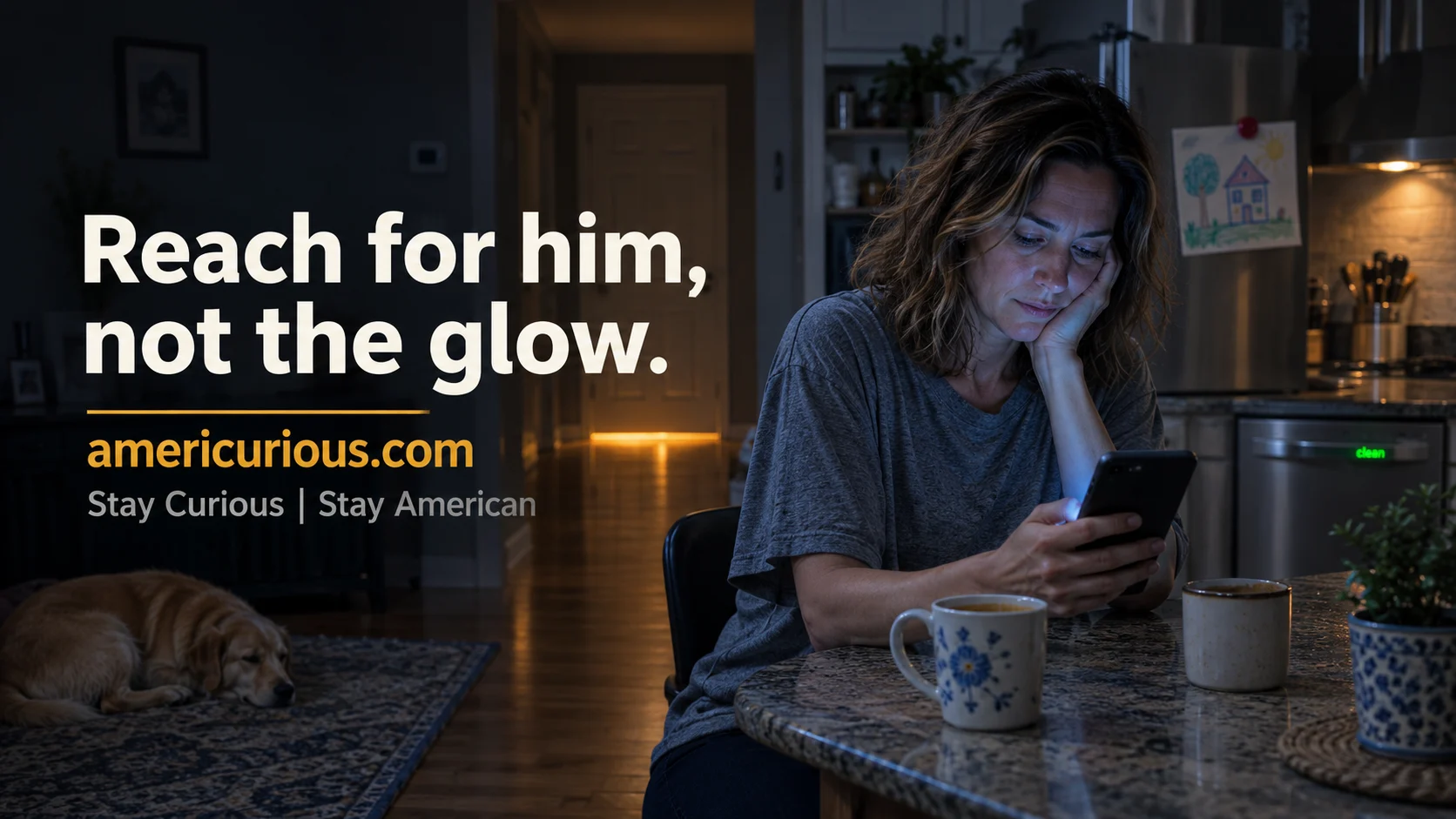
Married to someone who shuts down when you need reassurance? Why the anxious-avoidant trap peaks at 2 AM, and a 20-minute plan that actually helps.
He Went Quiet at 10 PM. By 2 AM I Was Asking a Chatbot If I’m Too Needy.
Quick answer: The anxious-avoidant trap is a pursue-withdraw loop. One spouse reaches for closeness and reassurance, the other feels flooded and pulls away, and each move makes the other one bigger. At 2 AM, don’t chase him, and don’t hand the reassurance job to an app. Calm your body first, name the pattern, and set up a break-and-return signal for tomorrow.
Renee, the woman in this story, is a composite. I built her from patterns in clinician writing, published research, and the things people say in public forums about this exact problem. She isn’t one real person, and nobody here is identifiable. I’m not a therapist either. I read the research so you don’t have to do it at 2 AM with the brightness turned down.
2:02 AM
You’re not asleep. You haven’t been asleep.
The dishwasher finished an hour ago, and the house has that ticking quiet it only gets after a fight nobody won. He’s in the basement with the TV on low, or he’s already in bed with his back to you, breathing the way people breathe when they’ve decided the conversation is over.
You said you weren’t mad. You said it twice. I’m not mad, I just need to know we’re okay. He said “We’re fine.” Then he said “I’m just tired.” Then he picked up his phone and the door in his face closed, quietly, the way a good door does.
Now the phone’s in your hand, face lit, brightness on the lowest setting so you don’t wake him. The cursor is blinking in a chat window. You type: Am I too needy?
You delete it. You type it again, with more backstory this time, because you want the answer to be fair. You want somebody to say no, honey, you’re not crazy. You want it right now.
If this is you, I’m not going to tell you to put the phone down. Not yet. First I want you to know you’ve got company, probably more of it than you think, and there’s an actual explanation for why 2 AM feels like this.
What’s going on in that house
Here’s what the 2 AM version of this looks like from the inside. See if it fits.
- Your chest feels tight, like you forgot something important.
- You replay his tone. The exact word. The half-second pause before “fine.”
- You rehearse what you should’ve said. Then you rehearse what you’ll say tomorrow.
- You tell yourself not to text him. You’re already drafting the text.
- You feel stupid for needing this much, and then you feel scared that the stupid feeling is the thing that’s going to wreck everything.
And somewhere under all that, a very small voice: if I’m too much, he’ll leave.
Okay. Hold that one for a second. Because there’s a good chance that voice isn’t telling you the truth, and the research says why.
You’ve already tried the fixes (and they didn’t fail because of you)
Let’s clear the table first, because I’d bet money you’ve done most of this.
You took the attachment quiz. Maybe three of them. You got a label, and so did he. Cool. That told you who you are and nothing about what to do at 2:02 AM.
You tried playing it cool, because some corner of the internet told you that if you back off, he’ll come closer. That advice was written for dating, where the stakes are a text thread. You’re eleven years in, with a mortgage and two kids and a dog who needs a walk. One Mumsnet poster, newly married to an avoidant husband, said almost exactly this: every video she found was about people who were dating, and nobody was talking to couples who actually intend to stay.
You tried bringing it up “calmly” in the morning. He heard an ambush. You heard a wall.
You tried the therapy-speak scripts, the “I feel… when you… because…” ones. Annie Wright, a licensed marriage and family therapist, writes that scripts like these wear off within about a week because they don’t touch what’s actually driving the loop.
And you tried journaling, which turned into rehearsing the fight with a pen.
None of that failed because you lack discipline, or insight, or love. It failed because every one of those fixes treats this as a you problem or a him problem. It’s neither. It’s a loop, and loops don’t care how smart you are.
It’s not a flaw in you. It’s a loop.
This feels like proof that you’re too much. The research tells a different story.
Researchers call it the demand-withdraw pattern: one partner presses for connection, resolution, or change, and the other one tries to end the discussion and create distance. A 2024 study in the Journal of Marital and Family Therapy followed 63 heterosexual couples through moderate conflict. It found that during the woman’s issue, men were more likely to withdraw, and during the man’s issue, women higher in attachment anxiety were more likely to demand. Demand in one partner went along with withdrawal in the other, and the reverse.
Read that again slowly. The roles shift depending on whose issue is on the table.
So no. You aren’t “the needy one” as a permanent identity. (And if you’re a husband reading this and recognizing yourself as the one who reaches and reaches, you’re welcome here. The roles flip in plenty of marriages. Renee’s chair is just the one I’m sitting in tonight.)
Here’s the picture I find helpful. Think of two smoke detectors wired to the same circuit. One is set extra sensitive and goes off at the first wisp of toast. The other is set to shut itself off when the noise gets too loud. Put them in one kitchen and you get exactly this: the first screams, the second goes dark, and the darkness sets the first one off even harder. Nobody’s broken. They’re just wired to each other. That’s what clinicians mean when they describe the anxious-avoidant trap as two alarm systems each setting off the other.
You’re not too much. You’re a smoke detector in a kitchen with another one, and somebody burned the toast.
So why is the phone in your hand?
I want to be careful here, because this part is new and I don’t want to scare you or shame you.
More people are taking the 2 AM question to a chatbot. A McMaster University analysis from February 2026 describes the exact scene: the argument ends, you keep running it back in your head, you open an AI and type something like am I right or am I overreacting? The author points out that questions like am I needy, am I unlovable, am I the problem carry so much shame that telling a person feels risky. A chatbot feels safe. It doesn’t sigh. It doesn’t have a face.
That makes sense. It really does.
Then there’s the University of Washington study, summarized in their August 2026 research highlights. Researchers compared survey answers from 168 people with nearly 20,000 of their ChatGPT messages. People higher in attachment anxiety were more emotionally engaged with the chatbot, trusted it more, and were more likely to act on its suggestions. People higher in avoidance trusted it less.
Two honest caveats. This study found associations, not cause and effect. It doesn’t show that AI makes anyone’s marriage worse. And the McMaster piece also names real upsides: privacy, less stigma, a place to draft what you’re trying to say. Its warning is narrower, that quick reassurance can lock in a one-sided story before you’ve heard the other side.
So here’s my take, as plainly as I can say it. The chatbot isn’t the villain. It’s a symptom. The part of you that picks up the phone at 2 AM is the part that needs to feel safe with someone, and the app can’t be that someone. It can’t lie down next to you. It can’t say your name in the morning.
It also quietly skips the exact thing that would break the loop, which is you and him finding your way back to each other, not you and a screen finding comfort.
One small irony worth knowing. The Gottman Institute, in its guidance on taking a break after an argument, advises against texting your partner, calling someone to vent, or googling the topic during the break. Their reasoning is that you need real distance from the stressor. Asking an AI to analyze the fight is closer to googling it than to resting from it.
What he’s probably doing in the basement
Let me stick up for him a second, because the version of him in your head at 2 AM is a lot colder than the real one.
When a conflict gets loud, a lot of people go into what researchers call flooding: heart racing, tunnel vision, shutting down. John Gottman’s research found it takes roughly 20 minutes away from the stressor for stress hormones to clear. A flooded person can’t have a productive conversation. Their body just won’t let them.
So that silence you’re reading as he’s checked out, he doesn’t care? It might be his system is overloaded and he doesn’t know how to say so. That’s not an excuse. It’s information.
The trick is telling the difference between three things that look the same from the doorway:
| Stonewalling | Silent treatment | Healthy time-out | |
|---|---|---|---|
| What’s driving it | Physical flooding, a shutdown he may not choose | Deliberate punishment or control | Self-aware regulation |
| What it looks like | Goes blank, looks away, short answers | Ice, with a point to prove | “I need 20. I’ll find you at 9:30.” |
| How it ends | Drifts, topic never returns | Whenever you apologize | A return and a real conversation |
Table: Three kinds of “quiet” that feel identical at 2 AM but need different responses. Adapted from how Gottman-based sources distinguish them.
If the quiet ends in a conversation, it was a time-out. If the topic just evaporates and everybody pretends, that’s the pattern that wears marriages down. And if the quiet is meant to hurt you, that’s a different problem, and I’ll come back to it near the end.
Okay. So what do we actually do?
Now that we know the mechanism, here’s how we start taking it apart.
A few ground rules before anything else.
You’re not doing a fix. You’re running experiments. Pick one lever. Test it for three nights. If it doesn’t help, that isn’t failure. It’s data. It means your friction point is somewhere else, and now you know where not to look.
Everything here passes the One-Inning Test. You could do it in the next 15 minutes, in the dark, with no budget, running on four hours of sleep.
And since I can feel your guard going up: yes, some of this will sound like the same “regulate your nervous system” stuff that makes you want to throw your phone. I roll my eyes at that too. But look at what’s different here. These aren’t about becoming a calmer person. They’re about breaking a loop at the moments it’s most breakable.
Pick by your situation:
- If you have 5 minutes right now: Experiments 1 and 2.
- If you’re too wrecked to think: Just Experiment 2.
- If he won’t talk about any of it: Skip to Experiment 4.
- If you like structure and plans: Go straight to Experiment 5.
The Immediate Micro-Fixes (tonight, in the dark)
Experiment 1: The ten-minute pause plus one note.
Before you open any app or text anyone, wait ten minutes. Just ten. Then open your notes app, not a chat window, and finish three sentences:
What I’m feeling is ______. What I need is ______. What I could ask for tomorrow is ______.
Example: What I’m feeling is scared. What I need is to hear we’re okay. What I could ask for tomorrow is one sentence.
That’s it. I’ll be honest: this isn’t a research-validated protocol. It’s a practical way to turn a spiral into a sentence. Treat it like any experiment.
If it doesn’t work (you write the note and still feel frantic), then move to Experiment 2. It means your body is the problem, not your words.
Experiment 2: Body first.
You can’t think your way out of a racing heart. Try this: breathe in through your nose for about four counts, out through your mouth for about six, and keep the exhale longer than the inhale. Do it for two or three minutes. Gottman-style sources note that practicing self-soothing when things are calm makes it easier to reach in a crisis, so even one practice round tomorrow counts.
If lying still makes it worse, get up, drink some water, and stand at the kitchen island with the lights off. Boring is the point.
If your thoughts loop anyway, don’t fight them. Name three things you can see in the room. That’s a grounding trick, and it’s cheap.
Experiment 3: If you’re going to use AI anyway, give it a smaller job.
I’m not going to pretend you won’t. So here are three questions to ask yourself before you hit enter:
- [ ] Am I asking for information (what is flooding?) or for a verdict (who’s right?)
- [ ] Is this something I’d be willing to say to him tomorrow?
- [ ] Will I stop after one answer?
If you want help with wording, great. Ask it to help you draft one calm sentence, then close the app. If you’re asking it to rule on the fight, you’re back in the loop wearing a different costume.
The Words Experiments (tomorrow, daylight)
Experiment 4: Ask for the smallest possible reassurance.
You’ve probably noticed that asking for reassurance in the middle of the storm doesn’t work. He’s flooded. You’re flooded. Nobody’s in there.
So don’t ask then. Ask later, at a calm moment, for something tiny he can actually give:
“Last night got big for me. I’m not trying to reopen the fight. Can I get one sentence from you today? Just, are we okay?”
Notice what that does. It tells him you aren’t about to ambush him. It gives him an exit that’s easy to say yes to. And it shrinks the ask from fix everything to thirty seconds.
If he says “we’re fine” in a flat voice and you feel nothing, that’s data too. Try asking when he’s less tired, or ask for a different form: a hand on your back, a text at lunch.
Experiment 5: Set up the break signal in broad daylight.
This one needs both of you, but it’s the highest-leverage move on this list.
The idea comes straight from Gottman-based guidance: agree in advance on a word or phrase that means “I’m getting flooded, I’m not leaving you, I’ll be back.” The break should last at least 20 minutes, involve something calming rather than rehearsing the fight, and end with a set time to come back. Pick the signal on a good day, maybe over coffee on a Saturday:
“When one of us is overloaded, let’s say ‘I need twenty.’ It means I’m not abandoning you and I’m not winning. It means I’ll come find you at [a specific time]. Deal?”
If he agrees but then disappears without returning, that’s the sign to build the return part tighter. Say a specific time and put it on both phones. If he won’t agree to anything, go to Experiment 6.
The Support Layer (when you want more than tricks)
Experiment 6: Try couples therapy that’s built for this loop.
Emotionally Focused Therapy (EFT) was designed around exactly this pursue-withdraw dance. A 2024 meta-analysis covering 20 studies and 332 couples found medium to large effects, with about 70% of couples symptom-free at the end of treatment. An earlier randomized-trial meta-analysis also found EFT helped, but its authors cautioned about possible publication bias and noted that gains from the other approach they studied weren’t maintained at 12 months. So it’s promising, not magic.
Money is real. If cost is your wall, ask therapists about sliding-scale rates, look at community mental health centers, or start with an individual therapist who knows attachment work.
If he won’t go, you can still go alone. That counts.
When it’s more than a cycle
I need to say this plainly, because this framing doesn’t fit every marriage.
The pursue-withdraw pattern is a communication loop. It isn’t a diagnosis, and it isn’t an excuse for hurting someone. If your silence at 2 AM comes with fear of him, with threats, control, intimidation, or violence, this isn’t an attachment-style problem and “give him space” isn’t the answer. You can reach the National Domestic Violence Hotline any time. And if the 2 AM thoughts ever go darker than loneliness, call or text 988.
The honest part
Here’s the part I didn’t want to write.
I can’t promise this works. Some couples do the experiments, find a rhythm, and the nights get quieter. Some don’t. Some find out the gap between them is bigger than a cycle. Forum threads are full of both. People say things got better once the avoidant partner picked up a few skills. Others say the relationship ended, and they carried the pattern into their next one. Both are real.
And I’ll tell you what Renee told me she was most ashamed of: the 1 AM text. The long one. She sent it anyway. He read it Sunday morning and went to the garage for an hour. It added three days to the quiet. She’s not proud of it, and she isn’t broken for sending it either. It’s what a nervous system does when it’s scared.
If you’ve sent that text, you’re in very good company.
The goal isn’t a flawless marriage. It’s a night where you reach for him instead of the glow.
If you want a longer look at what’s happening underneath the loneliness, I wrote about it in It’s Not a Lack of Love. It’s the Loss of Friendship That Makes a Marriage Unhappy. And if the 2 AM exhaustion is partly the mental load you’ve been carrying alone, How to Stop Being the Default Parent When Your Husband Says “Just Tell Me What to Do” may hit close to home.
Quick answers
Can an anxious and avoidant couple have a healthy marriage?
Yes, but it takes steady effort from both people. The cycle is a pattern, not a sentence, and couples therapy built on attachment, such as EFT, has solid evidence behind it.
Why does my husband shut down when I need reassurance?
He may be flooded, meaning his body is overloaded and he can’t keep talking. Researchers have found that withdrawal often shows up when one partner demands and the other feels overwhelmed.
How long should a break last after an argument?
At least 20 minutes, according to Gottman-based guidance, with a set time to return and a calming activity in between.
Is it bad to ask ChatGPT for relationship advice?
It isn’t automatically harmful, and it can help with drafting what you want to say. The risk is relying on it for reassurance or a verdict, which can settle you into one side of the story. The research linking anxiety and chatbot reliance is correlational.
Is withdrawing the same as the silent treatment?
No. Stonewalling is usually a flooded shutdown. The silent treatment is deliberate. A healthy time-out has a clear end and a return.
When should we see a couples therapist?
If the same fight keeps repeating, if the silence stretches for days, or if either of you feels unsafe or hopeless, don’t wait.
You don’t have to do all of this
You don’t need a six-part system. You need one tool that fits into your actual night.
If everything above feels heavy, drop it. That’s not you failing. It tells you the friction is somewhere else, and now you know.
Here’s your first move, and it takes ten minutes. Tonight, or the next time the 2 AM feeling hits: set a timer for ten minutes before you open any app. When it goes off, write the three sentences from Experiment 1 in your notes app. That’s all.
Your take-home
You are not too much. You’re one half of a loop that was running long before tonight, and loops can be interrupted. Start with your body, then one small sentence, then one small ask. Keep your expectations modest and your curiosity high.
You and he aren’t enemies. You’re two people with smoke detectors wired together. The work isn’t to turn yours off. It’s to learn, slowly and with a few failed experiments, to hear each other’s alarm for what it is.
If this landed, please:
- 👍 Like it so it reaches someone who’s awake right now
- 💬 Comment with the one experiment you’re going to try (or the one that already works for you)
- 🔁 Share it with a friend who’s been staring at the ceiling too
- 📬 Subscribe to AmeriCurious for more honest, research-backed notes on love and the rest of American life
- 🔖 Bookmark this for the next 2 AM
“Some nights the bravest thing in a marriage is a ten-minute pause and one honest sentence.”
— AmeriCurious
This article is for general information and isn’t a substitute for professional mental health care.