A real Thanksgiving letter to the neighbors who became family, plus exact words, scripts, and a 10-minute plan to thank your community without sounding fake.
Quick Answer: A Thanksgiving letter to your community works when it names three specific moments, names what those moments changed, and ends with one low-pressure invitation to stay connected. Try this formula: one specific memory, one ripple effect, one invitation. Example: Thank you for bringing enchiladas on the night I had no groceries. Because of that night, my kids learned that neighbors can be family. Would you like to come for pie on Saturday? No need to bring anything.
Dear neighbors,
It’s 2:04 a.m. and I’m wide awake on the couch again.
Ope. Sorry. I know that’s a weird way to start a Thanksgiving letter. But if I’m being honest — and I promised myself I’d be honest in this one — that’s where this letter actually started. Not at the kitchen table with cute stationery. On the couch. In the dark. With my phone in my hand and a draft I kept typing and deleting and typing again.
Because here’s the thing I can’t stop thinking about: I don’t want you to think I’m writing this because I need something.
I don’t want you to think I’m lonely. I don’t want you to think I’m falling apart. I don’t want you to think this is one of those big dramatic letters where I’m about to ask for help.
I just… I never said it right. And I really, really want to say it right this time.
So here goes. For real this time.
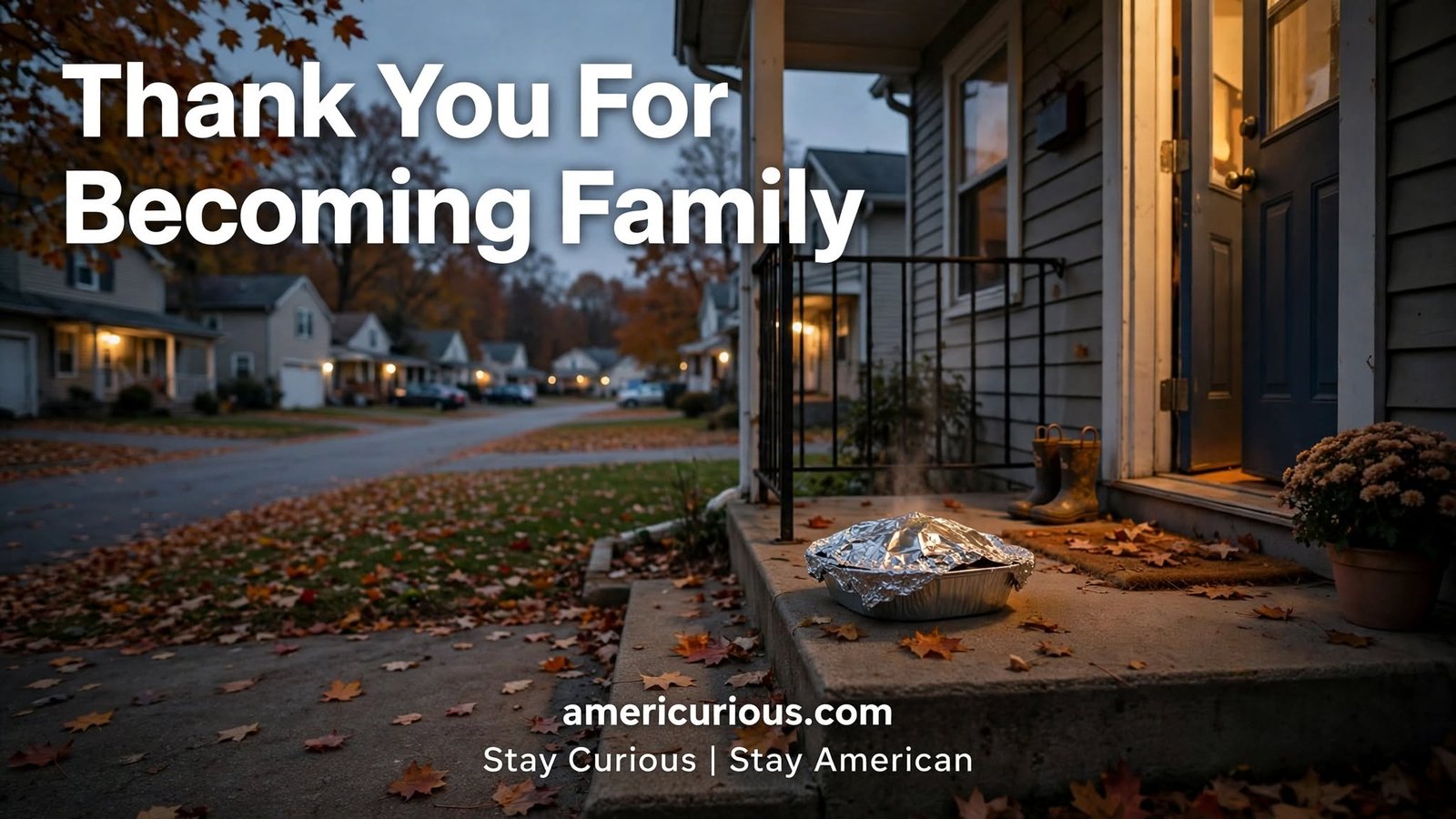
Do you remember that foil-covered dish on my porch step? The one that showed up in March, still warm, no note, no knock, no ding-dong, here I am being a good person, please come to the door and perform gratitude for me?
I stood in my doorway holding it and I cried. Not pretty crying. Ugly, snotty, kitchen-floor crying. Because my mom had just died, and I had two kids asking what was for dinner, and I had no groceries, and I had no plan, and then — there it was. Food. Just… food. From people who didn’t need me to say thank you the right way.
I never found out which one of you left it. Maybe it was all of you. I still think about that dish every single time I open my front door.
That’s why I’m writing this now. Before Thanksgiving. Before the table gets quiet and I talk myself out of it again.
Thanksgiving this year is Thursday, November 26. I looked it up because I kept getting the date mixed up in my head, and yes, it’s the fourth Thursday, like always. My kids will be here. It’ll be small. It’ll be good. It’ll be… quieter than the Thanksgivings I grew up with.
And I keep thinking, if I don’t say this now, I’m gonna spend the whole holiday feeling guilty for not saying it. And then I’m gonna spend December feeling guilty for feeling guilty. You know that loop? Yeah. I’m in it.
So. This is me, breaking the loop.
Related Post….
How I Finally Asked Everyone to Bring Something
The letter I never sent
Okay, confession time.
I actually wrote you a letter back in March. A long one. Like, embarrassingly long. I wrote it at the kitchen table after the kids went to bed, and I used all the words you’re supposed to use. Heartfelt. Blessed. Grateful beyond measure. All of it.
And then I never sent it.
I told myself the moment had passed. I told myself it would be weird now. I told myself you’d think, who is this lady and why is she writing us a novel about a casserole?
Here’s what I know now, eight months later: gratitude doesn’t have an expiration date. I made that up. I made that up because I was scared of looking needy.
That fear — that if I say thank you too big, you’ll start seeing me as the lonely divorced mom — that fear has cost me more than any awkward letter ever could.
Because the truth is, after I took that casserole, I avoided that whole side of the street for two weeks. Two weeks! I would see someone coming and I’d pretend I was so busy getting the mail. Like, wow, this mail is fascinating. I cannot possibly make eye contact right now, this mail needs me.
I did that because I thought accepting help had marked me. Like I had a stamp on my forehead that said NEEDY.
And then one day, one of you — I’m not gonna name names because you’d die of embarrassment if I did — just said it so casual in the driveway, like it was nothing: “Oh, that was just extra food. We made too much.”
Extra food. Not charity. Not a rescue mission. Extra food.
That sentence freed me. For real. It made me realize you weren’t keeping score. I was the one keeping score. I was the one turning every kind thing into a debt I had to pay back perfectly.
So if you’ve ever done that — kept score on yourself for accepting help — I see you. I was you. I kind of still am you, at 2:04 a.m. on my couch.
This letter is me trying to stop.
Why the generic thank-yous never worked for me
I need to clear the slate here, because if you’re like me, you’ve already tried to do this four different ways and they all flopped. And if I just hand you another template, you’re gonna think, yeah, right, tried that.
You’ve probably tried this stuff. I did:
The gratitude journal. I started one in January. Cute notebook, gold pen, the whole thing. I wrote in it for, like, nine days. Then it lived in my junk drawer next to the dead batteries and the takeout menus. That didn’t fail because you lack discipline. It failed because writing for yourself, by yourself when you’re already feeling alone just feels… lonelier. You needed to write to someone. That’s a different thing entirely.
The store-bought card. I bought one. It had a pumpkin on it and inside it said something like, “Wishing you warmest wishes and boundless gratitude this season.” I left it unsigned on my counter for three weeks. Because I would never, ever say “boundless gratitude” out loud to a human being. Not to you. Not to anyone. If I handed you that card, you’d be like, who wrote this, a greeting card robot? Yeah. Exactly.
The giant group-chat draft. Oh, this one. I typed a whole paragraph thanking “everyone” for “everything” and “being amazing” and then I deleted it before I hit send. Because thanking everyone is the same as thanking no one. You know it. I know it. We both felt that ick.
The big Thanksgiving host plan. I was gonna host everyone. A real table. Matching dishes. A turkey I would definitely not burn. Then I did the math — money, seats, my tiny rental kitchen, the fact that I own exactly six forks — and I quietly gave up on that idea in October. And then I felt guilty for giving up.
None of those failed because you’re bad at gratitude. They failed because they were too big, too vague, or too fake for a real street with real people.
This sounds like standard, generic “just be grateful” advice, which usually makes me roll my eyes too. I get it. If someone had handed me a Pinterest board that said gratitude changes everything! I would have closed the tab so fast.
But this isn’t that. This is not about feeling grateful. This is about naming one true thing that already happened. That’s it.
Callout: The skepticism check
If your guard just went up because this is starting to sound like toxic positivity — just be blessed, just be thankful, good vibes only — good. Keep that guard up. I don’t want you to write a letter that says you’re blessed when you’re actually grieving, tired, and kind of mad that life looks like this right now. You can be grateful and grieving. You can be thankful and tired. This letter has room for both. If a line in your draft feels fake, cut it. Fake gratitude helps no one.
This feels like a personal failure, but the data tells a completely different story
…and so you end up staring at the ceiling at 2 a.m., angry at yourself for not just sending the dumb text already. Why is this so hard? Why can’t I just be normal about this?
It’s not a character flaw. It’s not because you’re awkward. It’s because this is actually hard for a lot of us right now.
The U.S. Surgeon General’s advisory described loneliness as a subjective distressing experience that results from perceived isolation or inadequate meaningful connections. The CDC’s summary of the Surgeon General’s advisory on social connection and worker well-being notes that approximately half of U.S. adults report experiencing loneliness. Half. So if you feel weird about needing people, you’re not the weird one. You’re the normal one.
The Lancet Public Health summary of the WHO Commission on Social Connection report puts it even bigger: an estimated 16 percent of people worldwide experienced loneliness between 2014 and 2023, and loneliness was associated with an estimated 871,000 deaths per year during 2014 to 2019. I’m not telling you that to scare you. I’m telling you that because connection isn’t a cute extra. It’s not the marshmallow on top of the sweet potatoes. It’s part of health. Like sleep. Like food.
And Thanksgiving? Thanksgiving puts a spotlight on it. A guide based on a Pew Research Center survey of 9,609 U.S. adults found that about 5 percent planned to dine alone, and another 2 percent planned no Thanksgiving dinner at all. The same guide points out what Pew didn’t measure: how many of that 5 percent chose it and how many would have said yes to an invitation. You can read that breakdown in NexSpark’s guide to spending Thanksgiving alone.
That gap matters. Because there’s a huge difference between I chose quiet and I wanted company and nobody asked. One feels like rest. The other feels like being forgotten.
Plus, the holidays are just… a lot. An American Psychiatric Association poll summarized by Lyte Psychiatry’s guide to planning Thanksgiving with less stress found that 28 percent of adults said they were experiencing more holiday-related stress than the year before. The top stressors were grieving or missing a loved one at 47 percent, affording gifts at 46 percent, and challenging family dynamics at 35 percent. So yeah. If your Thanksgiving feels heavy, you’re not doing it wrong. You’re doing it in a hard year.
Now that we know the mechanism behind the glitch, here is how we systematically dismantle it — not by fixing your whole life, not by becoming a different person, but by testing one tiny, specific, 10-minute experiment.
Because here’s what the gratitude research actually says, and I love this part: it doesn’t say be more grateful. It says write it down, specifically, to a real person.
The Greater Good Science Center’s guide to four great gratitude strategies describes the gratitude letter as writing to someone you never properly thanked, budgeting about 10 minutes for writing, and — if you can — delivering it in person. In the 2005 study they cite, that letter had the greatest positive impact on happiness one month later among five practices tested, and the biggest benefits came when people read it aloud in person. But — and this is important — the happiness faded back to baseline by six months. So no, one letter is not a magic fix. It’s not a cure for grief or loneliness. It’s a practice. Like stretching. You do it, it helps, you do it again later.
And here’s the part that made me breathe out for the first time: in another study of nearly 300 adults seeking counseling, the people who wrote gratitude letters reported significantly better mental health four weeks and 12 weeks later — and most of them never even sent the letters. The writing itself helped.
So if you write this and you chicken out and you don’t send it? It still counts. I’m serious. It still counts.
But I think you’re gonna send it. Because we’re gonna make it so small you can’t talk yourself out of it.
The three-moment filter: how to pick what to say
Okay. Here’s the part where your brain goes, but I have like 47 things to thank them for, where do I even start? I know. Mine did that too.
Don’t try to list the whole year. You’ll drown. Pick three. Just three. One from each bucket.
Table 1: The Three-Moment Filter — Pick One From Each Row
| Bucket | What it sounds like | My example |
|---|---|---|
| 1. Practical help | Something they did with their hands | Shoveled my driveway before I woke up, when I had no shovel and two kids to get to school |
| 2. Steady presence | Someone who just kept showing up | Texted “just checking in” on the days after my mom died, without needing a reply |
| 3. Quiet kindness | Something they did without being asked | Left food on the porch without ringing the bell, so I didn’t have to perform gratitude while grieving |
Caption: Use this filter to keep your Thanksgiving letter to community specific, short, and true. One moment per bucket is enough.
That’s it. That’s the whole filter.
If you’re thinking, but I don’t have three big moments, good. I don’t want big moments. Big moments feel like a movie. I want small, true moments. The borrowed ladder. The extra tomatoes. The “I made too much, want some?” text at 7:12 p.m. The neighbor who took my daughter to practice when I was stuck on a work call.
Small is what makes it believable. Small is what makes it yours.
Because you don’t have two hours to overhaul your entire holiday, we are going to ignore long-term habit changes for now. Instead, we are testing one micro-intervention that takes exactly 10 minutes at your kitchen table. Timer on. Phone on Do Not Disturb. Pen, paper, or notes app — whatever you already have. No buying anything. No matching envelopes. No perfect handwriting required.
Care to Read?!
Tradwife Tribune: The Nine O’Clock Table — Keeping Supper Warm When His Shift Belongs to the Grid
The letter, continued
Okay, back to the letter. I’m still here. You’re still here. Let’s finish it together.
Dear neighbors,
Thank you for shoveling my driveway before I woke up on February 3. I had no shovel. I had two kids in puffy coats. I had a school drop-off in 20 minutes and a full-on panic in my chest. And then I opened the front door and it was just… done. You didn’t make a big deal out of it. You didn’t even tell me it was you. I found out three weeks later because someone mentioned it in the pickup line like it was nothing. It wasn’t nothing to me. It was the day I stopped feeling like I was doing this alone.
Thank you for the texts after my mom died. Not the big, formal ones. The little ones. The “just checking in” ones. The “no need to reply” ones. You have no idea how much those “no need to reply” words mattered. Because I couldn’t reply. I didn’t have words. But I read every single one, usually at 2 a.m., usually crying, usually feeling a tiny bit less alone in my kitchen. You kept showing up without asking me to perform being okay. Thank you for that. For real.
And thank you for that porch food. I already told you about that one. But I’m saying it again because my kids still talk about it. My daughter still says, “Remember when the neighbors left us dinner and we didn’t even have to get dressed?” Yes, baby. I remember. I remember everything.
Because of you, my kids learned something I couldn’t have taught them with a lecture: that neighbors can be family. That help doesn’t always come with a knock and a speech. Sometimes it just shows up warm, in foil, on a step. Sometimes it shows up as a cleared driveway. Sometimes it shows up as a text that says, “I got you. No worries if not.”
I want them to remember this street like that. Not as the place where Mom was sad after Grandma died. As the place where people took care of each other. For sure, that’s what I want.
I love you guys. I know that’s a big thing to say to people you mostly talk to in driveways. But I do. I love you guys.
— Em
P.S. I still don’t know who left the casserole dish. If it was you, please tell me so I can return your dish. It’s been washed. It’s been washed like four times. I am so sorry. I kept forgetting. It’s on my counter right now next to the dead batteries. Ope.
The playbook: five copy-ready scripts
Now that we know the mechanism, let’s get literal. Don’t just tell yourself “I’ll thank them.” Steal these words. Copy, paste, tweak one detail, send.
Think of these as behavioral experiments, not pass/fail tests. Test this hypothesis for three days: If I name one specific moment, people will feel seen, not burdened. If a script flops, that’s not you failing. That’s data. You learned what doesn’t fit your street, which gets you closer to what does.
Pick the one that matches your current energy. Don’t do all five. That’s the old you, overhauling everything. New rule: one lever.
1. The handwritten note — for the neighbor who helped the most
Dear [Name], Thank you for shoveling my driveway on Feb. 3 when I had no shovel and two kids to get to school. I never thanked you right, so here it is: you saved my morning. And honestly, you saved a lot more than that. No need to reply, just wanted you to know I remember. — Em
2. The group-chat message — for your street, building, or school parent chat
Hey everyone, quick thing before Thanksgiving gets crazy. Thank you for all the little stuff this year — the extra food, the rides, the “just checking in” texts. My kids and I felt it. Really. If you’re around Saturday, we’re doing pie on the porch around 4. No need to bring anything, no worries if not. Just pie if you want it.
3. The porch note — for the quiet helper you don’t know well
Hi! It’s Em from across the street. Thank you for leaving food on our porch in March. You didn’t ring the bell and I was so grateful for that. My kids still talk about it. Thank you for being that kind of neighbor. Happy Thanksgiving.
4. The text to one person — for when a group message feels too much
Hey, it’s Em. I keep thinking about that time you watched the kids for 40 minutes so I could take that work call. I never thanked you right. So thank you. For real. Can I bring you pie on Saturday? No pressure at all if you’re busy.
5. The invitation after the thank-you — for when you’re ready for the next step
I wanted to say thank you before Thanksgiving, not after. Thank you for making this street feel like family this year. If you’re free the Saturday after Thanksgiving, I’m doing a super casual pie-and-coffee thing, 4 to 5:30. Come for 10 minutes or the whole time. Bring nothing. Just come if you want.
Each one is under 80 words. Each one names one moment. Each one has an easy out. None of them ask for money. None of them say “boundless gratitude.” You’re welcome.
Pull quote: “You don’t need a perfect letter. You need one true sentence.”
Troubleshooting: If-then
- If you try the handwritten note but you freeze on the first line… then switch to the text version. Same words, lower friction. The medium doesn’t matter. The specific memory does.
- If you send the group-chat message and no one replies in 10 minutes… then do not spiral. People are in grocery stores, in traffic, in life. Give it 24 hours. Silence is not rejection. It’s November.
- If you write the letter and it starts sounding like a greeting card… then delete every adjective. Delete blessed, heartfelt, warmest. Keep only verbs and nouns: who did what, when, what changed. Read it out loud. If you wouldn’t say it in a driveway, cut it.
- If gratitude feels impossible because you’re grieving… then write to one person, not the whole community. Or write it and don’t send it. Remember: in that study, most people didn’t send theirs and still felt better. Writing counts.
The invitation ladder: pick your level
If your environment makes a big Thanksgiving invite impossible — small house, tiny budget, six forks, same — don’t force it. Let’s pivot to a smaller lever instead.
This is where we stop trying to host Thanksgiving Day itself, and we start building the after Thanksgiving connection. Because Thanksgiving is one day. Loneliness doesn’t care about one day. It cares about December. January. February when it’s dark at 5 p.m.
Table 2: The Invitation Ladder — Same Thank-You, Three Levels of Energy
| Level | What you say | Time and cost | Easy out |
|---|---|---|---|
| Level 1: Porch coffee | “I’m making coffee Saturday at 10, come grab a cup if you’re out” | 15 minutes, coffee you already have | “No worries if not, I’ll be out there anyway” |
| Level 2: Pie on Saturday | “Pie on the porch, Saturday 4 to 5:30, bring nothing” | 90 minutes, one store-bought pie | “Come for 10 minutes or the whole time” |
| Level 3: December potluck | “Anyone want to do a super casual potluck in December? Everyone brings one thing” | 2 hours, you provide the main, they bring sides | “Totally fine if it doesn’t work, just throwing it out there” |
Caption: Choose the lowest rung you can actually do this week. A small invitation you send beats a big invitation you dream about.
If you are an introvert who loses energy from big groups, try Level 1. One person. One cup. Done.
If you thrive on social accountability and you have a free weekend, skip to Level 3. Make the group chat do the work.
If you have 5 minutes right now, do the text script. If you have a free Saturday, plan for pie. Let your energy pick, not your guilt.
And here’s the cheat code from Friendsgiving world: a potluck gives you a job. In a guide to going to Friendsgiving alone, Solo Era’s guide to joining or hosting Friendsgiving without a group recommends asking early, naming a specific dish you can bring, and giving an easy out like “no worries at all if it’s full.” That same logic works in reverse when you host. When you say “bring a side if you want, no pressure,” you make it easy to say yes, and you make it easy to say no. Both matter.
What if no one replies?
Okay, deep breath. Let’s talk about the fear underneath all of this.
What if you send it and… nothing? No heart react. No text back. No knock. Just… crickets.
First: that does not mean you failed. It means it’s November. People are traveling. People are cooking. People are overwhelmed. People read a beautiful message, think oh I need to reply to that properly, and then forget because their kid threw up in Target. That’s not rejection. That’s life.
Second: if silence happens, try one lighter follow-up in 48 hours. Not a second big letter. Just this:
Hey, just bumping this in case it got buried. No worries at all if Saturday doesn’t work. Just wanted you to know I’m thankful for you. Hope your Thanksgiving is good.
That’s it. No guilt trip. No “I guess you don’t care.” Just a bump and a blessing and a door left open.
Third: if this Thanksgiving still feels heavy because someone is missing — your mom, your dad, your person, your old life — please know that a letter doesn’t have to fix grief to be worth writing. Grief and gratitude can sit at the same table. Mine do. Every year. My mom’s chair is empty and my neighbors’ casserole dish is full and both things are true at the same time.
If the heaviness lasts past the holiday, or it starts messing with sleep, work, or how you show up for your kids, talk to someone you trust, or a doctor or mental health professional. In the U.S., you can call or text 988 any time. This post is general information, not medical advice. You deserve real support, not just a blog post.
What if you are the one who is alone?
I need to pause here, because I know some of you reading this are not the person writing the thank-you. You’re the person hoping someone writes you one.
So let’s do the two-question test I learned from that NexSpark guide. Picture 4 p.m. on Thursday. Then ask yourself two things:
- Do you feel relief or dread? Relief means you’re picturing quiet. Dread means you’re picturing the gap.
- If someone invited you today, would you go? A fast yes tells you more than any mood check.
Relief + a no = that’s a chosen day. Enjoy it. Make your small feast on purpose. Take a walk. Call one person you love at a set time.
Dread + a yes = that’s an unchosen day. And that day is worth fixing before it arrives, not on the day itself.
This feels like a personal failure, but the data tells a completely different story — tables get set in early November. If nobody knew you were alone, they didn’t exclude you. They just didn’t know.
So here’s your experiment for this week: ask one person. Just one. Use this exact script, stolen from that Friendsgiving guide and tweaked for real life:
Hi! I heard you might be doing something for Thanksgiving. I’m in town and would love to come if there’s room. I can bring a dessert or a side. No worries at all if it’s full.
If that feels too big, flip it. Host a tiny one. Two or three people. Not Thanksgiving Day — the weekend before or after. “I’m hosting a small Friendsgiving on Saturday at 5. Bring a dish if you like, no pressure.” Two to four guests is plenty. Small tables make conversation easier.
And if hosting feels impossible too, look for a community meal, a faith community meal, a volunteer shift, or a group meetup. Check if you need to sign up. And if you’re a host reading this with room at your table — She Speaks Truth’s blueprint for opening your home on Thanksgiving has a beautiful idea: post in your neighborhood group, talk to neighbors, ask your church if anyone will be alone, and make it a potluck so everyone brings a dish and everyone gets to participate. Someone on your street might be waiting to be asked.
You don’t have to earn an invitation by being cheerful enough. You just have to ask.
The closing of the letter
Dear neighbors,
I started this letter at 2:04 a.m. because I couldn’t sleep. I’m finishing it now at my kitchen table, with cold coffee and a kid asking me what’s for breakfast for the third time.
I don’t need a big Thanksgiving. I don’t need a perfect table. I don’t need you to reply with a big speech.
I just needed you to know: you became family this year. Not fake family. Not Facebook family. Real, show-up-with-a-shovel, leave-food-without-knocking, text-me-when-I-can’t-reply family.
So thank you. For real this time. For all of it.
And if you’re free Saturday after Thanksgiving — pie. Porch. 4 p.m. Bring nothing. Bring yourself. Bring your kids in their pajamas if you want. No worries if not. The invitation stands even if you can’t come. It stands all winter, actually.
You know where I live. The house with the dish on the counter that I still owe somebody.
All my love,
Em
P.S. Your turn. Fill in this one line for your street, your building, your people: Thank you for ________. Because of that, ________. Want to ________? No worries if not.
That’s your whole letter. That one line is the whole thing.
FAQ: The questions you’re actually Googling at 2 a.m.
How long should a Thanksgiving letter to my community be?
Aim for 10 minutes of writing, usually one page or less. Three specific moments, one ripple effect, one invitation. Short and true beats long and generic every time. If it takes longer than 10 minutes, you’re probably editing out your real voice.
Should I handwrite it, text it, or post it in a group chat?
Use whatever you’ll actually send. A text you send beats a handwritten letter you never mail. Handwriting feels special for one neighbor. A group chat works for a whole street. A porch note works for the quiet helper you don’t know well. Pick the lowest-friction option.
Should I name specific people in a community letter?
Yes, if you can. Naming one moment with one name makes the whole letter feel real. If you’re writing to a whole group, name two or three moments with different people. Avoid thanking “everyone for everything” with no names, because that reads as generic and forgettable.
What if I missed Thanksgiving? Can I still send it?
Yes. Gratitude doesn’t expire. Send it the Saturday after, or in December, or in February when someone shovels your driveway again. A late thank-you still counts. In fact, a late thank-you often lands harder because it’s unexpected.
What if I have no budget for this?
Then this is perfect for you. This letter costs paper you already have, or a phone you already own. No gift basket, no pie you have to bake from scratch, no matching cards required. One store-bought pie for a porch invite is plenty, and even that is optional.
What if I don’t know my neighbors well yet?
Start even smaller. Use the porch-note script with one moment, even if that moment is small: thank you for waving, for bringing in my trash can, for saying hi in the pickup line. Small moments are how strangers become neighbors, and neighbors become family.
Your micro-win: don’t try to build this entire system today
Don’t try to build this entire system today. Instead, pick just one variable to test in the next ten minutes.
Set a timer for 10 minutes. Write one sentence. Just one. Use this starter if your brain goes blank:
I still think about the time you ________.
Finish that sentence. That’s it. That’s your experiment.
If that sentence feels too heavy, drop it immediately. It means your friction point is somewhere else. Try the text script instead. Try the porch note instead. Try just thinking of one moment while you make coffee. There is no pass/fail here. There’s just data: what felt true, what felt fake, what felt doable.
And if none of these levers fit? Ditch them. Seriously. The goal isn’t to execute a perfect five-step checklist. The ultimate win is if you walk away with just one distinct tool that fits seamlessly into your life — one true sentence, one text, one pie on a porch. That’s enough. That’s more than enough.
You don’t have to fix loneliness in one letter. You just have to let one person know they mattered this year. That’s how a street becomes a community. That’s how a community becomes family.
So here’s my take-home for you, from my couch to yours: write the one-sentence version tonight. Send the real version before Thanksgiving. And then let the invitation stand all winter. You don’t have to be perfect. You just have to be specific. And you already have everything you need — you have the memories.
If this letter helped you, will you do three tiny things for me? Like it so I know it landed. Comment with the one sentence you’re going to send — I read every single one, and your sentence might be the exact words someone else needs. Share it with one neighbor, one friend, one person who needs a nudge to send their own thank-you. Subscribe to AmeriCurious so you don’t miss the next letter, and bookmark this one so you can find that pie-on-Saturday script when you need it at 2 a.m.
“Gratitude doesn’t have an expiration date. A late thank-you still counts — and a specific one can turn a street into family.”
— AmeriCurious
Sources: CDC summary of the Surgeon General’s advisory · Lancet Public Health on the WHO Commission on Social Connection · Greater Good Science Center on gratitude strategies · NexSpark on Thanksgiving alone · Lyte Psychiatry on Thanksgiving stress · Solo Era on Friendsgiving alone · She Speaks Truth on opening your home