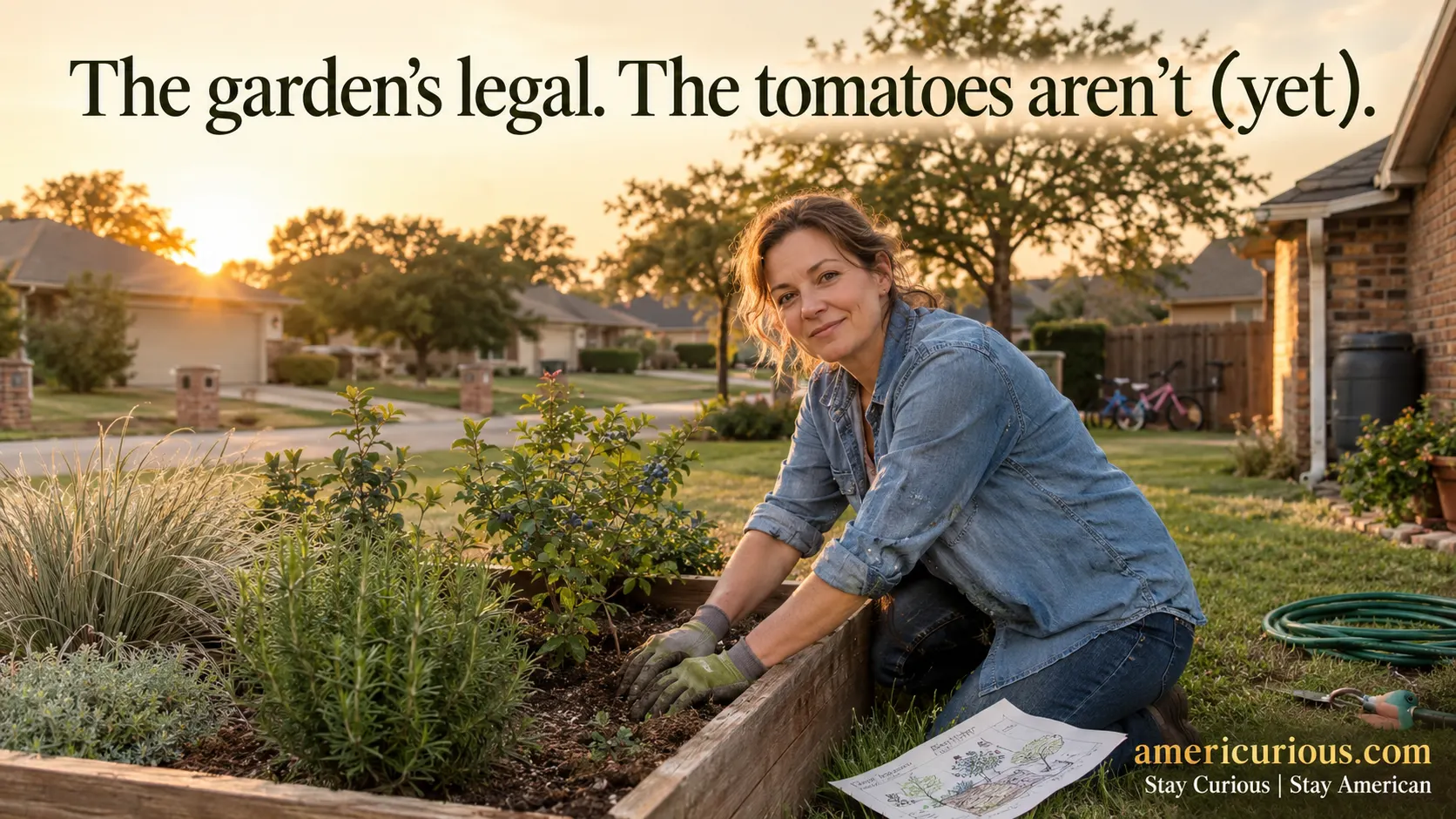
Texas’s 2025 HOA reforms protect rain barrels, native landscaping, and solar — but not vegetable gardens or chickens. See the full 2026 map before you plant.
Quick Answer:
No — Texas’s 2025 HOA reforms did not give you the right to grow vegetables or keep chickens. They did lock in real protections for native landscaping, rain barrels, composting, drip irrigation, and solar. Two 2025 bills that would have covered food gardens and chickens — HB 294 and HB 2013 — both passed the House and both died in the same Senate committee. Nothing is coming in 2026 to fix that; Texas’s next regular session isn’t until January 2027. Here’s exactly where the line sits, and what to actually do about it. ✅
What Texas’s New HOA Laws Actually Protect in 2026
You check the mailbox expecting the water bill, and instead there’s the other envelope — the one with the association’s logo on it. Inside: a photo of your garden bed, timestamped, with a citation number.
You know this is coming, sort of. You’ve read the headlines. Texas cracks down on HOA overreach. Homeowners win big on landscaping rights. You planted your tomatoes this spring half-convinced the law had your back now.
It didn’t. Not for this.
Here’s the catch: Texas really did rewrite a chunk of HOA law in 2025 — and it’s genuinely stronger than most homeowners realize. It just didn’t touch the one thing you actually planted.
Why You Assumed You Were Covered (You Weren’t Wrong To Think So)
If you’d heard that Texas HOAs can no longer fight homeowners over native plants, drought-tolerant yards, rain barrels, composting, or solar panels — you’d heard right. That part of the story is real, current, and worth understanding in specific terms, because it’s the part most homeowners still get fuzzy on.
Texas Property Code §202.007 has quietly been one of the stronger homeowner protections in the country since 2013. In plain terms: your HOA cannot enforce a rule against you composting yard waste, installing rain barrels or a rainwater harvesting system, running drip irrigation, or landscaping with native or drought-resistant plants instead of turf. Any covenant that says otherwise is void — it doesn’t matter how old the CC&Rs are or how the board feels about it.
Two 2025 bills sharpened that further. HB 517 closed a real problem: during an official watering restriction, your HOA can’t fine you for a brown lawn, and that protection runs 60 days past the restriction’s end — so you’re not racing the clock to re-green a yard the city just told you not to water. HB 1432 killed the “hire a landscape architect” runaround some boards used to slow-walk native-yard requests: your own hand-drawn plan and plant list is now legally enough. And separately, HB 431 tightened solar protections under §202.010 — including for solar roof tiles, not just panels.
None of that is nothing. If your version of slow living leans toward xeriscaping, rain barrels, a compost bin, or finally putting solar on the roof, the legal ground under you is more solid in 2026 than it’s ever been.
The One That Didn’t Make It: What Happened to HB 294 (and HB 2013)
Here’s the part that got left out of the “Texas HOA reform” headlines, and it’s the part that actually lands on your desk as a citation.
A bill called HB 294 would have done for food what §202.007 already does for landscaping — protecting your right to grow fruits and vegetables, keep up to six chickens or rabbits, and run a small cottage food operation, regardless of what your CC&Rs say. It wasn’t a fringe long-shot, either: the Texas House passed it 127–6. Then it went to the Senate Local Government Committee — and the official record shows it sat there with no further action until the session closed.
A second, narrower bill — HB 2013, focused specifically on chicken-keeping — followed almost the identical path: passed the House, referred to the same Senate committee, left pending, never brought to a floor vote. Two separate attempts, two separate committee deaths, same session.
That sounds coincidental until you read the committee’s own public comment record: HOA boards and management groups submitted formal opposition, citing concerns about predators, board authority, and — in at least one case — bird flu. 📍 Whatever you make of those arguments, the practical result is the same either way: as of today, Texas has no statute protecting your right to grow food or keep chickens against your HOA’s wishes. Your CC&Rs, not state law, decide that question.
And nothing is coming to fix it soon. Texas only holds a full legislative session in odd-numbered years — the next one convenes January 12, 2027. The two special sessions Texas did hold in 2025 covered redistricting, flood relief, property tax, and hemp regulation — food-garden and chicken rights weren’t on either agenda, and nothing suggests they’ll be added via a special session in 2026. 📍
A quick honest caveat: some homeowners point to HJR 126, the 2023 constitutional amendment protecting farming and horticulture rights, and wonder if it might cover this instead. As of this writing, no court case or attorney general opinion has tested whether that amendment reaches private HOA covenants at all — it’s a genuinely open question, not a settled win. A related 2023 law protecting backyard farming from municipal regulation was explicitly written not to touch private HOA covenants, which is a reasonable hint at how a court might treat HJR 126 too — but a hint isn’t a ruling.
Your 2026 Texas HOA Slow-Living Map
Here’s the whole picture in one place — something worth screenshotting before your next ARC submission.
| Slow-Living Practice | Protected by Texas Law? | Governing Statute |
|---|---|---|
| Native/drought-resistant landscaping | ✅ Yes | §202.007 |
| Rain barrels / rainwater harvesting | ✅ Yes | §202.007 |
| Composting yard waste | ✅ Yes | §202.007 |
| Drip/efficient irrigation | ✅ Yes | §202.007 |
| Solar panels / solar roof tiles | ✅ Yes | §202.010, HB 431 |
| Brown lawn during a watering restriction | ✅ Yes, temporarily | §202.008 (HB 517) |
| Vegetable/fruit gardens | ❌ No | None — HB 294 died |
| Backyard chickens or rabbits | ❌ No | None — HB 294 & HB 2013 died |
| Small cottage food business at home | ❌ No | None — HB 294 died |
What To Actually Do About It
None of this fixes your citation by Friday. But it changes exactly where you spend your energy — and where you don’t waste it.
Step 1 — Run the two-column reality check on your own CC&Rs. Before you do anything else, split your association’s rules into what’s landscaping (probably unenforceable if it fights §202.007) and what’s food or livestock (probably still fully enforceable). This takes twenty minutes and saves you from citing the wrong law to your board — which, understandably, tends to go badly.
Step 2 — Let foodscaping do double duty. This isn’t about hiding vegetables in the flower bed and hoping nobody looks closely. It’s a legal argument: rosemary as a hedge, blueberry bushes as foundation shrubs, herbs worked into an existing bed — these are drought-tolerant, native-adjacent plantings that happen to be food, which means many of them can genuinely ride on §202.007’s protection rather than your board’s goodwill. The friction here is real: it only works for plants that can pass as ornamental. A row of corn won’t.
Step 3 — Submit the one-page plan, per HB 1432. Before you plant anything landscaping-adjacent, put your own hand-drawn plan and plant list in writing and submit it for ARC review. You are not legally required to hire anyone to prepare it for you — say so, politely, if asked. This one document heads off most of the “aesthetically incompatible” letters before they’re written.
Step 4 — Bank the easy wins first. If you’ve been putting off solar, a rain barrel, or a compost bin because you assumed a fight was coming, this is the moment to submit that request and name the statute in your letter. These are the protections with the least ambiguity in all of Texas HOA law right now — start building your paper trail here, not on the fight you can’t win outright.
Step 5 — For food gardens and chickens, stop looking for a legal shortcut, because there isn’t one yet. The only approach that’s actually worked for homeowners in this exact spot is changing the covenant itself — bringing it to the board as a proposed amendment, with neighbors who’ll back it, rather than trying to plant first and litigate later. It’s slower and it asks more of you than citing a statute would. It’s also, right now, the only lever that’s real.
If You’ve Already Been Fined
For a landscaping dispute, your response can be direct: cite §202.007 (and HB 1432 if they’re demanding a professional-drawn plan), note the covenant provision conflicts with state law, and ask for written confirmation that the citation is withdrawn.
For a food-garden or chicken dispute, the honest move is different — and it matters that it’s different. There’s no statute to cite back at them. What’s worked for other homeowners is asking, in writing, for a hearing before the full board rather than accepting a first-notice fine, and proposing a covenant amendment rather than arguing the current one doesn’t apply to you. It does.
Texas HOA Slow-Living: Frequently Asked Questions
Can my Texas HOA legally stop me from growing vegetables?
Yes. Texas has no statute protecting food gardens from HOA restriction. A 2025 bill that would have changed this, HB 294, passed the Texas House but died in a Senate committee.
Did Texas pass a law protecting HOA gardens in 2025 or 2026?
No. HB 294 (fruits, vegetables, small livestock, cottage food) and HB 2013 (chickens specifically) both passed the Texas House in 2025 and both died in the same Senate committee without a floor vote.
Can my HOA ban rain barrels or composting?
No. Texas Property Code §202.007 has protected both since 2013, and an HOA rule against them is void.
Does Texas law protect solar panels from HOA restrictions?
Yes, under §202.010, strengthened in 2025 by HB 431 to explicitly cover solar roof tiles as well as traditional panels.
Is there any chance Texas passes a food-garden law in 2026?
Very unlikely to happen through a regular process — Texas has no regular legislative session scheduled in 2026; the next one convenes January 2027. It would take a special session specifically adding this topic, and neither of the two 2025 special sessions did.
Can my HOA make me plant grass instead of native plants?
No. §202.007 voids that kind of requirement, and HB 517 additionally protects you from fines over a drought-browned lawn during an official watering restriction.
Methodology & Trust
This piece was built from the current text of Texas Property Code Chapter 202 (§§202.007, 202.008, 202.010), official Texas Legislature bill history and analysis for HB 294 and HB 2013 (89th Regular Session, 2025), Governor’s office special-session announcements for 2025, and Ballotpedia/Texas Association of Counties records on the 2026 legislative calendar. Confidence tags: ✅ verified across current, authoritative sources; 📍 consistent across reporting but not independently court-tested; ❓ genuinely unresolved. This is general information, not legal advice — your specific CC&Rs and situation matter, and a Texas real estate attorney is the right call before you act on a dispute with real money at stake.
Conflict of interest disclosure: AmeriCurious has no financial relationship with any HOA, property management company, or landscaping business mentioned or implied here.