A researched travel-and-culture profile of Tangier Island, Virginia: Soft Shells, Hard Shores
🦀 Follow the catch through the ledger
A crab’s new shell is a short-lived business plan. On Tangier, watermen watch “peelers”—hard blue crabs close to molting—in tanks; after the crab sheds, it stays soft for only a brief window before its new shell firms again. That narrow window turns biology into a local economy and gives the harbor its own clock. 2
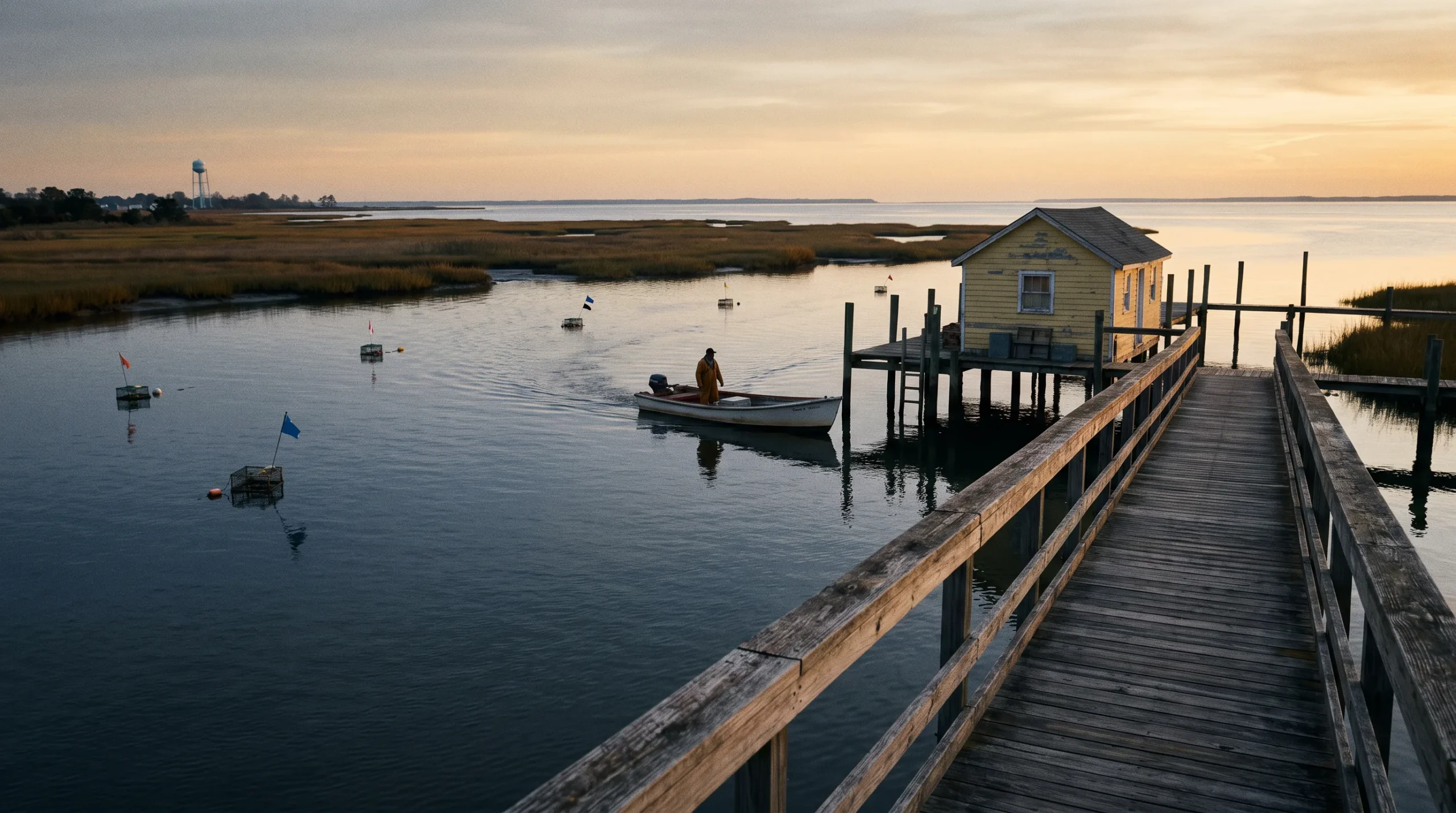
The tide gets the first line in Tangier’s ledger. This is a working watermen’s town in the Chesapeake Bay, not an open-air museum or a resort built around visitors. The signature view—crab shanties, deadrise boats, and low marsh—is also the infrastructure of people earning a living from the water. 6 1
A nickname has an invoice behind it. “Soft-shell crab capital of the world” is a proud industry label, not an official crown: the crabs are genuinely important, but so are hard crabs, oysters, fish, fuel, freight, and the visitor trade. Virginia’s historic-district record traces fishing and oyster work as primary livelihoods from the 1840s, with oysters and blue crabs becoming major exports by the late nineteenth century. 1 2
The 2026 catch sheet was not a victory lap. Town Council minutes described a weak oyster market and a late start to crabbing, pressures that land on watermen first and then spread through the island’s stores, fuel supply, household repairs, and municipal books. The town’s adopted FY2026–27 budget totals about $1.49 million; its fuel dock is the largest revenue fund, while water and sewer still show a projected deficit. 1 4
The revival story is practical, not bougie. There is no warehouse-to-brewery transformation to report: in February 2026, Tangier-connected founder Addison Crockett launched a community foundation, while a $356,500 grant is paying for a shoreline adaptation plan due by December 2026. That is a start toward a more resilient local economy, not a seawall already built; a follow-on grant for further design work had not come through by mid-2026. 8 1 6
🗺️ Three ridges on a shallow stage
Tangier is a set of ribs stitched together by bridges. The town is less than one square mile, arranged across the low West, Main, and Canton ridges, with small bridges crossing the tidal cuts between them; the town stands around four feet above sea level, while much of the surrounding island is marsh. That geography is not scenery at the edge of town—it is the town’s daily constraint and its natural asset. 1
Main Ridge is a spine, not a shopping promenade. The museum, post office, school, church, a small grocery, restaurants, and island services cluster along the public roads, while private homes and working docks fill in the spaces between. The water tower—painted with a crab and a cross—does the work of a signpost and a civic logo at once. 1 3 2
The best shortcut has a name locals already use. “The Gut” is the channel between ridges; a small bridge over it makes a good pause at sunrise, when the marsh, birds, crab pots, and first workboats provide a more convincing island welcome than any souvenir sign. A 2025 town diary calls the bridge a favorite place for coffee and watching the morning, while a visitor’s account describes a quiet, sandy bay beach, salty skin, and crab-pot buoys stippling the inlets—a weather-dependent sensory memory, not a promise of solitude. 6 7
“No cars” needs a footnote. Visitors cannot drive to Tangier or bring a car over on the passenger boats, so the visitor’s pace is usually on foot, by bicycle, or by rented cart. The community itself is not literally vehicle-free: the school describes students arriving by foot, bike, scooter, or golf cart, and local work vehicles are part of island life. 1 4
📜 The date on the brochure is not the best history
Start before the English map. Shell middens and stone points show that Indigenous people used the offshore ridges for fishing and shellfish long before Europeans arrived. John Smith and his crew saw the islands in 1608 and called them the “Russell Isles,” after crew member Dr. Walter Russell; Smith did not find a settled English village waiting for him. 6
The state’s first recorded settlement date is 1778. Virginia’s Department of Historic Resources says settlers came from Cornwall and Devon and identifies 1778 as the first recorded settlement; some tourism pages repeat 1686, but that earlier date is not the state register’s documented date. The tidy founding myth is less useful than the distinction between Indigenous use, colonial land patents, and a permanent recorded settlement. 1 6
Fort Albion’s most consequential export was freedom. The British built the fort in 1814 as a Chesapeake base during the War of 1812 and a refuge for self-emancipated African Americans who reached British lines; some joined the Colonial Marines, while others were resettled in British territories. When British forces withdrew in 1815, they burned the fort, and erosion has since put its site underwater. 6 1
A preacher turned a military forecast into local lore. Joshua Thomas, a waterman who became a Methodist minister, lived on Tangier from 1804 and served as a spiritual leader across the Chesapeake islands. Tradition says he warned British troops that their attack on Baltimore would fail; the story is part of the island’s memory, not proof of supernatural foresight. 1
The historic district is still somebody’s home. Tangier’s district was added to the Virginia and National registers in 2014, with an underwater boundary extension in 2015; its architecture includes nineteenth- and early-twentieth-century frame and weatherboard houses. The register explicitly warns that many listed properties are private dwellings, visible from public roads but not open for visitors to wander through. 1 1
🗣️ The accent is real; “Restoration English” is not
The vowels arrive before the story does. Tangier-born linguist David L. Shores describes a distinctive vowel system and local idioms; in his account, “pull” and “Paul” can sound alike in island speech. This is a regional dialect of English, not a separate language preserved under glass. 1
A few words make a better glossary than a fake accent. Former Tangier teacher Bruce Gordy compiled hundreds of local expressions: “wudget” means a large wad of money, “in the sweet peas” means asleep, and a flat bicycle tire may be described as “my bike’s bust.” “Spar grass” for asparagus is another surviving local form, while “talking backwards” refers to tone-heavy, often sarcastic speech. 1
“Restoration English” is no more accurate. Linguist David Shores explicitly rejects the popular “Elizabethan English” claim; National Geographic describes Tangier speech as a distinctive regional dialect, while the historic record traces settlers to Cornwall and Devon. Treat the Restoration-era label as folklore, not an established linguistic classification, and leave imitation to the people who grew up with the dialect. 1 1
⛪ A K–12 school, July Fourth, and the missing rivalry
The island’s civic center has both a bell and a classroom. Swain Memorial United Methodist Church is a landmark, and Tangier Combined School houses kindergarten through grade 12 in one building; the school says it is the only public K–12 combined school in Virginia and a center of community life. Recent local reporting puts enrollment at roughly forty students. 1 4 6
The mascot is easier to verify than the rivalry. A school-spirit retailer identifies the teams as the Islanders and lists royal blue, white, and black; the official school pages I checked do not publish a rivalry history. I could not verify a long-running Friday-night-football obsession or a current named rival, and a retailer’s uncorroborated claim about a 2023 basketball title is not enough to print as settled fact. 2
The old rivalry was across the sound, not across a scoreboard. Tangier and nearby Smith Island, Maryland, share a watermen’s economy, and historic accounts describe confrontations over crabbing rules that differed across state lines. That is an industry history, not evidence of a current feud between neighbors. 2
July Fourth is the island’s family reunion, not a ticketed festival brand. Tangier’s community foundation founder calls it a favorite annual day, and the town’s 2025 diary describes the holiday as part of local life; I could not verify a public-facing 2026 event schedule. The 2026 Tangier Sound Music Festival did take place on June 13, but in Crisfield, Maryland—not on the island. 8 6 1
The 2026 calendar did bring a consequential visitor. Virginia Governor Abigail Spanberger visited on September 10 for a Chesapeake Bay Commission meeting, walking the island and hearing residents’ concerns about erosion and the future. It was a policy visit, not a festival, but it put Tangier’s local questions in a room with state and regional decision-makers. 1
🪶 Let the marsh do the entertaining
Tangier’s park is a boat launch and a good map. The Virginia Department of Wildlife Resources describes an Orange harbor loop, a Blue trail through marsh, a Yellow route toward the southern beach, a Pink loop around the Uppards, and a pedestrian path toward Port Isobel. These are water-and-walking routes, not a paved state-park circuit. 1
The wildlife list arrives before the boat. Herons, Glossy Ibis, Clapper Rail, and Seaside Sparrow use the marsh; Osprey and Northern Gannet are among the birds seen toward Port Isobel, while stingrays move through the shallows of Cod Harbor. In late summer, a colony of terns and Black Skimmers nests northeast of the southern beach, so a good visitor gives the birds room rather than trying to get the closer photograph. 1
The quiet beach is an outing, not a secret. Paddle the Yellow Trail off the Orange route for a less-town-centered view, but check tide, wind, launch arrangements, and current access before setting out. DWR notes there is no Birdability site review available, so visitors with mobility or access needs should contact the town or a local operator rather than assume the trails are easy. 1
The oddest museum specimen is better than a cryptid. The Tangier Island History Museum displays an “oyster-crab”: a blue crab with oysters growing on its shell, caught by Mayor James “Ooker” Eskridge in 2017 and examined by scientists after people wondered whether it was a hoax. I could not verify an established local ghost or cryptid tradition; the real uncanny story is how much of the former settlement on the Uppards has become marsh, with erosion exposing graves. 4 9
🍽️ Eat what the boats and kitchens are doing
Order the soft shell, but ask whether it is actually in season. A crab cake or crab soup is a classic Chesapeake order; the island’s signature treat is a soft-shell crab sandwich when the catch and kitchen align. Hilda Crockett’s Chesapeake House has long been associated with family-style meals, including crab cakes, clam fritters, and corn pudding, but its older tourism listing is not a live menu. 2 10
Lorraine’s has a current local receipt. The restaurant was serving dinner when the governor visited in September 2026, and Virginia Tourism lists crab cakes and made-to-order sandwiches among its offerings. Four Brothers Crab House and Ice Cream Deck, and the revived Muddy Toes Café, are other names in local visitor coverage; confirm hours and menus directly, especially outside the boat season. 1 1 6
Do not plan a bar crawl. Tangier has a long-standing dry tradition and no verified pub strip; treat it as a small residential community, not a place to assume you can buy alcohol or find late-night service. 8
Check This Out!
Roswell, New Mexico: The Town That Monopolized the Sky
🎞️ Hollywood got a no; the documentary got a yes
The movie came with a script and left without a location. In 1998, Warner Bros. scouts considered Tangier for scenes in Message in a Bottle, but the town council rejected the proposal after residents objected to drinking, profanity, and sex in the script. Tangier did not become the film’s set, which is a more useful pop-culture fact than claiming a movie was shot there. 1 2
For the island itself, start with Earl Swift. His 2018 nonfiction book Chesapeake Requiem: A Year with the Watermen of Vanishing Tangier Island follows the work and people behind the headlines; linguist David Shores’s Tangier Island: Place, People, and Talk is the deeper dialect companion. The 2026 documentary Been Here Stay Here, directed by David Usui, offers a contemporary portrait of family, faith, work, and a community looking at its future. 6 9
One Tangier-born painter made the Bay a family album. Willie Crockett, a Tangier native who was a waterman, preacher, poet, and painter, turned marshes, workboats, and wildlife he knew firsthand into Chesapeake landscapes. The PBS documentary The Art of Willie Crockett and Virginia’s Eastern Shore follows that life, and his family’s gallery site still lists prints such as Going Home to Tangier. 1 1 1
The big mystery points down, not up. AmeriCurious has followed Roswell, New Mexico—the town that monopolized the sky; Tangier’s strangeness is less extraterrestrial than tidal, written into a map whose edges keep changing. Its best folklore is a preacher’s reported prophecy and a scientifically inspected crab, not a story that needs a monster. 1 4
🌊 Keep a ledger of land, people, and promises
“Sinking” is not the whole mechanism. Tangier is losing land through shoreline erosion, storms and wave action, while the ground itself subsides and relative sea level rises; the island’s low ridges leave little spare elevation. Research and local reporting agree that roughly two-thirds of the island’s land has disappeared since the nineteenth century, although the mechanism and pace are not a single-number story. Residents do not all frame the cause or the fix the same way: some emphasize visible wave erosion and favor hard shoreline protection, while scientists model interacting erosion, subsidence, and rising-water pressures. 1 1 1 6
2051 and 2053 are model outputs, not a ferry-booking deadline. A 2021 Frontiers in Climate study projected complete conversion of the town’s mapped uplands to wetlands by 2051 under its model; a 2026 WHRO report summarized the same study as predicting an uninhabited town by 2053. Those are projections tied to assumptions about land, water, and habitability—not a scheduled evacuation date or a guarantee that every part disappears at once. 1 6
Some protection exists; much of the next chapter is still planning. The airport already has a seawall and the harbor a jetty, while the 2025–26 grant is funding an adaptation plan built around vulnerable shorelines, marsh, oyster reefs, and living shorelines. The plan was expected by December 2026, but the additional funding needed to advance designs had not been secured as of the summer reporting, so “grant awarded” should not be translated into “island saved.” 1 6
The population column refuses to reconcile neatly. The 2020 decennial census counted 436 people; a 2024 ACS-based estimate reports 252, with a margin of error of 116, while 2026 local and regional reporting often uses figures around 400 or “under 500.” These are not interchangeable live headcounts, so the honest conclusion is a very small, aging community with uncertain current totals—not one magic number. 1 1 5 4 3
A survey value is not a sales market. Data USA reports a 2024 median property-value estimate of $157,900 and a median age near 66, but those ACS figures are not a list of 2026 asking prices or closed sales; the population estimate itself carries a wide margin. I could not find a reliable current sales series for Tangier, so a few listings should not be dressed up as a boom, a crash, or proof that waterfront life is cheap. 1
A house here comes with an access plan. The historic stock includes wood-frame and weatherboard homes, but a prospective buyer should investigate flood exposure, insurance, water and sewer, repair logistics, and how supplies reach the property. The town’s own 2026 budget discussions describe a declining tax base of occupied homes and aging infrastructure; this is a living community, not a speculative second-home market with mainland convenience. 1 4
🛥️ Getting here is a scheduling exercise
The Crisfield day boat is a day boat, not a commuter ferry. In the 2026 season, Tangier Island Cruises posted a 12:30 p.m. departure from Crisfield, arrival around 1:45, a 4 p.m. return from Tangier, and arrival back at about 5:15; adult round-trip fare was $35. That leaves roughly two hours on the island, and by 16 October the operator was thanking passengers for the season. 1 1
Reedville is the other seasonal day-trip option; Onancock is not. The Chesapeake Breeze’s posted Reedville itinerary runs roughly 10 a.m. to 4:15 p.m., with a fare from $42.80; check the live booking calendar before building a trip around it. As of August 2026, Virginia DWR said the Onancock ferry was suspended, while its current guide lists the Crisfield and Reedville tour boats as seasonal. 4 1 3
After cruise season, “year-round” does not mean “same-day.” A mail-and-passenger boat runs from Crisfield through the year except Sundays, but DWR says visitors need to stay overnight on Tangier. Confirm passenger access, return arrangements, fare, and weather status with the operator; an old schedule copied onto a travel page is not a reservation. 1
Your car stays on the mainland. The Crisfield operator lists a parking area near its dock at 1001 West Main Street, but its directions do not clearly promise free parking or a guaranteed space, so ask before you arrive. Salisbury–Ocean City–Wicomico Regional Airport (SBY) is the nearest scheduled-airport gateway for the Crisfield side, with limited regional service; Tangier’s own small airport is for general aviation or charter, not an airline connection. 1 3 1
A missed return is a plot, not a minor inconvenience. Channel shoaling disrupted 2026 boat operations and prompted dredging work, while seasonal boats operate subject to weather. Recheck the operator’s schedule close to departure, reserve the return, and do not plan a tight onward flight or drive as if Tangier were a mainland neighborhood. 6 1
🛏️ Stay after the day boat leaves
Beds here are homes-with-inns, not resort beds. The island’s options are small bed-and-breakfasts, an inn, and self-catering cottages; visitor listings include Bay View Inn, Brigadune Inn, and Hilda Crockett’s Chesapeake House. An older island guide lists Bay View as year-round and the Chesapeake House as seasonal, but availability changes—call the property before buying a boat ticket. 1 10 2
Choose your base by how much you want to walk. For a first visit without a car, staying near Main Ridge makes the museum, dock, and small business cluster easiest to reach; West Ridge or Hog Ridge offers a quieter, more waterfront-feeling stay but may mean a longer walk or a cart ride. Families may prefer a cottage with a kitchen, while couples often find a small inn the simplest way to spend a night on the island. 1 1
The weather favors the shoulders, not the slogans. Nearby Wallops Island’s 1991–2020 climate normals put July average highs in the mid-80s Fahrenheit and January highs in the mid-40s; Tangier’s exposed water and wind make those regional figures a guide, not a forecast. Late spring and September are sensible windows for a first trip, while midsummer brings heat and late-summer bird nesting; October service winds down, and winter remains island life but not easy visitor logistics. 1 9 1
🧭 Visitors are guests in a working neighborhood
Walk the public lines and ask before taking portraits. The historic-district record says many homes are private, and the crab shanties and docks are workspaces, not props; admire from public roads or join a tour that has permission. A small island has a long memory, so curiosity lands better when it comes with consent. 1 1
Treat the shore as an undeveloped bay edge, not a swimming-pool beach. Check tides, wind, and access before paddling, wear a life jacket on the water, and keep well clear of nesting birds in late summer. Visitors with mobility needs should contact DWR or a local operator ahead of time because the wildlife trail has no current Birdability site review. 1
The museum is worth the $3 and a phone call. The National Park Service lists the Tangier Island History Museum at 16215 Main Ridge Road, generally 11 a.m.–4 p.m. Monday through Saturday and noon–4 p.m. Sunday, with $3 admission and several free-admission categories. Its page was last updated in April 2025, so confirm hours at 757-891-2374 before planning around it. 1
Pack for an island, not for an errand. Bring water, sun and wind protection, any essential medication, and a flexible schedule; do not assume there will be a quick mainland run if a boat is delayed. Sunday boat service is limited, weather can change the crossing, and small restaurants and shops do not behave like a 24-hour resort strip. 1 8
🎁 Take home a locally made view
Buy a photograph, not an invented heirloom. Tangier-based photographer and waterman Cameron Evans sells prints of the working harbor, marsh, water tower, and island life; his current shop lists images such as “Tangier From Above” and “Crab-House Reflection.” The town’s own visitor story notes that visitors can buy his photographs and souvenirs at his island shop. 2 6
The print is locally authored, not just locally branded. I could not verify that fig preserves or hand-woven crab-trap ornaments are made on Tangier, so I would not promise either as a signature souvenir. A photograph by someone who works and photographs here carries the place home more honestly than a generic crab magnet. 2
Soft shell on the plate; hard choices on the shore.
— AmeriCurious