A field guide to the UFO capital of the world — and to the water, the milk, the parked jetliners, and the hit-and-run geology underneath the kitsch.
👁️ The Eyes Nobody Sanctioned
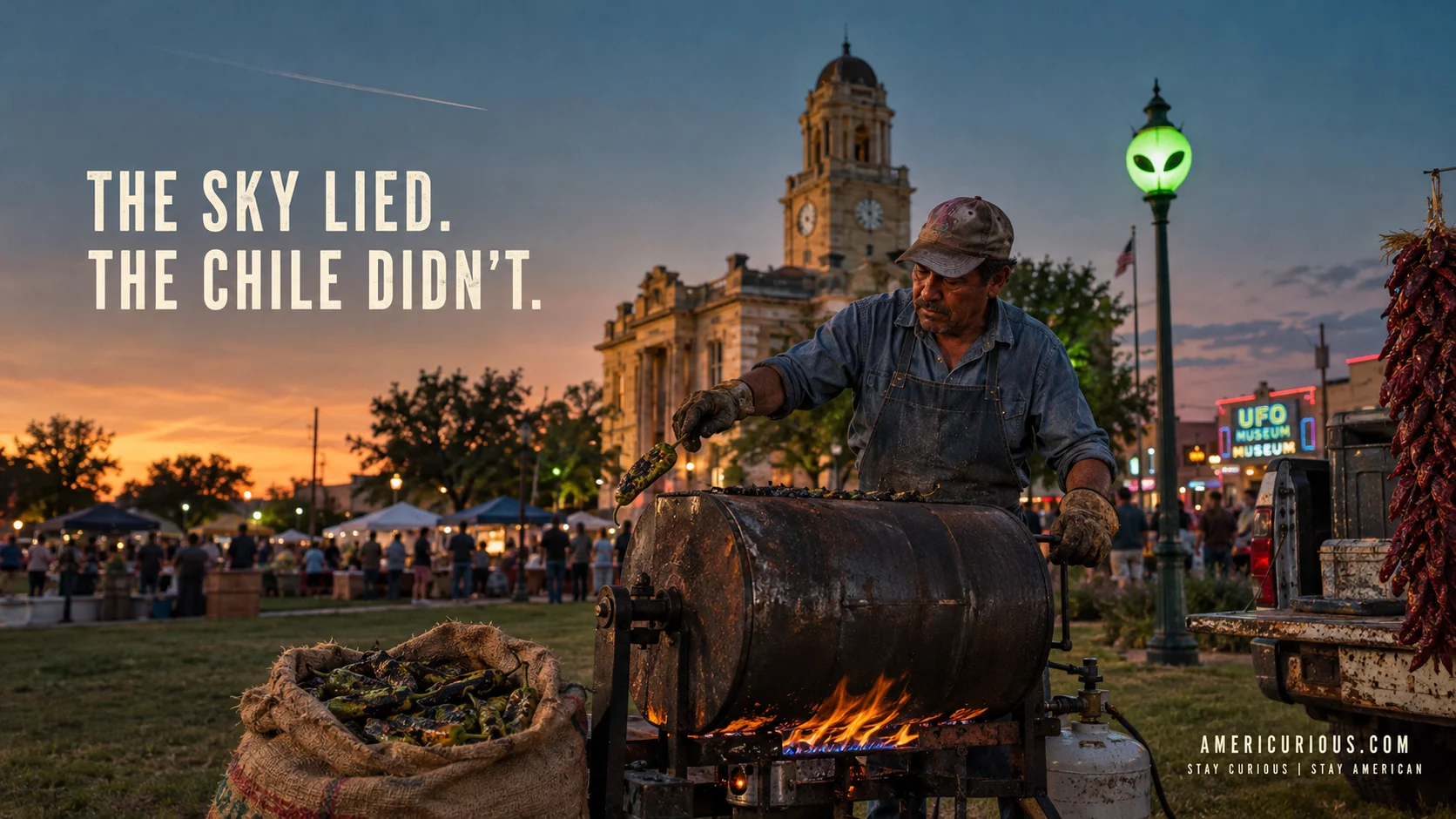
Start with the streetlights, because they explain everything. Roswell’s downtown globes have slanted alien eyes painted on them, glowing green at night along Main Street from roughly Second to Eighth — and the city did not do that.
It was a guerrilla art project by Larry and Sharon Welz, who painted them on in a single night in 2001 without permission, missed a bunch of lamps in the rush, and never got the grant they asked for to finish the job (Roadside America has the whole confession). Roswell’s response was to let them stay.
That’s the town in one anecdote: a story arrives from outside, unauthorized and half-finished, and the local economy eventually learns to bill for it. Roswell doesn’t hedge the brand — the world calls it the UFO Capital of the World and its own festival sells itself with the slogan “Beam Up From Boring” — and the vibe is best described as a retro-futurist company town whose product is a rumor. Which is a strange thing to say about a place most people think of as a gift shop with a city council — until you notice that this isn’t the first time Roswell made money off something falling out of its own sky.
If you want the cleanest comparison in American townology, look at Colma, California, where the defining industry is who’s underground. Roswell is the inverse: a town that monetized what came down.
🚀 Before the Saucers, There Was a Man Launching Things Over Eden Valley
Roswell was a sky town twenty years before it was a saucer town, and the person who did it was Robert H. Goddard, the father of modern rocketry. He moved here in 1930 after Massachusetts neighbors complained about his rockets setting woods on fire and the local fire marshal effectively banned further launches — so he took his lab to the desert, built his workshop beside a pueblo-revival house at Mescalero Ranch, and fired test vehicles from a launch tower out at Eden Valley, about ten miles from town (the New Mexico Space Trail tells it straight; National Geographic marked the hundredth anniversary of his first liquid-fuel launch in 2026).
His best flight barely cleared 9,000 feet, and he died in 1945 convinced the country hadn’t noticed him. Not quite two years later, the Roswell Army Air Field in his adopted town announced it had recovered a flying disc.
The town itself came up differently: as a water story. Van C. Smith and Aaron Wilburn threw up two adobe buildings in 1869 at the spot where the Rio Hondo met the Pecos, and the settlement took Smith’s father’s name — Roswell Smith, a Lafayette, Indiana lawyer — mostly so the mail would stop wandering up and down the river (the Roswell Daily Record dug into the naming). John Chisum ran cattle through here and moved his headquarters four miles southeast in 1875; Southeastern New Mexico got the nickname “Little Texas” because its Anglo settlers came in from the Old South and outnumbered everybody else’s politics.
🛸 Nineteen Forty-Seven: The Press Release That Refused to Die
The short version, which is the only version everyone agrees on: rancher W.W. “Mac” Brazel found shredded metallic debris on the J.B. Foster ranch about 75 miles northwest of town, near Corona, in mid-June 1947. He sat on it for a few weeks, then heard the flying-disc chatter on the radio and drove it to the Chaves County sheriff, who called the base (Smithsonian has the sober version).
On July 8, Roswell Army Air Field’s public information officer put out a release saying the base had come into possession of a flying saucer. The Roswell Daily Record ran it. The next day, Brigadier General Roger Ramey told the world it was a weather balloon, and photos of Major Jesse Marcel posing with tinfoil ran everywhere.
Forty-seven years later, the Air Force declassified its own answer: the debris was almost certainly from Project Mogul, a classified balloon-train program built to listen for Soviet nuclear tests, and Flight No. 4 — launched June 4, 1947, from Alamogordo — was never recovered (History.com lays out the timeline and the 1997 follow-up on the “bodies”). The town’s most valuable asset is, in the official telling, a leak from a spy program that wasn’t supposed to exist.
🏜️ The Springs That Made This Town Are Now Extinct
Here’s the part that never makes the souvenir T-shirts. Roswell sits at about 3,570 feet on the Pecos Slope, roughly seven miles west of the Pecos River, with the Sierra Blanca highlands on the western horizon and the Llano Estacado flattening out east (WorldAtlas covers the ground). The town exists because of artesian springs — the North Spring and South Spring fed perennial streams that made the Rio Hondo valley a reliable place to water cattle coming up the Goodnight-Loving Trail from Texas. Those springs are gone; the New Mexico Bureau of Geology describes North Spring as “now-extinct,” drained by a century of pumping from the Roswell Artesian Basin (the quadrangle report is free and grimly fascinating).
What the basin still supports is agriculture on an industrial scale — and, fifteen miles southeast, water that looks like it came from somewhere else entirely. Bottomless Lakes State Park is a chain of sinkholes in the red bluffs, 17 to 90 feet deep, and they are bottomless in name only. Lea Lake, the biggest, is the only one you can swim in, with a sandy beach, a spring pushing out roughly 2.5 million gallons a day, and pedal-boat rentals that run Memorial Day through Labor Day.
Divers have been coming for the darker ones — state parks rules permit scuba at Devil’s Inkwell, and both it and Cottonwood get winter trout stocking. If you’d rather watch things fly than sink, Bitter Lake National Wildlife Refuge is 24,563 acres of desert-meets-Pecos wetland where more than 100 species of dragonflies and damselflies have been recorded — which is why the refuge throws an annual Dragonfly Festival and why birders show up in late October for sandhill cranes and snow geese.
Would you rather? Swim in a sinkhole that locals insist has no bottom, or stand in a marsh outside town while a hundred species of dragonfly decide whether you’re a threat? Roswell will happily sell you either.
🌊 The Night the Desert Drowned
On the night of October 19, 2024, a stalled upper-level low parked over Arizona and funneled Gulf moisture into southeast New Mexico. Roswell got 5.78 inches of rain in a day — an all-time record, about four times its normal October rainfall — and the Spring River, a city stream that had been running dry, came out of its channel (NASA’s Earth Observatory documented the aftermath from orbit).
Two people died. The National Guard reported hundreds of rescues, dozens of hospitalizations, cars swept into the river channel, and city facilities under feet of water; the city’s damage estimate ran toward $500 million, with the Roswell Museum alone taking about $12 million (KRQE reported that toll). Officials called it a 500-year flood.
Then it happened again. In June 2025, monsoon rain flooded Roswell a second time, with the mayor noting that contractors were still scarce from the first round (KRQE). And the rebuild is nowhere near done: as of late 2026 the Roswell Museum and Art Center is still closed with no reopening date, the Convention and Civic Center is still dark, and a city task force is weighing LIDAR flood maps against where to rebuild (the Albuquerque Journal checked in on the museum’s collection).
Callout, and I mean this practically: if you’re coming for a specific attraction, call ahead. Roswell’s flood-recovery list still includes the museum and planetarium, the Convention and Civic Center, the Adult Center, the Spring River Zoo’s pond, and Nancy Lopez Golf Course at Spring River. The zoo itself reopened in December 2024 with free admission from 10 a.m. to 4 p.m., but parts of the park have been in and out of service since.
What the calendar actually asks of you
| Window | What you get | The catch |
|---|---|---|
| April–May | Highs in the 70s and 80s, the two most pleasant months the data allows | Wind, and the start of chile-planting dust |
| June | Long days, cheap rooms, empty trails | 93°F averages; 2025 proved June can now throw a flash flood |
| July–August | The UFO Festival, monsoon drama, green everything | Heat, insurance-grade thunderstorms, hotel prices at their annual peak |
| Late September–October | Chile roasting, jazz festival, cranes arriving, golden cottonwoods | “Monsoon” can still stall over town — see October 2024 |
| November–February | 55°F days, empty streets, cheapest lodging of the year | Nights below freezing on more than 110 nights a year; short daylight for a town built on staring |
The elevation is low enough that altitude won’t wreck you and high enough that the sun will: July highs average near 94°F, the city clears 90°F on close to 88 days a year, and annual precipitation is only about 15 inches that mostly arrives all at once, sideways.
Terrain and wildlife brief: sun protection and water are not optional, and neither is the flood rule every local knows by heart — never drive into moving water over a road, because six inches of it will knock you off your feet and a foot will float your car. Rattlesnakes and scorpions live here; the ranch tours that take visitors out to the 1947 debris field still make people sign a waiver for cactus, lizards, scorpions, and snakes (that detail survives in the archives).
🐄 The Real Payload: Cheese, Crude, and Jetliners
Now the uncomfortable arithmetic, because it’s the most interesting thing about this town and nobody prints it on the tote bags.
Roswell’s first big employer was a myth-free federal program: Walker Air Force Base, established 1941, home after the war to the only nuclear-armed bomb wing on Earth, and closed in 1967. When the base left, the town didn’t die — it diversified into things you can’t Photoshop onto a hoodie.
The county’s largest private employer is Leprino Foods, the world’s biggest mozzarella manufacturer, which has run a plant here for more than thirty years with 600 employees and takes in over 6 million pounds of milk a day from dairies within about fifty miles. Chaves County has hosted roughly 23 dairies and around 76,000 milk cows, ranking first in the state for corn silage and producing alfalfa by the ton — though dairy has been consolidating for years, with several operations closing in the early 2020s under feed and labor pressure.
Five miles south of downtown, the Roswell Air Center turned a bomber base into a maintenance economy: a 13,000-foot runway and more than 500 parked airliners feeding a global used-parts market, Dean Baldwin’s aircraft painting operation, and Ascent Aviation Services, which broke ground on a wide-body hangar and committed to 360 jobs and roughly $20 million in investment with a projected $545 million statewide impact over a decade (the state’s announcement). Felix Baumgartner’s record stratospheric jump launched from this field in 2012 — which means Roswell’s airspace has been a commercial launch site for both balloons and humans long after the saucer story stalled.
Tourism is real but smaller than the myth: the International UFO Museum and Research Center welcomes about 200,000 visitors a year in a former 1930s movie theater on Main, and took its five-millionth guest in 2023. At the same time, Roswell’s population has slipped to roughly 46,900, median household income sits near $51,600, and more than one in four residents lives below the poverty line. The aliens are the town’s brand. Cheese, oil, airplane parts, and a hospital are its mortgage.
The revival story is the boring kind that actually works. MainStreet Roswell has been plugging away at the historic district since 1988 and is now a Main Street America–accredited program, which is grant-speak for a downtown that gets deliberate attention instead of nostalgia (their own accounting). The results have been real but uneven: a then-city-councilor told Marketplace in 2010 that downtown vacancy had fallen from 48 percent to under 3 percent on the back of the festival economy — and visitors today will still find storefronts with paper in the windows.
🍔 Green Chile, Finger Food, and the 72-Homer Hangover
Eat like a local: the green chile cheeseburger and green chile stew at Martin’s Capitol Café on West Fourth, family-run for decades, is the standard order in a town where chile is a food group. For something with a tablecloth and a bottle, Pecos Flavors Winery + Bistro on West Second is the first producing winery in Chaves County — open Tuesday through Saturday, closed Sunday and Monday, so plan accordingly.
Black Cock Brewery on SE Main carries the local beer banner with a name designed to survive exactly one search-engine filter. The Liberty, at 312 N Virginia, is the real surprise: a working music venue booking touring acts through fall and winter — Black Flag in October 2026, Steve Earle and the Linda Lindas on the same calendar year. And yes, there’s a McDonald’s on South Main shaped like a silver flying saucer, built in 2005 and now the only one left on the planet, since the original saucer McDonald’s in Cambridgeshire, England was demolished in 2008.
Then there’s the piece of Roswell trivia that has nothing to do with space and everything to do with appetite: in 1954, a 32-year-old first baseman named Joe Bauman hit 72 home runs for the Class C Roswell Rockets of the Longhorn League — with a .400 average, 224 RBIs, and 188 runs — and fans used to push cash through the backstop fence after each one (the record stood until Barry Bonds hit 73 in 2001). A local packing plant gave him a cured ham per homer, which reportedly kept his teammates fed. Minor League Baseball’s annual home run award bears his name, and the city renamed the old Fair Park for him in 2005 — he broke his pelvis at the ceremony and died of pneumonia weeks later.
🏈 Friday Nights in the Wool Bowl
Two public high schools, one stadium, and a civic religion with a seating capacity of 6,000. The Wool Bowl opened in 1968 and remains home field for both of Roswell’s big programs — the Roswell High Coyotes in dark crimson, white, and black, and the Goddard Rockets, named for the rocket pioneer, in navy and Columbia blue.
The crosstown game is the fixture, and lately it hasn’t been close: Roswell beat Goddard 42–7 in 2022 and 35–21 in 2025. There’s a second, quieter rivalry with Artesia, the oil-patch town about forty miles south on US 285 that shares the Coyotes’ district and has been Roswell’s measuring stick for as long as anybody’s kept score. The rivalry is real enough that when the 2024 flood wrecked the city, the two local football communities shelved it to run cleanup and relief side by side — which is how you can tell a rivalry matters.
Roswell also hosts something odder: the New Mexico Military Institute, founded 1891 and listed on the National Register in 1987 — the country’s only state-supported co-ed college-prep military boarding high school and junior college, known as the “West Point of the West.” Its teams are the Broncos and the Colts in scarlet and black, and its alumni list includes Roger Staubach, Sam Donaldson, and Owen Wilson. Around here, “the Institute” needs no further explanation — and if you hear the phrase “red or green?” you’re being asked about chile, with “Christmas” as the correct answer when you want both. Say “chili” in Roswell and you’ll get a bowl of somebody else’s idea of stew; the fruit of the plant is spelled with an e, and locals will police it politely.
🎬 Faking It on Location
Roswell has been a television setting for nearly thirty years and a filming location for almost none of it. The 1999 series Roswell was set here but shot in Southern California, and the CW’s Roswell, New Mexico (2019–2022) — adapted from Melinda Metz’s Roswell High books — shot in New Mexico but not in Roswell, working out of Santa Fe and Las Vegas, New Mexico, and using Lindy’s Diner in Albuquerque as its fictional Crashdown Café.
Local officials even made noise about luring the production to the town it was named for, tax credit arithmetic being what it is (KRQE covered the wish). So the town’s most-watched depiction is a place it never quite was — one more layer of Roswell being Roswell.
Better trivia, and verifiable on the city’s own seal: Roswell’s municipal seal contains an alien, a green one, hovering over the mountains, river, and livestock. It is probably the only city seal in America that depicts a constituent from another planet.
💀 The Ghost Is a Piece of Paper
Roswell doesn’t have a Mothman, and I won’t pretend it does. The local monster is bureaucracy: a press release, a retraction, a classified balloon program, and a filing cabinet that the Air Force spent two reports trying to close.
The lore that still does work is human-scale. Mac Brazel, the rancher, gave one on-the-record interview describing a weather balloon and died in 1963 without saying more; the family that owns the ranch today tells tour groups that he was taken to the base and came back with a new truck and an order never to speak of it again. Jesse Marcel Jr. maintained for the rest of his life that his father brought home debris etched with purple symbols.
The man who started Roswell’s whole business never sold a single coffee mug in his life, and the mug sellers owe him a statue.
Roswell’s other ghost story is a house: on July 2, 1947, Dan Wilmot and his wife reported seeing a saucer pass over their street, and that house now rents on Airbnb as the “UFO home” — which is either the most American sentence ever written or the second most.
And the Bottomless Lakes will never shake the folk claim that they have no bottom, despite a state park’s worth of hydrology saying 17 to 90 feet. Every town needs one lie it refuses to retire.
🛏️ Two Blocks, One Base Camp
Roswell is not a hard town to reach anymore, which is new. United Express, flown by SkyWest, launched twice-daily nonstop Denver–Roswell service in February 2026, joining American’s daily Roswell–Dallas/Fort Worth flights at the Air Center. The terminal experience is the good kind of retro: free parking, no lines at TSA, five miles south of downtown.
Most visitors still drive, because Roswell sits where US 285 and US 380 cross and no interstate bothers with it. Figure roughly 3.5 hours from Albuquerque, 3 from Lubbock, 3.5 from El Paso, about 1.5 from Ruidoso’s mountains, and about two from Carlsbad Caverns. Bottomless Lakes is 15 miles southeast; Bitter Lake National Wildlife Refuge sits on the northeast edge of town, close to the airport.
Base yourself on North Main between roughly Second and Eighth, and you can walk the whole downtown core. What you can’t do is count on rideshare: rent a car, or use Roswell Transit, which adds routes and stops during the festival (the festival’s own FAQ recommends it). Parking is free and abundant at the airport — one of the perks the county advertises alongside short TSA lines — and easy everywhere else in a town that has never had to defend a curb.
| Lodging style | Where it lives | The honest read |
|---|---|---|
| Chain hotels (Fairfield, Holiday Inn Express, Hampton, Home2, La Quinta, TownePlace) | North Main, walking-to-driving distance from downtown | Reliable, cheap by national standards, fills completely during festival week |
| The old-guard independents (Roswell Inn, Frontier Motel, the hotel at 2000 N Main that has flown more than one brand flag) | North Main | Cheap, occasionally excellent, verify the brand and the room before you book |
| Vacation rentals, including the 1947 Wilmot house | Downtown and the older residential blocks | Best option for a group; also the fastest way to sell out on anniversary years |
Timing note with a real deadline in it: 2027 is the eightieth anniversary of the incident. The 60th drew something like 50,000 people in 2007, the 70th was expected to draw 30,000 to 50,000 in 2017, and the 2026 festival — July 2–4, with preliminary attendance over 12,000 — was a normal year by comparison (KRQE’s headcount). Dates for the 80th aren’t published yet as of this writing; assume the first week of July and book early anyway, because the math on anniversary years is not subtle.
The rest of the calendar, in the order it hits — these are 2026 dates, and the windows repeat:
- Roswell Galacticon, July 2–4 in 2026, at the UFO Museum annex on North Main — a comic-con-scale weekend with $5 day passes over age 10 (schedule).
- The Chile Cheese Festival, late September on the Chaves County Courthouse lawn: chile roasting, a green chile stew competition with actual rules, pecan pie, and a farmers market that merges into it (MainStreet Roswell runs it).
- The Eastern New Mexico State Fair, October 5–10 in 2026 at the North Main fairgrounds — recently listed at around 54,000 attendees — for carnival rides, junior livestock, and bull riding (official site).
- The Roswell Jazz Festival, five October days (October 21–25, 2026) with free sets on the courthouse lawn and in Reischman Park, plus ticketed shows (the festival has run since 2006).
🧭 The Un-Touristy Version
Skip nothing, but sequence it well. Do the International UFO Museum early on a weekday — $7 for adults, $5 for seniors and military, $4 for kids 5–15, open 9 to 5 daily — then walk the murals: Larry Bob Phillips’s “We Believe” ramp illusion by the museum, the Invasion Station mural on North Main, the Alien Print Shop wall on North Richardson, and the 2013 welcome sign out on East Second that grown adults photograph with more sincerity than they’ll admit.
The genuinely un-touristy picks, in order of how few people you’ll share them with:
- Walker Aviation Museum, inside the airport terminal, free, roughly the size of a garage, with weird short hours and a volunteer who will tell you more than you asked. Donations standard.
- The Miniatures and Curious Collections Museum, which does exactly what it says and is a fine 45 minutes on a hot afternoon.
- Bone Springs Art Space at 212 E Walnut, a renovated warehouse with a gallery, classes, and a gift shop of regional handmade work — plus Harold Lee Jones and Agustin Pozo Galvez exhibiting through fall 2026.
- Alien City Dragway at 72 Lemay, where the no-prep racing nights have a $20 spectator gate and absolutely no interest in your UFO theories.
- Bitter Lake at dawn, because the dragonflies are the one thing in this town that outnumbers the aliens.
As for how locals carve up the place: there’s the historic core around downtown, Lea Avenue, and the Institute, with the 1912 White house that’s now the Historical Society for Southeast New Mexico (open by appointment, mind the hours); there’s the North Main retail corridor where the chains and the big box stores live; and there’s the southeast along the Spring River, which is working-class Roswell and also, since October 2024, the part of town that has to think about water every time it rains.
Now the honest version of Main Street, because you’ll read otherwise elsewhere: the dense, walkable core is about two blocks, several storefronts are still dark, and Sunday and Monday hours are thin enough that you should check before you build an afternoon around a shop. What’s thriving is small and specific — the museums, the tarot readers, the ice cream counters, the antique and rock shops, the indoor disc golf, and the music venues — plus a civic arts scene that keeps three organizations running year-round: the Roswell Symphony Orchestra, the Community Little Theatre, and the dinner-and-a-show operation Way Way Off Broadway (the tourism office keeps the roster).
Roswell’s soundtrack and its smell are the same two things all year. In late September the whole courthouse square smells like a propane roaster full of green chile, and that’s the town’s signature fragrance in the same way salt air is a coast’s. The sound is wind through pecan rows, a swamp cooler fighting a 100-degree afternoon, coyotes yipping somewhere off the golf course at 2 a.m., and the occasional deep rumble of a wide-body coming in low over town for maintenance work.
🏘️ What a House Costs When the Sky Is Free
Roswell’s housing stock is mostly modest postwar ranch brick with carports, plus a pocket of grand early-1900s houses near downtown and the Institute. The median home sale price has been running right around $220,000 in 2026, while Census figures put the typical owner-occupied home’s value nearer $153,000 — a gap that tells you a lot about the difference between the houses that sell and the houses that merely sit. Sale-to-list has been hovering near 80%, and homes go under contract in roughly a month when they’re priced right.
Two things complicate the bargain. The first is jobs: aviation maintenance, dairy, oil and gas, healthcare, and the Institute bring people in, but population has been drifting down about a half a percent a year, so this is a value market, not a growth market.
The second is water — not scarcity on the aquifer side, but the reverse, and it’s now a line item in the price of a house near the Spring River channel, where floodplain maps, insurance questions, and the city’s post-flood rebuilding rules are being sorted out in public. Newcomers skew toward medical and aviation workers, Institute families, and retirees who like 55-degree January afternoons. Nobody is arriving in a hurry.
🎁 The Souvenir Test
The obvious purchase is a bag of alien merch on Main Street, and the good version of that is the UFO Museum’s own gift shop, which funds the archives rather than a novelty wholesaler.
The honest answer, though, is that Roswell’s real take-home products are chile and clay. Buy a ristra of dried red chiles from Graves Farm — they roast on the courthouse lawn at the Chile Cheese Festival every September, and their ristras have long been a fixture of the MainStreet Saturday farmers market. Grab a bottle from Pecos Flavors, the county’s first producing winery, because you cannot buy a Chaves County estate wine anywhere else in the world.
And for the “alien-shaped pottery from local New Mexico clay” version of a souvenir, buy the real thing instead: work by Pecos Valley Pottery Guild artists — Wanda Dent has taught clay in this town’s schools for over a decade and exhibits at The Gallery at Main Street Arts on North Main and at Bone Springs. It’s thrown, fired, and signed by someone who lives here, which is more than the resin figurines can say.
One last, strange option: the flood-torpedoed Roswell Museum is selling recovery merchandise through Bone Springs and the Miniatures museum while its galleries sit gutted. Buy the museum’s own memento of the disaster, and you’re holding the most Roswell object imaginable — a town selling you a keepsake of the night the sky finally did hit back.
Roswell built a brand on something allegedly falling out of the sky, and then spent eighty years learning that the thing that decides whether a town stays standing is six inches of rain. Keep one eye on the horizon and one on the water table, and remember that the closest encounter you’ll ever have here has an account number at City Hall.
— AmeriCurious