🪦 First, Do The Headcount — Then Do It Again Underground
Colma is the rare American town where a census taker needs two clipboards. Above ground live roughly 1,500 people — the 2020 census counted 1,507 2 — and below ground lie an estimated 1.5 to 1.6 million more 1. Run the math and the dead outnumber the living by roughly 1,000 to 1 1.
That is not a Halloween marketing line. The Colma Historical Association’s own cemetery roster lists 17 cemeteries, from Holy Cross Catholic Cemetery, established in 1887, to Golden Hill Memorial Park, established in 1994 1. Counting gets argued over locally because that list includes Pet’s Rest Cemetery and the inactive Sunset View Cemetery, which is why some guides say 17 and others say 18 3.
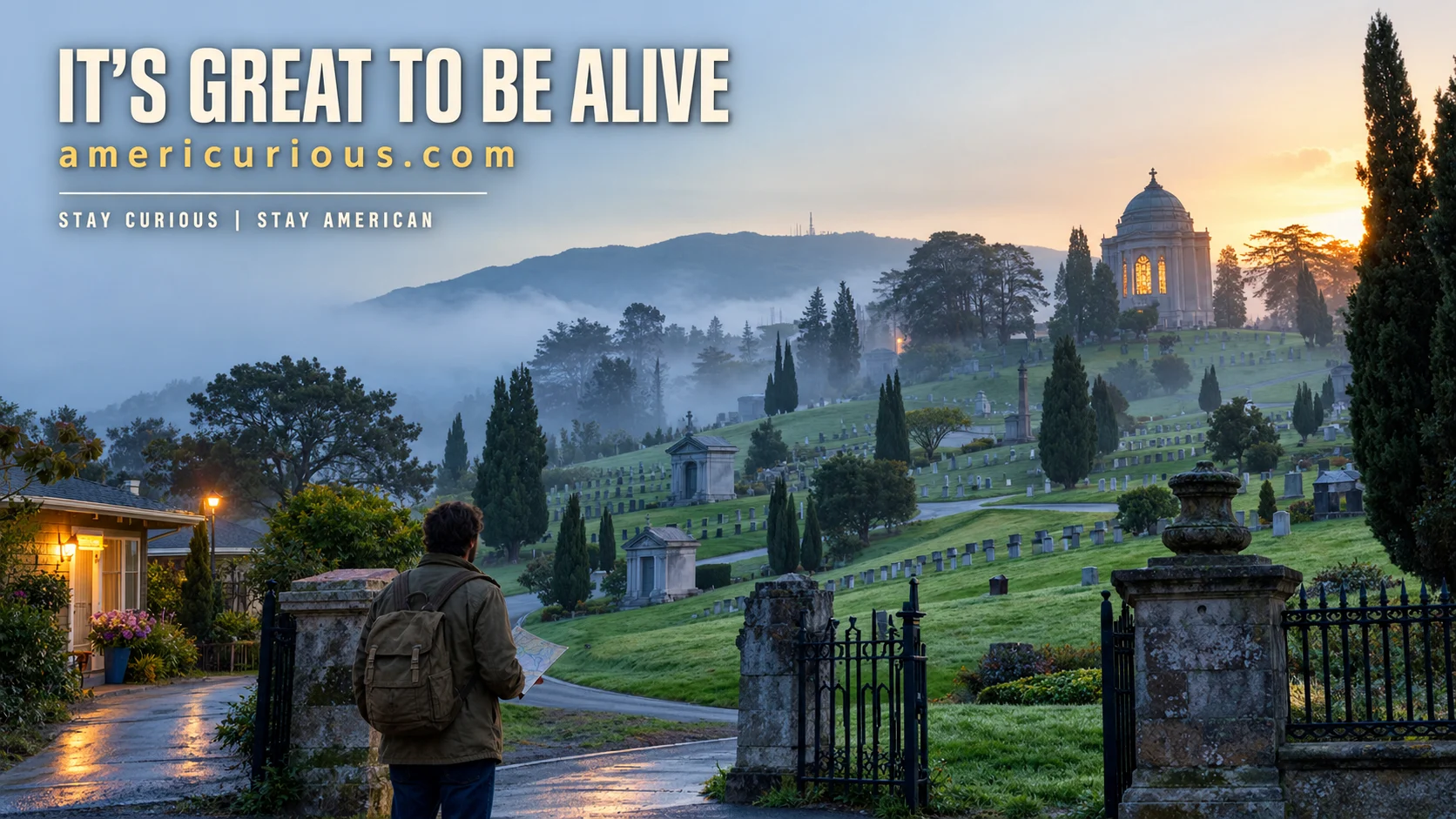
The town leans into the joke before you can make it. Its official motto, recorded on the town website, is “It’s great to be alive in Colma” 1, and its nicknames include “City of Souls” and “City of the Silent” 1. If you are building a Bay Area loop around places that do not feel like everywhere else, Colma earns a stop on the same logic behind our 7 uncrowded U.S. road trips for summer — go where the crowd, in this case, is extremely quiet.
🗺️ Two Square Miles, Three Neighbors, And One Mountain Watching
Colma covers about two square miles on the San Francisco Peninsula in San Mateo County, directly south of San Francisco 2. The town says 2.2 square miles, while the Census Bureau measures 1.9 square miles of land, a small discrepancy worth knowing if you are comparing sources 2.
Its borders tell you the layout faster than a map can. Daly City sits to the north and west across Junipero Serra Boulevard, South San Francisco sits to the south, and San Bruno Mountain State Park rises to the east 2. That mountain is not scenery in the distance — it is the town’s eastern wall, and it explains why Colma feels tucked into a shallow bowl of green slopes, fog, and headstones.
About 73% of the town’s land is cemeteries 2. The living, the shopping, and the car lots get the remaining quarter, which is why every practical question in Colma — where to park, where to live, where to build — becomes a land-use question first.
⚖️ San Francisco Did Not Lose Its Dead. It Evicted Them.
Colma started in the 19th century as homes and small businesses strung along El Camino Real and the San Francisco and San Jose Railroad line 2. Before it was a necropolis, it was farm country, known for vegetables, hogs, and flowers, and local historians note that violets became a symbol of the area 3. The name Colma itself comes from an Ohlone word for “springs” 2.

The turn came when San Francisco decided its land was worth more to the living. The city banned new burials in 1900–1901, then ordered its existing cemeteries removed, a process that played out through eviction notices in the 1910s and the great exhumations that followed 1. Approximately 150,000 bodies were moved between 1920 and 1941, at a reported cost of $10 per grave and marker, and families who did not pay saw relatives reburied in mass graves 2.
The first big mover was the Catholic Church. In June 1887, Archbishop Patrick Riordan dedicated Holy Cross Cemetery in a Colma potato field, years before the evictions forced everyone else’s hand 4. Cypress Lawn followed in 1892, Greenlawn in 1903, and Woodlawn in 1904, as fraternal, religious, and ethnic groups bought Colma land ahead of San Francisco’s deadline 4.
Incorporation was a defensive play, and the town has never hidden that. The Town of Lawndale incorporated on August 5, 1924, largely at the behest of the cemetery owners, with the 14 associated cemeteries working together to protect the burial grounds from being moved again 1. Because another Lawndale already existed in Los Angeles County, the post office kept the name Colma, and the town formally changed back to Colma on November 17, 1941 2.
🏛️ The Depot, The Blacksmith Shop, And Four Buildings Doing The Remembering
The Colma Historical Museum is the town’s anchor for living history, and it is really four buildings, not one. The complex includes the former Olivet Cemetery office building, the historic Colma Train Depot, a freight shed, and a reproduction blacksmith shop 2. That train depot matters more than it looks, because funeral trains once brought coffins and mourners down the Peninsula as a routine part of Colma life 1.
Inside, the Patricia Hatfield Memorial History Room starts with the Ramaytush Ohlone and works forward through Spanish settlers, European immigrants, post–World War II families, and Filipino residents 2. It is a small museum with a big job — it has to explain a town that was farmed, railed, incorporated, and buried into existence. Exhibits also cover World War II memorabilia, local businesses, and local churches 2.
Check before you go: The Historical Association currently lists the museum at 1500 Hillside Boulevard as open Saturdays only, 12:00–3:00 p.m., with free entry, and asks visitors to call or email ahead 2. An older Town of Colma locations page lists longer Tuesday–Sunday hours 1, so treat Saturday hours as the safer bet until you confirm at (650) 757-1676.
The town marked its centennial in 2024 with a parade, a community fair, banners, a film, and a commissioned public art mural chronicling Colma’s history 1. For a place founded to keep the dead from being displaced twice, Colma is unusually deliberate about writing its own record. The museum even holds the records for the inactive Sunset View Cemetery, 1901–1948 1.
🌫️ The Cemeteries Are The Parks, And The Fog Is On The Grounds Crew
Ask where Colma’s green space is and you will get a strange, correct answer: everywhere, and most of it has headstones. Cypress Lawn alone is described by the San Mateo County Bird Alliance as a historic garden cemetery and arboretum occupying over 200 acres, and as an eBird hotspot especially good for fall migrants 5. The Alliance’s next scheduled walk there is Saturday, October 31, 2026, from 8:30 to 11:00 a.m., on level, paved paths 5.
That garden-cemetery design is the point, not a coincidence. Colma grew out of the rural-cemetery tradition associated with Mount Auburn Cemetery, which treated burial grounds as landscaped public space at a time when many cities lacked parks 5. Colma’s residents have used that landscape accordingly for generations, learning to drive on cemetery roads and playing among the trees at the edges 2.
For conventional hiking, look east. San Bruno Mountain State and County Park, on Colma’s border, holds several rare and endangered species, including the San Bruno elfin butterfly, plus the Summit Loop and Ridge Trail with views of the Pacific, San Francisco, and the Bay 2. Shorter options include the Saddle Loop and the Bog Trail, which crosses Colma Creek on small wooden bridges 1.
The weather keeps all of that green without ever really warming up. In Colma, temperatures typically vary from 45°F to 69°F over the year, rarely dropping below 38°F or rising above 78°F, according to Weather Spark’s climate summary 1. September is the hottest month, with an average high of just 69°F, and January is the coldest, with an average low of 45°F 1.
🎟️ Movie Nights On The Mausoleum Lawn, Trolleys Through The Arboretum
Colma’s signature events understand exactly where they are being held. The town’s Cinema at the Cemetery series screens films outdoors on the Italian Cemetery Mausoleum lawn at 540 F Street, with doors at 6:00 p.m. and the movie at sundown 1. The 2026 slate listed by the town included Back to the Future on September 26 and Monsters, Inc. on October 10, both free and all-ages 1.
The biggest purely civic date is in summer, not October. The Colma Community Fair ran July 11, 2026, from 11:00 a.m. to 3:00 p.m. at Town Hall, 1198 El Camino Real, with games, music, food trucks, and crafts, free for attendees 1. The town’s Summer Concert Series followed at the Community Center, with Carnaval on August 13, 2026 and Native Elements on August 20, 2026, both 6:00–8:00 p.m. and free 2.
Still ahead this year, the town’s 6th Annual Trunk or Treat is set for October 23, 2026, 6:00–8:00 p.m. at the Community Center, with registration required and a low-sensory session from 6:00–6:30 p.m. 1. The Family Pumpkin Party follows on Monday, October 26, 2026, though its registration deadline was October 12, so call the Community Center before assuming space remains. Cypress Lawn counters with its Night Walking Tour on October 24, 2026 and a free Holiday Remembrance Event on December 16, 2026 1.
Cypress Lawn is, quietly, one of the Bay Area’s better tour programs. Its 2026 calendar included a Black History Month trolley tour on February 28, a Women’s History trolley tour on March 28, a Stained Glass Walking Tour, a Sports Trolley Tour on July 25, and a Memorial Day Remembrance on May 25 with an Avenue of Flags and complimentary lunch 1. Many trolley tours are free or donation-based, while specialty walking tours have run about $20–$23, so book through the Cypress Lawn events page rather than just showing up 1.
🥞 Garlic Rice At 3 A.M. Is A Legitimate Colma Food Group
Colma does not have a lamp-lit, shop-window Main Street, and pretending otherwise would be a lie. Its commercial spine is El Camino Real — State Route 82 — plus the Serramonte Boulevard retail-and-auto corridor, where the town’s major employers include Target, Best Buy, Home Depot, Kohl’s, and a Black Bear Diner 1. You shop here the way Peninsula people actually shop, by car, between errands.
What Colma and immediately adjacent Daly City do exceptionally well is Filipino food, which fits a town whose museum names Filipino residents among the groups that defined modern Colma 2. The essential stop is Café Colma, inside the Lucky Chances Casino at 1700 Hillside Boulevard, serving Filipino, Chinese, and American comfort food 24 hours a day, seven days a week 3. Regulars point newcomers to the silog plates — garlic rice, egg, and your choice of tocino, longanisa, or corned beef — and to the adobo 3.
Nearby, Manila Eatery draws lunch crowds for cafeteria-style Filipino dishes, including longanisa, tocino, garlic rice, and lumpia 4. Daly City, minutes away, deepens the bench with Fil-Am Cuisine, Tselogs, Chibog, and Ling Nam 3. The post-cemetery-visit meal at Café Colma is a real local ritual, mentioned in review after review by families who have been doing it for years 5.
The older Colma food economy is still visible if you know where to look. Holy Cross Cemetery’s resource page lists a working row of florists — Colma Floral Shop, Flowerland, Lester’s Flower Shop, Paul’s Flowers, and Torres Flowers — alongside monument companies on El Camino Real and Hillside Boulevard 1. Flowers and stone are not souvenir garnish here; they are the original retail.
🔍 A Headless Railroad Man, An Emperor, And A Pet Cemetery Walk Into Town
Colma’s trivia bench is deep enough to field a team. Start with Phineas Gage, the railroad foreman who survived an iron rod through his skull in 1848, died in San Francisco in 1860, and whose headless body was later moved to a mass grave at Cypress Lawn while his skull went to Harvard Medical School’s Warren Anatomical Museum 1. People still come to Colma looking for a man whose most famous part is 3,000 miles away 1.
At Woodlawn Memorial Park, look for Joshua Norton, the self-proclaimed Emperor of the United States and Protector of Mexico 1. At his feet lies José Sarria — the drag performer who in 1961 became the first openly gay candidate for public office in the United States, declared himself the Widow Norton, and in 2013 was buried beside the Emperor in a plot he had purchased 2. For decades, Sarria led an annual procession to Norton’s grave, which makes this Colma’s most joyful pilgrimage site, not its spookiest 2.
The celebrity circuit is real, but pick your cemetery before you wander. Joe DiMaggio and Mayor George Moscone are at Holy Cross, William Randolph Hearst and Willie McCovey are at Cypress Lawn, Levi Strauss is at Home of Peace, Wyatt Earp is at Hills of Eternity, and rock promoter Bill Graham is at Eternal Home 1. Earp’s grave is described by his cemetery as the most-visited gravesite in Colma 5.
Then there is Pet’s Rest Cemetery, founded in 1947 and still operating at 1905 Hillside Boulevard 1. Local lore and visitor guides identify its most famous resident as Tina Turner’s dog 1. In a town that takes remembrance seriously, extending it to pets is not a gimmick — it is the business model, applied consistently.
One more piece of trivia with teeth: when San Francisco’s markers were abandoned, some were recycled into public works, and unclaimed dead went into mass graves 2. Colma’s manicured lawns sit on top of a relocation that was orderly for some families and anonymous for others. The town’s best guides do not sand that edge off, and neither should visitors.
🚆 You Can Take BART To The Necropolis, Which Feels Correct
Colma is one of the easiest cemetery towns in America to reach without a car. The Colma BART Station at 365 D Street connects to SamTrans buses throughout San Mateo County and toward San Francisco and the airport, per BART’s station page 2. San Francisco International Airport is the practical fly-in gateway for the Peninsula, with BART and SamTrans providing the ground link into Colma 2.
Drivers come via Interstate 280 or El Camino Real, and parking is rarely the fight it is in San Francisco. BART lists Colma parking at $3.40 per day, with monthly reserved parking at $93.80, and notes capacity is generally available 2. Cemetery lots and retail lots along El Camino Real are built for weekend visitation volume, so your parking problem is more likely to be finding the right cemetery gate than finding a space.
Getting around inside town is a hybrid. Sterling Park and the Community Center are walkable for residents, and individual cemeteries are made for slow walking, but hopping between Cypress Lawn, Holy Cross, and Woodlawn is a drive or a SamTrans ride. Treat each cemetery as its own destination, get a map at the office, and do not assume you can cut across — fences, services, and private ceremonies govern movement.
🌡️ The Sweet Spot Is September, And Summer Will Lie To You About Warmth
The best window for Colma is early July to early October, with the peak tourism score in the last week of August, according to Weather Spark 1. September and early October are the connoisseur’s pick, warm by Colma standards — highs near 69°F — with the summer fog starting to loosen 1. Bring a jacket anyway, because a 69°F high on a windy ridge above the coast is not a t-shirt promise.
Winter does not shut Colma down, but it changes the errand. The wet season runs roughly November to April, February averages about 7.9 wet days, and January and December each average about 3.5 inches of rain in a 31-day window 1. Cemeteries stay open and the museum keeps its Saturday hours, but lawns get slick and San Bruno Mountain trails get muddy.
Crowd timing here is event timing, not hotel-season timing. The busiest cemetery days are Memorial Day weekend, Mother’s Day, Día de los Muertos season, and the October run of town and Cypress Lawn programs 1. Go on a weekday morning for the quiet version, when the only competition for a bench is the grounds crew.
🛏️ Sleep In Daly City, Wake Up Five Minutes From The Gates
Colma itself is short on conventional lodging, so most visitors sleep just over the line in Daly City or South San Francisco. The closest well-reviewed base is the Hampton Inn San Francisco–Daly City at 2700 Junipero Serra Boulevard, listed at about 1.0 mile from the Colma Historical Museum 1. That Junipero Serra corridor is the hub to choose — it puts you between Colma BART, Daly City restaurants, and the cemetery row.
If airport logistics matter more, South San Francisco’s Gateway Boulevard and Oyster Point area add larger airport-style hotels, including Hilton Garden Inn and AC Hotel properties within a few miles 1. Expect chain-hotel practicality, not a historic inn with a wraparound porch. In Colma, the historic buildings house the dead and the museum, and the living check in one town over.
Rates swing with San Francisco and airport demand, so price your dates rather than trusting any printed number. The reliable savings move is staying in Daly City instead of downtown San Francisco and riding BART in. You will pay Peninsula prices either way, but you will park like a person who lives here.
🌿 The Quiet Corners Are Cultural, Not Just Quiet
Colma divides itself the way it buries — by community. There are four Jewish cemeteries (Home of Peace, Hills of Eternity, Salem Memorial Park, and Eternal Home), plus Italian, Serbian, Japanese, Greek Orthodox, and Chinese cemeteries, each with its own landscape and architecture 3. Walking from one to the next is the fastest education in Bay Area immigration history you can get without a library card.
The living town, by contrast, is essentially one neighborhood. Sterling Park, between Hillside Boulevard and El Camino Real around B through F Streets, holds roughly 300 housing units and about 90% of Colma’s resident population 2. Its anchors are the Sterling Park Recreation Center at 427 F Street — playground, half-court basketball, fitness area, and a rentable picnic area with a barbecue pit — and the Colma Community Center at 1520 Hillside Boulevard 1.
For the un-touristy hour, go inside Cypress Lawn’s mausoleum and look up. Local guides single out the stained-glass corridors and skylit halls near the top of the hill as the interior to prioritize 3. The Japanese Cemetery and the smaller Serbian and Greek Orthodox grounds reward the same slow approach — fewer celebrity hunters, more architecture, more quiet.
The photogenic money shot is those stained-glass corridors when the fog burns off and color drops onto the marble. The sensory signature of the town is cut grass, damp eucalyptus drifting down from San Bruno Mountain, lawn equipment in the middle distance, and — near Hillside Boulevard at any hour — garlic rice and coffee from Café Colma 3. Colma sounds like a park and smells like a garden that employs a lot of people, which is exactly what it is.
⚠️ The Crime Chart Is Lying To You, And The Cemeteries Have Rules Anyway
Colma’s per-capita crime statistics look alarming until you understand the denominator. With only about 1,500 residents but enormous retail and daytime traffic, Colma has topped California property-crime rate lists — one analysis put it at 64,134 per 100,000 residents in 2022 5. Colma’s own police chief told the San Francisco Chronicle years earlier that the violent-crime rate is skewed by the tiny population, and that most property crime is shoplifting and auto burglaries at the shopping centers 5.
Translate that into visitor behavior and it is simple. Lock your car and hide valuables at the big retail lots and at BART, the same as you would at any suburban mall in America. The cemeteries themselves are daytime places, many now fenced, with services in progress — dress and behave like you are at somebody’s family event, because you are 1.
On San Bruno Mountain, the hazards are ordinary California ones. Summit routes do not allow dogs, trails can be exposed and windy, and hikers should wear layers, carry water, and watch for poison oak off-trail 2. Do not plan a night visit to a cemetery to test the ghost stories — the town actively discourages it, and gates and patrols enforce it 2.
🏈 The Living Root For The Rams, And Argue With Jefferson Like Family
Colma has no high school inside its tiny borders, so its teenagers generally go to Westmoor High School in Daly City, which serves Daly City, Pacifica, and Colma in the Jefferson Union High School District 1. Westmoor’s teams are the Rams, in green and white 1. If you want instant local credibility, those are the colors and that is the mascot.
The rivalry with Jefferson High School — the Grizzlies, also in Daly City — has a name, a trophy, and a ledger. Their football game was dubbed the Daly City Bowl, or the Greater Daly City–Colma Chamber of Commerce Trophy Game, and Westmoor still leads the historical series 20–17–2 1. Jefferson owned long stretches, including 1988–1995, and Westmoor went a decade without a winning season and 13 years without beating Jefferson by the end of 1995 1.
The old league structure that fed the Bowl ended in the 1990s, so do not expect that exact football fixture on a modern Friday night. The rivalry survives in other sports, with Westmoor and Jefferson still meeting in Peninsula Athletic League play, including soccer and volleyball fixtures in 2026 5. Around here, Daly City is also the friendly civic rival — Colma residents shop, eat, and send their kids to school there, then root against it anyway.
The local dialect is occupational, not twangy. Town and Historical Association materials literally categorize the famous dead as “Famous Underground Residents” 1, and residents grow up knowing which neighbors work in flower shops, set headstones, or keep the grounds 2. Day-to-day Colma also runs multilingual, with Spanish and Tagalog among the important languages spoken at home alongside English 5.
🎬 Harold Met Maude Here, Then The Town Sang About Itself
Colma’s defining film moment happened at Holy Cross Cemetery, 1500 Mission Road. Harold and Maude (1971), Hal Ashby’s dark comedy about a death-obsessed young man and a vivacious older woman, filmed Harold’s first meeting with Maude at Holy Cross 1. Standing in those rows, you understand the casting instantly — no set designer could out-build Colma.
The deeper cut is Colma: The Musical (2006), written by and starring H.P. Mendoza — a Westmoor alumnus — about three friends, Billy, Rodel, and Maribel, drifting after high school graduation in a town where the dead outnumber the living 2. Variety called out its opening number, “Colma Stays,” with the parenthetical joke “like rigor mortis” 2. It remains the rare hometown movie that is actually from the hometown, made by somebody who grew up with the punchline.
On the page, Colma anchors Doug Dorst’s 2008 novel Alive in Necropolis, about rookie Colma police officer Michael Mercer trying to keep the peace in a town where the dead outnumber the living 2. The documentary A Second Final Rest: The History of San Francisco’s Lost Cemeteries (2005), by Trina Lopez, covers the relocations themselves 2. Read or watch either before you visit and the lawns stop being scenery.
💰 First Violets, Then Headstones, Then Car Lots And A Cardroom
Colma’s economy has had three acts, and you can see all three from El Camino Real. Act one was agriculture — vegetables, hogs, and commercial flowers, especially violets, grown on land locals considered perfect for them 3. Act two was the death industry itself: gravediggers, flower growers, monument makers, and hearse drivers who settled beside the cemeteries they served 5.
Act three arrived in the 1980s, when Colma diversified into retail and automobile dealerships that brought in far more sales-tax revenue 2. The town’s budget documents name sales tax, cardroom tax, and property tax as its main revenue sources 1. The cardroom is Lucky Chances Casino at 1700 Hillside Boulevard, a 24/7 card room that opened June 28, 1998, and houses the ever-open Café Colma 2.
Today’s auto row is not a metaphor. The town’s major-employer list includes Serramonte Ford, Honda of Serramonte, Lexus of Serramonte, Stewart Chevrolet, CarMax, Cadillac, and Tesla operations, alongside Cypress Lawn and the big-box stores 1. Colma monetized both of its certainties — everybody needs a car on the Peninsula, and everybody, eventually, needs a plot.
The revival story here is preservation, not breweries in a dead mill. The town saved its train depot and an old cemetery office by turning them into its museum 2, added a centennial history mural in 2024 1, and turned an Italian Cemetery mausoleum lawn into a movie venue 1. And the fourth-generation monument trade carries on in Colma workshops, where families like the Fontanas still cut and sandblast granite beside the Italian Cemetery 2.
👻 The Ghost Stories Are Great. The Locals Would Like A Word.
Now the lore, because you were always going to ask. Peninsula ghost roundups repeat tales of a gargoyle-like creature hopping between tombstones at night and a bloody, vanishing figure spotted by a night-shift officer outside Woodlawn 3. A 2005 East Bay Times account of Colma police patrols added a skull found in a tree at Holy Cross, plus candles, seance remnants, and couples using the headstones for privacy 1.
Treat those exactly as sourced — decades-old police anecdotes and rumor, not established haunting. People who live and work in Colma consistently push back on the haunted-house framing, insisting the cemeteries are places of reverence and history 1. Ghost hunters have run paranormal investigations in Colma and, in at least one account relayed by a cemetery official, found nothing 2.
The strangest well-attested story is gentler. In 1997, sap on a pine tree in a Colma cemetery formed an image that many visitors identified as the Virgin Mary 2. Whether you file that under miracle, coincidence, or tree biology, it fits Colma better than any gargoyle — this is a town where the supernatural, when it shows up at all, shows up as devotion.
The town’s real relationship with Halloween is negotiated, not embraced or banned. It runs Trunk or Treat and pumpkin events at the Community Center, and screens movies at the Italian Cemetery, while discouraging outsiders from entering cemeteries at night hunting ghosts 2. Fun for the living, respect for the dead, fences for everybody else.
🏡 A $8,950 Bungalow Then, A Million-Dollar Question Now
If you moved here, you would almost certainly move to Sterling Park. After World War II, veterans bought Sterling Park bungalows for about $8,950 with GI loans, building the residential town inside the necropolis 1. The neighborhood’s housing stock remains largely mid-20th-century, modest single-family homes — many with classic ranch layouts — on quiet, tree-lined streets around F Street and Arlington Drive 3.
The modern numbers are pure Peninsula. Recent American Community Survey estimates put Colma’s population at 1,441, median household income at $121,488, median home value at $1,040,900, and median rent at $2,152 per month 1. The same data count only 571 total housing units, which is the whole story in one figure 1. When 73% of your town can never be housing, supply is not a policy failure — it is a founding condition.
Demographically, the living town is small, established, and diverse. Survey data place the median age around 42, and other demographic profiles describe a community where Hispanic or Latino residents are the largest ethnic group, with significant Asian and immigrant communities — about a third of residents foreign-born in one widely used profile 5. Newcomers tend to arrive via the same Daly City housing spillover that fills Westmoor’s classrooms, not via a Colma-specific boom, because Colma has almost no land left to boom with.
That is the honest transplant pitch. You get quiet streets, BART access, and neighbors who know your name, in exchange for a million-dollar entry price and the world’s most peaceful rush hour. Your largest nearby open space will always be a cemetery, and in Colma that is understood as an amenity, not a warning.
🎁 Pass The Souvenir Test At The Museum, Then At The Stonecutter’s
Skip the generic San Francisco snow globe; you are not in San Francisco, and Colma would like that noted. Start at the Colma Historical Museum on a Saturday between 12:00 and 3:00 p.m., where entry is free and the staff can point you to the town’s historic cemetery walking materials 2. A cemetery walking map from the museum is the correct paper souvenir — useful in the field, specific to these 17 grounds, and impossible to confuse with any other town’s.
For the made-here object, go to the monument trade that built this place. Holy Cross’s directory lists working Colma monument companies including Acme Memorial Company and American Monumental Company on Hillside Boulevard and El Camino Real 1, and Bocci Designs traces its Colma monumental masonry back to 1896 2. Ask a stonemason about a small custom-engraved token or keepsake stone, and ask first — these are working memorial shops serving grieving families, not gift boutiques.
That pairing is the whole town in your tote bag. A map for the famous underground residents, and a small piece of engraved stone from the living craftspeople who have marked Colma graves for over a century. Buy the map for the trip, and the stone for the shelf.
In Colma, every resident eventually gets a permanent address with excellent landscaping — so move fast, tip your stonemason, and enjoy the lease while you’re still on the living side of the directory.
- AmeriCurious