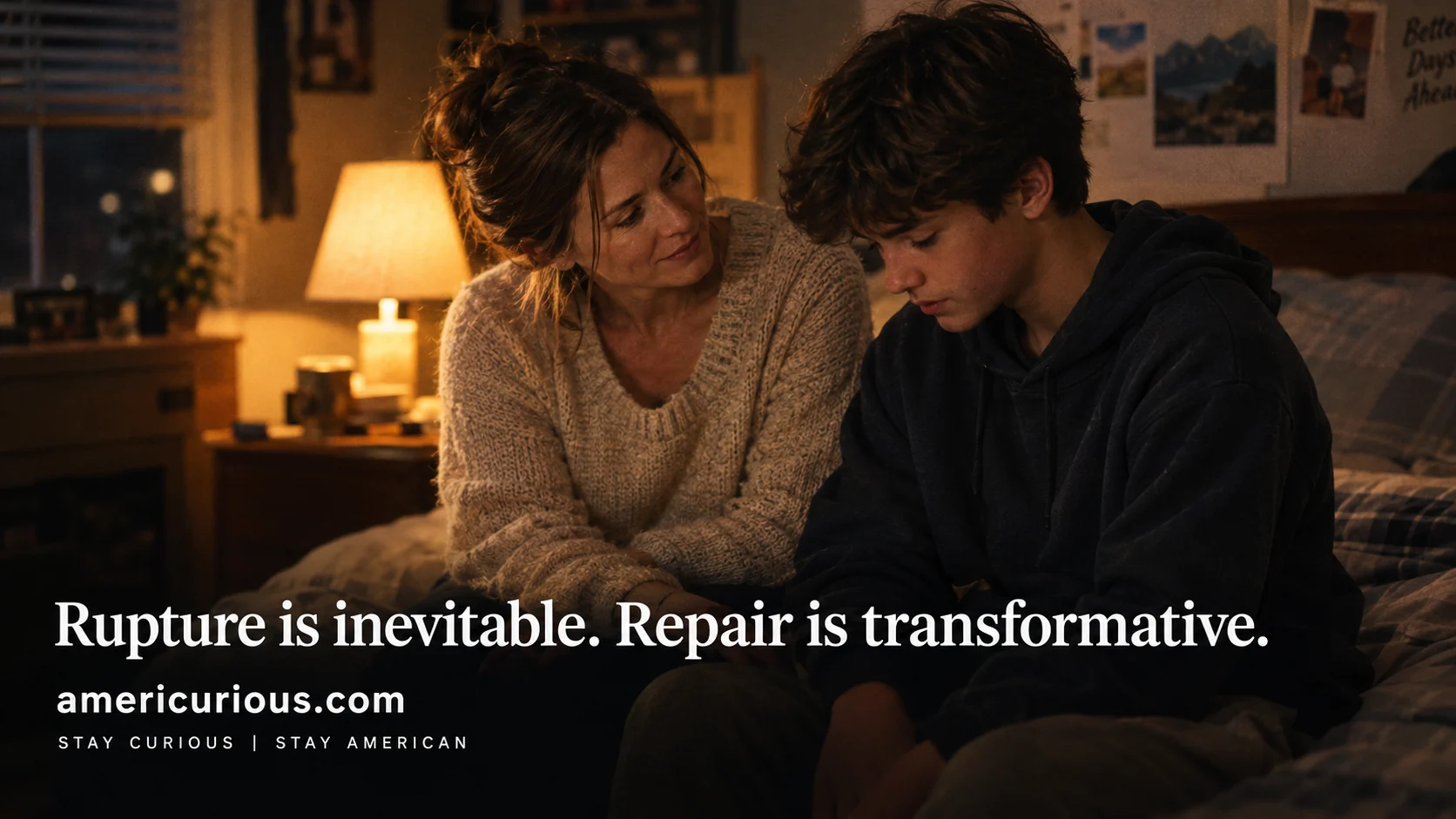
Struggling with door slams and mom guilt? Learn how to repair connection with teenagers, set sturdy boundaries, and turn adolescent angst into resilience.
TL;DR: Quick Insights for Exhausted Parents
- Rupture is inevitable, but repair changes everything: Yelling at your child doesn’t destroy your relationship; leaving outbursts unrepaired and letting your teen default to self-blame is what causes long-term emotional scars.
- Separate identity from behavior: You are a good parent having a hard time, and your teenager is a good kid having a hard time.
- Set true boundaries without aggression: A boundary is something you do that requires your child to do nothing. Stop making compliance requests and start holding sturdy lines while validating their disappointment.
- Master the 15-second repair script: Step back, regulate your own shame, sit on their bed at 11:15 p.m., name what happened, take 100% responsibility for your reaction, and state what you will do differently.
The Sunday Night Kitchen Scene
The sizzle of pan-roasted chicken had barely died down in the iron skillet, and the kitchen sink was already filled to the brim with soapy water and dirty pots.
You wiped your hands on a kitchen towel, running on three hours of broken sleep after a weekend spent chauffeuring kids across Will County for soccer and volleyball tournaments.
Then your 13-year-old son, Ethan, slouched into the kitchen, glanced at the dinner table, scoffed, and snarled: “Chicken again? Disgusting.”
                 SUNDAY NIGHT RUPTURE FLOW
 [Kitchen Outburst] ──> [Door Slam] ──> [Bathroom Floor Guilt]
         │                                       │
         └───────────────────────────────────────┘
                            │
               [11:15 p.m. Bedside Repair]
The Sudden Snap
Something in your chest snapped. All the exhaustion, the unread emails, and the feeling of being completely invisible in your own home surged upward in a hot wave.
You dropped the dish rag and yelled, “What is wrong with you? Can’t you be grateful for one single thing in your life?”
Ethan’s eyes widened in sudden shock before hardening into defiance. “I hate you!” he screamed, turning on his heel and sprinting down the hallway.
The Bathroom Floor Freeze

The crack of his bedroom door slamming shut echoed through the house, rattling the picture frames in the corridor and leaving you standing frozen over the counter.
An hour later, at 11:30 p.m., you found yourself sitting on the cold tile floor of your locked bathroom, head pressed against your knees, listening to the quiet hum of the hallway fan.
The familiar 2 a.m. thoughts started their relentless loop in your mind: Why did I yell like that over a stupid plate of chicken? Am I a monster? Have I ruined my relationship with my son forever?
The Myth of Perfect Parenting
If you have ever sat on that floor feeling suffocated by mom guilt, you need to hear this truth immediately across the kitchen table: you are not a monster.
Modern parenting has convinced us that a good mother never loses her temper, never raises her voice, and keeps every room in the house floating in seamless harmony.
When conflict erupts, we assume we have failed our children. But the psychological reality is radically different.
Care to Read?
Teens Using AI for Health Advice: 5 Risks Parents Should Understand
Yelling, Door Slams, and the Bathroom Floor: Why You’re Not a Monster
The Trap of “Good Girl” Socialization
Many of us were raised as “good girls” who learned to scan our environments constantly to keep everyone around us happy, comfortable, and calm.
When your teenager explodes or acts out, your brain absorbs their emotional distress, pulls it directly into your own chest, and mislabels it as personal guilt.
You feel an urgent desperation to fix their mood—not because you’re a bad parent, but because you want to stop feeling the agonizing sensation of their anger in your own body.
Reality Check: Taking on your child’s emotional dysregulation and calling it “mom guilt” isn’t self-awareness—it’s emotional confusion that prevents you from leading sturdily.
Identity vs. Behavior: The 2-Hand Technique
To break out of the paralyzing shame spiral that keeps you stuck on the bathroom floor, you must learn the foundational psychological shift of separating who you are from what you did.
Dr. Becky Kennedy emphasizes that shame is an evolutionary freeze response; when you tell yourself “I yelled, so I’m a terrible parent,” your brain freezes, making it impossible to learn or take positive action.
Instead, practice the literal Two-Hand Technique in the quiet of your room:
          THE TWO-HAND SELF-REPAIR TECHNIQUE

   [ Left Hand: Identity ]       [ Right Hand: Behavior ]
  "I am a good parent..."        "...who had a moment I
                                   am not proud of."
- Hold out your left hand: Look at it and say, “I am a good parent (my core identity).”
- Hold out your right hand: Look at it and say, “Who had a moment I am not proud of (my temporary behavior).”
When you hold those two truths simultaneously, you free up the emotional energy required to walk down the hall and make things right.
“Rupture moment is not who you are and it’s not your future… Yelling at kids messes kids up far less than yelling at kids and not repairing after you’ve yelled.” — Dr. Becky Kennedy
The #1 Mistake Parents Make After a Rupture (And How to Repair Connection with Teenagers)
What Happens in Your Child’s Brain When You Don’t Repair
When an explosive fight happens and you retreat to your room without reconnecting, your child is left alone in a state of high physiological distress.
Because you are their primary source of safety, their brain panics when you temporarily become a source of fear.
To survive this terrifying paradox and keep believing that their home is safe, a child’s brain defaults to one primary coping strategy: self-blame.
UNREPAIRED RUPTURE CYCLE:
Parent Outburst ──> No Reconnection ──> Child Feels Unsafe ──> Child Defaults to Self-Blame ("I'm bad")
As psychoanalyst Ronald Fairbairn famously observed, it is neurologically safer for a child to believe they are bad than to accept that their environment or caregiver is unsafe.
Left unrepaired, those childhood self-blame stories—“I’m unlovable, I make bad things happen, something is wrong with me”—become the exact blueprint for adult anxiety, depression, and chronic self-doubt.
Repair Rewrites the Ending of the Chapter
Here is the profound hope built into human memory: memory is not a static videotape. Memory is the original event combined with every subsequent time you remember that event.
When you go back to your teenager after a fight and deliver a true repair, you do not erase the yelling, but you completely rewrite the ending of that memory chapter.
Instead of the chapter ending with “Mom lost her mind, I was terrified, and I went to sleep alone believing I was unlovable,” the new ending becomes: “Mom came into my room, took full responsibility for her temper, made me feel safe, and proved that our bond can survive hard moments.”
                             REWRITING THE MEMORY CHAPTER

  Unrepaired Chapter Ending:                 Repaired Chapter Ending:
┌──────────────────────────────┐           ┌──────────────────────────────┐
│  • Parent shouted            │           │  • Parent shouted            │
│  • Child left alone          │   ───►    │  • Parent entered room       │
│  • Story: "I am unlovable"   │           │  • Took 100% responsibility  │
└──────────────────────────────┘           │  • Story: "I am safe & loved"│
                                           └──────────────────────────────┘
“Repair is the act of going back to a moment of disconnection, taking responsibility for your behavior, and acknowledging the impact it had on another… A 15-second intervention can have a lifelong impact.” — Dr. Becky Kennedy
Apology vs. Repair: The “Not-Repair” Pitfalls
Most parents confuse a true repair with a defensive apology. An apology tries to shut a conversation down (“I’m sorry I yelled, okay? Can we move on?”), whereas a true repair opens it up.
The most damaging mistake you can make is issuing a fake repair that sneaks the blame right back onto your teenager’s shoulders.
+---------------------------------------------------------------------------------------------------+
| TABLE 1: BAD REPAIR VS. TRUE REPAIR AFTER A RUPTURE                                               |
+--------------------------------------------------+------------------------------------------------+
| The "Fake Repair" (Shifts Blame)                 | The "True Repair" (Takes 100% Responsibility)  |
+--------------------------------------------------+------------------------------------------------+
| "I'm sorry I yelled, BUT if you didn't complain  | "I keep thinking about what happened in the    |
| about dinner, it wouldn't have happened."        | kitchen earlier. I'm so sorry I yelled."       |
+--------------------------------------------------+------------------------------------------------+
| "You really need to be more grateful for a home- | "It was scary when I raised my voice like      |
| cooked meal, and then you won't get screamed at."| that. My temper was NOT your fault at all."    |
+--------------------------------------------------+------------------------------------------------+
| "I'm sorry, okay? You know how stressed I am     | "I am working on managing my own frustration   |
| with work right now. Are we good?"               | so I can respond calmly, even when stressed."  |
+--------------------------------------------------+------------------------------------------------+
The 15-Second Repair Script
When you are ready to repair, walk down the hallway at 11:15 p.m., knock softly on your teenager’s door, step inside, sit on the edge of the mattress, and use these three simple elements:
- Name what happened: “I keep thinking about what happened earlier in the kitchen.”
- Take 100% responsibility: “I’m so sorry I yelled. It was scary, and it was NOT your fault.”
- State what you are doing differently: “I’m working on managing my own big feelings so I can stay calm when I’m frustrated. I love you.”
If your teenager rolls his eyes, looks at his phone, or mutters, “Whatever, get out of my room,” do not take the bait.
He is simply pushing the emotion away temporarily so his nervous system can digest the immense relief of your words. Trust that the repair landed deep in his body.
Check This Out!
E-Bike Accident Lawsuit Guide: What 178% Surge Means for Arizona Parents Now
Boundaries Without Aggression: Stopping the “Overcorrection” Pendulum
The Modern Parenting Overcorrection
Decades ago, society cared very little about children’s emotional landscapes—kids were told to “shut up and finish your plate or else.”
In response, our generation pledged to do better. But we overcorrected into something equally toxic: we became terrified of our children’s emotions, letting their moods dictate household choices.
                 THE PARENTING OVERCORRECTION PENDULUM

  1970s Authoritarian               Modern Overcorrection            Good Inside Framework
 ┌────────────────────┐            ┌────────────────────┐           ┌────────────────────┐
 │  Disregard Kids'   │   ───►     │  Scared of Kids'   │  ───►     │  Empathy PLUS      │
 │  Emotions          │            │  Emotions          │           │  Sturdy Boundaries │
 └────────────────────┘            └────────────────────┘           └────────────────────┘
Dr. Becky Kennedy notes that empathizing with a child’s feelings is only half your job; the other half is setting true boundaries—exercising authority without aggression.
Requesting vs. Boundary-Setting: The Elevator Button Test
A boundary is something you tell someone YOU will do, and it requires the other person to do NOTHING.
When you tell your 13-year-old, “Put your phone away right now,” you are not setting a boundary—you are making a request that requires his total compliance to succeed.
If he ignores you, you feel powerless, lose your temper, and blurt out random punishments you have no intention of enforcing (“No screens for a month!”).
+---------------------------------------------------------------------------------------------------+
| REQUEST VS. STURDY BOUNDARY COMPARISON                                                            |
+--------------------------------------------------+------------------------------------------------+
| Weak Request (Requires Teen Compliance)          | Sturdy Boundary (Requires Only Parent Action)  |
+--------------------------------------------------+------------------------------------------------+
| "Please stop playing video games and come down   | "Video game time ends at 8:00 p.m. At 8:00,    |
| to dinner right now!"                            | I am turning off the Wi-Fi router for the night."|
+--------------------------------------------------+------------------------------------------------+
| "Don't touch your phone while you're doing your  | "I know phones are designed to draw us in. I'm |
| math homework in your bedroom."                  | keeping your phone in my desk until homework's |
|                                                  | done."                                         |
+--------------------------------------------------+------------------------------------------------+
The Tennis Court Visual
Imagine a tennis court with a high glass wall extending up from the net. You stand on your side of the court; your teenager stands on theirs.
When your middle schooler throws a door-slamming tantrum over a screen-time boundary, keep their emotional distress firmly on their side of the glass wall.
                    THE TENNIS COURT VISUAL

         PARENT SIDE                     TEEN SIDE
       ┌──────────────┐   Glass Wall    ┌──────────────┐
       │ Holds Boundary│    │ Net │     │ Emotional    │
       │  & Empathy    │ ───┼─────┼───► │ Distress &   │
       │ ("I'm calm") │    │     │     │ Disappointment│
       └──────────────┘                 └──────────────┘
You can stay calm on your side and say, “I hear how angry you are that game time is over tonight. It’s okay to be mad at me, but the Wi-Fi is still turning off.”
Sturdy Parent Action: A child’s pushback or door-slam after you set a boundary is not proof that you failed as a parent; it is proof that you set a real boundary and they are processing the disappointment.
Deciphering the Middle School Brain: Normal Teen Angst vs. Real Distress
The Age-11 Limbic Shift
Parents are often shocked when their sweet 10-year-old transforms into a moody, distant 11-year-old overnight.
Dr. Lisa Damour explains that adolescence neurologically begins at age 11 with the onset of pubertal brain changes.
ADOLESCENT BRAIN DEVELOPMENT:
[Limbic System (Emotions)] ──► Fires First at Age 11
[Prefrontal Cortex (Logic)] ──► Matures Slowly Until Age 25
Power gets redistributed rapidly to the brain’s emotional center (the limbic system), while the executive reasoning center (the prefrontal cortex) takes another decade to fully mature.
Angst is the Price of Admission
We must stop treating normal adolescent emotional distress as a mental health pathology.
Mental health does not mean feeling happy, calm, or relaxed all the time; mental health means having emotions that fit the context and managing those feelings effectively.
When your middle schooler cries over a school friendship shift or storms off after a bad sports practice, that distress is not a failure—it is a growth-giving workout for their developing emotional system.
                                  MID-POST POLL

  What is currently the hardest moment in your house with your teenager?

  [ ] A. The post-school door slam & total withdrawal ("I'm fine, leave me alone")
  [ ] B. The late-night kitchen explosion over dinner, homework, or screens
  [ ] C. The complete refusal to follow house rules or boundary requests
  [ ] D. The constant emotional roller-coaster of 6th-8th grade social drama
The 11:15 p.m. Bedside Meeting
Do you wonder why your teenager ignores your questions at the dinner table all evening, but suddenly appears in your bedroom doorway at 11:15 p.m. ready to talk?
Dr. Lisa Damour reveals that teenagers are driven by a deep developmental need for autonomy.
When they initiate a conversation at 11:15 p.m. in the dark, they satisfy two needs at once: connecting with you while retaining total control over the meeting’s timing, topic, and exit.
THE 11:15 P.M. BEDSIDE MEETING STRATEGY:
Teen Initiates ──► Controls Topic & Timing ──► Parent Uses "Editor Method" ──► Connection Rebuilt
The “Editor Method”: How to Listen Without Advice
When your teenager finally opens up late at night, resist the overwhelming urge to fix their problem or offer immediate wisdom.
Imagine your teen is a field reporter reading an intense news story aloud to you. Your job as the editor is NOT to jump in and rewrite the story.
Your job as the editor is simply to listen intently and produce the headline: “Oh man, that stinks. I’m so glad you’re telling me about this.”
“Curiosity plus empathy or just empathy is overwhelmingly the most effective and wanted response when teenagers come our way with their distress.” — Dr. Lisa Damour
Long-Game Parenting: Building Resilience Instead of Wiring for Anxiety
The Danger of the “Sunny Bench”
When your child comes home crying because they were left out of a social group or failed a math quiz, your natural instinct is to yank them over to a “sunny bench” with quick fixes or false praise (“Well, those girls aren’t even nice anyway! You’re the prettiest girl in 6th grade!”).
Dr. Becky Kennedy warns that constantly optimizing for immediate happiness actually wires children for adult anxiety.
                   THE FEELINGS BENCH VS. SUNNY BENCH

  The "Sunny Bench" (Causes Anxiety):    The "Feelings Bench" (Builds Resilience):
 ┌──────────────────────────────────┐   ┌──────────────────────────────────┐
 │ • "Don't be sad!"                │   │ • "I'm so glad you're telling me"│
 │ • Quick distraction/fixes        │   │ • "I believe you"                │
 │ • Message: Feeling is scary      │   │ • "Tell me more"                 │
 └──────────────────────────────────┘   └──────────────────────────────────┘
When you rush to erase your child’s disappointment, you teach them that hard emotions are dangerous and intolerable.
Instead, walk over and sit down next to them on their uncomfortable “feelings bench” using these three magic lines:
- “I am so glad you are talking to me about this.”
- “I believe you.”
- “Tell me more.”
When a parent proves they are not afraid to sit on a hard feelings bench with their child, the child realizes: “If my mom isn’t panicking about this feeling, it must not be as scary as I thought.”
Scaffolding Capability: Planning Like a Coach
Counselor Kristen Hatton advises parents to plan like a coach and farm like a farmer.
A coach watches film for the entire season rather than obsessing over a single bad play, and a farmer plants seeds with long-term patience, knowing growth happens quietly beneath the surface.
Stop doing tasks for your middle schooler that they are neurologically capable of learning to do themselves.
               THE SCAFFOLDING PROTOCOL (e.g., Emailing a Coach)

 [Step 1: Sit Together] ──► [Step 2: Guide Words] ──► [Step 3: Teen Types & Sends]
- Don’t make the layup for them: If Ethan needs to tell his coach he’s missing practice, don’t write the email yourself.
- Scaffold the skill: Sit at the laptop together, guide his wording (“How do you think you should start? ‘Dear Coach Mike…'”), but let his fingers press the keys.
The 11:15 p.m. Resolution: Writing a New Ending
Returning to Sunday Night
Let’s return to where our story began. It is 11:15 p.m. on Sunday night.
You have used the Two-Hand Technique on the bathroom floor. You have reminded yourself: I am a good parent who had a moment I’m not proud of.
You walk down the quiet, carpeted hallway. Ethan’s bedroom door is closed, a thin sliver of light glowing beneath the frame.
You knock gently, push the door open, sit down on the edge of his bed in the dark, and speak softly:
“Hey, Ethan. I keep thinking about what happened in the kitchen earlier. I am so sorry I yelled at you. It was scary, and it was NOT your fault at all. I was stressed out, but it is my job to manage my own temper. I love you.”
Silence hangs in the room for three long seconds.
Then, you see his tense shoulders drop. He stares down at his quilt, clears his throat, and murmurs: “Thanks, Mom. Sorry about the chicken.”
The original rupture didn’t disappear—but the chapter ended in safety, trust, and connection.
+---------------------------------------------------------------------------------------------------+
| 5 PLAIN-LANGUAGE TAKEAWAYS FOR EXHAUSTED PARENTS                                                 |
+---------------------------------------------------------------------------------------------------+
| 1. Rupture is inevitable; Repair is transformative. You don't need to be a perfect parent to      |
|    raise a resilient child; you just need the courage to go back into the room and repair.        |
|                                                                                                   |
| 2. Separate identity from behavior. Repeat daily: "I am a good parent having a hard time," and     |
|    "My child is a good kid having a hard time."                                                   |
|                                                                                                   |
| 3. Boundaries are what YOU do. Stop begging for compliance and start holding true lines that      |
|    require zero teen cooperation to execute.                                                      |
|                                                                                                   |
| 4. Sit on the feelings bench. Use the three magic lines ("I'm glad you're talking to me," "I      |
|    believe you," "Tell me more") instead of rushing to fix their discomfort.                      |
|                                                                                                   |
| 5. Scaffolding builds genuine confidence. Guide your teenager through hard tasks without making    |
|    the layup for them.                                                                            |
+---------------------------------------------------------------------------------------------------+
Frequently Asked Questions (FAQ)
What should I do when my teenager slams the door and screams “I hate you”?
Do nothing immediately. Resist the urge to scream back or issue instant punishments. Recognize that “I hate you” is an uncontained expression of overwhelming disappointment or hurt. Step back, regulate your own emotions, and approach their door 20 minutes later with a simple repair and boundary script: “I know you were really upset about plans changing. I’m sorry I yelled. It’s okay to be mad at me, but it’s not okay to scream at me. I love you, and we’ll talk tomorrow.”
How do I stop yelling at my kids when I’m completely exhausted and overwhelmed?
Recognize that yelling happens when emotional feelings exceed available regulation skills in a high-stress moment. When you feel the surge coming, use the “Bathroom Floor Pause.” Put your feet flat on the ground, hand on your heart, and repeat: “I am a good parent having a hard time.” Separating your identity from the behavior allows you to access the calm needed to reset before speaking.
Why does my middle schooler refuse to talk after school but wants to talk at 11:00 p.m.?
Middle schoolers spend all day following adult demands. When they come home, they need to regain autonomy. Late-night conversations allow them to control the meeting’s timing, topic, and duration. Capitalize on those late-night door-frame moments—use the “Editor Method” to listen intently without giving unprompted advice.
How do I know if my teen’s moodiness is normal angst or clinical depression?
Normal adolescent angst involves intense emotional swings, seeking privacy, and occasional pushback, but the teenager still functions in core areas (going to school, maintaining friendships, sleeping, engaging in interests). Clinical red flags include drastic, persistent changes in overall functioning: dropping out of all activities, sudden academic failure, complete social isolation, substance abuse, or chronic walking on eggshells in the home.
Transform Your Household Crisis Moments
- Primary Soft-Sell CTA: Here’s our free, printable “15-Second Repair & Sturdy Boundary Cheatsheet” to tape inside your kitchen cabinet for moment-of-crisis scripts.
- Secondary Newsletter CTA: Join thousands of suburban moms on the weekly Sturdy Parent Dispatch for 2-minute actionable parenting scripts delivered every Sunday afternoon.
What’s Included in Your Cheatsheet
 ┌────────────────────────────────────────────────────────────────────────┐
 │           15-SECOND REPAIR & STURDY BOUNDARY CHEATSHEET                │
 ├────────────────────────────────────────────────────────────────────────┤
 │ 1. The 15-Second Repair Protocol (Dr. Becky Kennedy)                   │
 │    • 3-Step Bedside Script (Name event ➔ Take 100% ownership ➔ Next)  │
 │    • Two-Hand Self-Repair Technique (Identity vs. Behavior)            │
 │    • Table 1: Bad Repair Traps vs. True Repair Scripts                 │
 │                                                                        │
 │ 2. Sturdy Boundaries Without Aggression                                │
 │    • Golden Rule: Something YOU do requiring child to do NOTHING       │
 │    • Table 2: Weak Requests vs. Sturdy Boundaries Action Guide         │
 │                                                                        │
 │ 3. De-Escalation & The Tennis Court Visual                             │
 │    • Keeping distress on THEIR side of the net (No "Mom Guilt")        │
 │    • The 10-Second Bathroom Floor Reset                                │
 │                                                                        │
 │ 4. Late-Night Connection & The "Editor Method" (Dr. Lisa Damour)       │
 │    • Why teens open up at 11:15 p.m. (Autonomy & low threat)           │
 │    • 3 Magic Lines for the "Feelings Bench" ("I believe you", etc.)    │
 │                                                                        │
 │ 5. Emergency Fridge Cheatsheet & Decision Matrix                       │
 │    • Quick-action table for moment-of-crisis scenarios                 │
 └────────────────────────────────────────────────────────────────────────┘
How to Use It
- Tape Section 1 & 2 to your refrigerator or bathroom mirror for quick 10-second resets before approaching your child.
- Keep Section 4 in mind for late-night bed-frame talks, using the “Editor Method” to headline their experience without giving unprompted advice.
- Use Section 5 as an emergency script matrix whenever tension flares up around screens, chores, or door slams.
“You don’t need to be a perfect parent to raise a resilient child—you just need the courage to go back into the room, sit on the bench, and write a better ending to the story.”