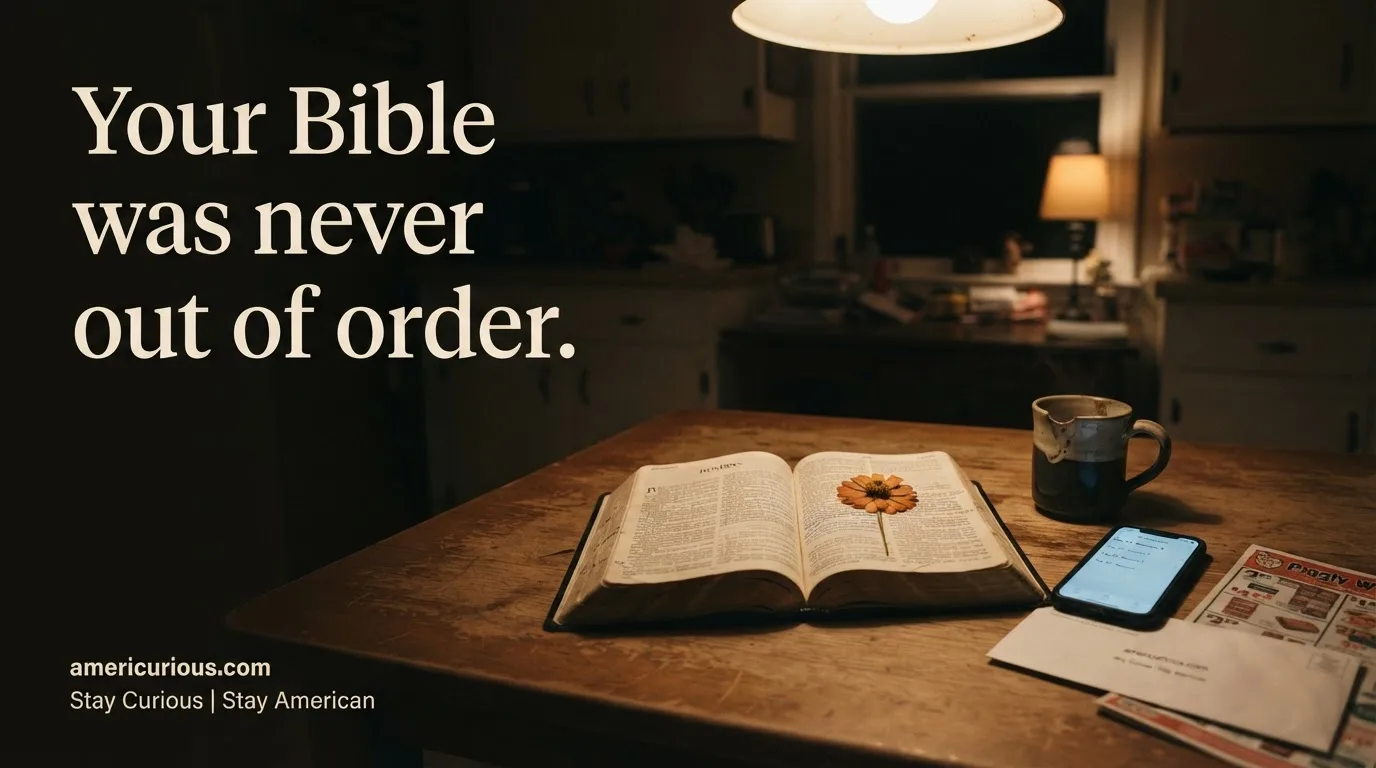
The Bible isn’t in chronological order — it’s a library shelved by genre. Here’s why the order feels confusing, plus a reading order that finally makes sense.
TL;DR: The Bible isn’t one book — it’s 66 books by roughly 40 authors, written over about 1,500 years, shelved by genre, not by date. That’s why Job may be the oldest book in the Bible and still sit mid-shelf, why Chronicles replays Samuel and Kings, and why Paul’s letters are sorted by length instead of by when he mailed them. Once you see the shelves, you can pick a reading order that fits you — starter route, chronological, shelf tour, or whole-book. No plan-shame included.
It’s 9:47 on a February night in Hixson, Tennessee, and my friend Mel is on the losing end of Leviticus.
The kitchen table holds everything that matters in her life right now: a coffee she’s reheated twice, a CareCredit envelope she’s pretending not to see, and a phone propped against the napkin holder showing Leviticus 7. Fine flour. Oil. Frankincense. Grain offerings, and then — for variety — more grain offerings.
Upstairs on the nightstand sits her mother’s Bible. A 1978 Ryrie Study Bible, King James, spine cracked white, ballpoint notes in the margins, and a zinnia from her mother’s garden pressed flat at Ecclesiastes 3. Her mama died fourteen months ago. On January 1, Mel started a read-the-Bible-in-a-year plan. For her.
On February 17, at 9:47 p.m., she typed four words into the search bar, quiet, like somebody in the house might hear:
is it a sin to skip leviticus
If you’ve ever typed something like that — or thought it and didn’t dare — pull up a chair. Because here’s what nobody told Mel, and I’m guessing nobody told you either: the Bible isn’t chronological, and it was never meant to be. It isn’t one book at all. It’s a library — sixty-six books by about forty authors, most of whom never met, written across fifteen centuries. Once you see the shelves, the whole thing stops feeling like a test you’re failing.
And you’re not alone. Not even a little. Roughly nine in ten American households own a Bible — the average home has three — and only about one in five Americans has ever read the whole thing through, even once (Lifeway Research). Quitting a Bible plan isn’t a dirty secret. It’s the most normal thing in American religion.
So that’s what this is: the map Mel never got. Why the order is the way it is, the seven places it’ll tie your brain in a knot, and four Bible reading orders that actual human beings finish. One of them has your name on it.
The February Wall
Mel didn’t delete the app, you understand. She just stopped opening it.
That’s how she quit — the way you stop calling somebody. Not a breakup. A slow fade, one swiped notification at a time. The streak counter she was going to lose. The knot in her stomach every time the phone lit up at night.
Weeks later, at this same table, she finally said the thing out loud: “I’m telling you, I read nine books in book club one year. Nine. And I can’t get through this one.”
And then the thing she couldn’t say, until she could: What if I’m just not a Bible person? And what does that make me at forty-one, in this town, with my mama’s Bible sitting on my nightstand?
Reality Check
About 87 percent of American households own a Bible — the average home has three. Yet only about one in five Americans has read the entire Bible even once (11 percent once, 9 percent more than once), and 53 percent have read relatively little of it. Even among people who attend worship services, less than half read the Bible daily. (Lifeway Research; American Bible Society)
“Most Americans don’t know first-hand the overall story of the Bible — because they rarely pick it up.”
— Scott McConnell, Lifeway Research
Owning a Bible and reading one are different things. And quitting one says nothing about your faith. It says plenty about the map you were handed.
Why Leviticus hits like a wall (it’s not you)
Look at what a January reader actually runs into.
Genesis is a page-turner — families, feuds, a coat of many colors. Exodus brings plagues and a sea splitting down the middle. Then the story engine parks at a tent in the desert, and the next book is an instruction manual. Measurements. Mixtures. Grain offerings.
That’s not a spiritual failure. That’s structural. The books of the Bible aren’t shelved by when things happened. They’re grouped by type of literature — law, history, poetry, prophecy — like sections in a bookstore (Compelling Truth; Bible Study Tools). A straight cover-to-cover plan walks you into the law section about six weeks in, right as the story fuel runs dry.
The wall isn’t built from your shortcomings, in other words. It was always going to be there. For everybody.
The question nobody asks out loud
Every Tuesday night, Mel sits in a circle of women at her church — folding chairs, a Keurig, and folks who quote chapter and verse like they’re sending links. When reading plans come up, Mel says she’s “behind but getting there.”
She’s not behind. She’s lying, small and polite, the way most of that room is.
How long has it been since you told somebody the truth about where you stopped?
Why the Bible Isn’t Chronological
Some weeks after the wall, Mel came home from a twelve-hour shift — humming magnets, insurance paperwork, the whole thing — and instead of reaching for the phone, she reached for her mother’s Bible.
The margins are full of her mama’s ballpoint: underlines, little arrows, and beside one of the psalms, in her handwriting, “Jan ’82.” Mel had been reading that Bible like mail addressed to somebody else. That night, she says, she stopped seeing a book and started seeing a building.
And buildings have rooms. Here’s the sentence that changes everything: the Bible is not a book. It’s a library — sixty-six books (thirty-nine in the Old Testament, twenty-seven in the New), written by about forty different authors over roughly 1,500 years. Kings and shepherds, fishermen, poets, a physician — most of whom never met, writing in three languages (Bible Study Tools; Scriptural Grace).
Nobody sat those forty people down in order. There was no order. The books lived on scrolls, and the keepers who stored them shelved them as they chose (Christianity.com). What we inherited is a library shelved by genre — meaning books that answer the same kind of question live together.
Table 1: The Old Testament’s shelves (Protestant order)
| Shelf | Books | What lives there |
|---|---|---|
| Law | Genesis – Deuteronomy | Beginnings, the exodus, and the covenant rulebook |
| History | Joshua – Esther | The nation’s rise, collapse, and slow rebuild |
| Wisdom | Job – Song of Songs | Poems, prayers, and arguments with God |
| Prophets | Isaiah – Malachi | Sermons preached to kings and exiles |
The New Testament has its own logic: four tellings of Jesus (the Gospels), one history of the first church (Acts), twenty-one letters, and one wild finale (Revelation).
Whose last page you get depends on whose Bible you’re holding
Here’s one that got Mel good.
The Jewish Bible — the Tanakh — holds the same books as the Old Testament, counted differently: twenty-four books, with Samuel, Kings, Chronicles, and the twelve minor prophets each combined into single scrolls (NeverThirsty). But the order is different, and the last page is a whole different sermon.
The Jewish order ends with 2 Chronicles — Cyrus of Persia telling the exiles to go home. The Christian Old Testament ends with Malachi, pointing at the promise of Elijah — a runway straight into John the Baptist and Matthew (Boston College, Center for Christian-Jewish Learning).
“Tanakh ends with the second book of Chronicles… We end with a prophetic book. And there’s a real theological point to that.”
— Boston College, Center for Christian-Jewish Learning
Two libraries. Same books. Different last pages — and both endings are on purpose.
Before we go on, a little something for the road.
Pop quiz. Phone down, no Googling. One book in the Bible might be older than Genesis itself, and it’s shelved nowhere near the front. Which one?
A. Genesis (come on)
B. Job
C. Psalms
D. Ecclesiastes
Answer’s at the end. If you already know, act surprised for the rest of us.
Why the New Testament isn’t in order either
The Gospels come first, then Acts. Then the letters — which is where it gets sneaky.
Paul’s letters are arranged by length. Not by date, not by importance — by page count, longest first: Romans, then the Corinthians letters, on down to little Philemon. Hebrews hangs at the end of Paul’s section because, from early on, people doubted Paul wrote it (Church of Jesus Christ, Bible Dictionary; Garrett Ham; Ehrman Blog).
Paul’s actual earliest surviving letters? 1 and 2 Thessalonians, written around AD 50–51 — years before Romans (Ham; Bible Dictionary).
So the order you’ve been quietly feeling dumb about? It isn’t a timeline. It never was. It’s a shelf. Nobody told you, because nobody told them.
Seven Places the Order Will Tie Your Brain in a Knot
The MRI control room hums. Mel says you stop hearing it after a decade, until somebody new mentions it. On her lunch break, phone propped against a coffee cup, she read about where Job sits in the Bible and said “no” out loud to an empty room.
Then she went back for more. Greatest hits:
1. Job — possibly the oldest book, mid-shelf.
What you were handed: Job sits after Esther, in the middle of the library, in the poetry section.
What’s actually going on: some scholars think Job was written down before Genesis was — possibly centuries earlier. Most modern scholars date the writing later, between the seventh and fourth centuries BC, while agreeing the story itself is set in far older times (Crosswalk; Oxford NRSV introduction). Either way: maybe the oldest book in the Bible, shelved with the poems, where the timeline can’t touch it.
2. Chronicles — the recap episode.
What you were handed: you finish Kings, exhale, turn the page — and the next book starts over at Adam.
What’s actually going on: Chronicles rewinds on purpose and retells the monarchy from the top. Think “previously, on the Old Testament” (Theology and the City).
3. Ezra and Nehemiah — late events, early shelf.
What you were handed: they sit at the end of the history shelf, before Job.
What’s actually going on: their events happen late in the story — well after Job’s story does. A book about late events, shelved before a book about early ones, and nobody’s apologizing (Theology and the City).
4. Psalms — an anthology, not a diary.
What you were handed: 150 poems in one block, mid-Bible.
What’s actually going on: those poems come from authors spread across hundreds of years (Chad Ashby). Psalm 51 sits in the anthology while the sin it answers sits back in 2 Samuel 11–12. Read side by side, they’re one scene.
5. The prophets — shelved away from their own story.
What you were handed: Isaiah through Malachi, one long run at the end.
What’s actually going on: those preachers preached into specific moments of the kings’ reigns, and their sermons are shelved in a different wing entirely from the histories they belong to (Ashby). Isaiah next to the king he was hollering at is a different book.
6. Ruth and Esther — technically on the wrong shelf.
What you were handed: Ruth right after Judges, Esther over by Nehemiah.
What’s actually going on: Ruth opens by telling you it happens “in the days when the judges ruled” (Ruth 1:1). And in the Jewish order, Ruth and Esther don’t sit with the histories at all — they live in the Ketuvim, the Writings (Study the Church).
7. Paul’s mail — sorted by thickness.
What you were handed: Romans first, like the entrance exam.
What’s actually going on: Romans is first because it’s longest. Philemon sits near the end because it’s shortest — it’d fit on one sheet of paper (Bible Dictionary; Ham; Ehrman Blog). Paul in the order he actually wrote? Start with 1 Thessalonians, around AD 50–51 — a young missionary answering a young church’s questions.
“If they read ‘all the way through’ and it makes sense, they probably didn’t read it very well.”
— Theology and the City
Sit with that a second. If the whole thing reads smooth and linear to you, you’re probably skimming. The tangle isn’t your reading comprehension. It’s the shelf system, doing exactly what shelf systems do.
Four Ways Through the Library
Come March, Mel’s sitting in the church parking lot ten minutes early for her Tuesday group, scrolling plans on her phone, when it hits her: nothing in this contract says January. Starting in March feels less like failure than it sounds.
So here are the four paths I walked her through. One of them is yours.
Table 2: Four reading orders, side by side
| Path | Best for | The idea | Watch out for |
|---|---|---|---|
| A. The Starter Route | The burned and the brand-new | Story first, law second, mail third | Purists will squint at you. Let them. |
| B. The Chronological Route | “I want it to read like one story” | Everything in the order it happened | Jumps genres mid-narrative |
| C. The Shelf Tour | “I want to understand the library itself” | Read shelf by shelf, in order | The law shelf is a long walk |
| D. The Book Club Method | The nine-books-a-year crowd | Whole books, one to three sittings | Needs an attention span your phone eats |
Path A: The Starter Route
For Mel. Maybe for you. You start with Jesus, then the story of everything, then go back for the rest. Print it and tape it to the fridge next to the school menus:
- John — Jesus, told by somebody who was there
- Luke, then Acts — one story in two volumes: Jesus, then the church he started
- Genesis — where everything begins
- Exodus — the rescue
- Mark — the fastest gospel in the drawer
- Psalms — for the bad nights
- Romans — Paul’s longest letter, and the deep end of the pool
Path B: The Chronological Route
This is the one that fixes the knot we just looked at — a chronological Bible reading plan. You read events in the order they happened. Job lands back in the patriarchs’ era. The prophets get shelved inside the reigns they preached to. Psalms land beside the David story. The four gospels get woven together in parallel, and Paul’s letters drop into Acts at the points he actually wrote them (Learn of Christ; Theology and the City).
Two good ways in:
The Bible Recap, with Tara-Leigh Cobble. 365 daily readings in chronological order; after you read, an eight-minute recap — her “God shot” is the thing the passage shows you about God’s character. And here’s the part that matters if you’re starting in March: the plan is numbered Day 1 through Day 365, not January 1 through December 31. You can start any day of the year (Learn of Christ).
The Bible in a Year, with Fr. Mike Schmitz. It’s Catholic. Mel’s not. She listened anyway, and liked him fine. It’s built on Jeff Cavins’ Great Adventure Bible Timeline, and within 48 hours of launching in 2021 it was the number-one podcast in the USA on Apple Podcasts — number one again in 2022, and it’s crossed a billion downloads since (Ascension Press; CatholicVote). Turns out the hunger was there all along.
“He’s where the joy is.”
— Tara-Leigh Cobble, signing off every episode of The Bible Recap
Paths C and D: The Shelf Tour and the Book Club Method
The Shelf Tour reads the library the way it’s built: law, then history, then wisdom, then prophets. You come out the other side understanding the shelves from the inside — what the poems are for, what the prophets are doing.
The Book Club Method is Mel’s secret weapon. She finished nine books in book club one year because book club reads whole books. So read whole books. Job in two evenings. Philippians in one coffee. Esther in a single sitting, preferably with snacks. The Bible behaves differently when you let a book be a book.
What about Leviticus?
Not a sin to struggle. Not a sin to move on, either — what matters is getting familiar with the whole thing, in whatever order gets you through (Bible Study Tools).
But here’s what Mel found: Leviticus reads different once you know what it is. It’s a manual — how to run worship in a tent, in a desert, a long time ago. Manuals read better after you care about the tent. Pair it with the story; don’t lead with it.
Your no-shame restart kit:
- Start today. March counts. So does June.
- Pick ONE path. Two plans is zero plans.
- Tell one person the truth about where you stopped. Kitchen table, not stage.
- Keep something you can hold. Paper doesn’t die when your heart’s not in it.
- When you wall — and you will — come back tomorrow, not next January.
Which one’s yours? Not which one should be yours — which one will you actually do on a Tuesday at 9:47 p.m.?
What Clicks in Order — and What Honestly Doesn’t
October, Mel’s back porch. Sweater weather, the kudzu on the fence line going brown, a coffee she only reheated once.
She’s on Path B, and one evening she reads 2 Samuel 11 and Psalm 51 back to back — the affair, the cover-up, the prophet’s finger in the king’s chest, and then the psalm that came out of it. “Create in me a clean heart, O God.” For the first time in her life, she says, the Bible behaved like one story.
Then she found, in her mother’s ballpoint, beside that same psalm: “Jan ’82.”
She sat there a while. Some things you don’t rush.
What clicks in order: the prophets preaching to their actual kings. David’s sin and his repentance as one scene instead of two. Paul’s letters arriving like real mail, 1 Thessalonians first — a young missionary answering a young church’s real questions (Compelling Truth; Learn of Christ).
What honestly doesn’t: chronological Bibles break mid-narrative to jump genres, and plenty of readers find that disjointed — you trade one confusion for another (Theology and the City). And neither order is the right one. The shelves aren’t a mistake to correct; grouping by genre was meant to show you patterns (Compelling Truth). Shelf order for shape. Timeline for story. You’re allowed both.
The Permission Slip You Were Never Handed
Tuesday night. Folding chairs, a Keurig, the women’s group. Mel gets up about ninety percent of her nerve and asks it:
“Okay, so — why is Chronicles in there twice?”
One beat of silence. Then Rhonda, sixty-three, who’s been in that church longer than Mel’s been alive, lets out a breath: “Oh, thank God. I’ve wondered that for nine years.”
Six women in that circle. Six abandoned reading plans. Not one confession until that minute.
And wanting the Bible in order isn’t some modern weakness, either. Around AD 160, a writer named Tatian wove the four gospels into one chronological narrative — they called it the Diatessaron. Augustine tried a harmony. John Calvin tried a harmony (Chad Ashby). People have been trying to tidy these shelves for the better part of two thousand years. You’re in extremely patient company.
The pretending is structural, too. Even among Americans who attend religious services more than once a week — the front-pew crowd — only about a third have read the whole Bible (Lifeway Research).
Your permission slip
You are not behind. You were handed a library and told it was a novel.
Reading the Bible isn’t a merit badge.
The plan is allowed to bend. So are you. Start today — not January 1.
The Stuff You Googled, Answered Plain
Is the Bible supposed to be read in order?
No. The books of the Bible aren’t shelved in order of events — they’re grouped by genre: law, history, poetry, prophecy. Straight-through is one option, not the rule, and getting familiar with the whole thing matters more than the sequence (Bible Study Tools).
What order should a beginner read the Bible in?
The Starter Route above: John, Luke, Acts, Genesis, Exodus, Mark, Psalms, Romans. Story first, law second, mail third. If you’d rather have the whole thing in date order, a chronological plan like The Bible Recap is the gentlest on-ramp — and you can start any day of the year, not just New Year’s (Learn of Christ).
Is it OK to skip Leviticus?
It’s not a sin. Read in whatever order gets you through. But before you skip, try pairing it with the story — Leviticus is a manual for worship in the desert tabernacle, and manuals read better once you care about the tent. And if you do move on, the Psalms will keep. They’ve kept this long.
What’s the difference between a chronological Bible and a regular Bible?
A regular Bible is the library, shelved by genre. A chronological Bible rearranges everything by when events happened — prophets woven into the kings, gospels read in parallel, Paul’s letters dropped into Acts where he wrote them. You gain one flowing story; you lose the shelf logic, and the genre jumps can feel jarring (Theology and the City; Learn of Christ).
Four Books In, No Shame
When I talk to her again, it’s spring. March again — which is the point.
She’s on Path B with her mother’s Ryrie open beside the phone app. Paper and pixels. “Jan ’82” and Day 1. She’s in Ruth when we talk — a little four-chapter book about a widow who wouldn’t quit — four books in, zero shame. No, I’m not reading that as a coincidence.
The zinnia at Ecclesiastes is still holding.
So, plain words before you go. That’s why the Bible isn’t chronological — and why that turns out to be good news:
- It’s a library, not a novel. Sixty-six books, about forty authors, fifteen centuries, shelved by genre — like a bookstore, not a diary.
- The confusing spots aren’t errors. Job mid-shelf, Chronicles rewinding, Paul sorted by page count — that’s the shelf system working as built.
- Chronological reading is powerful, not sacred. Prophets in their reigns, Psalms beside David, Paul’s mail in real time. It jumps around, and that’s fine.
- Quitting is normal. One in five Americans has read the whole Bible once. You’re not disqualified. You’re typical.
- The best reading order is the one you’ll finish.
Before you download anything, one honest question: which book walled you the last time — and were you handed a map, or just a page count?
And if this found you the way February found Mel — bookmark it for the week you’ll need it. Send it to the friend who quit and never said so. And if you’re the commenting kind, tell me the book that walled you. I’ll go first: Leviticus. Twice.
Your Bible was never out of order. You were just handed a library and told it was a novel.
Pop quiz, answered. It’s B — Job: possibly the oldest book in the Bible, shelved square in the middle of the library with the poems, where the timeline can’t touch it (Crosswalk; Oxford NRSV introduction). If you got it, you understand the shelves better than most folks who’ve sat through forty years of Sunday school. If you guessed A — well. That was the whole point.