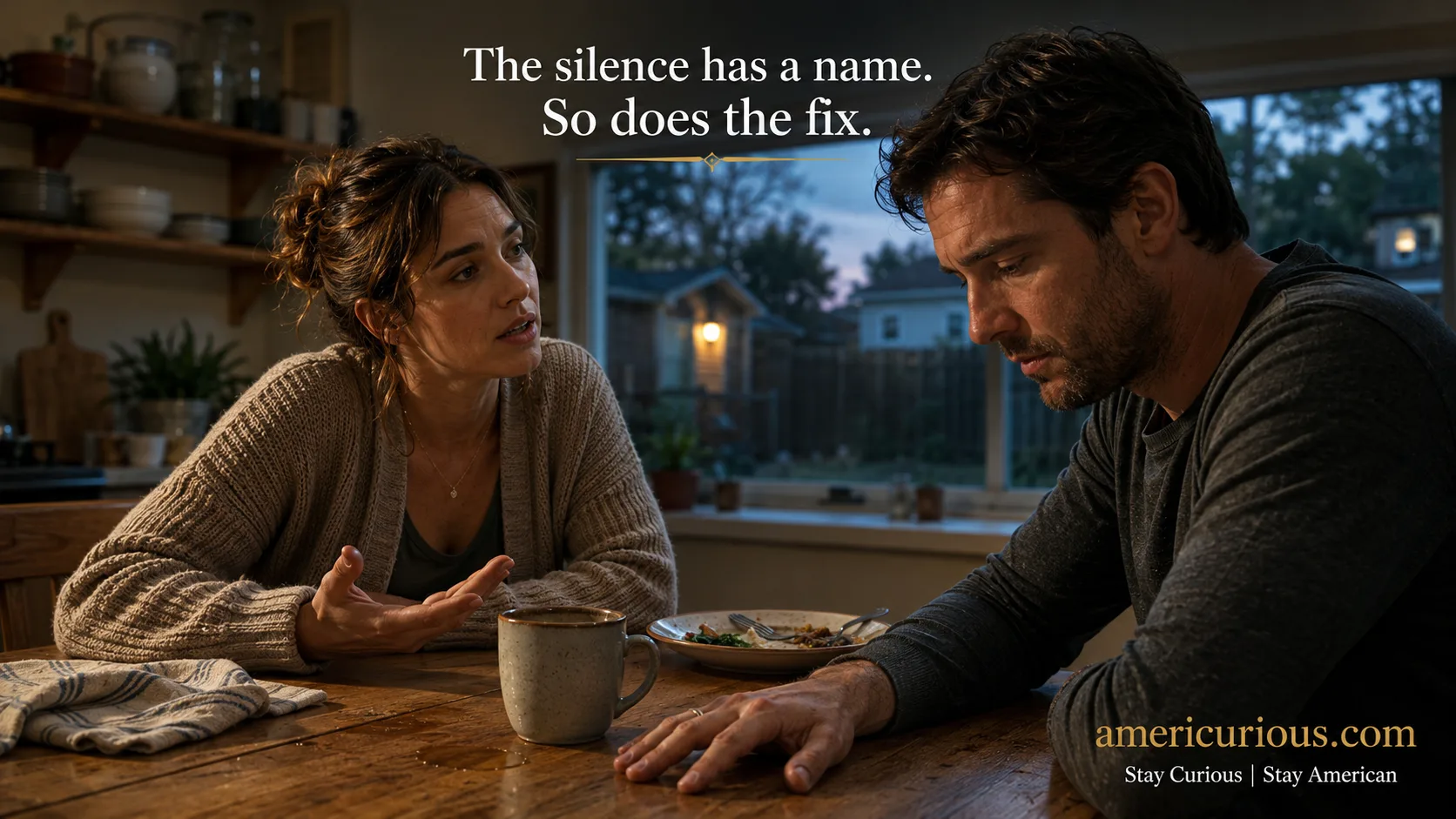
Your spouse gets defensive, then silent, every time you raise a concern about their kids. Here’s the real cause and the two-sided fix that works.
Quick Answer
“Ghost defensiveness” isn’t a clinical term — it’s a plain-language name for something very real: your spouse gets defensive about a comment involving their kid, then goes quiet, and you’re left arguing with a wall. The clinical version of this is well documented — it’s defensiveness followed by stonewalling, two of the four communication patterns researcher John Gottman found most predictive of divorce. In second marriages, it’s usually fueled by a guilt they’ve never said out loud: the fear that admitting their kid has a problem means admitting the divorce hurt them. The fix isn’t “communicate more.” It’s a specific two-sided move — one for the person raising the concern, one for the person shutting down.
How “Ghost Defensiveness” Ruins Second Marriages
The Night You Stopped Bringing It Up
You’d been quiet about it for a week. Then you finally said it, gently: something’s off with how his son talks to you when he thinks no one’s listening.
He didn’t yell. He didn’t get curious. His jaw just tightened, and he said something about how you don’t understand what the divorce did to that kid, and could you maybe cut him some slack for once.
And then he went quiet. Not stomping-out quiet. Just… gone. One-word answers for the rest of the night. You tried again the next morning; same wall.
Here’s the catch: you didn’t imagine that wall. And you’re not the problem for noticing it.
You’re Not Imagining the Wall — It Has a Name
What you just lived through has a name in relationship research, even if nobody in your house is calling it that. Psychologist John Gottman spent decades recording real couples in conflict and found four communication patterns that predicted divorce with startling reliability. Two of them are exactly what happened at your kitchen table: defensiveness — meeting a concern with counter-blame instead of ownership — and stonewalling, the total withdrawal that follows when defensiveness doesn’t make the conversation stop.
They tend to travel together. Defensiveness comes first — a real or perceived accusation gets met with “well, you do this too” instead of “tell me more.” When that doesn’t shut the conversation down, stonewalling finishes the job.
Why Defensiveness Almost Always Comes From Guilt, Not Ego
Here’s the part that gets left out of most stepfamily advice: that defensiveness is rarely about you being wrong. It’s much more often about a fear he can’t say out loud — that if he admits his kid is struggling, he’s admitting the divorce did damage, and that’s his fault to carry.
This shows up often enough in divorced and remarried parents that researchers and family therapists have a name for it — sometimes called “Disneyland parent” syndrome, and it isn’t a dad-only thing or a mom-only thing. It’s what happens when guilt about the divorce turns into over-permissiveness with the kid, and turns into defensiveness the second that permissiveness gets questioned. He’s not defending his son. He’s defending the last thing keeping his guilt at bay.
That doesn’t make the behavior okay. It does make it something other than “he just doesn’t care what I think.”
Why “Just Communicate More” Never Worked
You’ve probably already tried the obvious fix. More gentle timing. More journaling before you bring things up. More waiting for the “right moment.” None of it sticks, and here’s why: generic communication advice assumes the problem is that you’re saying it wrong. The actual problem is what happens after you say it — the specific defensiveness-then-stonewalling sequence — and that sequence has its own, different fix than “communicate more” ever offered you.
What’s Actually Happening When He Goes Quiet
Walk through the sequence once, plainly, because naming it drains some of its power. You raise something real. He hears it as an attack on his parenting, or worse, on his relationship with a kid he already feels guilty about. He gets defensive — counter-blaming, minimizing, changing the subject to something you did. When that doesn’t make you drop it, his nervous system does the rest of the work for him: he shuts down, goes flat, stops engaging. Not because he’s punishing you. Because he’s flooded, and shutting down is what a flooded nervous system does.
None of that makes the silence okay to live inside of. It does mean the fix isn’t “try harder to get through to him mid-fight.” The fix happens on both ends, and mostly outside the fight itself.
The Two-Sided Fix (Because This Isn’t a One-Person Problem)
This isn’t a you-problem to solve alone, and it isn’t a him-problem you can fix by being patient enough. It’s a two-person pattern, so the fix has two sides.
If You’re the One Raising Concerns
Name the fear before you say the thing. Before your next conversation, take ten seconds and guess at what he’s actually afraid of — probably some version of “this means I failed my kid.” You’re not saying this out loud yet. You’re just changing what you’re walking into the room believing about him. That sounds like almost nothing. It isn’t — it’s the difference between walking in ready to prosecute and walking in ready to talk to someone who’s scared, and it changes your tone before you say a word.
Swap the opener, not the whole speech. Take whatever you were planning to say and rewrite the first sentence as a specific “I feel” statement instead of a verdict about him or his kid. Not “your son is disrespectful” — try “I feel dismissed when he talks to me that way, and I want us on the same page.” Research on how conflicts start backs this up plainly: 90% of the time, the way a conversation starts determines how it will end. This will feel like you’re softening a completely valid concern. You’re not. You’re just giving it a chance to land. Kirsten Siewert M.A.
If You’re the One Who Shuts Down
Practice the small sentence somewhere low-stakes, first. Pick a minor, unrelated disagreement this week — not the loaded one — and practice one sentence of partial ownership out loud: “You’re right, I could’ve handled that better.” Accepting responsibility for even part of a conflict, without accepting all the blame, is the actual antidote to defensiveness — but it’s a skill, and the stepkid conversation is the wrong place to try it for the first time. The Gottman Institute
Agree on a pause signal before you need one. In a calm moment — not during a fight — agree on one small phrase either of you can use to call a break, like “I need ten minutes,” with an explicit promise to come back. This matters because the antidote to stonewalling isn’t willpower in the moment; it’s a plan made in advance for what to do when your body wants to disappear.
When It’s Bigger Than a Bad Habit
None of this is a substitute for professional support, and it isn’t meant to be. If the stonewalling doesn’t budge even after you’ve both tried these steps, or if what’s happening in your house involves contempt — mockery, eye-rolling, real disrespect, not just withdrawal — or if you ever feel unsafe, that’s a signal to bring in a licensed couples therapist rather than keep troubleshooting it yourselves. That’s not failure. That’s the actual next right step, and for a lot of couples it’s the step that makes everything above work.
Frequently Asked Questions
What is “ghost defensiveness”?
It’s a plain-language name — not a clinical term — for the pattern where a partner responds to a concern with defensiveness and then withdraws into silence, functionally “ghosting” the conversation while still in the room. The underlying mechanism is documented: Gottman’s defensiveness and stonewalling patterns.
Is it true that most second marriages end in divorce?
Not as cleanly as the internet claims. The widely repeated “60%” and “73%” figures for second and third marriages lack a clear, current primary source. The most defensible government figure comes from a 1995 national survey: second marriages had roughly a 23% chance of ending in separation or divorce within 5 years, and 39% within 10 — dated data, but real data, unlike the round numbers everyone else is quoting.
Do stepchildren really increase divorce risk?
Directionally, yes — blended-family conflict over parenting is widely documented as a real strain on second marriages. A specific percentage split isn’t reliably sourced, so treat any single stat you see quoted with real skepticism.
Is defensiveness the same as standing up for yourself?
No. Standing up for yourself addresses the actual point being raised. Defensiveness counter-blames or plays victim instead of engaging with it — that’s the distinction worth noticing in yourself.
When should we see a couples therapist instead of trying this ourselves?
If stonewalling persists after both of you have genuinely tried these steps, or if contempt is present, or if you feel unsafe in any way — bring in a licensed professional. This article is general relationship education, not a substitute for that.
Methodology & Trust
This piece draws on the Gottman Institute’s published research on defensiveness and stonewalling, CDC/National Survey of Family Growth data on second-marriage duration, and current (2026) divorce-statistics analysis specifically examining the reliability of commonly cited remarriage divorce figures.
Confidence tags: verified across current, authoritative sources; the stepchildren-specific divorce percentage some sites cite was checked and could not be verified to a primary source, so it was left out rather than repeated.
This is general relationship education, not therapy, diagnosis, or a substitute for licensed care — if what’s described here matches a persistent pattern in your relationship, a licensed couples therapist is the right next step.
Conflict of interest disclosure:
AmeriCurious has no financial relationship with any couples-therapy provider, relationship coach, or organization mentioned or implied here. If affording that professional help is part of what’s stopping you, that’s a real and separate barrier worth addressing on its own.