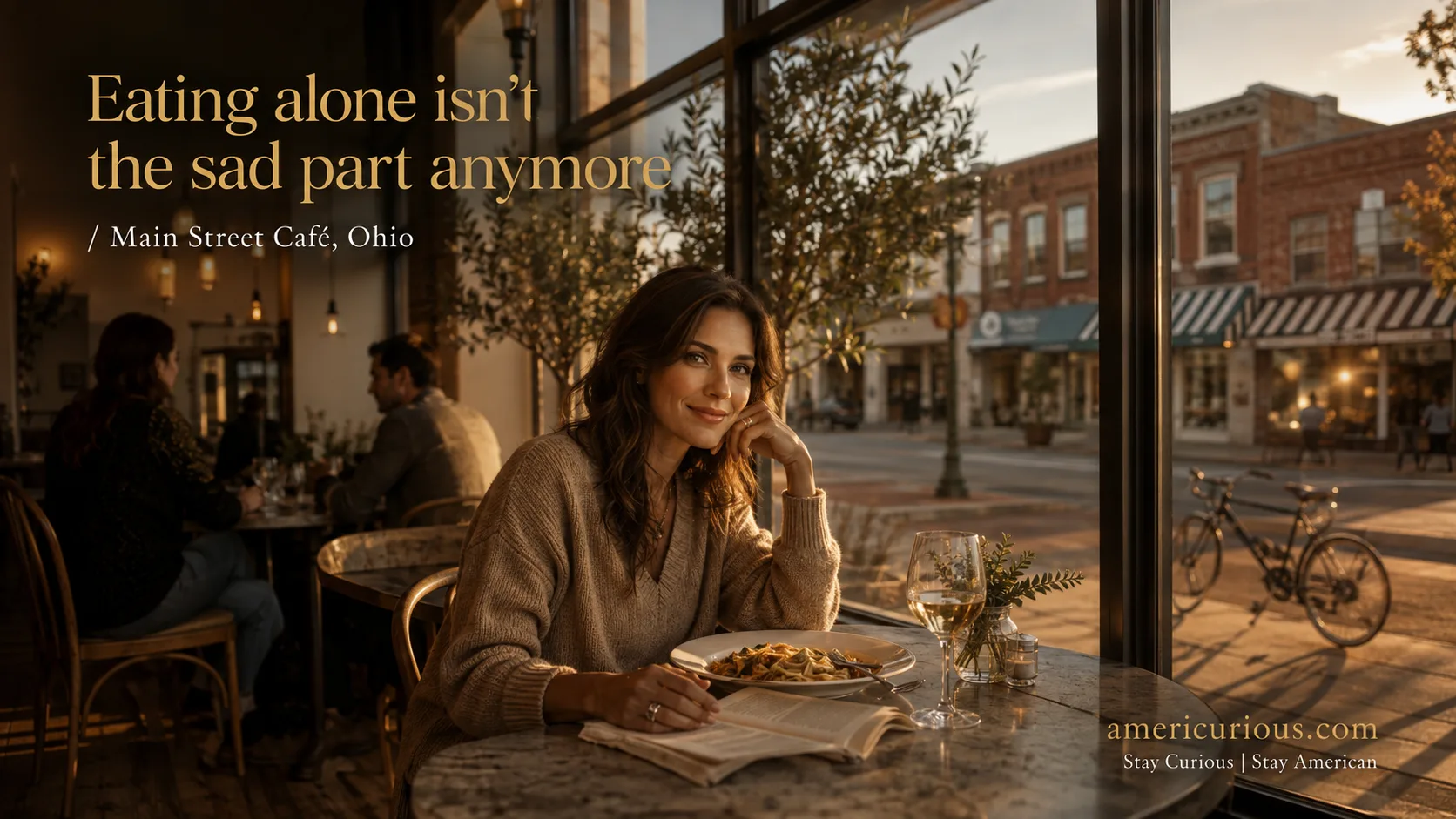
Solo dining is surging across U.S. restaurants. Explore the verified data behind this dining trend, why Americans now eat alone by choice, and read more.
Quick Answer
As of August 2026, solo dining in the United States is climbing sharply: quick-service orders for one now make up roughly 47% of visits, up from 31% just four years ago, while full-service reservations for one have jumped over 20% year-over-year. The shift isn’t primarily about loneliness or tight budgets — data and industry surveys point to something closer to a cultural reclassification of “alone” from sad to strategic.
There was a time — not that long ago, if you ask the diner booths that have seen it all — when a table set for one came with an apology built in. A hostess would ask, gently, “Just you tonight?” and something in the tone suggested she already felt bad for you. That tone is disappearing fast, and the data backs it up.
What’s Actually Happening
The numbers arrived from several directions this year, which is usually the first sign a trend has legs rather than a single press release behind it. Yum Brands — the corporate parent of Taco Bell, KFC, and Pizza Hut — reported in its 2026 Food Trends Report that solo orders now account for about 47% of quick-service visits, up from 31% in 2021, a rise the company put at 52% over that stretch. Restaurant software company Toast separately clocked single-diner reservations at full-service restaurants up 22% year-over-year in the third quarter, even though solo bookings still represent under 1% of total reservations. And in a late-July column, a Bloomberg Opinion writer cited OpenTable data showing solo dining in U.S. restaurants rose 23% from 2025 to 2026.
None of these are the same survey measuring the same thing the same way — a useful reminder to treat any single number as a data point, not gospel. But three independent sources pointing the same direction, in the same year, is worth taking seriously.
What’s notable is who’s doing it and why they say they’re doing it. A TouchBistro survey found about 1 in 5 U.S. consumers regularly dine solo, with nearly half of Gen Z and just under half of millennials doing so at least once a week. And when Yum Brands’ own researchers asked people why, the answer wasn’t “I have no one to eat with.” It skewed toward the opposite: control. As the company’s chief marketing officer put it to Axios, food has become one of the easiest places to get that back in an unpredictable world. Roughly a quarter of solo diners said they were out chasing a specific craving, not hunting for a deal — and more than half were spending $10 to $30 or more per visit, which isn’t the profile of someone pinching pennies alone in a booth.
🚗 Ever wonder why a stranger’s two fingers off the wheel means so much on a country road? Read the story behind the rural wave →
The “Why Now”: Control Dressed Up as Company
Here’s the catch — this isn’t really a story about restaurants. It’s a story about what a restaurant table has come to represent.

For most of American dining history, a table for one signaled absence: the business traveler between meetings, the recently divorced, the person who couldn’t get anyone else to come. Solo dining carried a faint whiff of failure. What’s shifted is the meaning attached to being alone in public. A psychiatrist quoted in coverage of the trend noted that the stigma around eating by yourself is fading — alone time is being recast not as a deficit but as a deliberate choice, one more lever people can pull to manage a chaotic day.
That reframing didn’t happen in a vacuum. It’s landing at a moment when a lot of the things Americans used to count on for stability — job security, housing costs, the shared civic rituals that structured a week — feel less dependable than they used to. In practice, when people can’t control the bigger picture, they tend to tighten their grip on the smaller one: what they eat, when they eat it, and whether anyone else’s preferences get a vote. A solo meal is one of the last decisions in a day that nobody else gets to weigh in on. That’s not loneliness. That’s a stress valve.
Restaurants have noticed and are re-engineering around it — single-portion plates, faster ordering flows, seating designed to flex between a party of one and a party of six without either feeling like an afterthought. That’s not incidental; it’s operators following the money to where the covers are.
The Deeper Pattern: America’s Long Argument With Itself Over Togetherness
That sounds simple — but it isn’t, because this isn’t the first time Americans have had this exact argument, just with different props.
A pattern you’ll notice if you zoom out: American culture runs on a permanent tension between two competing instincts — the pioneer’s self-reliance and the town square’s need for company. Political scientist Robert Putnam spent an entire book, “Bowling Alone,” documenting a late-20th-century version of this — bowling leagues and civic clubs emptying out as Americans increasingly did things solo, a shift he warned was quietly draining the country’s stock of trust and mutual obligation. That book landed in 2000, decades before a smartphone made solo anything frictionless, and the debate it kicked off — is doing things alone corrosive, or just a different, less rigid way of being social — never really resolved.
🗺️ America has a Paris, Texas and a Paris, Kentucky — turns out that’s no accident. Get the full copycat-town story →
The solo-dining moment is a mild-mannered rerun of that same argument, with a Pizza Hut app instead of a bowling league. One camp reads it as evidence people are more isolated than ever, retreating from shared tables the way earlier generations retreated from shared civic life — a legitimate worry, given how much research ties frequent social connection to long-term wellbeing. The other camp reads it as the opposite: not isolation, but liberation from obligatory togetherness that was never really about connection so much as convention. Both readings can be true for different people at the same table for one.
What consistently works, historically, is that Americans don’t actually resolve this tension so much as keep renegotiating its terms. The dinner table cleared out a bit for solo diners this decade the same way it made room for TV trays in the 1950s and drive-through lanes in the ’70s — each time reshaping togetherness rather than eliminating it. Group dining, notably, is up too, not down — it’s just gotten more deliberate, planned rather than default. That’s the real signal underneath the trend: Americans aren’t quitting connection. They’re getting pickier about when it’s worth showing up for.
The next time a hostess asks “just you tonight?” — don’t expect the apologetic tone. Increasingly, the honest answer back might just be: yes, and on purpose.