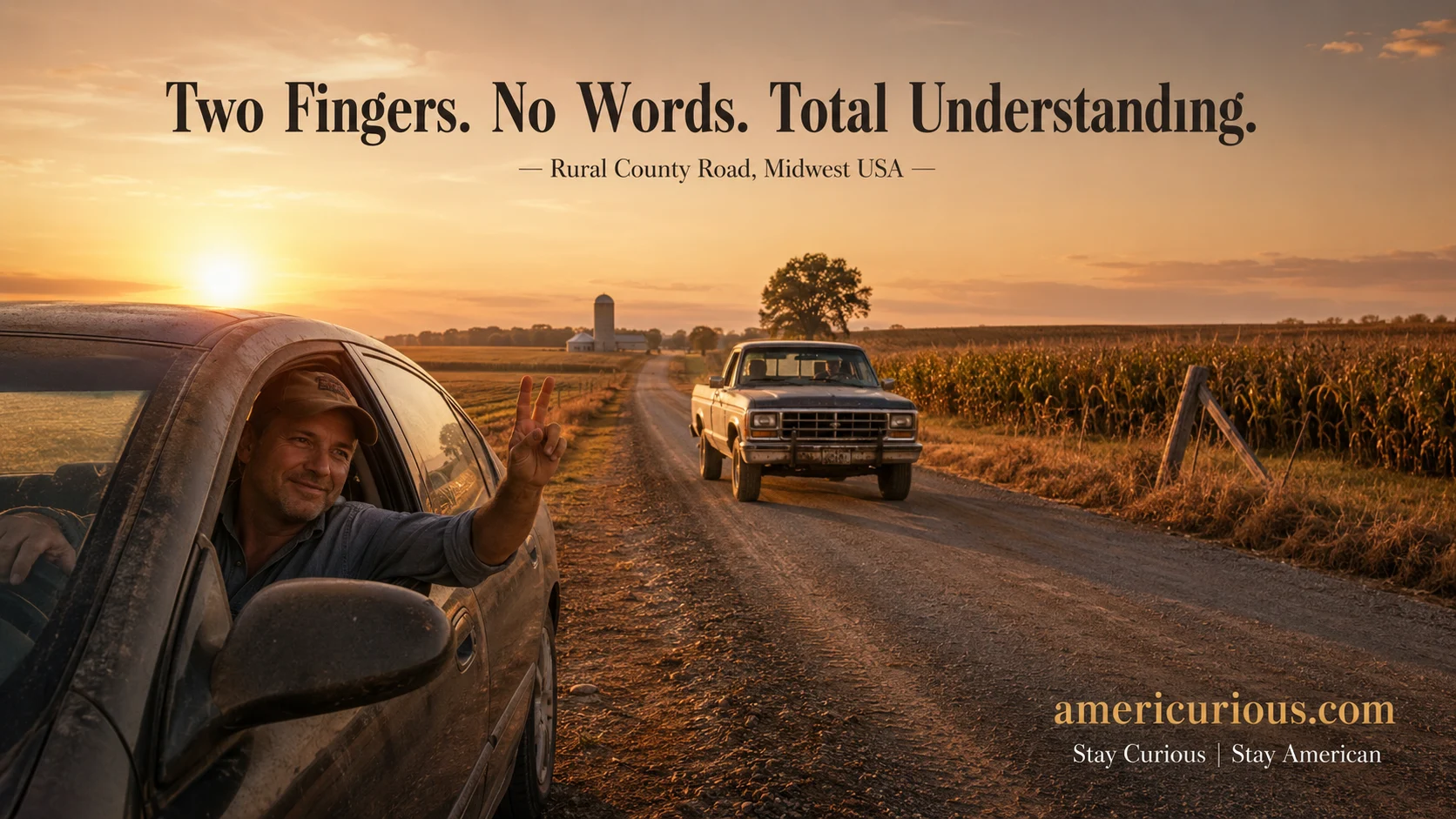
The rural wave is a small road gesture with real history and meaning. Discover why strangers still greet each other on quiet country roads today.
Quick answer:
The rural “steering-wheel wave” — a raised finger, two fingers, or a full palm lifted off the wheel as vehicles pass on a country road — is a low-effort, low-population-density form of social bonding. It likely descended from horseback-era greetings and grew into a driving custom because sparsely populated roads made every passing car worth acknowledging. It persists today as a quiet signal of shared territory, trust, and belonging that costs nothing and means more than it looks like it should.
Why Strangers Wave at Each Other on Empty Country Roads
You’re fifteen miles from the nearest gas station, windows down, gravel dust curling behind your tires, and a truck appears going the other way. You’ve never seen this person before and never will again. And yet, as you pass, one or two fingers lift off the wheel. You lift yours back. Neither of you slows down. Neither of you says a word. The whole exchange takes less than a second, and somehow it still feels like something happened.
That’s the rural wave — sometimes called the farmer wave, the hi sign, the trucker’s wave, or, if you’re in Texas, the “Texas two-finger.” It’s one of the most consistent unspoken rules in American driving, and almost nobody who does it could explain why they started.
Where did this even come from?
Nobody can point to a single inventor, and that’s part of what makes it interesting — it wasn’t designed, it evolved. The most persuasive explanation, one that’s circulated through Texas Monthly and regional papers for decades, treats it as an adaptation of an older courtesy: travelers on horseback or on foot lifted a whole hand to greet whoever they crossed paths with. Once everyone moved to cars, keeping both hands on the wheel made a full hand-raise impractical, so the gesture shrank. A finger or two lifting briefly off the wheel became the compressed, road-safe version of the same idea.
The Jeep-specific version of this tradition — the “Jeep wave,” where Wrangler owners flash fingers at other Jeeps — has its own separate folklore, often traced to World War II GIs recognizing a shared vehicle and, by extension, a shared experience. That one is about brand and camaraderie among strangers who own the same machine. The rural wave is broader and older: it’s not about what you’re driving. It’s about where you both happen to be.

Geographically, it shows up wherever population thins out — the rural Midwest, the Mountain West, the back roads of the South. Iowa has leaned into it hardest: in 2014, a local radio host’s campaign led Governor Terry Branstad to officially proclaim a statewide “Farmer Wave Week,” complete with the governor demonstrating his own one-finger technique for reporters. That’s a strange amount of state-level ceremony for something so small, and that’s exactly the point — the wave means enough to people that it earned a governor’s signature.
So why do people actually do it?
Here’s the part that’s easy to miss: the wave isn’t really about friendliness in the abstract. It’s about math. On a rural road, you might pass three or four cars an hour. In that context, another vehicle isn’t background noise — it’s an event. Acknowledging it costs you nothing and confirms something quietly important: I see you, you’re not a threat, we’re sharing this space. On a crowded interstate or a city street, that same acknowledgment would be exhausting and meaningless, because there’s no scarcity to make it matter. Familiarity through scarcity is the engine here — the fewer people you encounter, the more each encounter is worth registering.
There’s also a subtler social contract at work. Research on trust between strangers has found that people extend goodwill toward people they’ll likely never interact with again not because they expect anything back, but because of an internalized sense that respect is simply owed, regardless of the odds of reciprocity. The rural wave is that idea distilled into a single motion: a tiny act of respect toward someone whose name you’ll never know, offered because withholding it would feel like a small failure of manners, not because you’re angling for anything.
Interestingly, the “more rural, more helpful” story usually attached to small towns doesn’t hold up as cleanly as people assume. Broader studies on prosocial behavior toward strangers have found that a community’s general willingness to help isn’t reliably predicted by how rural or dense it is — other factors, like a community’s relative economic stability, tend to matter more. That complicates the tidy “small towns are just nicer” explanation. The wave might have less to do with rural people being inherently warmer and more to do with rural roads creating conditions — low traffic, high visibility, long sightlines — where a tiny gesture of goodwill is cheap to give and easy to notice.
The part nobody talks about: the wave has rules
What’s genuinely underexplored is how much unspoken etiquette governs a gesture that supposedly requires none. Locals can tell within a beat whether a wave was reciprocated with the right energy — a full, enthusiastic hand lift from someone driving a rental car with out-of-state plates reads as slightly performative, almost like a tourist trying on a local accent. The restrained, two-finger version — barely a flick, eyes forward, no big smile — reads as fluent. It’s a gesture with a dialect. Overdo it and you signal that you’re new here; underdo it and you might come across as rude; get it exactly right, low-key and automatic, and you signal that you belong on that road, even if you’re a stranger to everyone on it.
That’s the real trick behind the tradition: it’s a system for signaling insider status without saying a word, and it works precisely because almost nobody consciously registers they’re being evaluated. You either wave like you’ve done it your whole life, or you don’t.
The takeaway
The rural wave survives not because rural America is uniquely kind, but because rural roads create a rare situation: enough scarcity to make a stranger notice you, and enough safety to make a tiny gesture toward them costless. Next time you’re out on a two-lane road far from anywhere and a truck passes going the other direction, try it — one or two fingers, no big production. You’ll probably get one back. And for a second, two strangers who’ll never meet again will have quietly agreed on something: we’re both out here, and that’s worth a nod.