
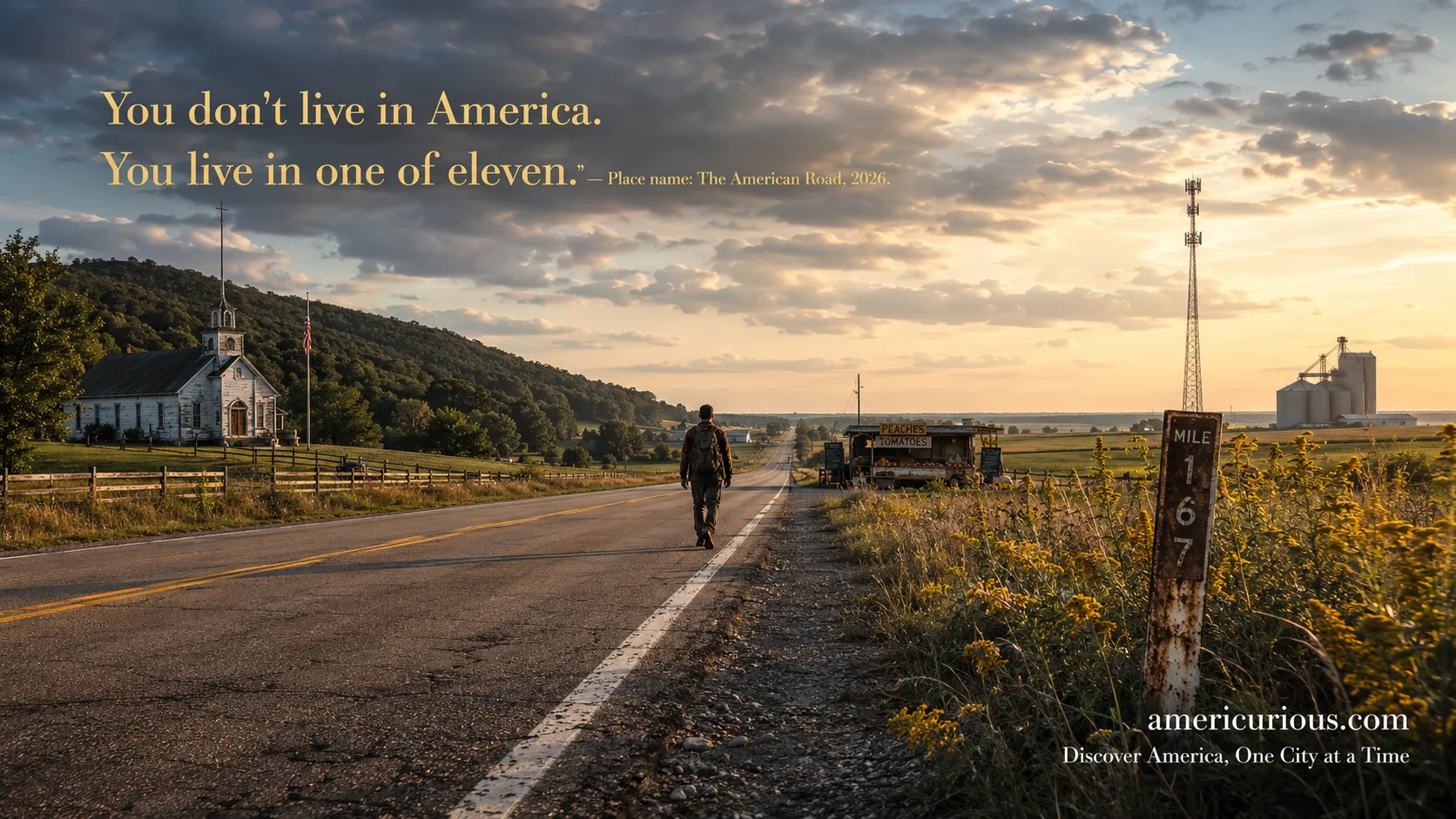
Forget red vs. blue. America is really made up of 11 distinct regional cultures — each with its own history, food, values, and identity. Here’s the map nobody taught you.
You’ve heard it your whole life: “We’re all Americans.” And sure, in a passport-and-anthem sense, that’s true. But spend a week in rural Appalachia after a month in San Francisco, or drive from coastal Mississippi to coastal Maine, and you’ll feel it in your bones — something is fundamentally different. The food tastes different. People talk differently. What counts as polite, what counts as ambitious, what counts as a good life — all of it shifts.
That feeling isn’t your imagination. It’s geography doing what it’s always done: shaping people.
The real America isn’t one nation. It’s eleven — and knowing which one you’re in changes everything.
🗺️ Why “One America” Is a Myth (And Why That’s Beautiful) {#why-one-america-is-a-myth}
The Data: How Regional Identity Shapes Politics, Food, and Values
Most political maps slice America into 50 states. Most cultural commentators divide it into “coastal elites” vs. the “heartland.” Both frameworks miss the point almost entirely.
The better map is older than the states themselves. It’s drawn from the actual founding populations — who settled where, what they believed, what they built, and how those values calcified over generations. According to award-winning journalist and historian Colin Woodard, North America is made up of eleven distinct nations, each defined by a shared culture established by each nation’s founding population.
This isn’t abstract academic theory. Regional identity shapes which policies get enacted, which foods become local institutions, which values parents pass to children, and even which personality traits cluster in which zip codes. A 2024 special issue in Current Research in Ecological and Social Psychology confirmed that regional cultural differences produce measurable, real-world consequences in behavior, attitudes, and wellbeing — not just in how people vote, but in how they live.
In short: Where you’re from isn’t just a detail on your dating profile. It’s a lens through which you see everything.
The “American Nations” Framework: 11 Cultures, One Country
The definitive guide to this idea is Colin Woodard’s American Nations: A History of the Eleven Rival Regional Cultures of North America (Viking, 2011), a Wall Street Journal bestseller named a Best Book of 2011 by The New Republic and winner of the 2012 Maine Literary Award for Non-Fiction.
Woodard’s argument is deceptively simple: forget state lines. The cultural DNA of any region was set by whoever arrived first and in greatest numbers, and that DNA persists for centuries. A Scots-Irish backcountry settler’s great-great-great-grandchildren in eastern Tennessee still hold a recognizable cultural inheritance distinct from the descendants of Dutch merchant families in Manhattan — or Puritan communalists in Massachusetts.
Woodard’s newest book, Nations Apart: How Clashing Regional Cultures Shattered America, published by Viking Press in November 2025, updates and extends this framework for the fractures we’re living through today.
The eleven nations Woodard identifies aren’t just curiosities for history buffs. They map almost perfectly onto modern voting patterns, social trust levels, educational attainment gaps, religiosity data, and foodways research. Once you see the map, you can’t unsee it.
Why Understanding Regional Differences Makes You a Smarter Traveler, Voter, and Neighbor
Here’s the practical payoff. When you understand why a place is the way it is — not just that it’s different — three things happen.
First, you travel better. You stop being the tourist who’s confused or vaguely offended when locals don’t behave the way you expect. You start being the curious visitor who actually gets somewhere.
Second, you interpret the news better. The phrase “rural voters feel left behind” stops being a vague cliché and becomes a specific, traceable set of historical grievances rooted in real regional cultures.
Third — and this one’s underrated — you become a better neighbor. America’s deepest divisions aren’t really between “us” and “them.” They’re between people who’ve never had a framework for understanding each other’s starting point. This guide is that framework.
📌 TL;DR: America’s cultural map has 11 regions, not 2. Each was shaped by a distinct founding population, and each still operates by a recognizable set of values. Understanding them makes you a sharper thinker and a more empathetic human.
🧭 The 11 Regional Cultures Decoded (With Local Intel) {#the-11-regional-cultures-decoded}
What follows isn’t a simple stereotype roundup — it’s a working guide to each culture’s core values, founding history, food identity, and on-the-ground personality. Think of it as briefing notes before you cross into new territory.
1. Yankeedom: New England’s Legacy of Education & Community
Core geography: Maine, Vermont, New Hampshire, Massachusetts, Connecticut, Rhode Island — plus much of upstate New York, northern Pennsylvania, Michigan’s Upper Peninsula, and the northern tier through Wisconsin and Minnesota.
Founding DNA: Puritan Congregationalists from East Anglia, arriving in the 1620s. They weren’t running from government — they were trying to build a godly, educated, community-centered utopia. That impulse toward collective improvement never went away.
Values: High investment in public education, civic participation, distrust of concentrated individual power, and a deep belief that government can — when run correctly — be a force for good.
✅ Best for: History buffs, fall foliage pilgrims, anyone who wants walkable towns with a library on every corner, and people who take their lobster roll very seriously.
❌ Avoid if: You want sprawling suburbs, cheap land, or to leave a conversation without being asked your opinion on three municipal referenda.
🍽️ Must-try: Clam chowder (the real cream-based kind, not Manhattan’s tomato imitation), Maine lobster rolls (butter, not mayo — fight me), Vermont maple syrup straight on snow, whoopie pies in any diner in western Massachusetts.
💬 Local phrase: “Wicked good” (Massachusetts), “Bang a U-ie” (New Hampshire, meaning a U-turn), “Ayuh” (Maine’s all-purpose affirmative).
🌐 Local intel: Don’t mistake Yankee reserve for unfriendliness. This is a culture where showing up repeatedly earns trust. The neighbor who barely waves in October will be plowing your driveway in January.
2. New Netherland: The Cosmopolitan Corridor (NYC to Philadelphia)
Core geography: New York City metro, northern New Jersey, and the Philadelphia region.
Founding DNA: Dutch merchants of the West India Company settled Manhattan (then Nieuw Amsterdam) in the 1620s as a deliberately pluralistic trading post. From day one, it was designed to make money — not convert souls, not establish a godly community, just trade. Profit required tolerance, so tolerance became the default setting.
Values: Commerce, cosmopolitanism, cultural plurality, ambition, density. This is the culture most comfortable with the idea that people of radically different backgrounds can coexist peacefully as long as business is good.
✅ Best for: People who want access to everything, love anonymity in a crowd, thrive on intensity, and define “enough money” as “slightly more than you have now.”
❌ Avoid if: You crave open space, slow-paced interactions, or houses that cost less than a spacecraft.
🍽️ Must-try: A proper New York slice (fold it, eat it walking), a Philly cheesesteak (Amoroso roll, Cheez Whiz if you’re brave), bagels with lox so fresh it changes your relationship with salmon.
💬 Local phrase: “Forget about it” (means six different things depending on inflection), “the city” (always New York, even if you’re in New Jersey), “jawn” (Philadelphia’s singular all-purpose noun).
3. The Midlands: America’s Quiet Heartland
Core geography: Central Pennsylvania through Ohio, Indiana, central Illinois, Iowa, and into parts of Nebraska and Kansas.
Founding DNA: Quakers, Germans, and other religious minorities who wanted to be left alone. William Penn’s “holy experiment” in tolerance attracted settlers who valued moderation, community harmony, and skepticism of ideological extremes.
Values: Live-and-let-live pragmatism, suspicion of zealotry from any direction, strong family and community ties, and a profound preference for keeping the peace over winning arguments.
✅ Best for: Families seeking affordable stability, people who want a genuinely good quality of life without the performance of it, and anyone who believes “fair and decent” is actually a complete life philosophy.
❌ Avoid if: You need to be near an ocean, an airport with international flights, or a restaurant serving interesting food past 9pm.
🍽️ Must-try: Amish whoopie pies (yes, again — they originated here, not in Maine), Cincinnati chili (on spaghetti, with cheese, no arguments), Indiana sugar cream pie, and any church potluck you can wangle an invitation to.
💬 Local phrase: “That’s not too bad” (means excellent), “Oh, for cute!” (Midwest Minnesota/Iowa expression of delight), “Ope!” (the universal Midwestern sound of minor surprise or apology).
4. Tidewater: Coastal Tradition & Southern Gentility
Core geography: Coastal Virginia and Maryland, lowland North Carolina, and Delaware.
Founding DNA: English aristocratic cavaliers who arrived in Virginia in the mid-1600s, deliberately modeling a hierarchical, manor-based society on the English landed gentry. They brought enslaved Africans to work their tobacco plantations and built a culture around deference, honor, and a very specific code of “good breeding.”
Values: Tradition, manners, hierarchical social structures (even when the explicit hierarchy is gone), reverence for ancestry, and a gentleness of manner that can be disarming to outsiders.
✅ Best for: History lovers, people who believe politeness is a genuine virtue, and anyone fascinated by the architectural legacy of early America.
❌ Avoid if: You’re not interested in navigating a culture where “how are you?” is a genuine social ritual rather than a passing greeting.
🍽️ Must-try: She-crab soup (Charleston and coastal Virginia), Virginia ham (dry-cured, salty, life-altering), blue crabs from the Chesapeake (steamed with Old Bay, eaten outside on paper tablecloths), and Maryland beaten biscuits.
💬 Local phrase: “Bless your heart” (the full semantic range of this phrase requires its own guide), “Carry me to the store” (meaning take me, not lift me).
5. Greater Appalachia: Independence, Faith, and Folkways
Core geography: Stretching from southwestern Pennsylvania and West Virginia through Kentucky, Tennessee, the Ozarks, into parts of Texas and the western Carolinas.
Founding DNA: Scots-Irish borderlanders — people from the violent, stateless borderlands of northern England and the Scottish lowlands who arrived in the 18th century. They had good reason to distrust central authority: every government they’d ever known had been either exploitative or absent. They were fierce, egalitarian within their communities, intensely loyal to family and clan, and deeply suspicious of outsiders.
Values: Personal liberty (and a hair-trigger about anything that infringes on it), deep family and community loyalty, evangelical faith, oral tradition, and a pride that sometimes shades into stubbornness.
✅ Best for: Outdoor adventurers, people who value true self-reliance, music lovers (this is where American roots music — bluegrass, country, old-time — was born), and anyone drawn to a culture where your word is genuinely your bond.
❌ Avoid if: You expect fast economic mobility or you tend to see any form of pride in tradition as backwardness.
🍽️ Must-try: Pinto beans and cornbread, country ham and red-eye gravy, ramps (foraged wild onions, a spring ritual), stack cakes, and black-eyed peas on New Year’s Day (absolutely mandatory).
💬 Local phrase: “Fixin’ to” (about to do something), “might could” (possibly, as in “I might could help you with that”), “holler” (a small valley — also where a lot of people live).
6. The Deep South: Honor, Hospitality, and Heritage
Core geography: South Carolina lowcountry, Georgia, Alabama, Mississippi, and parts of Louisiana, Florida, and Texas.
Founding DNA: Wealthy English planters from Barbados who colonized South Carolina in the 1670s — they brought a fully formed plantation economy, complete with the explicit ideology that a small elite class should dominate a large enslaved majority. This was, from the start, the most hierarchical, honor-bound, and rigidly stratified of all the American cultures.
Values: Hospitality that’ll stun you, fierce community pride, religious faith woven into daily life, a complex and ongoing reckoning with a violent history, and a warmth of social connection that makes visitors feel like kin within hours.
✅ Best for: People who want to experience genuine Southern hospitality (it’s not a myth), lovers of American history in its most unvarnished form, and anyone whose soul is moved by gospel music.
❌ Avoid if: You’re not prepared for the weight and complexity of the region’s history, or for a summer humidity that feels genuinely malevolent.
🍽️ Must-try: Low Country boil, shrimp and grits (especially in the Charleston tradition), fried chicken that will restructure your understanding of the dish, banana pudding, and sweet tea — a beverage so culturally significant it has been called the table wine of the South.
💬 Local phrase: “Y’all” (plural you, essential), “All y’all” (emphatic plural), “I reckon” (I suppose/believe), “pitch a fit” (throw a tantrum).
7. New France: Cajun, Creole, and Cultural Fusion
Core geography: Southern Louisiana (especially the bayou parishes), Quebec, parts of New Brunswick, and pockets of northern Maine.
Founding DNA: French settlers who arrived with a fundamentally different relationship to the land and to Native peoples than their English counterparts. French colonial culture was more flexible about racial and cultural mixing — the result, especially in Louisiana, is a dazzling creolized culture that blends West African, Native American, Spanish, and French elements into something genuinely unique on earth.
Values: Joie de vivre, communal celebration, a deep spirituality (mostly Catholic), fierce attachment to cultural distinctiveness, and a culinary tradition so central to identity that cooking is essentially a form of cultural expression.
✅ Best for: Food lovers, music lovers, people who believe life should be a celebration wherever possible, and anyone ready to have their concept of “American culture” permanently expanded.
❌ Avoid if: You don’t eat seafood, can’t handle spice, or are uncomfortable with a pace of life that simply refuses to be rushed.
🍽️ Must-try: Crawfish étouffée, boudin (a pork-and-rice Cajun sausage), gumbo (a week-long argument about roux, okra, and filé powder), beignets at Café Du Monde at 2am, and King Cake during Mardi Gras season.
💬 Local phrase: “Laissez les bons temps rouler” (let the good times roll — the unofficial motto), “Lagniappe” (a little something extra, pronounced lan-yap), “Making groceries” (going food shopping).
8. El Norte: Borderlands Bilingualism & Innovation
Core geography: The U.S.-Mexico borderlands — southern Texas, New Mexico, Arizona, and Southern California — plus the cultural sphere reaching into northern Mexico.
Founding DNA: Spanish colonizers arrived in what is now New Mexico over a century before the Pilgrims landed at Plymouth. The borderlands that developed were never purely Spanish, or purely Indigenous, or later purely Mexican or American — they were always hybrid, always negotiated, always defined by movement across lines that kept shifting.
Values: Hard work, self-reliance, bilingualism as a practical asset, deep family loyalty, entrepreneurial hustle, and a bicultural identity that the modern political debate over “immigration” completely fails to capture.
✅ Best for: People who appreciate a culture that actually lives the “melting pot” ideal, food lovers, and anyone fascinated by a region that is simultaneously ancient and relentlessly forward-moving.
❌ Avoid if: You’re not comfortable in a place where cultural and linguistic context shifts fluidly and often.
🍽️ Must-try: New Mexico green chile (on everything — eggs, burgers, stew — non-negotiable), San Antonio puffy tacos, Tex-Mex breakfast burritos the size of a forearm, and tamales made from a family recipe that’s 80 years old and never written down.
💬 Local phrase: “Órale” (an all-purpose expression of affirmation, surprise, or let’s go), “No mames” (don’t mess with me), “the Valley” (the Rio Grande Valley — THE valley).
9. The Left Coast: Progressive Experimentation & Nature Worship
Core geography: The coastal strip from the Bay Area through Oregon and Washington, plus southeast Alaska.
Founding DNA: A fascinating collision: Yankee missionaries and educators who arrived in the 1840s and 50s brought New England’s communal improvement ethic, while the Gold Rush brought a wild, transient population that cared deeply about individual reinvention. The result was a culture that kept Yankeedom’s faith in collective improvement while adding a radical openness to new ideas and a near-spiritual relationship with the natural world.
Values: Environmental consciousness, individual authenticity, social progressivism, technological optimism, and a genuine belief that the world can be redesigned from first principles.
✅ Best for: Outdoor adventurers, tech workers, people who want to live inside a beautiful place that’s also trying very hard to become a better society, and anyone whose spiritual life is conducted mainly in old-growth forests.
❌ Avoid if: You’re not prepared for housing costs that defy basic economic logic, or for the peculiar social pressure to have very strong opinions about things like water footprints.
🍽️ Must-try: Mission-style burritos (San Francisco’s contribution to civilization), Dungeness crab (a Pacific Northwest fall ritual), fish tacos in the Baja-California style, sourdough bread, and any farmer’s market produce in July.
💬 Local phrase: “Hella” (Northern California intensifier, as in “hella good”), “on fleek” may have died nationally but vibes-based slang stays fresh here, “the 101” (always with the article for freeways).
10. The Far West: Rugged Individualism & Resource Wealth
Core geography: The Great Basin, Rocky Mountain states, eastern Oregon and Washington, and Alaska’s interior — essentially everything between the Left Coast and the Midlands/Appalachia.
Founding DNA: This region wasn’t settled so much as industrialized. Mining companies, railroad corporations, and federal land agencies drove the population in. The people who came were often escaping something, and they arrived in a landscape so vast and unforgiving that the only survival strategy was fierce self-reliance.
Values: Deep skepticism of federal authority (even though the federal government created most of these states), extractive resource economics, a cowboy mythology that is both genuine and heavily curated, and a libertarian streak that crosses party lines.
✅ Best for: People who genuinely need space — physical and psychological, outdoor recreationalists, and anyone whose concept of a good Saturday involves zero other humans.
❌ Avoid if: You need walkable neighborhoods, diverse food options, or dense cultural infrastructure.
🍽️ Must-try: Colorado green chile (different from New Mexico’s — don’t mix them up), Basque food in Boise (a legitimate surprise), Montana bison burger, Nevada Basque lamb stew, and whatever a ranch cook makes you for breakfast at 5am.
💬 Local phrase: “Back East” (anywhere east of the Rockies), “the Front Range” (Colorado’s eastern slope cities), “outside” (Alaskans use this to mean the Lower 48).
11. First Nation: Indigenous Sovereignty & Living Traditions
Core geography: Not a single continuous territory but sovereign tribal lands across the continent — from the Navajo Nation in the Southwest to the Haudenosaunee Confederacy in the Northeast, the Lakota territories of the Plains, the tribal nations of the Pacific Northwest, and hundreds more.
Founding DNA: These are not “nations” in Woodard’s framework the way the others are — they predate all of them by thousands of years. They are the original political cultures of the continent, and they are not relics. They are living, evolving, legally recognized sovereign entities, each with distinct languages, governance traditions, spiritual practices, and cultural identities.
Values: Sovereignty, reciprocity with the natural world, intergenerational responsibility, oral tradition as living scholarship, and a resilience that has survived centuries of deliberate destruction.
✅ Best for: Anyone serious about understanding what America actually is — not just the European colonial narrative, but the full, unabridged story of this continent.
❌ A note on tourism: Many tribal nations welcome visitors; many do not. Always verify what’s appropriate, and visit as a learner, not a consumer of spectacle.
🍽️ Must-try: Fry bread (complex cultural history, delicious reality), Navajo tacos, salmon prepared in the Pacific Northwest tradition, Three Sisters (corn, beans, squash) in any form, and wild rice harvested by Ojibwe communities in the Great Lakes region.
🌐 Local intel: The Native Land Digital map is the best tool available for understanding whose land you’re actually on, wherever you are in North America.
📌 TL;DR: Each of the 11 cultures has a distinct founding story, a core value set, and a food identity. They overlap, blend, and evolve — but the underlying DNA is remarkably persistent.
🧪 Your Regional Culture Quiz: Which “American Nation” Are You? {#your-regional-culture-quiz}
10-Question Assessment: Values, Food, Speech, Politics
Answer each question as honestly as you can. There are no wrong answers — only regions.
1. What’s your default response when a stranger asks for help?
- A. You help immediately and ask questions later.
- B. You help, but you want to know the situation first.
- C. You give directions and keep moving.
- D. You invite them in for coffee.
2. Pick the sentence that sounds most like you:
- A. “I could care less what other people think.”
- B. “We really should all try to get along.”
- C. “Rules are fine as long as they make sense.”
- D. “My family has done it this way for generations.”
3. What’s your honest relationship with the federal government?
- A. It’s too big and needs to stay out of my business.
- B. It’s a tool — useful when managed well.
- C. It’s the only thing keeping things fair.
- D. It’s distant and often doesn’t understand us.
4. What’s your ideal landscape?
- A. Mountains with nobody else on them.
- B. A small town with a good hardware store and a church.
- C. A dense city where everything is walkable.
- D. Flat farmland or coastal wetlands that your family has worked for decades.
5. What do you put on a hot dog?
- A. Whatever I want, it’s my hot dog.
- B. Mustard and relish, maybe sauerkraut.
- C. Chili and cheese (Cincinnati style, don’t @ me).
- D. It’s not a hot dog, it’s a sausage, and the distinction matters.
6. How do you feel about newcomers to your community?
- A. Wary until they prove themselves.
- B. Welcome, but they should learn the local way.
- C. The more the merrier — fresh perspectives are valuable.
- D. A little threatening, honestly.
7. Pick the value that matters most to you:
- A. Freedom.
- B. Community.
- C. Progress.
- D. Heritage.
8. What does “a good education” mean to you?
- A. Learning a skill that gets you a job.
- B. Learning to think critically and participate in society.
- C. Learning the history and traditions of your people.
- D. Getting out so you can come back and help.
9. What’s your weekend?
- A. Fishing, hunting, or working on land.
- B. A festival, a farmers market, or a neighborhood cookout.
- C. Hiking, surfing, or cycling followed by good food.
- D. Family — always, just, family.
10. What makes you proudest to be American?
- A. The individual freedom to build your own life.
- B. The civic tradition of self-government.
- C. The diversity and constant reinvention.
- D. The specific place and people you come from.
How to Score Yourself
Mostly A’s: You carry the spirit of Greater Appalachia or the Far West — fiercely independent, skeptical of authority, and deeply loyal to your own.
Mostly B’s: You’re a Midlander through and through — pragmatic, community-oriented, and genuinely committed to keeping the peace.
Mostly C’s: You’re Left Coast or Yankeedom — you believe institutions and collective action can make things better, and you’re willing to experiment.
Mostly D’s: You’re rooted in Tidewater, the Deep South, or New France — tradition matters, family matters, and place matters in a way that’s almost physical.
Mixed results? That’s actually the most accurate. Most Americans carry two or three regional identities — the place they grew up, the place they live now, and the place they secretly wish they were from.
🐦 Tweet this: “Turns out I’m 60% Yankeedom, 40% Left Coast. The regional cultures of America are more revealing than any personality test. [link] #Americurious”
🚫 The 3 Regional Stereotypes That Hold Us Back (And What’s True Instead) {#the-3-regional-stereotypes-that-hold-us-back}
Myth #1: “The South Is Monolithic”
The stereotype: “The South” is one big, homogeneous culture of sweet tea, country music, and conservative politics.
The reality: There are at least four distinct Southern cultures in Woodard’s framework — Tidewater, the Deep South, Greater Appalachia, and New France — and they are genuinely different from each other in history, food, politics, and values. A Cajun Catholic from Lafayette and a Scots-Irish Baptist from eastern Tennessee share a latitude, not a culture. New Orleans has more in common with Havana and Marseilles than it does with Montgomery. Asheville has more in common with Boulder than it does with Savannah.
Why it matters: Treating “the South” as monolithic makes regional policy worse, travel advice useless, and political analysis embarrassingly shallow. A good rule: if your analysis of “the South” could apply equally to Appalachian West Virginia and coastal Louisiana, your analysis isn’t specific enough.
Myth #2: “Coastal Elites vs. Heartland” Is a Real Divide
The stereotype: America is split between out-of-touch coastal cities and forgotten heartland communities, and these two sides can’t understand each other.
The reality: The “coastal elite” framing erases enormous internal diversity on both coasts (the Left Coast and New Netherland are radically different cultures, despite both touching salt water), and it romanticizes internal diversity in the “heartland” while simultaneously flattening it. There are struggling post-industrial cities in New England and thriving innovation hubs in the Midwest. There are deeply cosmopolitan pockets in Dallas and profoundly parochial subcultures in Brooklyn.
The more useful frame: It’s not coast vs. interior. It’s specific value systems — around individual liberty, collective welfare, tradition, and progress — that don’t map cleanly onto geography. They correlate with geography, but the correlations have exceptions everywhere, and the exceptions matter.
Myth #3: “Regional Differences Are Fading in the Internet Age”
The stereotype: With everyone consuming the same media, shopping at the same chains, and talking to each other on the same platforms, regional culture is disappearing into a bland national monoculture.
The reality: The data says the opposite. Residential sorting — people moving to places that match their values — has actually intensified regional cultural differences over the past 25 years. The Big Sort, as journalist Bill Bishop called it, has made deep-red counties redder and deep-blue counties bluer, made college-educated populations more geographically concentrated, and made cultural differences between regions more pronounced, not less.
Global food culture has also, counterintuitively, deepened regional food identity — regional food specificity is now a selling point, with the fastest-growing global dishes distinguished by their hyperlocal origin stories, like birria from Jalisco and aguachile from Sinaloa. American regional food is following the same logic: people want to know that their green chile is from Hatch, NM, not just “southwestern.”
Bottom line: Regional cultures aren’t fading. They’re evolving. And understanding that evolution is more interesting than mourning a homogenization that isn’t actually happening.
🐦 Tweet this: “The ‘coastal elites vs. heartland’ frame is too simple. America has 11 regional cultures — and knowing which one you’re in changes how you read everything. [link] #Americurious”
✅ Why Trust This Guide: E-E-A-T Authority Block {#why-trust-this-guide}
Author credentials: This guide was developed by the Americurious editorial team, with a research foundation in American cultural history, regional sociology, and U.S. foodways. Our writers have collectively spent time in all eleven cultural regions — not as tourists but as people who stayed long enough to understand the rhythms.
Primary sources used in this guide:
- Colin Woodard, American Nations (Viking, 2012) — foundational framework
- Colin Woodard, Nations Apart (Viking, November 2025)
- Ebert, Götz, Benet-Martínez & Rentfrow, Current Research in Ecological and Social Psychology, 2024 — peer-reviewed research on regional cultural differences
- Datassential, Global Flavors Report, February 2026 — food culture data
- Native Land Digital — Indigenous territory mapping
- Pew Research Center, National Pride Survey, 2025 — national identity data
Data transparency: All statistics cited link directly to primary sources. Where data is drawn from secondary analysis, the original study is also cited.
Last verified: May 23, 2026.
Correction policy: Found something outdated or inaccurate? Contact us and we’ll verify and update within 48 hours. This guide is a living document.
📝 Frequently Asked Questions
Q: Is the “11 American Nations” framework officially recognized?
In short: it’s a scholarly framework, not a government designation. Colin Woodard’s model is grounded in historical research and is widely referenced in political science, sociology, and journalism. It’s a lens for understanding cultural geography, not a legal or census category.
Q: Don’t these regions overlap? I feel like I belong to two or three.
Yes, they do — and that’s accurate. The boundaries Woodard draws are porous, and major cities often straddle cultural zones. Chicago, for example, sits at the intersection of the Midlands, Yankeedom, and a Deep South diaspora community. That’s why it works as a cultural capital: it genuinely contains multitudes.
Q: Does this framework account for recent immigration?
This is the most important challenge to the model. Woodard’s framework describes founding-population DNA — it doesn’t perfectly account for 20th- and 21st-century immigration, which has dramatically reshaped many regions, especially El Norte and New Netherland. The honest answer is that the framework is a useful starting point, not a complete picture. The U.S. is more dynamic and diverse than any single map can capture.
Q: What’s the most “average American” culture?
By almost every measure, the Midlands. It’s the most politically balanced, the most economically median, and the culture that shows up most in national advertising when brands want to appeal to “real America.” Whether that makes it aspirational or boring is, appropriately, a regional question.
Q: How do I find out which nation I actually live in?
The most detailed interactive maps based on Woodard’s work are available at colinwoodard.com. County-level breakdowns show where the cultural lines actually run — often through the middle of states you’d never expect.
🔄 This guide is composed with real-time research and updated sourcing. Last verified: May 23, 2026.
Discover more from AmeriCurious
Subscribe to get the latest posts sent to your email.