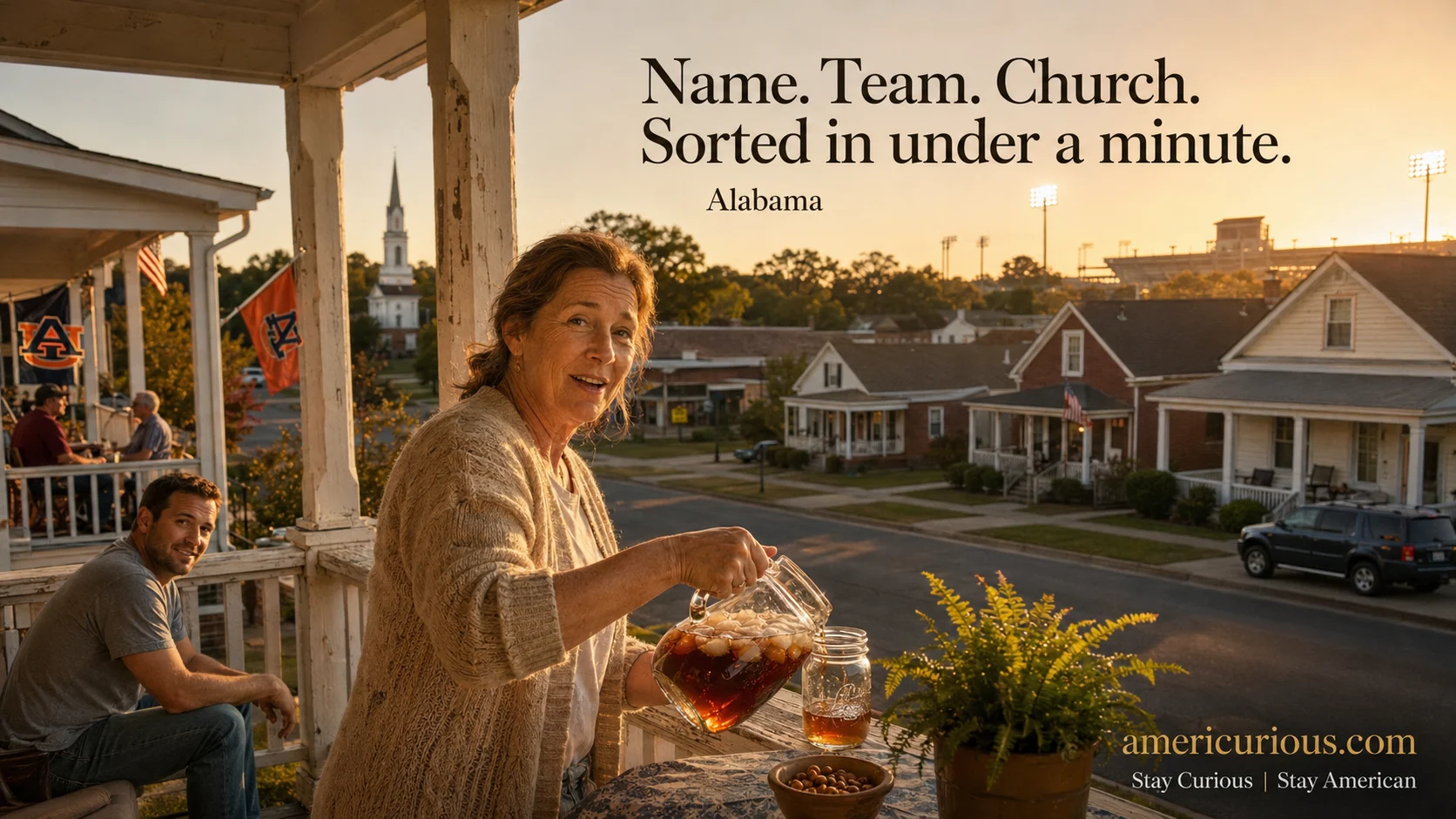
Alabama’s unspoken social rules sort strangers by name, football team, and church in under a minute. Discover the history behind it—read more on AmeriCurious.
A Jewish family walks into an Alabama polling place. The volunteer running through introductions hits her with the standard script: name, then football team, then church. She says, “We’re Jewish.” He blinks. Then he has to be told that Jews don’t actually attend church — because in his mental filing system, that box doesn’t exist. The exchange is real, recounted years later by the woman’s own kid, who grew up getting handed “starter Bibles” by well-meaning classmates.
That’s not a rude question. That’s not even really a question about religion.
It’s a sorting algorithm. 🧭
The Script Nobody Wrote Down (But Everybody Knows)
Ask an Alabama native to describe meeting someone new and they’ll rattle off the sequence without thinking: What’s your name? Auburn or Alabama? What church do you go to?
No one taught this. No etiquette book printed it. It just runs in the background, the way a border-control officer runs a passport through a scanner.
Here’s what each question is actually doing:
| Question | What It Sounds Like | What It’s Actually Checking |
|---|---|---|
| “What’s your name?” | Basic pleasantry | Family lineage, sometimes race/class signals |
| “Auburn or Alabama?” | Sports small talk | Regional loyalty, education, tribal camp |
| “What church do you go to?” | Casual curiosity | Denomination, class, whether you’re “one of us” |
A stranger can run this in under thirty seconds and walk away with a rough social map of you — long before “so, where are you from?” ever gets asked.
“It’s Goliath vs. Goliath.” — on the Iron Bowl rivalry that anchors question two
Why Football Became a Loyalty Test
The Auburn-Alabama rivalry didn’t start as a referendum on identity. It started as a scheduling dispute.
The two schools first played in 1893, and even that game began in disagreement — Alabama counted it as their last game of 1892, Auburn counted it as their first of 1893. Fitting, honestly.
Then things got worse. By 1907, arguments over referee nationality and player expenses got so bad the schools simply stopped playing each other for 41 years. Two generations of Alabamians grew up in a state split down the middle with no game to settle the argument.
When play finally resumed in 1948 — after the state legislature literally passed a resolution begging the schools to fix it — the rivalry came back sharper than ever. Auburn coach Shug Jordan gave it its permanent name in 1964, joking that his team didn’t need a bowl game because Birmingham’s annual clash was their bowl game — a nod to Birmingham’s old identity as the South’s steel-producing “Iron City.”
🔑 Key fact: Alabama has no major professional sports team. College football isn’t competing for attention with an NFL franchise — it is the state’s main character. That’s part of why “who do you root for” reads less like a hobby question and more like a citizenship test.
The Church Question Isn’t Curiosity. It’s Coordinates.
Here’s where the data gets genuinely striking.
According to Pew Research’s 2023–24 Religious Landscape Study, 40% of Alabama adults qualify as “highly religious” — measured by daily prayer, certainty of belief, and regular attendance — putting the state in the top 10 nationally. Alabama and Tennessee have also historically tied for the highest share of adults who say they attend services weekly, north of 50%.
Compare that to Vermont, sitting at the bottom of Pew’s list with 13% highly religious.
That gap isn’t trivia. It’s the reason the church question functions completely differently depending on where you’re standing.
🗳️ Quick poll (answer at the bottom):
If a total stranger asked you what church you attend within the first two minutes of meeting, would you feel:
A) Friendly and welcomed
B) Mildly interrogated
C) Actively cornered
The “Post-Christian” Contrast
This is where the foreign gaze gets interesting. Writer and pastor Richard Beck, splitting time between Texas and the UK, put it sharply: in a post-Christian country, small local congregations tend to be genuinely vibrant and chosen — while in a place where everyone defaults to Christian identity, the label can end up meaning almost nothing at all, an echo of a very old philosophical joke about conformity hollowing out conviction.
For a visitor from Western Europe — where regular attendance is often in the teens percentage-wise — being asked your denomination by a stranger at a gas station isn’t small talk. It’s like being asked your salary. It assumes religion is a public, default fact about you, not a private matter you volunteer if asked directly.
What Foreigners Actually Notice First
Before they even get to the church question, most international visitors flag something more basic: Americans talk to strangers constantly, and they mean almost none of it literally.
One frequently cited observation from travelers: Americans ask “how are you” the way other cultures say hello — not actually wanting an answer, which trips up visitors who try to respond honestly and get met with confused pauses.
University international-student orientation guides actually run entire workshops on this. One typical program description walks incoming students through the concept that a stranger commenting on last night’s game in an elevator is a friendly script, not an actual invitation to bond over sports.
Layer the South’s three-question ritual on top of that baseline American chattiness, and you get something visitors from quieter small-talk cultures — Northern Europe, much of East Asia — often describe as disorienting in a specific way: it’s warm, fast, and somehow still feels like a checkpoint.
📋 Quick Reality Check Box
- Alabama: ~40% “highly religious” (Pew, 2025) ✅
- Vermont: ~13% “highly religious” — the lowest in the nation
- Iron Bowl rivalry: paused for 41 years (1907–1948) over a scheduling fight
- “Starter Bibles”: a real, documented response to a kid saying “I don’t believe in God” in an Alabama classroom
Is This Just an Alabama Thing?
Not entirely, but Alabama sharpens it further than most.
Georgia and Mississippi run softer versions of the same script — Mississippi actually edges out Alabama as Pew’s most “highly religious” state overall. South Carolina’s close behind. But nowhere else pairs the religious sorting question with a football rivalry this singularly binary.
In Georgia, you might get asked Georgia vs. Georgia Tech, but it doesn’t carry quite the same “there is no third option, and mixed marriages are a real term people use” intensity that Auburn-Alabama does. Alabama’s version is unusually efficient precisely because it only has two boxes to check, twice over: Auburn or Alabama, church or “so, what happened to you.”
For newcomers wondering whether to expect this everywhere below the Mason-Dixon line, it’s worth reading how small talk mechanics shift region by region rather than assuming one uniform “the South.” The interrogation gets softer the further you get from the SEC’s old Deep South core, and noticeably different again once you cross into places like Texas’s small-talk conventions, where the questions exist but the rivalry-as-identity piece is diluted across a much bigger state.
🧩 Poll answer key
If you picked C) Actively cornered — congratulations, you have the instincts of roughly every non-Southern American and most international visitors dropped into this ritual for the first time. If you picked A), you’ve either lived it your whole life or you’re about to make a lot of friends at your first Alabama cookout.
Ask yourself this: what does it say about a culture that can sort a stranger’s entire social identity in three questions, in under a minute, without anyone involved feeling like they’ve been rude?
Maybe it says the South never actually stopped believing that where you stand — on faith, on football, on family — is the most useful thing a stranger can know about you before they even learn what you do for a living.