Here’s a fast way to judge a coastal town: park on its main street, and see how many minutes pass before your feet hit sand, a pier, or a bluff. In the ten towns below — from Humboldt County, California to Whidbey Island, Washington — the answer is never more than ten. Each one runs on a single walkable spine where the coffee shops, bookstores, and galleries sit close enough to the water that the ocean becomes part of the errand.
One piece of genuinely good news before the list: Highway 1 through Big Sur is fully open again. Caltrans reopened the final 6.8-mile section at Regent’s Slide on January 14, 2026, reconnecting the classic coastal drive end-to-end for the first time in years Highway 1 Discovery Route. The California towns below are reachable in either direction without detours.
How We Chose
The test is proximity, not polish. A “best downtown” here means a compact main street of independent, locally owned businesses where a walk that starts at a storefront ends at the water — no car move required. We favored towns under roughly 15,000 people and gave extra credit to working waterfronts (real fishing boats, not decorative marinas) and to main streets with protected historic architecture. We left off famous-but-overrun stops like Carmel-by-the-Sea and Cannon Beach on purpose: their downtowns are lovely, but “walkable” loses meaning when you spend 25 minutes hunting for parking — a complaint that comes up constantly in traveler forums, and one locals confirm.
The towns at a glance:
| Town | State | Main street | Downtown-to-water | Best season | The one thing not to miss |
|---|---|---|---|---|---|
| Point Arena | CA | Main St | 5-min drive to Arena Cove | Apr–Oct | 1928 Arena Theater marquee |
| Ferndale | CA | Main St | 5-min drive to Centerville Beach | May–Oct | Victorian storefronts, end to end |
| Cayucos | CA | Ocean Ave | 1 block | Sep–Oct | Pier + Brown Butter Cookie Co. |
| Pacific Grove | CA | Lighthouse Ave | ~1 mile walk | Oct–Feb (monarchs) | Lover’s Point coastal trail |
| Manzanita | OR | Laneda Ave | Ends at the beach | Sep–Oct | Laneda’s dead-end into the Pacific |
| Florence | OR | Bay St | On the riverfront | Jun–Sep | Siuslaw Bridge at sunset |
| Port Orford | OR | — (harbor) | Working dock | May–Oct | Crane-lifted “dolly dock” boats |
| Ilwaco | WA | Port district | On the harbor | May–Sep | Two lighthouses at Cape Disappointment |
| Langley | WA | First St | Bluff above the passage | Mar–May (gray whales) | Ringing the Whale Bell |
| Coupeville | WA | Front St | On Penn Cove | Mar (Musselfest) & summer | Wharf + Penn Cove mussels |
1. Point Arena, California
Point Arena’s Main Street is barely three blocks long, and that’s the point: you can absorb the whole downtown in twenty minutes and still feel like you’ve seen it properly. The anchor is the Arena Theater, a 1928 vaudeville-and-film house that community volunteers restored to its Art Deco glory in 1996–97 and that still screens first-run and art films nightly Arena Theater. Its neon marquee is an almost absurd flash of old Hollywood on one of the emptiest stretches of the California coast — it also contributes to the Point Arena Main Street Historic Commercial District.
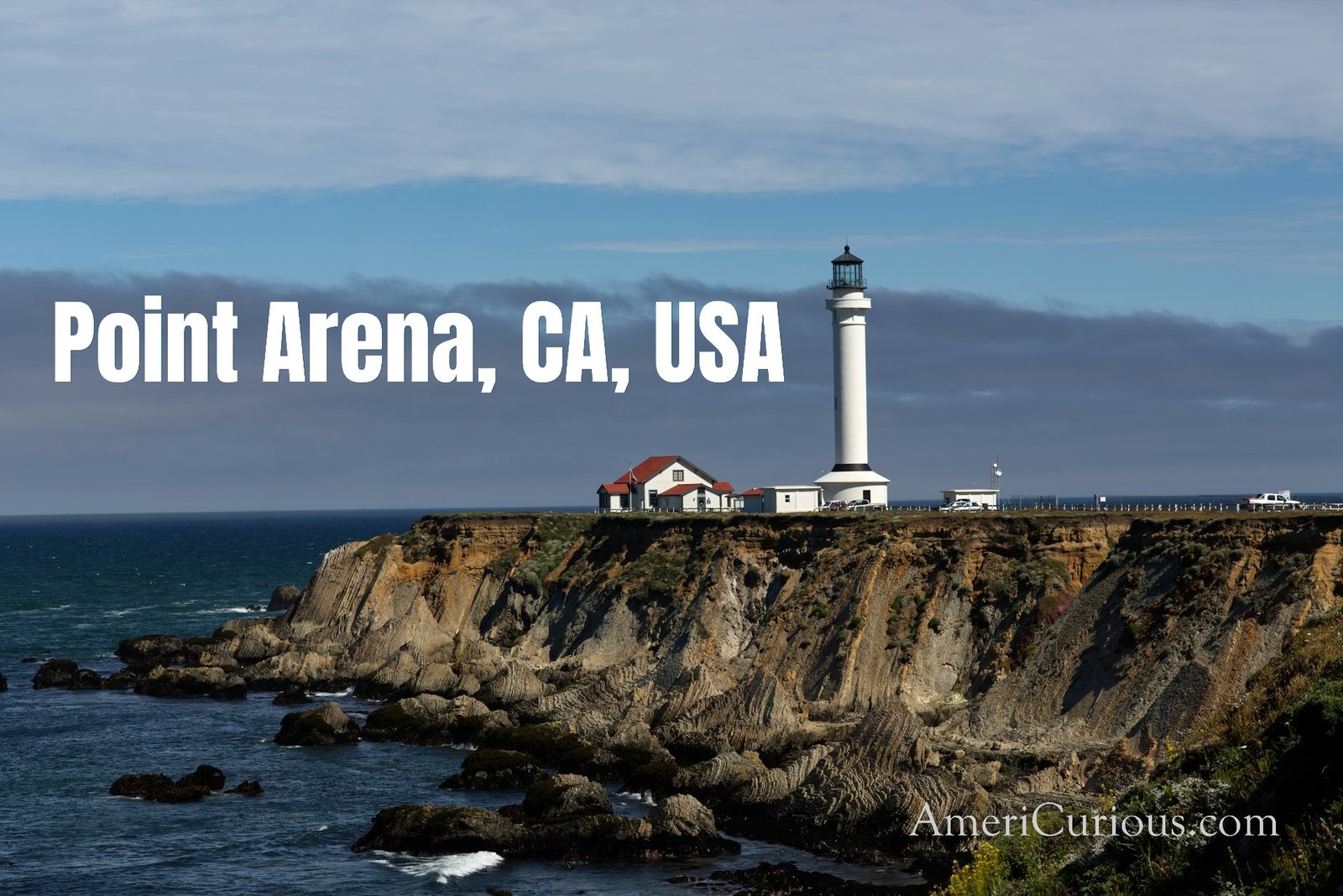
From downtown, follow the road down to Arena Cove, where a municipal pier juts into a working fishing harbor framed by cliffs. The grand finale is north of town: the Point Arena–Stornetta unit of the California Coastal National Monument, where trails cross open grassland above sea arches, and the Point Arena Lighthouse stands against the headlands.
90-minute plan: coffee and a walk of Main Street, a photo of the marquee, then straight to the cove.
2. Ferndale, California
Ferndale’s Main Street looks almost theatrical, but the elaborate Victorian storefronts are the real thing — dairy wealth from the surrounding Eel River country financed the ornate commercial blocks, and the whole strip sits within the Ferndale Main Street Historic District, listed on the National Register of Historic Places. The town counts over 200 original Victorian buildings in traditional and Queen Anne styles Victorian Village Inn, which is why even an ordinary coffee stop here feels like part of the sightseeing.
Start at the Victorian Inn end of Main Street, browse the candy-and-nostalgia shelves at Golden Gait Mercantile, and get context at the Ferndale Museum. Then change the scenery completely: Russ Park’s forested trails climb just above town, and Centerville Beach — broad, windswept, and usually empty — is a five-minute drive west.
Honest caveat: Ferndale is the least “coastal” town on this list (the beach is a drive, not a walk). It’s here because its downtown is arguably the finest intact Victorian main street on the entire Pacific Coast.
3. Cayucos, California
Cayucos is the anti-resort: a low-rise surf town where Ocean Avenue runs one block behind the beach and the biggest event of the day is the light changing over the pier. Brown Butter Cookie Company is the mandatory stop (get the original sea-salt dozen), Remember When is the best of the antique shops, and Good Clean Fun has outfitted surfers here for years.
One important correction, current as of September 2026: the seaward end of the Cayucos Pier has been closed since a February 2024 storm destabilized it, and San Luis Obispo County began emergency repairs on October 27, 2025, with a decision on fully replacing the damaged end still pending SLO County Public Works. So the classic advice — “walk to the end of the pier and turn around” — only partly works right now; you can walk the open section, and the view back at Ocean Avenue under the coastal hills remains one of the most recognizable on the Central Coast. Best months: September and October, when the summer fog lifts and the crowds vanish.
4. Pacific Grove, California
Pacific Grove is calm even by Monterey Peninsula standards — and that’s exactly why it beats neighboring Carmel for a slow afternoon. Lighthouse Avenue runs through a historic downtown of older commercial buildings, and the side streets give way to Victorian cottages from the town’s 19th-century Methodist retreat era. The Pacific Grove Museum of Natural History opened in 1883 — the same year as the Brooklyn Bridge — and its exhibits on Monterey Bay’s wildlife and geology make the shoreline you’re about to walk mean more Pacific Grove Museum of Natural History.
From downtown, walk toward Lover’s Point, where waves break close to the coastal recreation trail. Time your trip for October through February and you get the town’s signature event: migrating monarch butterflies clustering in the pines and eucalyptus of the Monarch Grove Sanctuary — the reason Pacific Grove’s nickname is “Butterfly Town, U.S.A.” City of Pacific Grove. Admission is free; viewing peaks November through February. On the return walk, skip Lighthouse Avenue and take the residential streets to see the town’s elaborate wooden porches and gables.
5. Manzanita, Oregon
Laneda Avenue makes navigation in Manzanita almost comically simple: walk west and the street literally ends at the Pacific. That single gesture — a main street that terminates in sand, with Neahkahnie Mountain rising beyond the north end of the beach — gives the tiny downtown a sense of place that towns ten times its size can’t buy. Cloud & Leaf Bookstore is a fine browse, and the Hoffman Center for the Arts runs exhibitions and programs in the heart of town.
The day’s best transition requires no car: follow Laneda until pavement gives way to beach. For the high angle, drive five minutes into Oswald West State Park and climb one of the trails above the shoreline — from the viewpoints, Manzanita’s seven-mile beach forms a pale strip between ocean and forest.
When to go: September into early October, which Pacific Northwest travelers consistently name as the coast’s sweet spot — summer crowds gone, rain not yet arrived.
6. Florence, Oregon
In Old Town Florence, the Siuslaw River is never out of sight. Bay Street follows the waterfront directly beneath the Siuslaw River Bridge, a 1936 bascule bridge designed by Conde McCullough — the engineer behind Oregon’s most iconic coastal spans — whose Art Deco towers form one of the most recognizable backdrops on the Oregon Coast. Fishing boats move through the harbor while older storefronts face the river; the Siuslaw Pioneer Museum covers the logging and fishing history that explains why the town grew exactly where river, forest, and coast meet.
Skip the urge to jump back on Highway 101. Instead, walk the boardwalk near the marina, where harbor seals sometimes surface, and stay for sunset: as the light drops behind the Siuslaw, the bridge towers and moored boats turn a working harbor into the best evening view in town. The Oregon Dunes begin just south and Heceta Head Lighthouse stands to the north — but both are tomorrow’s itinerary.
7. Port Orford, Oregon
A fishing boat hanging in midair is a normal sight in Port Orford. The port has no protected natural harbor, so instead of mooring in the water, vessels are lifted in and out by crane and parked on trailers — the only “dolly dock” system on the West Coast Visit the Oregon Coast. Watching a hoist swing a commercial boat over the dock is one of the most distinctive working-waterfront scenes in the country, and it’s free, steps from Battle Rock Park.
This is the least polished downtown on the list — no curated boutique strip — and that’s the appeal. Near Battle Rock, the Hawthorne Gallery shows contemporary art in a building steps from the ocean, and Port Orford Heads State Park offers short trails across forested bluffs to the old lifeboat station site, where the coastline runs north and south with almost no development in view.
Come for the docks at working hours (mornings are best); this is a town that rewards people who like their coast with rope, rust, and real work.
8. Ilwaco, Washington
Ilwaco’s downtown is its port, and the port still works for a living. Commercial fishing boats fill the slips, crews move gear along the docks, and the whole waterfront has a rougher, more honest edge than the polished marinas up the coast. The Columbia Pacific Heritage Museum explains the setting — fishing and transportation at the mouth of the Columbia River — and a segment of the Lewis and Clark Discovery Trail follows the waterfront, so a museum visit turns naturally into a harbor walk. On summer Saturdays, the Ilwaco Saturday Market fills the port.
The big scenery sits just beyond town at Cape Disappointment State Park, which holds two historic lighthouses: the Cape Disappointment Light above the river mouth and the North Head Lighthouse (lit in 1898) on a bluff facing the open Pacific Washington State Parks. From North Head, the mouth of the Columbia looks enormous next to the compact marina back in town — a perspective that explains the region’s “Graveyard of the Pacific” nickname better than any plaque.
9. Langley, Washington
A whale sighting can interrupt an ordinary afternoon in Langley. The town sits on a bluff above Saratoga Passage on Whidbey Island, and at Whale Bell Park — right at the edge of downtown — the rule is simple: spot a whale, ring the bell, and watch strangers become a crowd at the overlook. This isn’t a gimmick: every March through May, a small, unique group of roughly 10–12 gray whales known locally as the “Sounders” returns to feed in Saratoga Passage, sometimes right up against Langley’s seawall Langley Chamber of Commerce.
Most of the browsing happens along First Street: Moonraker Books is a longtime local favorite, the 1937 Clyde Theatre still shows films in a wonderfully intact small-town movie house, and art galleries appear between businesses rather than in any formal district. The Langley Whale Center adds context on the orcas, grays, and humpbacks of the Salish Sea. Before leaving, take the stairs down toward the water and look back at the bluff-top town from below — it’s the best portrait Langley offers.
10. Coupeville, Washington
Front Street in Coupeville stands so close to Penn Cove that boats and the changing light on the water become part of the downtown scenery. The wooden buildings date to the 19th century, and the town sits inside Ebey’s Landing National Historical Reserve — established by Congress in 1978 as the first historical reserve in the National Park system, protecting not just buildings but a whole working rural landscape National Park Service. Start on the historic Coupeville Wharf for the view back at shore, then walk to the Island County Historical Museum.
Lunch is part of the sightseeing: Penn Cove mussels come from the bay directly in front of Front Street and appear on nearly every local menu. If your timing is flexible, aim for early March, when the annual Penn Cove Musselfest takes over the waterfront with chowder tastings, mussel-farm boat tours, and live music Penn Cove Musselfest. Afterward, leave the waterfront for the Reserve’s bluff trail above Admiralty Inlet, where open prairie replaces storefronts within minutes.
Planning Notes
- String them together: A Seattle-to-San Francisco coastal drive hits Coupeville, Langley, Ilwaco, Manzanita, Florence, and Port Orford on 101/1 in order; Pacific Grove, Cayucos, Ferndale, and Point Arena slot into the California stretch. With Big Sur fully reopened as of January 2026, no detours are required Highway 1 Discovery Route.
- Best overall window: September–early October for weather and thinning crowds; October–February if monarchs in Pacific Grove are the priority; March–May for Langley’s gray whales and Coupeville’s Musselfest.
- The honest trade-off: these downtowns are small. Several can be fully explored in an hour. That’s the point — pair each with its beach, bluff, or lighthouse, and the “downtown + shoreline” combination is the actual attraction.
Frequently Asked Questions
What is the best small downtown on the Pacific Coast?
For pure architecture, Ferndale, California — over 200 Victorian buildings in a National Register historic district. For the best storefront-to-shoreline walk, Manzanita, Oregon, where Laneda Avenue ends directly at the beach.
Can you walk to the end of the Cayucos Pier right now?
Not fully. The seaward end has been closed since a February 2024 storm, and San Luis Obispo County began emergency repairs in October 2025. The open section still delivers the classic view back at town; check SLO County Public Works for current status.
When is the best time to visit Pacific Grove for monarch butterflies?
Mid-October through mid-February, with peak viewing November to February at the free Monarch Grove Sanctuary.
Which of these towns are working waterfronts rather than resort towns?
Port Orford (crane-lifted “dolly dock” fishing fleet), Ilwaco (commercial harbor), and Florence (active riverfront port) are the three where fishing still visibly drives the downtown economy.
Is Highway 1 through Big Sur open in 2026?
Yes. Caltrans reopened the final section at Regent’s Slide on January 14, 2026, reconnecting the full coastal route for the first time in years.