Read this one with something hot in your hands.
Picture a woman I’ll call Renee. Forty-four, runs the front office at a dental practice in Pittsburgh, and can calm a waiting room full of people who are about to get a root canal. Renee isn’t a real person. She’s a composite. But I’d bet my last bagel you know her. Maybe you are her.
It’s a Sunday night, and Renee is sitting on her bedroom floor, surrounded by black pants. Three pairs. All tagged 18. Pair one gapes at the waist wide enough to smuggle a sandwich. Pair two goes on fine until she sits down, and then it files a formal complaint at the hip. Pair three fits everywhere except the rise, which has set up camp somewhere near her ribs.
And here’s what Renee says out loud, to nobody, to the dog: “Ugh. What is wrong with me?”
Nothing, Renee. Nothing is wrong with you. Something is wrong with the number.
That’s the mistake, and it’s sneaky because it feels so responsible. Renee, like a lot of us, treats her size as a fact about her body. It isn’t. It’s a fact about a brand’s pattern. She’s been shopping for a number, and her body doesn’t have a number. Her body has measurements and a shape. The number is just a rumor that got printed on a tag.
Here’s the con: the number was never about you
Nobody mentions this at the register: there’s no single, industry-wide yardstick for what an “18” is. One fashion reference puts it plainly. Each designer, brand and retailer works from its own data, which is why trying things on is still the only reliable test.
Then it gets lumpier. Plenty of labels pick one fit model, build a sample around her, and use software to scale everything up and down from there. Quartz explained how that goes: it holds up fine near the fit model’s size, but several sizes away the garment gets stretched and distorted, because human bodies don’t grow in tidy, even increments. The extra inch goes to different places on different people. Meanwhile, a pattern expert quoted in Bustle says most designers grade up from a size 6 or 8, which guarantees you nothing about how that cut behaves at an 18, a 24 or a 30. And academic research on plus-size patterns, including a paper from Iowa State’s digital press, flags the usual trouble spots: bust, shoulders, upper arms, lower back.
So the pants on the hanger may have been designed for one body and then extrapolated, mathematically, to yours. After that they get a number, and you carry that number around like a driver’s license.
That same paper cites a 2012 NPD market-research figure: 56 percent of plus-size women couldn’t find clothes that fit well. It’s a decade-plus old, so treat it as a snapshot, not gospel. But the shape of the problem hasn’t changed, and the bra aisle plays the same game. Cup letters mean different things at different brands. A lingerie retailer’s conversion chart shows the same cup can be a G at one brand and an F at another.

Why we keep falling for it
If the number’s this unreliable, why do smart women keep trusting it? Because our brains are doing what brains do.
Anchoring. Psychologists use that word for the way the first number we meet becomes the reference point, and we adjust from it too little. The first 18 that ever fit becomes “my size,” and everything after gets judged against it.
The number as a report card. Somewhere along the line, size stopped being a measurement and started being a verdict. So a pair of pants that won’t close doesn’t read as “bad pattern.” It reads as “bad me.”
Blaming the wrong party. The tag says 18. The pants don’t fit. Who’s the authority here? We hand it to the tag and make ourselves the exception.
Sunk cost. You paid for them. They’re hanging there with the tags on. You keep them, because tossing them means admitting the money’s gone. The “someday” pile grows.
None of that is a character flaw. It’s just a loop. And loops can be broken.
What the loop actually costs
Back to Renee’s floor. The pants are only the visible part. There’s the Sunday-night time she spends trying on and re-trying on. There’s the trip to the post office or the return counter, then doing it again next month. There’s the shelf of almosts, which she’ll never wear but can’t quite release. And there’s the part that doesn’t show up on a receipt: she walks into every fitting room already guilty, braced for the verdict. A woman who expects to fail doesn’t enjoy shopping, and she doesn’t buy the thing that would’ve worked, either.
That’s a lot to pay for a number that was only ever a guess.
What to do instead (you can start tonight)
Grab a soft tape measure. A sewing one, not the metal one from the junk drawer. I’ll wait.
1. Get your real numbers. For pants and jeans: measure your waist where it creases when you bend to the side (bend, find the crease, stand up straight, measure right there). Measure the fullest part of your hips with your feet together, and the fullest part of your thigh. For bras: band right under the bust, then bust at the fullest point. Save it all in your notes app. Re-measure every few months. Bodies change, and that’s allowed.
2. Name your shape, not your size. Where are you fuller, relative to your waist? If you’ve ever had the waist-gap-and-hip-squeeze combo, that’s not you being “hard to fit.” That’s a hip-to-waist proportion the pattern didn’t plan for.
3. Shop the chart, not the tag. Before you buy, look at the brand’s actual measurements for that style and compare them with yours. Sixty seconds. Also check the stretch. A jean with give behaves differently than a rigid one, even at the same number.
4. Buy for the biggest part, tailor the rest. Taking in a waist is generally a simpler job for a tailor than adding room through the hips. A good tailor is the most underrated line item in any wardrobe.
5. Keep a fit log. Brand, style, size, what worked, what didn’t. By entry three or four, you’ll see your own patterns, and the pile of almosts stops being a mystery.
6. Run the sit-bend-reach test. In the fitting room, sit down, bend over, reach for the top shelf. If it only works standing perfectly still, it doesn’t work. And make returns painless: shop where bringing something back isn’t a production.
That’s the whole fix. You stop asking “what size am I?” and start asking “what does this garment measure, and what do I measure?” It’s less romantic, but it works.
One tool in the kit: Lane Bryant
So your tape’s out and your notes are open. Where do you shop with all this? There are a few routes. A good local tailor. Brands that fit-test on plus-size bodies instead of just scaling up (Universal Standard, for instance, has described treating each size as its own garment). Vintage, if you’ve got patience and a stout pair of eyes.
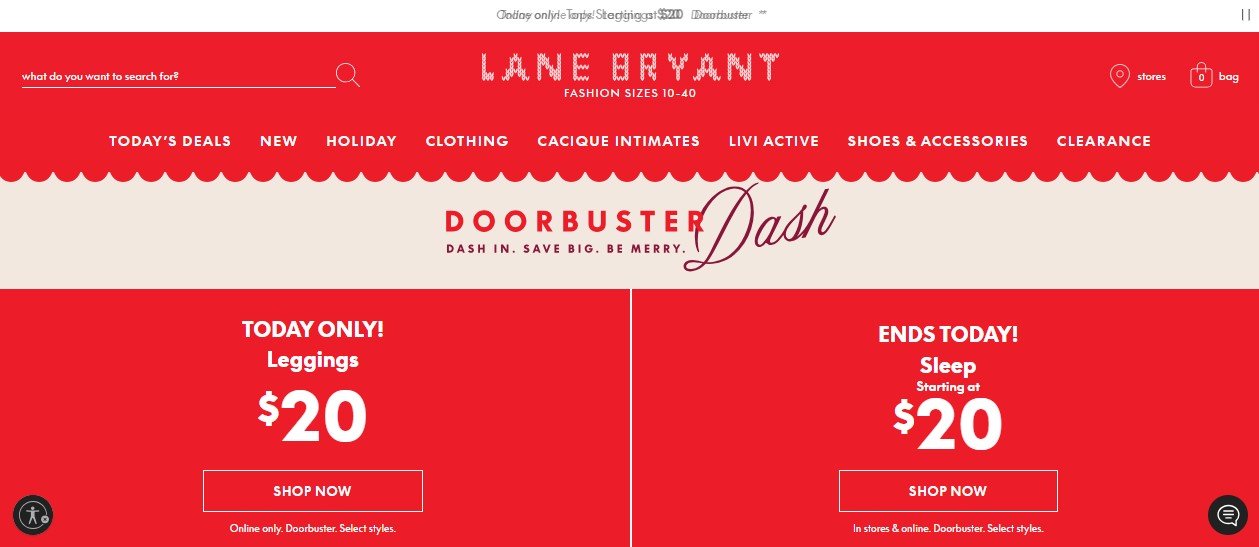
Lane Bryant is another one worth a look, and I’ll tell you why in terms of the exact problem we just walked through.
It started in New York in 1904 with Lena Bryant, a dressmaker who’d come over from Lithuania at 16, first with maternity designs. The company says her team built a proprietary size-grading system that put fit ahead of whatever the tag said, and that its more recent Fit for You initiative carries that idea forward. Whether today’s racks live up to that is for your fitting room to decide. But it’s the right obsession.
Here’s where it lines up with Renee’s floor:
The jeans fit guide works the way step 1 and step 2 do. The guide asks for a waist, low hip and thigh measurement, then sorts you by shape. Rectangular with a slight curve between waist and hips points to the 360 Flex Signature Fit. Smaller at the waist and rounder through the hips and thighs points to the No-Gap Curvy Fit, which is aimed squarely at Renee’s gap-and-squeeze problem. Rounder through the mid-section with smaller hips and thighs points to the Tighter Tummy Fit or a pull-on. I also like that it separates the fit (how the jean sits from waist to hip) from the leg shape (hip to hem). You’re picking two things, not trusting one number. Clothing runs sizes 10 to 40 across the brand, and the jeans guide covers 12 to 40.
The bra side tackles the cup-letter chaos. The bra fit guide and calculator walks you through a band and bust measurement, and recommends re-checking every six months. Cacique, their intimates line, offers bands 34 to 54 and cups B through K. The guide also works like a symptom checker. Slipping straps, gaping cups, a band that rides up or digs in: each one comes with a suggested fix, whether that’s a different cup, a different band, or a different style. Their sports bras come in three support levels, and the same measuring habit carries straight over to LIVI Active, their activewear line.
And there’s a human option. If you’d rather not go it alone, Lane Bryant offers free personal shopping appointments and bra fittings in store. The page says to plan on about an hour, set whatever budget you like, and that there’s no pressure to buy. It’s pitched at exactly the in-between-sizes problem. Online orders can also be returned at any of their stores, which is handy for the sit-bend-reach crowd.
A fair caveat, because I’m your friend and not a billboard: a brand’s guide is a starting line, not a verdict. Fit is personal, so try things on and run the test. If something still doesn’t work, write it in the log. That’s data, not a character flaw.
The takeaways, for the coffee-to-go crowd
- The size on the tag describes a brand’s pattern, not your body. Stop taking it personally.
- Measure yourself with a soft tape, save the numbers, and update them every few months.
- Know your shape (where you’re fuller relative to your waist), because that’s what decides fit.
- Compare garment measurements to yours before you buy, and check the stretch.
- Buy for the biggest part and let a tailor handle the rest.
- Keep a fit log and run the sit-bend-reach test every time.
- Use fit guides and in-store help (Lane Bryant’s are one option) as tools, but let your own measurements have the last word.
Renee, for the record, still has the three black pants. But she’s got her numbers in her phone now, a tailor on speed dial, and a much shorter list of things she’s willing to blame herself for.
You deserve the same.
Affiliate disclosure: If you click a Lane Bryant link here and buy something, I may earn a small commission at no extra cost to you. That’s how I keep the coffee flowing and the tape measure sharp. I only point you toward things I’d tell my own cousin about, and everything above holds up whether you click or not.