Illinois and Philadelphia require menopause workplace accommodations Jan 1 2027. Rights checklist, email scripts, and cooling fixes.
Answer-first summary:
Reasonable menopause workplace accommodations 2027 are job adjustments for perimenopause or menopause symptoms. The Illinois Menopause Equity and Care Act (HB5284, Public Act 104-0793) and Philadelphia Fair Practices Ordinance Bill 250849 both take effect January 1, 2027, requiring covered employers to provide accommodations unless undue hardship. You can ask for cooling, breaks, or flexible timing without sharing intimate details.
Editorial note: This post is for information only and is not legal advice or medical advice. If you have severe symptoms or face retaliation, talk to a licensed professional. If you are in crisis, call or text 988.
The 10:17 AM Meeting
Denise Carter is 49 and lives in a second-floor two-flat in Logan Square, Chicago. It’s a Tuesday in late January. She woke at 3:12 a.m. again, kicked the covers off, then pulled them back. Two hours of broken sleep. She stands in front of her closet at 6:45 a.m., holding two shirts – the black blazer that hides everything and the lighter blouse that breathes. She picks the black one.
The Blue Line rattles toward the West Loop. Her ed-tech nonprofit office runs cold in winter, then blasts heat by 10 a.m. when the sun hits the west windows. She has a desk fan tucked in her bottom drawer. She has never plugged it in.
At 10:17 a.m., she’s in a glass conference room. The agenda is on the screen. The project manager is talking about Q2 rollout. Then it starts at the back of her neck, a prickling heat that moves fast across her shoulders and up her cheeks. Her shirt sticks. She feels her pulse in her ears. She reaches for her water, knocks her pen off the table, laughs too loudly, and says, “Sorry, so warm in here.”
No one says anything. The meeting keeps going. She stops hearing it.
That moment is why you searched. You didn’t type “menopause workplace accommodations 2027” because you love HR policy. You typed it because you needed language for what happened in that room, and a way to make sure next Tuesday is different.
Denise’s story isn’t yours exactly, but the pieces are familiar if you’re in your mid-40s to mid-50s. Natural menopause most commonly occurs between ages 45 and 56, with a median age of 51 in the United States, according to StatPearls updated March 2026. The Eunice Kennedy Shriver National Institute of Child Health and Human Development also notes the average is 51. Perimenopause can start years earlier.
For years the American workplace treated this as something to power through in silence. Two data points show that silence has a cost. Across the EU, Eurofound’s 2024 European Working Conditions Survey found that only 15% of employees reported that their employer fully or partially accommodated disruptive menopause symptoms. In the US, Bonafide’s fourth-annual State of Menopause report found 76% of women reported having no workplace accommodations, while just over half of women (51%) said they want increased workplace accommodations.
That gap is why Illinois and Philadelphia put dates on the calendar.
Do this today: Write down what happened in your 10:17 a.m. moment. Time, room temperature, trigger, how long it lasted, what it cost you (missed note, left early, extra break). Two weeks of those notes becomes the most persuasive document you can bring to your manager.
Care to Read?
Perimenopause Brain Fog and Weight Gain: The Reset Guide
Why January 1, 2027 Changes Everything
Picture this: You are back at your desk after that meeting. A Slack notification pings. HR forwarded a newsletter: “2 New Laws Take Effect in 2027.” You almost swipe it away.
Don’t.
Illinois: The Menopause Equity and Care Act
On August 7, 2026, Illinois Governor JB Pritzker signed the Illinois Menopause Equity and Care Act, Public Act 104-0793. Its employment provisions take effect January 1, 2027, except changes to the Illinois Insurance Code which take effect January 1, 2028, according to LegiScan’s bill status.
What it does: It amends the Illinois Human Rights Act to add menopause-related conditions as a protected category, defined as perimenopause, menopause, and associated medical or symptomatic conditions. Here is the nuance that matters for small workplaces:
- Anti-discrimination ban: applies to Illinois employers with one or more employees, according to legal500 analysis.
- Reasonable accommodation duty: requires employers with four or more employees to provide reasonable accommodations unless it would impose an undue hardship.
So a Chicago cafe with two employees may not be required to provide accommodation under state law, but it is still prohibited from discriminating or harassing based on a menopause-related condition. [internal: illinois-employee-rights-guide]
Philadelphia: The Fair Practices Ordinance Change
In the city, the rule is simpler. On December 3, 2025, Philadelphia enacted Bill No. 250849, amending the Philadelphia Fair Practices Ordinance to prohibit discrimination based on menstruation, perimenopause and menopause. The amendments will take effect Jan. 1, 2027.
The ordinance applies to all employers with at least one employee and will not include a general small-business exemption. That same one-or-more-employee definition is confirmed in the city’s compliance guide: Same employer definition as the Fair Practices Ordinance: one or more employees from January 1, 2027. Even the smallest Philadelphia employers are covered.
The bigger map
As of September 2026, menopause-related legislation had been introduced in more than 25 states and enacted in 12 states plus the City of Philadelphia, according to the Menopause Education Center’s comprehensive review. Rhode Island enacted the nation’s first state law expressly requiring reasonable workplace accommodations for menopause-related conditions in 2025, effective June 24, 2025.
Connecticut added menopause-related conditions to its accommodation protections effective October 1, 2026. A separate provision requiring a statewide menopause toolkit for providers also took effect Oct. 1, 2026.
Federal action is also in the mix. The Menopausal Workers’ Fairness Act, HR 9671, was introduced July 14, 2026, proposing a federal process to request reasonable accommodations.
Comparison table: Where the three laws land
| Feature | Illinois HB5284 / PA 104-0793 | Philadelphia Bill 250849 | Rhode Island HB6161 |
|---|---|---|---|
| Effective | Jan 1, 2027 employment; Jan 1, 2028 insurance | Jan 1, 2027 | June 24, 2025 |
| Employer size for accommodation | 4+ employees | 1+ employees | 4+ employees |
| Employer size for anti-discrimination | 1+ employees | 1+ employees | 4+ employees |
| Doctor’s note | Functional need, limited doc | Functional need, limited doc | Limits ability to request medical documentation |
| Examples in guidance | Fans, breaks, flexible schedule, remote | Breaks, temperature, dress, remote | Modified schedules, cooler workspaces, flexible breaks |
Do this today: Check your coverage in 60 seconds. Are you Illinois (1+ for discrimination, 4+ for accommodation) or Philadelphia (1+)? Write down employer name, headcount, and city. That’s line one of your request.
What Counts as Reasonable, and What Doesn’t Require a Doctor’s Note
Picture this: You finally ask. You stand at your manager’s desk, hands a little sweaty, and say, “Can I have a small fan at my desk?” You wait for them to ask for a doctor’s note you don’t have.
Most anxiety in that doorway isn’t about the fan. It’s about proving you deserve it.
Reasonable means something that lets you do essential job functions without causing undue hardship to the business. You don’t have to stop being good at your job to qualify.
Common accommodations employers are already using:
- Temperature control – desk fan, moving to a cooler seat, access to thermostat or different meeting room.
- Air and water – access to cold water, more frequent bathroom or water breaks, a place to splash water on your face.
- Time flexibility – flexible start times after a night of insomnia, extra short breaks to manage a hot flash, ability to step out and return.
- Dress and location – relaxed uniform layering, option to work from home or quieter space on heavy-symptom days, video-off for remote meetings.
- Work design – adjusted break schedule during long coverage shifts, access to a rest area, modified duties for tasks done in high heat.
None requires renovation. Most cost under $30.
Now, the doctor’s note myth. Rhode Island’s law limits an employer’s ability to request medical documentation and was summarized as mandating accommodations akin to pregnancy without extensive paperwork. Illinois and Philadelphia use reasonable-accommodation-unless-undue-hardship standard but do not require intimate medical details or proof that menopause is a disability. In most cases, you do not have to establish that menopause constitutes a disability to qualify.
What employers can ask is limited to an interactive process: what do you need, how often, how long, does it work for the team? If they ask for documentation, a brief note confirming a medical condition and functional need is often enough.
Do this today: Circle two accommodations from the list that would have changed your 10:17 a.m. moment. Write them as functional needs: “access to a desk fan and two 5-minute cool-down breaks during a 3-hour coverage block.”
How to Ask Without Over-Sharing
Picture this: It’s Friday at 4:30 p.m. You don’t want to send the email. You write it, delete it, write it again.
You won’t sound dramatic if you use the script below. Built for Denise Carter’s exact situation – 49, working in Chicago, needs cooling and flexibility.
The 3-step method
Step 1 – Note (2 minutes). Two weeks of symptom impact notes: date, time, trigger, duration, task affected.
Step 2 – Ask (10 minutes). Short spoken ask first, then written request. Spoken builds trust. Written creates a record.
Step 3 – Track (5 minutes). Save email, response, what was provided. If in Illinois, you now have 2 years to file a charge with the Illinois Department of Human Rights, per Public Act 103-0973 extending deadline from 300 days to two years from Jan 1, 2025. In Philadelphia, you must file with the Philadelphia Commission on Human Relations within 300 days after the occurrence of the alleged unlawful practice.
Script 1: The 45-second spoken ask
“Hey [Manager first name], can I have two minutes privately? I have a medical condition that sometimes causes sudden heat and sleep disruption. It doesn’t affect my performance, but a small desk fan and the option to take two quick cool-down breaks during long meetings would help me stay focused. I’m happy to put it in writing. Does that work on your end?”
Script 2: Written reasonable accommodation request
Subject: Accommodation Request – [Name] – IL HB5284 / Philly 250849
Hi [Manager/HR Name],
I am writing to request a reasonable accommodation under the Illinois Human Rights Act as amended by the Menopause Equity and Care Act (HB5284 / Public Act 104-0793), effective January 1, 2027 [or: under Philadelphia Fair Practices Ordinance Bill 250849, effective January 1, 2027].
Functional limitation: occasional sudden heat episodes (2-3 per shift) lasting 3-5 minutes, plus sleep disruption affecting early morning starts 2x/week.
Accommodations requested:
- Small desk fan (under 12 inches) at workstation.
- Two additional 5-minute cool-down breaks during any meeting block over 90 minutes.
- Flexible start 8:30-9:30 a.m. up to two days per week, hours made up same day.
These allow me to perform essential functions of my role as [Title]. Happy to discuss alternatives and provide limited medical documentation if needed.
Thank you,
[Name] – [Date]
If they ask for a doctor’s note
“I can provide a brief note confirming a medical condition and functional need. I’m not comfortable sharing detailed history, and Rhode Island’s 2025 law specifically limits documentation requests. What minimum do you need to process this?”
Reasonable note: “[Name] has a medical condition that may require occasional temperature adjustment and short breaks. These support ability to perform job.”
Do this today: Send Script 2 by 4 p.m. Tuesday or Wednesday. Attach one-page note log PDF. Set 5-business-day follow-up reminder. Done looks like written reply with what is approved.
If They Say No, Here’s Your Next Move
Picture this: You sent the email. Three days later your manager says, “We can’t do fans, it looks unprofessional.” Your chest tightens.
A no without interactive conversation is not the end. Both Illinois and Philadelphia require an interactive process, not flat refusal. Undue hardship must be real, not preference.
What undue hardship actually means
Significant difficulty or expense relative to employer’s size, resources, operations. A 6-person nonprofit may not build a new wellness room, but can approve a $18 fan or shift swap. A 500-person system has harder time claiming hardship for flexible breaks.
When to call a pro trigger list
Call an employment attorney or legal aid if:
- Retaliation within weeks of asking (hours cut, poor review, reassignment).
- HR asks for invasive medical records or repeated notes.
- Told “we don’t do accommodations for that” after Jan 1, 2027 in covered jurisdiction.
- Symptoms impact safety or you need medical leave coordinated.
This is not legal advice. For Chicago, IDHR takes charges in Chicago or Springfield. You have 2 years to file under Public Act 103-0973 from Jan 1, 2025. In Philadelphia, start with Intake Unit 215-686-4670 and must file within 300 days.
Document everything in one folder. If experiencing severe anxiety or depression around work, call or text 988.
Do this today: If you got a no, reply within 24 hours: “Thank you for reviewing. To continue interactive process under [Illinois HB5284 / Philadelphia Bill 250849], can we discuss alternative causing less hardship, such as [second choice]? Available [two times].”
Low-Cost Cooling Fixes That Actually Work in a Midwest Office
Picture this: January in Chicago. Outside 18 degrees. Inside West Loop office, radiator hissing and afternoon sun pushes your corner to 78 degrees. You wore wool sweater because you froze at 8 a.m.
Midwest offices are temperature roller coasters. You don’t need construction. You need layering and airflow you control.
5 fixes under $30 that hiring managers have already said yes to:
- Personal USB fan, 8-inch, quiet. Keep in drawer. $16.
- Cooling towel or wrist wraps. Soak, wring, drape on back of neck 3 minutes after flash. $9 for 3-pack.
- Insulated 32-oz water bottle with straw. Cold water within arm’s reach. $22.
- Layering system, not blazer. Merino base + cardigan you can remove in 10 seconds beats one heavy piece.
- Seat swap trial. Ask facilities for seat away from radiator or direct sun for one-week trial. Bring thermometer data: “76-79 degrees between 2-4 p.m. Can we test north row Tue-Thu?”
Do this today: Order fan and bottle. Photo thermometer at 10:17 a.m. and 3 p.m. for three days. That’s your facilities ticket.
What 2028 Holds and How to Stay Ahead
Picture this: June 2028. You open onboarding packet at new job in Connecticut. There is a one-page model policy about menopause accommodations.
That’s not hypothetical. Connecticut’s law took effect October 1, 2026, adding menopause-related conditions to accommodation protections and directing the Commission on Human Rights and Opportunities to develop a model workplace policy and educational materials. The doctor-focused toolkit is not due until mid-2028, with distribution deadline June 1, 2028 and revised version if needed by Jan. 1, 2029, according to Medical Daily.
Translation: 2027 is compliance deadline. 2028 is education push. Employers who write a one-page policy now, train managers on two sentences (“We provide reasonable accommodations for menopause-related conditions under [law], talk to HR for options”), and add fans and flexible breaks to existing list will not scramble.
If you manage people in Illinois or Philadelphia, your 30-day prep: audit job descriptions for essential functions, update accommodation request form to include menopause-related condition as example, train two managers on interactive process, stock two fans in supply closet.
Do this today: If employee, set reminder Dec 15, 2026: “Check HR portal for updated 2027 policy.” If manager, set Nov 15, 2026: “Draft one-paragraph accommodation statement.”
Coming Back to the Conference Room
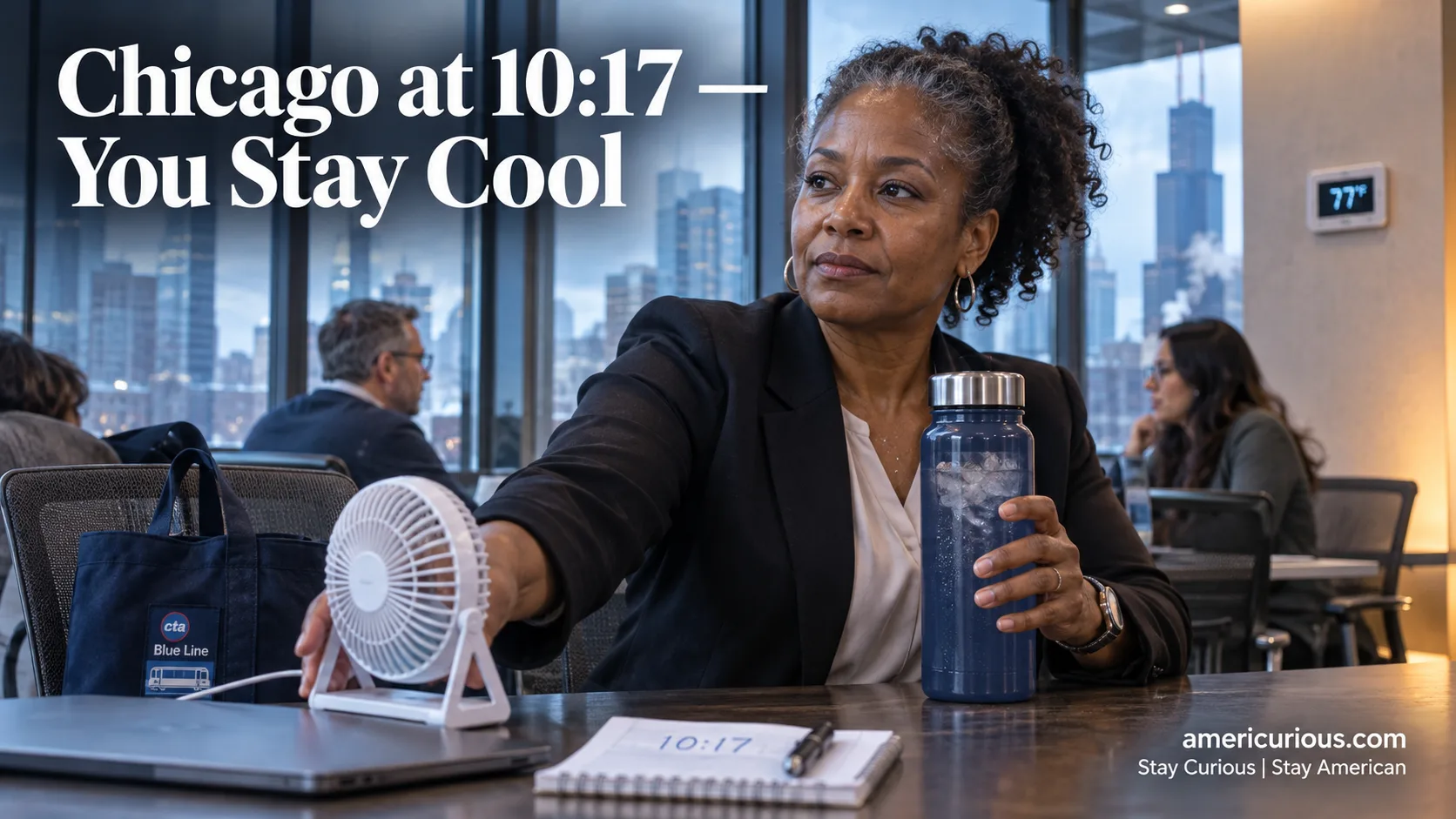
Picture this: February 2027. Same glass room. Same agenda. Denise has her fan on low and 32-ounce bottle with ice. Heat comes at 10:17 a.m. again. Prickles at back of neck.
This time she sips water, keeps listening, takes 3-minute cool-down break when meeting ends, logs it, returns to desk. No one comments. Work continues.
Reasonable accommodation doesn’t erase menopause. It gives you a little control over the room where it happens.
If you are reading this in Illinois or Philadelphia, your rights on paper change January 1, 2027. What changes at work depends on email you send before then.
Frequently Asked Questions
What is a menopause workplace accommodation in 2027?
A job adjustment that helps you perform essential functions while experiencing perimenopause or menopause, such as a desk fan, extra short breaks, cold water access, flexible timing, or remote options. Illinois and Philadelphia require it from Jan 1, 2027 unless undue hardship.
Does Illinois require a doctor’s note for menopause accommodations?
No extensive history required. Employers may request limited documentation of functional need. Rhode Island’s 2025 law limits requests, and Illinois uses reasonable-accommodation-unless-undue-hardship standard for 4+ employee employers.
Does Philadelphia’s law apply to small businesses?
Yes. The Fair Practices Ordinance amendment will apply to all employers with at least one employee and will not include a general small-business exemption, covering even smallest employers.
What if my employer says a fan looks unprofessional?
Ask to continue interactive process in writing and propose alternative with less hardship, like quieter fan, seat move, or scheduled cool-down breaks. Document exchange. File with IDHR within 2 years (Public Act 103-0973) or PCHR within 300 days if needed.
How much do most accommodations cost?
Most common options cost $0 to $30, including USB fans, insulated bottles, cooling towels, and schedule flexibility. Temperature and break adjustments typically not considered undue hardship.
Your Next Step
If Denise’s 10:17 a.m. moment felt familiar, you don’t have to wait until January.
Copy Script 2, fill in your two functional needs, and send this week. Save reply. If you manage a team in Illinois or Philadelphia, forward this post to HR with one line: “Can we add menopause-related conditions to our accommodation examples before December 15, 2026?”
About AmeriCurious & Author
AmeriCurious is a US-focused research blog exploring American cities, culture, and relocation, written by an author who moved to the US for graduate research and has lived on both coasts and in the Midwest.
Not legal or medical advice. For workplace rights, consult employment attorney in your state. For symptoms, talk to clinician or Menopause Society certified provider. If you need immediate mental health support, call or text 988.