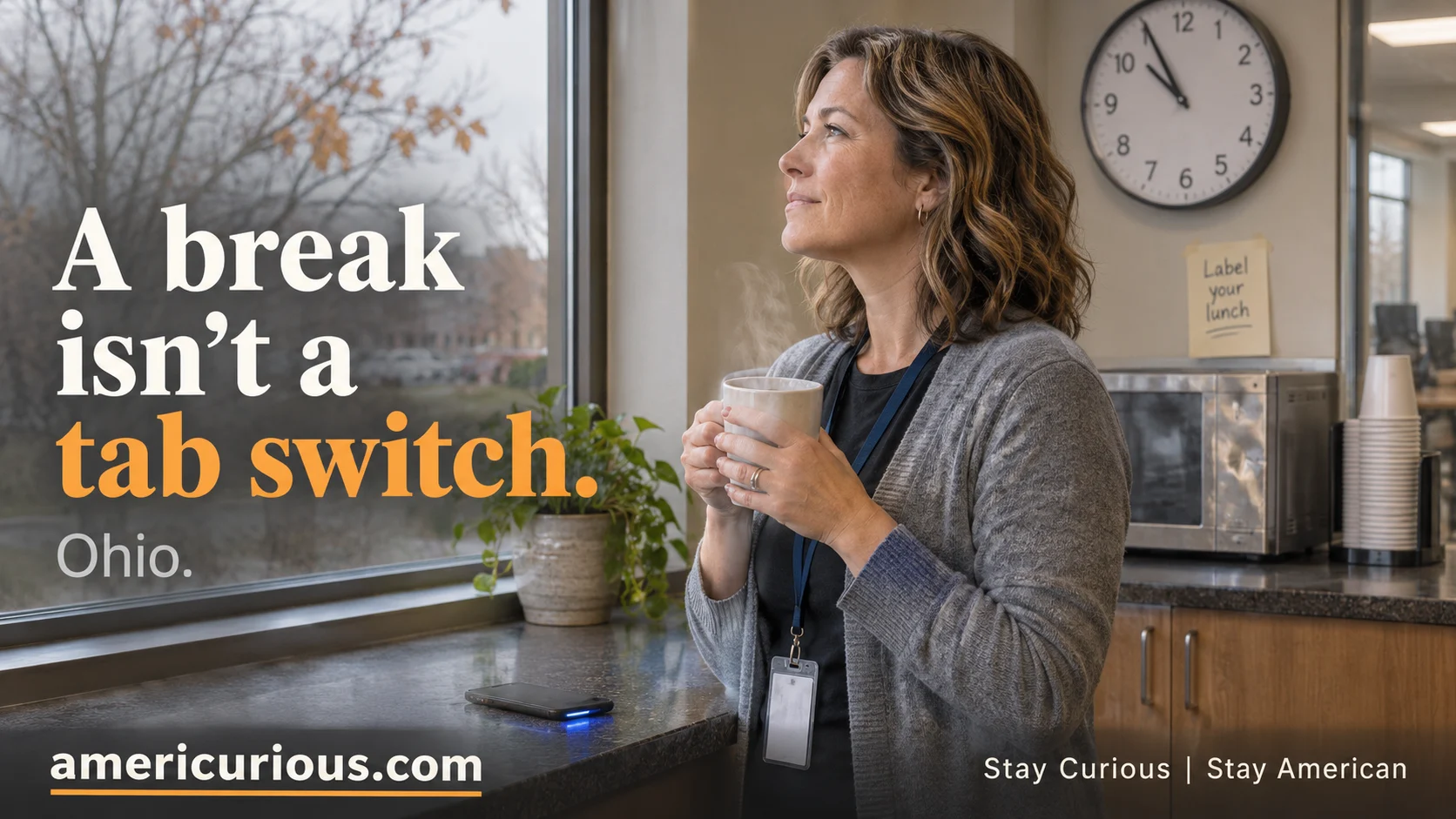
Scrolling through your breaks may not be restoring you. See what research, philosophy, and tradition say about short breaks that actually recharge.
In a workday of back-to-back calls and bottomless feeds, the five-minute break is the cheapest recovery tool most of us own, and we’re mostly spending it badly.
Here’s the odd thing about modern breaks: plenty of us take them, and plenty of them don’t break anything. The task stays open in your head, the phone fills the gap, and you return to your desk about as tired as you left it, with a side of guilt for “wasting” ten minutes.
Researchers call breaks of ten minutes or less “micro-breaks” (Albulescu et al., 2022). I’ll say “short breaks” and stretch the idea to about fifteen minutes: the gap between meetings, the walk to the printer, the pause between study sessions, the stretch after the kids are down and before the laptop reopens.
Why it matters: fatigue builds across a day, long unbroken sitting is linked to health risks, and a break is one of the few levers within reach. Each break is small, but you take dozens a week. Small things repeated are most of a life.
In scope: short breaks during work or study, for generally healthy adults. Out of scope: lunch hours, vacations, sleep, clinical burnout or depression, and labor policy, with one note for American readers. Federal law doesn’t require employers to give rest breaks, but when they do offer short ones (roughly 5 to 20 minutes), those count as paid work time (U.S. Department of Labor). State rules vary, so check yours.
Care to Read?
Unfulfilling Work: What to Do When Your Job Feels Empty
Mini Scenario: Dana’s “Break”
Dana, 38, coordinates operations for a regional distributor in Ohio. Her 10:30 budget call ends at 10:52, and her next meeting starts at 11:05. Perfect. A break.
She pours coffee, and while it brews she checks her phone. One Slack thread needs “a quick thought.” Then a news alert. Then a college friend’s beach photos from somewhere warmer than Ohio in November. Back at her desk at 11:03, she realizes she’s mentally drafting a reply to that thread, still half-chewing the budget call, and hasn’t looked up from a screen since 8:15.
By 3 p.m. she’s running on fumes. By her own count she took six breaks today. None of them felt like one.
Dana isn’t lazy, and she isn’t undisciplined. She did what most of us do: filled the gap with the nearest available stimulation and called it rest. That’s not a break. That’s a lateral transfer of attention.
The Question
How can I spend a five-minute break so that I come back with more energy and clearer attention, without turning rest into one more item on my to-do list?
What Science Says
Short version: short breaks help, modestly, and they help your energy more reliably than your output. The details are where it gets useful.
Do short breaks work? A little, and for energy more than output. A 2022 systematic review and meta-analysis pooled 22 samples (2,335 people) from experimental and quasi-experimental studies of breaks lasting ten minutes or less. Breaks produced small but statistically significant gains in vigor and reductions in fatigue (effect sizes around 0.35), but no significant overall effect on performance. Longer breaks did better for performance, mainly on less demanding tasks; for very draining work, the authors suggest ten minutes may not be enough (Albulescu et al., 2022). Many of the tasks were lab tasks, so real-world transfer is an open question.
Evidence strength: Moderate for less fatigue and more vigor. Mixed for performance.
Think of a short break as topping off the tank, not swapping the battery.
What you do during the break seems to matter. Two field studies surveyed workers repeatedly:
- In 86 office workers tracked over ten workdays, relaxation and social break activities weakened the link between a demanding day and a bad mood at day’s end. Cognitively demanding break activities made that link worse. Snacks and drinks overall made no difference, though caffeinated drinks did in a post hoc analysis (Kim, Park & Niu, 2017).
- In 95 employees surveyed across five workdays, breaks taken earlier in the shift, and breaks spent on activities people preferred, were linked to more recovered energy and concentration. Non-work activities weren’t shown to be better, and frequent short breaks beat rare short ones (Hunter & Wu, 2016).
Evidence strength: Limited to moderate. These studies are observational, so people who are already doing well may simply choose different breaks.
The phone question is genuinely mixed. In a survey of roughly 425 South Korean workers, people who used smartphones at lunch felt as mentally detached as those who walked or chatted, yet reported more emotional exhaustion that afternoon (Rhee & Kim, 2016). It wasn’t a randomized study, so tired people may simply reach for phones more. On the other side, a small study of 72 workers, presented at a conference, linked brief smartphone breaks (texting a friend, a quick game) to better end-of-day mood (Kansas State University, 2014). A fair reading: a one-minute text to your sister and a twenty-minute feed dive may be different animals.
Evidence strength: Mixed.
Moving helps your body, and maybe a bit of your brain.
- A meta-analysis of 20 experimental studies found that regular activity breaks, compared with unbroken sitting, lowered blood glucose and insulin after meals, but not triglycerides (Saunders et al., 2018). Those are short-term lab markers, not proof of lower disease risk.
- The current federal Physical Activity Guidelines for Americans (2018) tell adults to “move more and sit less,” citing a strong association between sedentary time and higher risk of heart disease, high blood pressure, and death from any cause, and they dropped the old ten-minute minimum for counting activity (HHS/ODPHP). That’s association, not proof of causation.
- In a randomized crossover trial of 30 sedentary adults, a five-minute walk every hour improved mood and reduced end-of-day fatigue compared with sitting all day, without changing cognitive test results (Bergouignan et al., 2016).
- A 2026 meta-analysis of 21 crossover trials (433 participants) linked brief standing or activity breaks to small improvements in executive function, but its authors rated the certainty of the evidence as low (Int J Behav Nutr Phys Act, 2026).
Evidence strength: Moderate for short-term blood sugar, mood, and fatigue. Emerging (low certainty) for thinking skills.
A few smaller findings. In a lab study, 150 university students took a boring attention test. During a 40-second mid-task break, those who viewed a city scene with a flowering green roof made fewer errors afterward than those who viewed a bare concrete roof (Lee et al., 2015). Evidence strength: Limited (one lab study, students). The popular 20-20-20 rule (every 20 minutes, look 20 feet away for 20 seconds) is widely recommended, but direct evidence is thin; one lab test found scheduled 20-second breaks didn’t reduce eye-strain symptoms, though its authors stressed that this doesn’t mean breaks are useless (Insight, 2023). Evidence strength: Limited.
Back-to-back meetings. Microsoft’s Human Factors Lab put EEG caps on 14 volunteers for two days of video meetings: four 30-minute meetings back-to-back on one day, and the same meetings with 10-minute meditation breaks between them on the other. A stress-linked brain-wave measure climbed across the back-to-back sessions and stayed flat with breaks (Microsoft, 2021). It’s a tiny, company-run study, and because the breaks included guided meditation, you can’t separate “a break” from “meditating.” Evidence strength: Emerging.
What to take from all this. Association isn’t causation, a lab task isn’t your Tuesday, and an average isn’t you. But the pattern is consistent enough to act on: short breaks buy a modest energy lift, and how you spend them matters.
You Might be Interested in This Post?!
Menopause at Work in 2027: Rights, Scripts & Accommodations
What Psychology Says
Psychology gives us the “why” behind those studies, and four ideas do most of the work.
1. Effort needs recovery, and the right kind. The effort–recovery model holds that work draws down particular mental and physical resources, which then need a chance to replenish; the micro-break literature leans on it heavily (Albulescu et al., 2022). Sabine Sonnentag and Charlotte Fritz later identified four experiences that make time off restorative: psychological detachment (not thinking about work), relaxation (low activation), mastery (a challenge or something new), and control (choosing how to spend the time) (Sonnentag & Fritz, 2007). Their questionnaire was validated in samples totaling 930 people. Most of this research concerns evenings and weekends, not five-minute gaps, so applying it to short breaks is a reasonable inference, not a proven fact. Dana’s break scored zero on detachment and arguably zero on control, since her phone chose for her.
2. Unfinished tasks follow you. In two experiments, Sophie Leroy found that people had trouble pulling their attention off an unfinished task, and their performance on the next task suffered (Leroy, 2009). She called it attention residue. Follow-up work proposes that a brief “ready-to-resume” plan, noting how you’ll pick the task back up, can reduce the cost of interruptions (Leroy & Glomb, 2018). Evidence strength: Emerging to moderate, mostly lab experiments.
3. Attention gets tired, and some scenes help it recover. Attention restoration theory proposes that effortful, directed attention wears down, and that gentle, effortless attention to pleasant natural scenes helps it recover. The green-roof experiment above is a direct test of the short-break version of that idea (Lee et al., 2015). Promising, not settled.
4. Good intentions lose to defaults. A break with no plan loses to whatever’s nearest, and what’s nearest is usually a screen. “If–then” plans (“If the call ends, then I stand up and walk to the window”) improved goal follow-through across a meta-analysis of 94 tests, with a medium-to-large average effect (Gollwitzer & Sheeran, 2006). Nobody has tested this specifically on breaks. Evidence strength: Moderate to strong for planning in general; untested for breaks.
What Philosophy Says
Two thinkers fit this problem well, and they don’t say quite the same thing.
Aristotle (Nicomachean Ethics X.6–7; Politics VIII). Core idea: relaxation exists for the sake of activity, not the other way around. Reasoning: we can’t exert ourselves continuously, so we need relaxation, but it would be absurd to toil all our lives for the sake of amusement (NE 1176b). Beneath the work-and-rest cycle, Aristotle wants something chosen for its own sake, which he calls scholē, leisure, with contemplation as his highest example (NE 1177b; Politics 1337b). Practical relevance: two questions. Does this break actually prepare me to act well afterward? And is there anywhere in my life where I do something simply because it’s worth doing? One caution: his ideal of leisure assumed free citizens supported by other people’s labor, a limitation worth remembering.
Seneca (On Tranquility of Mind 17.4–8). Core idea: a mind kept at one pitch wears out, so give it relief. Reasoning: Seneca compares the mind to fertile farmland that can’t be forced every season, and recommends amusement, walks in the open air, and a change of scene. But he also warns that constant indulgence in amusement dulls the mind, and he distinguishes loosening your grip on a thing from letting it go altogether. Practical relevance: a good break slackens the grip without dissolving you. It should leave you steadier, not foggier. Note that Seneca is advising a friend on tranquility, not on output.
What Religious and Traditional Wisdom Says
These traditions aren’t offering productivity tips. Each places rest inside a larger account of what a human life is for, so I’ll represent them on their own terms, not mine. Practical overlap with science is a bonus, not their purpose.
Hebrew Bible and Judaism. The Sabbath commandment grounds weekly rest in creation and extends it to the whole household, including servants and animals (Exodus 20:8–11). In The Sabbath (1951), Abraham Joshua Heschel called it a “palace in time” and argued that it isn’t merely recovery for the workweek; in his reading, the weekdays exist for the sake of the Sabbath, not the reverse. This is a weekly day with its own rich legal and devotional practice, not a five-minute break, and nothing here substitutes for it.
Christianity. In Mark 6:31, with crowds pressing in and no time even to eat, Jesus tells his disciples to “come away by yourselves to a desolate place and rest a while” (ESV). In Mark 2:27 he says the Sabbath was made for people, not people for the Sabbath. Psalm 23:2 pictures being led to green pastures and still waters. Christians read these passages differently (on how and when to keep Sabbath, for instance), but a common reading is that rest is a gift rather than a lapse in diligence.
Islam. The Qur’an says prayer is prescribed for believers at fixed times (4:103), and the five daily prayers and their timing are established through the Sunnah. The prayers punctuate the day at regular intervals. Their purpose is worship and remembrance of God, not recovery, and this article doesn’t claim a restorative effect.
Hindu tradition. In the Bhagavad Gītā (6.16–17), within the chapter on meditation, Krishna says yoga isn’t for those who eat or sleep too much or too little. It works for someone who is yukta, regulated or temperate, in eating, recreation, effort at work, and sleeping and waking (Telang translation, 1882). Recreation (vihāra) belongs to a disciplined life, though the goal is yoga, the end of suffering, not performance.
Buddhism. The Satipaṭṭhāna Sutta (MN 10) and the Ānāpānasati Sutta (MN 118) teach mindfulness of breathing, for example knowing a long breath as a long breath. The aim is insight and release from suffering, not stress management. In the Plum Village community founded by Thich Nhat Hanh, a mindfulness bell is a cue to stop and breathe consciously, for instance before meals.
Where They Converge
Despite different foundations, several practical themes recur.
- Limits are real. Aristotle says we can’t work continuously, Seneca compares us to overworked farmland, Mark 6:31 shows Jesus acknowledging exhaustion, the Gītā counsels moderation in effort, and the research documents fatigue that builds.
- Quality matters, not just minutes. Aristotle separates amusement from leisure, Seneca warns against sinking into indulgence, the Gītā asks for regulated recreation, and psychology links recovery to detachment and to activities you choose.
- Rhythm over heroics. Fixed daily prayers, a weekly Sabbath, a bell that calls for a breath: these traditions build pauses into the structure of time. In one field study, frequent short breaks beat rare ones (Hunter & Wu, 2016).
- Body and outdoors. Seneca prescribes open-air walks and the psalmist offers green pastures; the evidence for movement and green views is modest but consistent.
These overlaps matter because when an experiment and an ancient text point toward the same practice, it’s worth a trial. They don’t share foundations, though. Seneca isn’t offering a hypothesis about blood sugar, and the Sabbath isn’t a recovery protocol that happens to work.
Where They Differ
- What is rest for? In the science, and in Aristotle’s account of relaxation, a short break serves later activity. In Heschel’s reading of the Sabbath, the logic runs the other way: the workweek serves the day of rest. Islamic prayer and Buddhist practice serve worship and liberation. A productivity framing fits some of these and contradicts others.
- Whose preference counts? Field studies suggest that activities you prefer restore more (Hunter & Wu, 2016). Aristotle ranks activities, placing contemplation above amusement. “Do what you like” and “do what’s worthy” can pull apart.
- Switch off, or wake up? Relaxation research is about lowering activation. Buddhist breath practice aims at clear, sustained awareness, which may or may not feel relaxing.
- What kind of claim is it? The findings on blood sugar and fatigue are empirical and revisable. Sabbath, salah, and the Gītā’s yoga rest on commands, revelation, or metaphysics that science can neither confirm nor refute.
The Practical Solution
Seven moves, roughly in order of how solid the support is. Each one says what to do, how, and why, and I’ve labeled the kind of support behind it so you can weigh it fairly.
1. Decide in advance (planning: moderate to strong evidence in general, untested for breaks)
- Action: Attach each break to a cue.
- How: Write two or three if–then plans on a sticky note. “If this call ends, then I stand up and walk to the window.” “If it’s 10:15, then I take a loop around the floor.”
- Why: A plan removes the decision at the exact moment the phone is most tempting (Gollwitzer & Sheeran, 2006).
2. Park the task before you leave it (emerging evidence)
- Action: Close the loop in thirty seconds.
- How: Write one line where you’ll see it: “Next: paste vendor totals into the sheet.” Close tabs you won’t need.
- Why: It targets attention residue, the lingering pull of unfinished work (Leroy & Glomb, 2018).
3. Move for two to five minutes (moderate evidence for body and mood; low certainty for thinking)
- Action: Stand up and walk.
- How: Hallway, stairs, around the block. Light intensity counts. Aim for movement every 30 to 60 minutes of sitting. A systematic review of six controlled trials supported 2 to 3 minutes of light activity every 30 minutes (Radwan et al., 2022), and the hourly five-minute walks in the trial above worked too.
- Why: Better blood sugar after meals and, in that trial, better mood and less fatigue. If you have a health condition that limits activity, ask your clinician what’s appropriate.
4. Look far, and green if you can (limited evidence)
- Action: Rest your eyes on something distant.
- How: Find a window or step outside for 40 seconds to a minute and let your eyes wander over trees or sky. Treat the 20-20-20 rule as a reminder, not a law.
- Why: The green-roof experiment and attention restoration theory point this way (Lee et al., 2015).
5. Make the phone a choice, and prefer people (mixed evidence)
- Action: Don’t let your thumb pick the break.
- How: For breaks longer than a few minutes, leave the phone face-down at your desk. If you do want to scroll or text, decide that first and set a stopping point. A quick conversation with a coworker or a friend is a safer bet: social break activities were linked to better end-of-day mood (Kim et al., 2017).
- Why: Detachment seems to matter, and phone breaks were linked to more exhaustion in one survey (Rhee & Kim, 2016).
6. Break earlier, and build gaps into the calendar (limited to emerging evidence)
- Action: Don’t wait until you’re cooked.
- How: Take a short break mid-morning, before the slump, not only after it. Where your team allows, end 30-minute meetings at 25 and leave 5 to 10 minutes between calls.
- Why: Earlier breaks were linked to more recovery (Hunter & Wu, 2016), and the small Microsoft EEG study suggests stress accumulates across back-to-back meetings. Calendar norms are shared, so this one may take a conversation.
7. Optional: ten breaths (contemplative practice; treat it as a personal experiment)
- Action: Follow your breath briefly.
- How: Stand or sit with your feet on the floor and count ten slow breaths, returning gently to the count when your mind wanders. This is adapted from Buddhist breath mindfulness and the Plum Village bell.
- Why: Many people find it settling, but this article doesn’t claim a proven effect for one-minute versions as workday breaks.
Match the break to the gap. This is practical inference, not a research finding. If your morning was mentally heavy, favor low-demand breaks (walk, look far); in the Kim study, cognitively demanding break activities backfired. If you’ve been boxed in by other people’s demands, choose something that’s entirely your call (that’s control). If you’re isolated on a remote day, a short call may restore more than a quiet minute.
Try This Today: The Five-Minute Reset
About five minutes, no equipment.
- Before you start, rate your energy from 0 to 10 and jot it down.
- Next time you finish something, write one line: “Next: …”
- Leave your phone on the desk. Stand up and walk for about three minutes to the nearest window or outdoors. Look at the farthest thing you can see.
- Come back, rate your energy again, and note in a few words how it felt to restart the task.
You’ll end with two numbers and a sentence of real data about your own break.
7-Day Experiment
This is a personal experiment, not a clinical trial. Seven days can’t prove anything about breaks in general, but it can tell you something about your own days.
- Day 1, baseline: Change nothing. For each break, note the time, what you did, and energy before and after (0–10).
- Day 2, first intervention: Two phone-free breaks of about five minutes (mid-morning and mid-afternoon), each with a “Next:” line and a short walk.
- Day 3, repeat and refine: Add a third break. If your energy sagged earlier than you expected, move one break earlier.
- Day 4, environmental adjustment: Change the setting, not your willpower. Phone in a bag or drawer, water bottle across the room, a calendar gap between two meetings, and a note marking your nearest good window or outdoor spot.
- Day 5, challenge and variation: Try a different break type each time: one social (a call or a conversation), one outdoors, and optionally the ten-breath pause. Which restored you most?
- Day 6, consolidation: Pick your best two break types and write them as if–then plans.
- Day 7, review: Compare Day 1 with Days 2–6 and answer the reflection questions below.
Measure Your Progress
Keep it light. Three numbers are plenty.
- Energy change: your energy from 0 to 10 before and after each break. Look at the average change, not any single break.
- Real breaks per day: breaks of at least three minutes where you left the task parked and the phone was a deliberate choice.
- Restart ease: how easy it was to get back into the task, from 0 (a slog) to 10 (smooth).
These are self-ratings, so expectation and novelty will color them. That’s fine: you’re looking for patterns in your own days, not scores. If tracking itself becomes a stressor, drop the numbers and write one sentence per day instead.
Common Mistakes
- Turning rest into a performance metric. The effects on performance were small or non-significant in the research, and Heschel argues that rest isn’t merely fuel for work. If you’re optimizing breaks to squeeze out more output, you may be missing both the data and the point.
- Counting work-adjacent scrolling as detachment. Email, Slack, and the news keep the engine running.
- Expecting a reset. Short breaks are modest. For very draining work, ten minutes may not be enough, and no five-minute pause fixes a ten-hour day.
- Using breaks to patch a broken schedule. Breaks don’t replace sleep, days off, or a workload a human can actually carry.
- Treating ancient texts as proof, or prayer as a productivity hack. Seneca and the Gītā aren’t evidence for a study finding, and Sabbath and salah aren’t break protocols.
- Making rules into laws. The 20-20-20 rule and “every 30 minutes” are starting points, not established optima.
When This Isn’t Enough
Short breaks are for ordinary tiredness. See a clinician if you’re exhausted despite enough sleep and time off, persistently low or anxious, losing interest in things you used to enjoy, having trouble sleeping, or noticing physical symptoms such as chest pain, dizziness, or persistent vision problems. That isn’t a diagnosis, just a sign that self-help has reached its limit. Ordinary 3 p.m. fatigue doesn’t need medicalizing.
If your job leaves no room for breaks, that’s a workload problem, not a personal failing. Federal law doesn’t require rest breaks, though some states do, so check with your state labor department and consider raising it with your manager or HR (U.S. Department of Labor).
If you’re having thoughts of harming yourself, call or text 988, the Suicide & Crisis Lifeline, in the U.S. If you’re in immediate danger, call 911.
Reflection Questions
- Think of your last three breaks. For each one, where was your attention: still on the task, in an inbox, or actually elsewhere?
- Of detachment, relaxation, mastery, and control, which is your workday starving you of most?
- What would have to change in your calendar, not your willpower, for a five-minute gap to exist?
- When you reach for the phone during a break, what are you hoping it will give you, and is there a cheaper way to get it?
- Is there any part of your week where rest is its own point and not a refill for work? If not, what might that look like?
One-Sentence Takeaway
A good short break is one you can honestly say you left: body moved, attention elsewhere, task parked, and the phone a choice instead of a reflex.
Literature & Sources
Scientific Research
- Albulescu, P., Macsinga, I., Rusu, A., Sulea, C., Bodnaru, A., & Tulbure, B. T. (2022). “Give me a break!” A systematic review and meta-analysis on the efficacy of micro-breaks for increasing well-being and performance. PLOS ONE, 17(8), e0272460. https://doi.org/10.1371/journal.pone.0272460
- Bergouignan, A., Legget, K. T., De Jong, N., Kealey, E., Nikolovski, J., Groppel, J. L., Jordan, C., O’Day, R., Hill, J. O., & Bessesen, D. H. (2016). Effect of frequent interruptions of prolonged sitting on self-perceived levels of energy, mood, food cravings and cognitive function. International Journal of Behavioral Nutrition and Physical Activity, 13, 113. https://doi.org/10.1186/s12966-016-0437-z
- Lee, K. E., Williams, K. J. H., Sargent, L. D., Williams, N. S. G., & Johnson, K. A. (2015). 40-second green roof views sustain attention: The role of micro-breaks in attention restoration. Journal of Environmental Psychology, 42, 182–189. https://doi.org/10.1016/j.jenvp.2015.04.003
- Radwan, A., Barnes, L., DeResh, R., Englund, C., & Gribanoff, S. (2022). Effects of active microbreaks on the physical and mental well-being of office workers: A systematic review. Cogent Engineering, 9(1). https://doi.org/10.1080/23311916.2022.2026206
- Saunders, T. J., Atkinson, H. F., Burr, J., MacEwen, B., Skeaff, C. M., et al. (2018). The acute metabolic and vascular impact of interrupting prolonged sitting: A systematic review and meta-analysis. Sports Medicine, 48(10), 2347–2366. https://doi.org/10.1007/s40279-018-0963-8
- Acute cognitive effects of interruptions to prolonged sitting with brief standing or physical activity breaks: A systematic review and three-level meta-analysis (2026, July 13). International Journal of Behavioral Nutrition and Physical Activity. https://doi.org/10.1186/s12966-026-01953-6 (author list: see journal record)
- U.S. Department of Health and Human Services, Office of Disease Prevention and Health Promotion. Physical Activity Guidelines for Americans, 2nd edition (2018), Top 10 things to know. https://odphp.health.gov/our-work/physical-activity/current-guidelines/top-10-things-know (a third edition is planned for 2028)
- Microsoft Human Factors Lab (2021). Brain research on back-to-back meetings and breaks. Work Trend Index. https://www.microsoft.com/en-us/worklab/work-trend-index/brain-research
- U.S. Department of Labor, Wage and Hour Division. Breaks and meal periods. https://www.dol.gov/general/topic/workhours/breaks
- Johnson & Rosenfield study of the 20-20-20 rule, as reported by Insight (2023, January 23). https://www.insightnews.com.au/does-the-20-20-20-rule-work-for-digital-eye-strain/
Psychology
- Gollwitzer, P. M., & Sheeran, P. (2006). Implementation intentions and goal achievement: A meta-analysis of effects and processes. Advances in Experimental Social Psychology, 38, 69–119. https://doi.org/10.1016/S0065-2601(06)38002-1
- Hunter, E. M., & Wu, C. (2016). Give me a better break: Choosing workday break activities to maximize resource recovery. Journal of Applied Psychology, 101, 302–311. https://doi.org/10.1037/apl0000045
- Kim, S., Park, Y., & Niu, Q. (2017). Micro-break activities at work to recover from daily work demands. Journal of Organizational Behavior, 38(1), 28–44. https://doi.org/10.1002/job.2109
- Kansas State University (2014). Taking a short smartphone break improves employee well-being, research finds (news release on a conference presentation). https://www.k-state.edu/news/articles/2014/07/smartphone-break-employee-research.html
- Leroy, S. (2009). Why is it so hard to do my work? The challenge of attention residue when switching between work tasks. Organizational Behavior and Human Decision Processes, 109(2), 168–181. https://econpapers.repec.org/RePEc:eee:jobhdp:v:109:y:2009:i:2:p:168-181
- Leroy, S., & Glomb, T. (2018). Tasks interrupted: How anticipating time pressure upon return to an interrupted task leads to attention residue and low performance on interrupting tasks and how a “ready-to-resume” plan mitigates those effects. Organization Science. Listed in the author’s CV: https://www.uwb.edu/business/faculty/sophie-leroy/cv
- Rhee, H., & Kim, S. (2016). Effects of breaks on regaining vitality at work: An empirical comparison of ‘conventional’ and ‘smart phone’ breaks. Computers in Human Behavior, 57, 160–167. https://doi.org/10.1016/j.chb.2015.11.056
- Sonnentag, S., & Fritz, C. (2007). The Recovery Experience Questionnaire: Development and validation of a measure for assessing recuperation and unwinding from work. Journal of Occupational Health Psychology, 12(3), 204–221. https://doi.org/10.1037/1076-8998.12.3.204
Philosophy
- Aristotle. Nicomachean Ethics, X.6–7 (1176b–1178a), trans. W. D. Ross (1908); Politics, VIII.3 (1337b).
- Seneca. De Tranquillitate Animi (On Tranquility of Mind), 17.4–8, in Moral Essays, vol. 2, trans. J. W. Basore (Loeb Classical Library, Heinemann, 1932), pp. 202–285. Catalog record: https://catalog.perseus.org/catalog/urn:cts:latinLit:stoa0255.stoa013.opp-eng1
Religion / Theology
- The Holy Bible (ESV): Exodus 20:8–11; Psalm 23:2; Mark 2:27; Mark 6:31. https://esv.org/verses/Mark+6:31
- Heschel, A. J. (1951). The Sabbath: Its Meaning for Modern Man. Farrar, Straus and Young.
- The Qur’an, Surah An-Nisāʾ 4:103 (translation by Dr. Mustafa Khattab, The Clear Quran). https://quranpedia.net/tafsir/an-nisa/103/en
- Bhagavad Gītā 6.16–17, trans. K. T. Telang, Sacred Books of the East, vol. 8 (1882); see also the Besant & Das translation (1905). Translations compared: https://bhagavadgita-fyi.pages.dev/compare/6/17
- Majjhima Nikāya 10 (Satipaṭṭhāna Sutta) and 118 (Ānāpānasati Sutta), in Ñāṇamoli, B., & Bodhi, B. (trans.) (1995), The Middle Length Discourses of the Buddha. Wisdom Publications.
- Thich Nhat Hanh (1998, July 24). Mindfulness of Breathing 1 (Dharma talk, Plum Village). Transcript: https://archive.org/download/thichnhathanh/THICH%20NHAT%20HANH.rar/THICH%20NHAT%20HANH%2FEBOOK%2FENG%2FThich_Nhat_Hanh_Mindfulness_of_Breathing_1.pdf
Further Reading
- Abraham Joshua Heschel, The Sabbath (1951). The strongest case that rest is more than refueling.
- Josef Pieper, Leisure: The Basis of Culture (1948). A modern philosophical defense of leisure, in Aristotle’s lineage.
- Alex Soojung-Kim Pang, Rest: Why You Get More Done When You Work Less (Basic Books, 2016). Rest and creative work.
- Daniel H. Pink, When: The Scientific Secrets of Perfect Timing (Riverhead, 2018). Timing, energy, and breaks for general readers.
- Oliver Burkeman, Four Thousand Weeks: Time Management for Mortals (Farrar, Straus and Giroux, 2021). On limits and finite time.
- Seneca, Dialogues and Essays, trans. John Davie (Oxford World’s Classics, 2007). Includes On Tranquility of Mind.
- Thich Nhat Hanh, Peace Is Every Step (Bantam, 1991). Brief, practical mindfulness for ordinary moments.