Federal time-use data shows Americans socializing less than a decade ago. Here’s why, who it hits hardest, and what actually helps.
Quick answer:
Americans are socializing less as several everyday defaults thin at once: more time at home, more screen leisure, fewer places to gather, and pricier nights out. Federal data show 30 percent of people socialized on an average day in 2025, down from 38 percent in 2015. Recurring, shared, walkable activities appear to help most.
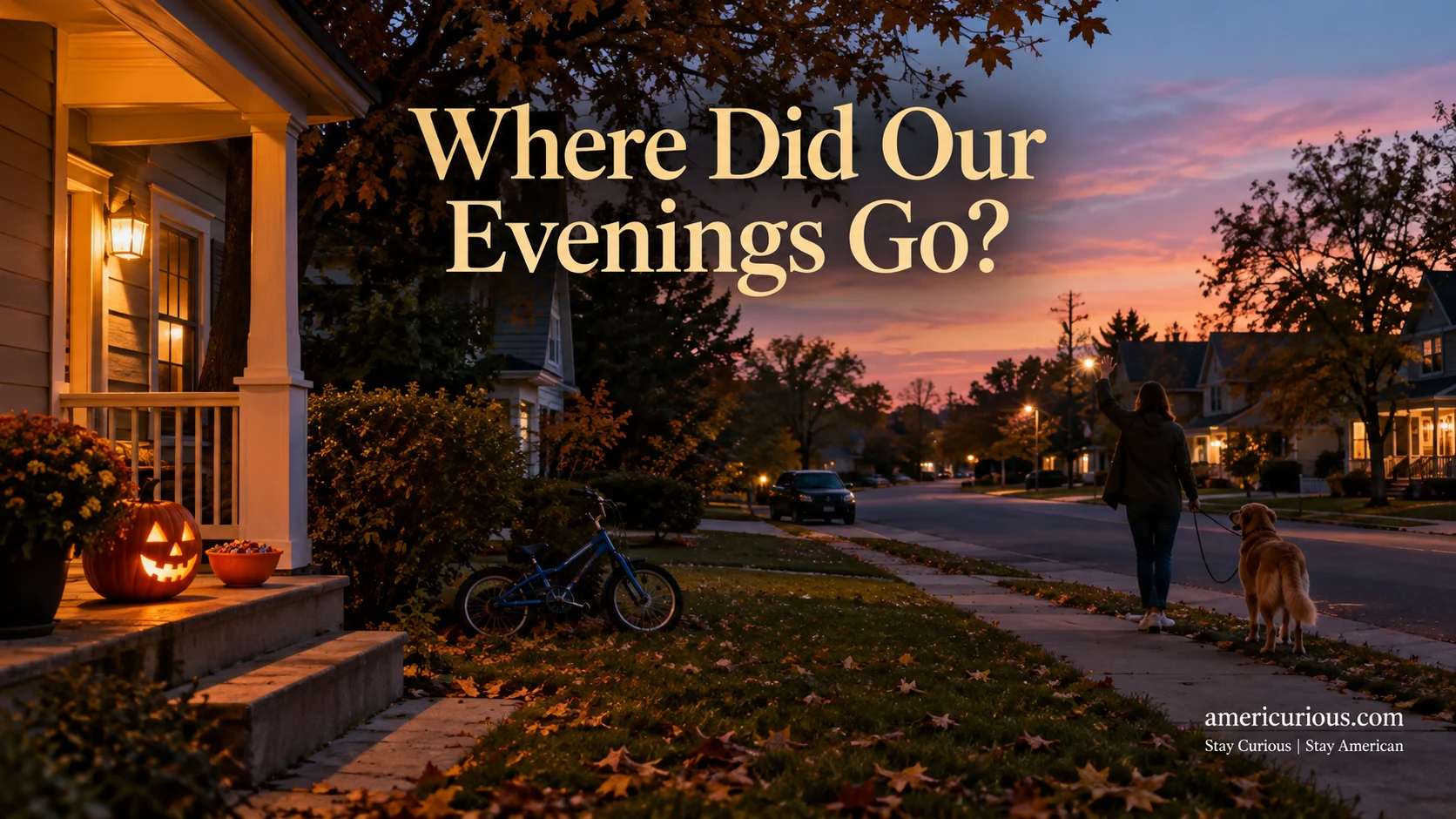
In one Akron neighborhood, something happened that no federal survey will ever capture: the kids came back for Halloween.
For years the holiday had mostly gone dormant there, the Associated Press reported in December 2025. Then a community development group that runs a coffee shop out of a former church, and hosts gatherings at the local elementary school, watched trick-or-treating return. Executive director Zac Kohl’s explanation of why those things matter was short: “It’s the personal connections.”
Hold onto that. This is a story about why Americans are socializing less, a decline the government now measures to the minute. It’s also about what a doorbell has to do with it. By the end, you’ll have a clearer idea of how a street earns its Halloween back.
How much less are Americans socializing, exactly?
On an average day in 2025, 30 percent of Americans age 15 and older spent time socializing and communicating, down from 38 percent in 2015, according to the Bureau of Labor Statistics’ American Time Use Survey, released June 25, 2026. Average time per person slid from 41 minutes to 35. Games and leisure computer use rose from 25 minutes to 37.
That’s the headline. The more useful number is what it adds up to. Six fewer minutes a day, by my arithmetic (6 × 365 = 2,190 minutes), comes to about 36 hours a year. That’s a bit more than two full waking days per person, quietly gone.
Watch the percentage-points trap, too. Dropping from 38 to 30 sounds modest, and some summaries have rounded it to “8 percent fewer people.” It’s eight points, which is roughly a fifth fewer people socializing on a given day (8 ÷ 38, my math).
Zoom out and the slide isn’t new. Axios’s July 2026 analysis of BLS data puts average daily socializing at about 45 minutes two decades ago and 35 now.
One honest footnote. The 2025 survey lost its fall. BLS suspended interviews from Oct. 1 through Nov. 12, 2025, during the federal shutdown, so there are no diaries for Sept. 30 through Nov. 11. It reweighted the remaining fourth-quarter diaries to stand in for the missing weeks. BLS says it can’t quantify any effect, and notes that time use has historically shown little seasonality. The direction matches what researchers have been seeing for years.
Who is hanging out less?
Almost everyone, though not equally. Axios’s analysis found the decline across age groups, steepest for 15- to 24-year-olds, who went from about an hour a day to 35 minutes. Gallup finds young American men unusually lonely, and the Survey Center on American Life finds class gaps in neighborhood life that geography doesn’t explain.
Start with time itself, which is not handed out evenly. BLS found adults 35 to 44 average 3.9 hours of leisure a day, less than any other age group, while those 75 and older average 7.4. Employed adults living with a child under 6 get 3.2 hours, and employed adults in households with no kids under 18 get 4.5. If you’re 38 with a toddler and a job, and “hang out” sounds like a dare, the federal government has the receipts.
Then there’s loneliness among the young. Gallup’s analysis of 2023 and 2024 data found 25 percent of U.S. men ages 15 to 34 had felt lonely a lot of the previous day. The median among peers in 38 wealthy democracies was 15 percent. U.S. women the same age were at 18 percent.
Finally, class. Working from home is a perk with a diploma attached. Among workers 25 and over, 51 percent with a bachelor’s degree or higher did some work at home on days they worked in 2025, versus 19 percent of those with a high school diploma and no college (BLS). Yet the Survey Center finds college graduates are more likely to socialize with neighbors, so staying home isn’t automatically isolating. Nobody has proven how those facts relate, and I won’t pretend otherwise.
Why are Americans socializing less?
No single culprit explains it. The leading explanations are remote work that stuck (35 percent of employed people worked at least partly at home in 2025), screen-heavy leisure, fewer places to gather, and the rising price of a night out. Television alone takes 2.6 hours a day, half of all leisure time, according to the BLS.
Sociologist Ray Oldenburg gave the missing piece a name in 1989: the “third place,” somewhere that’s neither home nor work. He described them as hosting “regular, voluntary, informal, and happily anticipated gatherings.” A diner counter is a third place with a griddle.
The Survey Center’s March 2025 survey found 54 percent of Americans regularly spend time at a coffee shop, bar, restaurant, or park in their community, down from 67 percent before the pandemic. Another 45 percent said they have no such place. A 2025 study co-authored by CU Boulder’s Jessica Finlay tracked 12 categories of gathering places using Census data. It found closures in every category between 2019 and 2021, hitting rural areas and communities with more Black, Hispanic, and less-educated residents hardest, as Fortune reported in August 2026. Fortune’s analysis of BLS business counts adds that the U.S. has lost a fifth of its movie theaters and nearly a third of its bowling alleys since 2001.
Then there’s money. Finlay told Fortune that affordability is a big part of the story. BYU’s Julianne Holt-Lunstad described her son’s group dinner in San Francisco, split evenly, that cost him $90 and left him hungry and stressed about the bill.
Before you blame the sofa, though, consider the Trust for Public Land’s May 2026 survey (YouGov, 4,346 respondents). Parks and outdoor spaces were the most common third place, named by 51 percent of people who have one, edging out bars, restaurants, and cafés at 47 percent. Free places still work. One caution on dueling numbers: the TPL survey found 58 percent of adults have a regular place, versus the Survey Center’s 54 percent. The two used different methods (an opt-in panel versus a probability panel), so don’t subtract one from the other.
Read about: How to Refocus Fast After Work Interruptions
Are Americans lonelier, or just busier?
Both can be true, and the data doesn’t settle it. Gallup found about 20 percent of U.S. adults felt lonely “a lot of the day yesterday” in February 2026. Pew found 16 percent feel lonely or isolated all or most of the time (2024). A 2025 University of Kansas study suggests many people have friends but lack the time, money, or energy to see them.
Gallup’s loneliness line is worth a look. It peaked around 25 percent in pandemic months, fell to 17 to 18 percent through much of 2022 to 2024, and has since drifted back to roughly 20 percent (Gallup, April 21, 2026).
The health stakes are why this isn’t just a mood piece. The U.S. Surgeon General’s 2023 advisory named isolation and loneliness as risk factors for cardiovascular disease, dementia, depression, and premature death. It put the risk of early death for socially disconnected people at up to 29 percent higher and compared the health impact to smoking up to 15 cigarettes a day. Holt-Lunstad, who helped author the advisory, says researchers understand the biological and behavioral mechanisms. Still, treat the big numbers as strong associations, not a label on a bottle. A Philadelphia Fed working paper by economist Enghin Atalay links more time alone with lower life satisfaction, and flags that the link is correlational. Isolation and loneliness also aren’t identical: you can be alone and fine, or surrounded and miserable.
Now the dissent. The University of Kansas American Friendship Project (more than 2,000 participants, 2025) found 57 percent had visited friends or family the previous day. That’s down from Princeton Survey Research Associates polls from 1995 to 2014. Yet people who prioritized friends and family reported higher life satisfaction and less loneliness. Those unhappy with their time with friends pointed to money, tiredness, and busyness. The researchers’ read, paraphrased: people have friends, and what they want is more time with them.
Here’s where the story turns. If the problem were mostly that Americans stopped liking each other, the fix would be a national attitude adjustment, and those have a spotty record. If the problem is that the defaults that once delivered company went missing (a corner place, a standing club night, a front stoop), the fix is logistics. That’s my read, not a finding. But logistics is something one person can start on a Tuesday.
This article is informational, not medical advice. If loneliness feels heavy or won’t lift, a doctor or counselor can help. In the U.S., you can call or text 988 anytime you’re in crisis.
Did the neighbors really go quiet?
Mostly, yes. The Survey Center on American Life’s April 2026 report, based on an Ipsos panel of 5,357 adults surveyed in October 2025, found 40 percent of Americans talk with neighbors at least a few times a week. A 2012 Pew study put that figure at 59 percent. For adults under 30, the share fell from 51 percent to about one in four.
Seniors held steadier: 56 percent still chat with neighbors a few times a week, a seven-point drop.
If you live outside a big coastal metro, here’s the finding for you. Among Americans without a college degree, socializing and problem-solving with neighbors looks about the same in urban, suburban, and rural neighborhoods. The report calls class a stronger signal than community type. What differs is access. Only 37 percent of Americans with a high school education or less report six or more gathering places within a 20-minute walk, versus nearly half of college graduates. One in ten Americans overall has none. People with none nearby were less likely to chat with a neighbor a few times a week (27 percent) than people with six or more (43 percent).
Now the practical part. In the same survey, 55 percent of people who walk their neighborhood at least weekly said they talk with neighbors a few times a week, versus 29 percent of those who walk only a few times a year and 19 percent of those who don’t walk at all. Dog owners who walk their dogs regularly: 50 percent. Dog owners who don’t: 33 percent. That’s correlation, not proof. Still, the most reliable matchmaker in the data is a leash.
One more wrinkle: 88 percent of Americans want neighbors who look out for each other, and 79 percent want neighbors who mind their own business. That’s a high bar for a casserole. Sixty-five percent define a good neighbor as one who doesn’t get too involved in your affairs.
What actually helps people reconnect?
Research points to gatherings that are in person, recurring, shared with others, and active rather than passive. A University of Georgia and BYU team analyzed 1,551 event-goers and found those features boosted connection most, though the lift typically faded within 24 hours. That favors a standing weekly game over a yearly blowout.
Holt-Lunstad told Fortune that interactive gatherings, such as dancing or roller skating, tend to build more connection than passive ones like a movie. She also said her students are drifting toward cheaper versions, such as roller skating, line dancing, and outdoor meetups.
A disclosure worth knowing: Eventbrite, the ticketing company, has partnered with these researchers on its Social Connection Project. The coverage I reviewed didn’t spell out how participants were recruited, so treat the findings as a strong lead rather than the last word.
The Trust for Public Land survey adds a humbling detail. Among people who want more time outdoors, the top thing that would get them out was having somebody to go with, named by 46 percent, and by a majority of young people and those with a history of anxiety or depression. The barrier isn’t wanting. It’s the plus-one.
AEI’s Daniel Cox argues the drive for personal autonomy has left Americans “allergic to institutions.” That’s a fair diagnosis and a useful one, because the habits that help look like small institutions: a standing night, a regular table, a shared job. Fortune reported that researchers call everyday contact with a wide mix of people “relational portfolio diversity,” and that it’s protective for health. In plain English: the barista, the neighbor, and the person at the next table count too.
What does a repaired street look like?
Based on documented cases, it looks ordinary: a recurring event, a physical spot people can walk to, and one person or group that decided to host. The AP profiled efforts in Akron, Baltimore, and rural Kentucky in December 2025. None is proven to scale, but each shows what “rebuilding connection” means on the ground.
Akron. The Well Community Development Corp. runs its coffee shop in a former church and fosters gatherings at a local elementary school. Across town, the Akron Metropolitan Housing Authority’s Erin Myers said a lakefront trail and nature center were sited to get people into the same space, talking.
Baltimore. On Collins Avenue, a short block on the city’s outskirts, neighbors turned an abandoned lot into a Peace Park that hosts food distributions and summer camps for kids. Ulysses Archie and his wife, Chrysalinn, who founded the Baltimore Gift Economy, deliberately don’t label donated food free, because he says that frames it as a transaction and they want it to feel like a gift. Myk Lewis, who came home to Baltimore after years in California, said neighbors help him care for his aging mother. He told the AP he probably couldn’t have restarted his life without them.
Kentucky. In New Castle, a farmers’ cooperative hosts a “Beef Bash” under a tent pavilion: area chefs, a guitarist, and farmers trading tractor-mishap and midnight-calving stories. Mary Berry of the Berry Center says the end of the tobacco quota system in 2004 took away something farmers had held in common, an agricultural economy and calendar. The community has grown less tight-knit as people commute or farm bigger.
Strip away the specifics and the pattern matches the research: something recurring, something to do, somewhere close, someone who volunteered. Frederick Riley, who runs the Aspen Institute’s Weave: The Social Fabric Project, says people in every community have decided it’s up to them to bring others together. Vivek Murthy, who issued the 2023 advisory and now leads the Together Project (supported by the Knight Foundation), says the connection movement is already building and needs to accelerate.
So how does a street get Halloween back? The AP doesn’t give a recipe, and I won’t invent one. It shows a neighborhood where a development group kept hosting ordinary gatherings in ordinary places until trick-or-treating returned. That isn’t proof of cause. It’s a clue about the shape of the answer.
Key takeaways
- Federal data show Americans socializing less: 30 percent did so on an average day in 2025, versus 38 percent in 2015, and average time fell from 41 to 35 minutes.
- No single cause explains it. Remote work, screen leisure, fewer gathering places, and cost all show up in the evidence.
- Researchers disagree on how lonely this makes us, but many people appear to want more time with friends and lack money, energy, or a plus-one.
- Class predicts neighborly life better than urban, suburban, or rural setting, and access to nearby gathering places matters.
- The habits tied to connection are recurring, shared, active, and close to home.
By the numbers
Table 1. Then and now (all figures sourced and dated)
| Measure | Earlier | Latest | Source and date |
|---|---|---|---|
| Share socializing/communicating on an average day | 38% (2015) | 30% (2025) | BLS, June 25, 2026 |
| Average minutes per day socializing/communicating | 41 (2015) | 35 (2025) | BLS, June 25, 2026 |
| Minutes per day on games and leisure computer use (includes social media) | 25 (2015) | 37 (2025) | BLS, June 25, 2026 |
| Talk with neighbors at least a few times a week | 59% (2012) | 40% (2025) | Survey Center, April 27, 2026 |
| Adults under 30 who do the same | 51% (2012) | about 25% (2025) | Survey Center, April 27, 2026 |
| Regularly spend time at a local coffee shop, bar, restaurant, or park | 67% (before pandemic) | 54% (2025) | Survey Center, July 2, 2025 |
| Felt lonely “a lot of the day yesterday” | 17-18% (2022-2024) | about 20% (Feb. 2026) | Gallup, April 21, 2026 |
Table 2. Neighborly habits and neighbor talk (associations, not proof)
| Group | Talk with neighbors regularly* |
|---|---|
| Walk the neighborhood weekly or more | 55% |
| Walk only a few times a year | 29% |
| Don’t walk the neighborhood | 19% |
| Dog owners who walk their dog regularly | 50% |
| Dog owners who don’t | 33% |
| Live near six or more gathering places | 43% |
| Live near none | 27% |
Source: Survey Center on American Life, April 27, 2026. The report words this as “a few times a week” for some comparisons and “at least weekly” for others.
Why this matters to you
Wherever you live, the research points to four moves. Try them for four weeks, because the connection boost from any single gathering fades fast.
| Move | What to do this month | What the evidence says |
|---|---|---|
| Repeat it | Pick one weekly slot, same time, same place | Recurring events boosted connection more than one-offs; the lift faded within about 24 hours (UGA/BYU, 2025) |
| Give it a job | Cook, walk, skate, build, play; avoid just sitting side by side | Interactive gatherings tend to build more connection than passive ones (Holt-Lunstad, via Fortune, 2026) |
| Name a plus-one | Invite one specific person | Top motivator for more outdoor time: having somebody to go with, 46% (TPL, May 2026) |
| Keep it walkable | Walk the same loop at the same hour | Weekly walkers talk with neighbors more often (Survey Center, 2026; correlational) |
If you live somewhere with few gathering places, and the closures hit rural areas hardest, host instead of hunting. This is my suggestion, not a study finding. Borrow a fire hall, church basement, library room, or tailgate, and ask a neighbor to co-host so it’s two people’s job. For the civic side, 79 percent of U.S. adults call local parks part of their community’s essential infrastructure (TPL, May 2026). Say so when your town sets its budget.
FAQ
How much time do Americans spend socializing?
According to the Bureau of Labor Statistics’ 2025 American Time Use Survey, released June 25, 2026, Americans averaged 35 minutes a day socializing and communicating, down from 41 minutes in 2015. On an average day, 30 percent of people did any, compared with 38 percent in 2015. The survey covers people age 15 and older.
Are Americans lonelier, or just spending time differently?
Both stories have support. Gallup found about 20 percent of U.S. adults felt lonely a lot of the previous day as of February 2026, up slightly from 17 to 18 percent in 2022 through 2024. But a 2025 University of Kansas study reported that many people still have friends and mainly want more time with them, citing money, fatigue and busy schedules.
Why are Americans socializing less?
Researchers point to several overlapping causes rather than one culprit: more time at home since remote work took hold, screen-based leisure, fewer public gathering places, and higher costs for going out. BLS found 35 percent of employed people did some work at home in 2025, and a 2025 study documented closures across all 12 categories of gathering places it tracked between 2019 and 2021.
Who is affected most?
Young people show the steepest drops: Axios’s analysis of BLS data found 15- to 24-year-olds fell from about an hour a day socializing to 35 minutes. Class also matters. Survey Center on American Life research from April 2026 found college graduates socialize with, trust, and lean on neighbors more than people without degrees, wherever they live.
What actually helps people reconnect?
A study led by Julianne Holt-Lunstad and Richard Slatcher, covering 1,551 event attendees, found in-person, recurring events attended with others, and ones where people actively participate, boosted connection most. The lift faded within about a day, so repetition matters. Separately, weekly neighborhood walkers were much more likely to talk with neighbors, though that link is correlational.
How reliable is the 2025 time-use data?
BLS cautions that the federal shutdown suspended American Time Use Survey interviews from Oct. 1 through Nov. 12, 2025, so no diaries exist for Sept. 30 through Nov. 11. BLS reweighted the remaining fourth-quarter diaries to represent the whole quarter and says it cannot quantify any effect.
Closing
On Saturday, Oct. 31, kids in thousands of American neighborhoods will do what one Akron neighborhood had to relearn: knock on a stranger’s door and expect candy. The clocks fall back the next morning, and the evenings get dark early.
So here’s my small, unscientific invitation. Turn on your porch light. Set out a bowl. Stand outside long enough to say hello to whoever walks by. A street gets its Halloween back the way a diner gets its regulars: somebody shows up, and then somebody shows up again.
About this article
How it was researched: On October 4, 2026, we reviewed primary and secondary sources including the BLS American Time Use Survey release, Gallup, the Survey Center on American Life, the Trust for Public Land, the Federal Reserve Bank of Philadelphia, the AP, Axios, and Fortune. Every figure is dated in text and traced to the Sources list.
Disclosures: None.
3. SOURCES
- U.S. Bureau of Labor Statistics, “American Time Use Survey Summary, 2025 Results,” June 25, 2026. https://www.bls.gov/news.release/atus.nr0.htm
- Axios (Erica Pandey), “Americans of all ages are spending less time socializing,” July 5, 2026. https://www.axios.com/2026/07/05/americans-socializing-decline
- Axios, “A loneliness epidemic meets uneven social infrastructure,” July 5, 2026. https://www.axios.com/2026/07/05/loneliness-epidemic-third-places-social-infrastructure
- Deseret News, “How Americans lived in 2025, per BLS time use survey,” July 31, 2026. https://www.deseret.com/family/2026/07/31/bls-american-time-use-survey-2025-how-americans-lived/
- Gallup (Dan Witters), “U.S. Depression Rate Remains Elevated,” April 21, 2026. https://news.gallup.com/poll/708221/depression-rate-remains-elevated.aspx
- Gallup, “Younger Men Among the Loneliest in the West,” May 2025 (cited via Gallup’s April 2026 page). https://news.gallup.com/poll/690788/younger-men-among-loneliest-west.aspx
- Survey Center on American Life (Cox, Grace, Shields), “Strangers Next Door: The Decline of Neighborhood Socializing and the Class Divide in Belonging,” April 27, 2026. https://www.americansurveycenter.org/research/strangers-next-door-the-decline-of-neighborhood-socializing-and-the-class-divide-in-belonging/
- Survey Center on American Life (Cox), “America’s Cultural Crossroads,” July 2, 2025. https://www.americansurveycenter.org/research/a-cultural-crossroads-americas-uncertain-future-amidst-enduring-discontent-and-rising-disconnection/
- Trust for Public Land, “National Survey on Outdoor Public Spaces” (memo), May 20, 2026. https://www.tpl.org/wp-content/uploads/2026/05/TPL-Outdoor-Public-Spaces-Polling-Memo-vF.pdf
- Fortune (Catherina Gioino), “Bars, bowling alleys, and movie theaters cost too much to run and visit…,” Aug. 2, 2026. https://fortune.com/2026/08/02/bars-bowling-alleys-movie-theaters-affordabilitiy-third-space-health/
- Fortune/AP (Peter Smith), “25 years after a Harvard professor told America it was ‘bowling alone’…,” Dec. 18, 2025. https://fortune.com/2025/12/18/loneliness-epidemic-bowling-alone-25-years-later/
- Associated Press (Peter Smith), “Bit by bit, small US groups chip away at historic levels of social isolation,” Dec. 18, 2025 (via News4JAX). https://www.news4jax.com/news/national/2025/12/18/bit-by-bit-small-us-groups-chip-away-at-historic-levels-of-social-isolation/
- University of Georgia, “Participating in in-person events fosters social connections,” 2025. https://news.uga.edu/?p=106006
- HealthDay, “Live events build social connection,” Aug./Sept. 2025. https://www.healthday.com/health-news/mental-health/live-events-build-social-connection
- University of Kansas, “Research shows people aren’t lonelier, they’re changing how they spend their time,” 2025/2026 (date to confirm). https://cmsdocs.ku.edu/news/article/research-shows-people-arent-lonelier-theyre-changing-how-they-spend-their-time
- Pew Research Center, “Men, Women and Social Connections,” Jan. 16, 2025. https://www.pewresearch.org/wp-content/uploads/sites/20/2025/01/ST_2024.1.16_social-connections_REPORT.pdf
- U.S. Surgeon General, “Our Epidemic of Loneliness and Isolation” (advisory), May 2, 2023. https://www.hhs.gov/sites/default/files/surgeon-general-social-connection-advisory.pdf
- Federal Reserve Bank of Philadelphia (Enghin Atalay), “A Twenty-First Century of Solitude? Time Alone and Together in the United States,” WP 22-11, 2022. https://www.philadelphiafed.org/-/media/FRBP/Assets/working-papers/2022/wp22-11.pdf
- Project for Public Spaces, “Ray Oldenburg,” n.d. https://www.pps.org/articles/roldenburg/
- Finlay et al., “Uneven Access to Essential Services and Amenities: Geographic Disparities in ‘Third Place’ Availability Across the United States From 2010 to 2021,” 2025 (cited via Fortune). https://www.sciencedirect.com/science/article/abs/pii/S135382922500173X