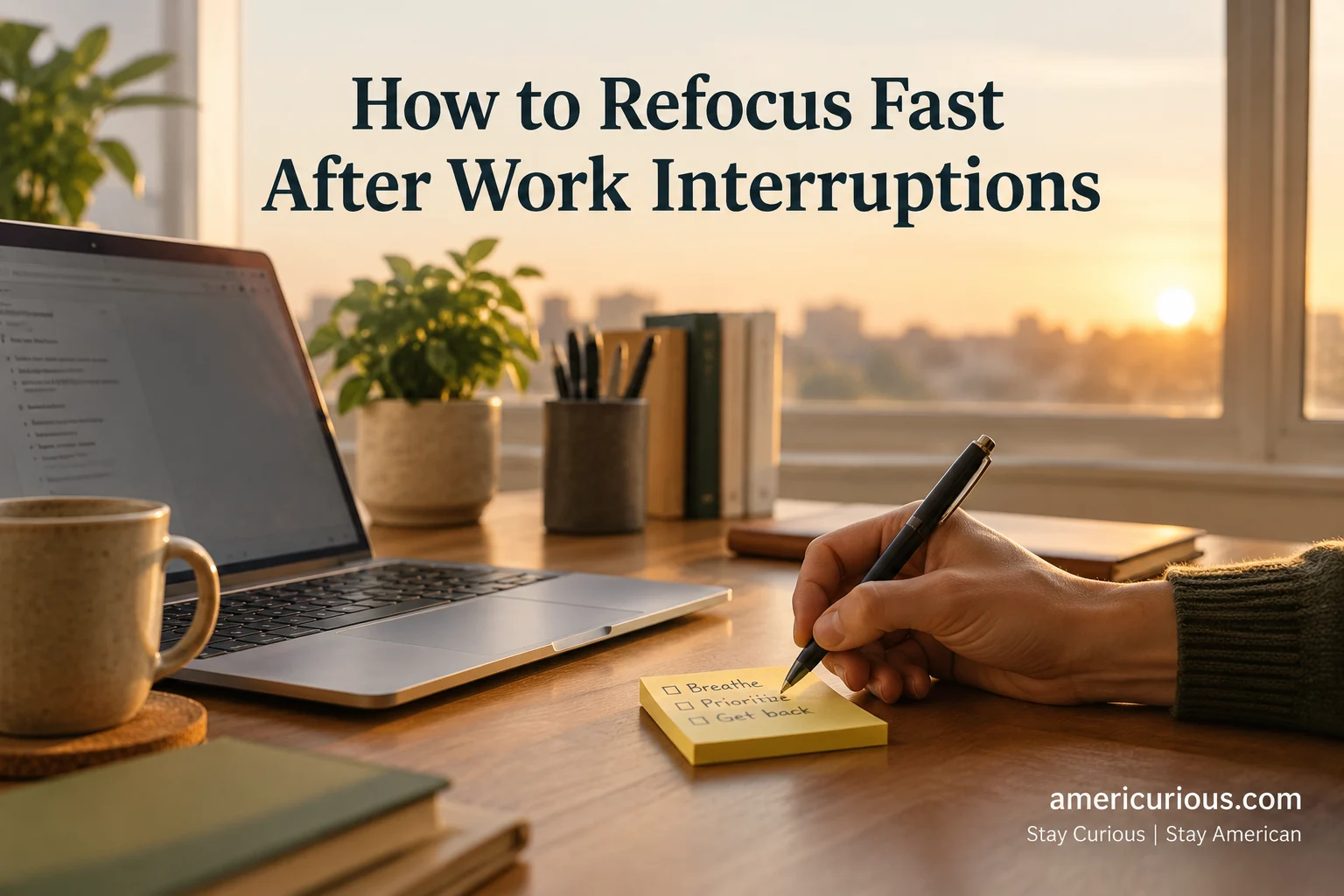
8 verified, research-backed ways to recover faster after interruptions at work — real studies, exact numbers, no fluff.
Getting pulled away mid-task costs more than the interruption itself — it’s the fumbling afterward that eats your afternoon. These 8 tips come from primary research that was opened, read, and checked before writing, not from productivity folklore. Only 8 qualified after a thorough search — a couple of promising leads (like scheduled “mental breaks” for sustained focus) had mixed replication results and didn’t meet the bar for inclusion.
Narrate Your Very Next Move Before You Switch Away
- Do this: The moment you sense an interruption coming (a ringing phone, someone walking up), spend 2–3 seconds silently naming your next concrete action on the current task before you switch.
- Why it works: This “prospective goal encoding” boosts the memory activation of your next step, so it’s easier to retrieve when you come back — before it decays under the weight of the interrupting task.
- Evidence: Trafton, Altmann, Brock & Mintz (2003), International Journal of Human-Computer Studies | lab experiment, N=17 | participants given an 8-second warning before interruption prepared far more often (13.5 vs. 3.1 times out of 30 chances) and resumed faster in the first session, read the study.
- Confidence: Moderate — one well-designed lab study; small sample.
- Alternative: If you can’t predict interruptions, jot the next step on a sticky note the instant you notice you’re about to be pulled away.
Give the Interruption Its Own Two-Line Plan
- Do this: When a new task lands on you mid-work, before returning to your original task, write one sentence specifying exactly when, where, and how you’ll handle the new item.
- Why it works: Unresolved tasks keep intruding on your thoughts (the Zeigarnik effect), but a specific plan tells your brain the loop is closed, freeing attention for what you were doing.
- Evidence: Masicampo & Baumeister (2011), Journal of Personality and Social Psychology | 6 experiments, N=69–174 per study | planners reported far fewer intrusive thoughts than non-planners (1.77 vs. 3.00 on a 7-point scale) and solved more anagrams on an unrelated task, read the study.
- Confidence: High — six converging experiments with consistent effects.
- Alternative: Say the plan out loud instead of writing it if you’re away from paper.
Corral Email Into Three Set Checks a Day
- Do this: Pick three fixed times (say, 10am, 1pm, 4pm) to check email, and close the tab or app in between.
- Why it works: Constant checking is a self-generated interruption; batching it cuts the number of context switches your brain has to recover from.
- Evidence: Kushlev & Dunn (2015), Computers in Human Behavior | within-subjects field experiment, N=124 | limiting checks to 3x/day significantly lowered daily stress (Cohen’s d=.45) and felt-distraction (d=.51) compared with unlimited checking, read the study.
- Confidence: Moderate — one solid field experiment; participants found it genuinely hard to stick to.
- Alternative: If three checks feels impossible, start with five and taper down.
Put Your Phone on Silent, Out of Reach
- Do this: During focused blocks, flip your phone to silent and place it in a drawer or another room — not just face-down on the desk.
- Why it works: Even unanswered notifications trigger an orienting response that fragments attention, independent of whether you actually pick up the phone.
- Evidence: Kushlev, Proulx & Dunn (2016), Proceedings of CHI 2016 | 1-week field experiment, N=221 | alerts-on weeks produced higher self-reported inattention and hyperactivity than alerts-off weeks, which in turn predicted lower productivity, read the study.
- Confidence: Moderate — single field study, self-report outcomes.
- Alternative: If you need the phone reachable for family reasons, at least disable badges and banners for non-essential apps.
Talk to Yourself by Name After a Rattling Interruption
- Do this: After an interruption that leaves you rattled (a tense call, sharp feedback), silently coach yourself in the third person for 30 seconds — using your own name instead of “I.”
- Why it works: This small linguistic shift creates psychological distance from the emotion, lowering reactivity without requiring you to suppress or dwell on the feeling.
- Evidence: Kross, Bruehlman-Senecal, Park et al. (2014), Journal of Personality and Social Psychology | 7 experiments, N=585 | third-person self-talk led to better objective performance under pressure in public-speaking and first-impression tasks, read the study.
- Confidence: High — seven converging experiments, large combined sample.
- Caveat: This regulates the emotional charge of the interruption; it won’t restore lost task-specific memory on its own.
Take a Five-Minute Walk Somewhere Green
- Do this: After a draining meeting or a mentally taxing interruption, step outside for 5–10 minutes near trees, plants, or a park — not a busy street.
- Why it works: Nature holds attention gently (“soft fascination”), letting your directed-attention system rest, while urban stimuli (traffic, crowds) keep demanding it.
- Evidence: Berman, Jonides & Kaplan (2008), Psychological Science | crossover experiment, N=38 | working memory scores were higher after a nature walk than after an urban walk, regardless of order, read the study.
- Confidence: High — well-replicated finding (over 2,000 citations, extended in later studies).
- Alternative: No greenery nearby? Even looking at photos of nature produced a smaller but measurable benefit in the same study.
Rehearse Your Regular Interruptions On Purpose
- Do this: If the same kind of interruption recurs (a coworker’s daily question, a specific alert), mentally rehearse the exact handoff — “when X happens, I do Y, then return to Z” — a few times so it becomes familiar.
- Why it works: Practice speeds resumption only for that specific pairing of tasks, not for interruptions in general, so targeting your most common one pays off disproportionately.
- Evidence: Cades, Boehm-Davis, Trafton & Monk (2011), Journal of Experimental Psychology: Applied | 3 randomized lab experiments | people resumed faster only with practice on that specific primary-and-interruption pairing; general practice didn’t transfer, read the abstract.
- Confidence: Moderate — controlled lab experiments, not yet tested in real workplaces.
- Alternative: Keep a short mental (or written) script for your top 2–3 recurring interruptions.
Push Non-Urgent Interruptions to a Natural Pause
- Do this: If you have any control over timing — a coworker asking “got a sec?” — ask if it can wait for your next natural break rather than interrupting mid-task.
- Why it works: Interruptions landing in the middle of a task cost more resumption time than ones at a subtask boundary, because mid-task interruptions cut off an active plan rather than a completed one.
- Evidence: Monk, Boehm-Davis & Trafton (2004), Human Factors | lab experiment | interruption timing significantly affected resumption time, with mid-task interruptions the most costly, read the abstract.
- Confidence: Moderate — single lab study using a driving-simulation-style task.
- Alternative: When you can’t delay the interruption, at least finish typing the sentence or completing the sub-step you’re mid-way through first.
Start here: If you only try one thing, write the two-line plan for whatever interrupted you (tip 2) — it has the most consistent evidence across six separate experiments and takes under 15 seconds.
For more ways to reclaim focus during the workday, AmeriCurious has other practical explainers worth browsing here.