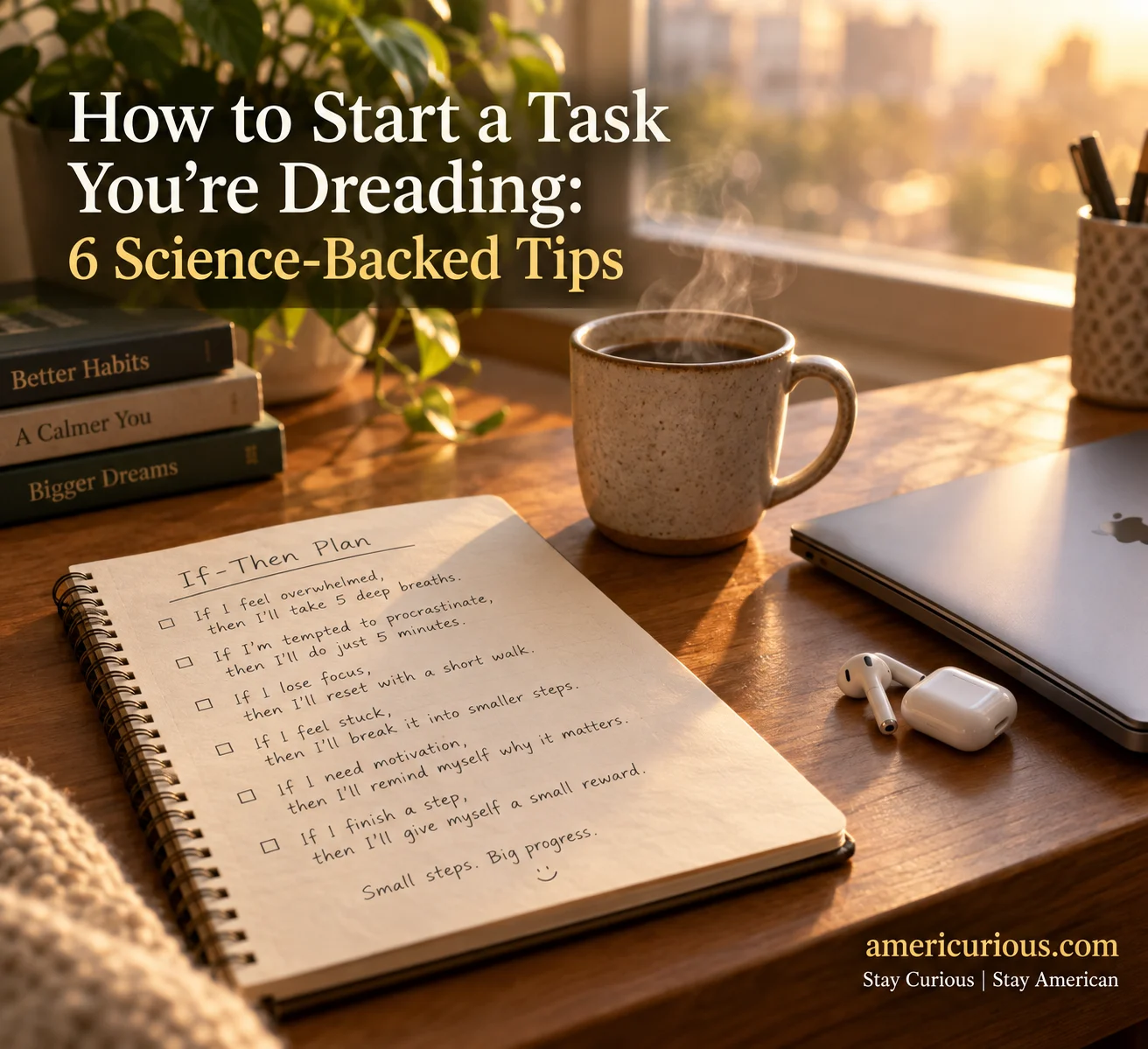
Beat procrastination with 6 verified strategies backed by real studies—from temptation bundling to future-self imagery—for freelancers and knowledge workers.
Getting started is the hardest part of any unpleasant task, and generic advice like “just do it” doesn’t help. Below are six tips that passed a strict research filter: each rests on a real study we opened and read, targets a distinct psychological mechanism, and costs nothing to try. We set out to find 10, but after excluding weak, retracted, or overly generic evidence, 6 survived — so that’s what you get.
Pin the task to a “fresh start” moment
- Do this: Instead of waiting to feel ready, deliberately schedule the start of a dreaded task for a temporal landmark — the first workday of the week, the 1st of the month, or the Monday after a holiday.
- Why it works: These moments psychologically separate your “past self” (who kept avoiding it) from your “present self,” making a clean slate feel available and lowering the mental barrier to starting.
- Evidence: Dai, Milkman & Riis (2014), Management Science | three archival field studies (Google search trends, university gym-visit records, goal-commitment data) | found that Google searches for “diet,” gym visits, and goal commitments all rose right after temporal landmarks such as the start of a new week, month, or semester | read the paper. SSRN
- Confidence: Moderate — three converging field studies, but correlational (archival), not a controlled experiment.
- Alternative: If no natural landmark is close, manufacture one — rename tomorrow “Week 1, Day 1” of the project in your calendar.
Make the unpleasant task the only way to get something you want
- Do this: Pick something you genuinely enjoy (a podcast, an audiobook, a specific playlist) and restrict yourself to using it only while doing the dreaded task — never at other times.
- Why it works: Bundling an instantly gratifying “want” with an effortful “should” makes starting the should-task the price of admission to something you’re actually looking forward to, so anticipation pulls you in rather than willpower pushing you.
- Evidence: Milkman, Minson & Volpp (2014), Management Science | field experiment, gym-goers restricted to tempting audiobooks only at the gym vs. control | participants with gym-only access visited the gym 51% more often than the control group, a statistically significant increase | read the paper. National Bureau of Economic Research
- Confidence: High — randomized field experiment with a clear, replicated effect in a related teaching study.
- Caveat: Effects faded somewhat after disruptions like holidays, so refresh the “want” periodically.
- Alternative: If nothing feels tempting enough, try the mindfulness exercise below instead.
Run a 4-minute “wish, obstacle, plan” before you sit down
- Do this: Before starting, spend about 4 minutes: name the task, vividly picture the best outcome of finishing it, then identify your single biggest obstacle, and write one sentence in “if [obstacle], then I will [specific action]” format.
- Why it works: Imagining the payoff builds motivational pull, while naming the obstacle in advance and pre-deciding your response turns a vague intention into an automatic trigger-response link, so you don’t have to talk yourself into starting in the moment.
- Evidence: Zhou, Wider, Wu, Xu, Qin & Borromeo (2026), Acta Psychologica | randomized controlled trial, N=81 procrastinating undergraduates, Mental Contrasting with Implementation Intentions (MCII) vs. a positive-thinking control | participants using MCII initiated their task on 58.8% of days versus 47.3% for the control group, a significant difference | read the paper. ScienceDirect
- Confidence: High — randomized trial with a direct behavioral (not just self-reported intention) outcome.
- Alternative: For a lighter-touch version, try just the future-self visualization tip below on its own.
Spend 3 minutes noticing your body before you start
- Do this: Right before opening the task, sit still for about 3 minutes and simply notice physical sensations — your breath, where you’re holding tension — without judging or trying to change them.
- Why it works: This brief present-moment awareness exercise appears to strengthen sustained attention, which in turn reduces the pull toward avoidance and boosts your stated intention to actually start.
- Evidence: Schutte & del Pozo de Bolger (2020), International Journal of Applied Positive Psychology | randomized experiment, N=174 adults, brief mindfulness exercise vs. control activity before rating intention to work on a delayed task | mindfulness-condition participants expressed significantly more intention to work toward completing the task they tended to procrastinate on than participants in the control condition | read the paper. Une
- Confidence: Moderate — a single, well-designed RCT, and it measures stated intention rather than confirmed follow-through.
- Alternative: If sitting still feels harder than the task itself, use the “if-then” plan tip above instead.
Forgive yourself for procrastinating last time
- Do this: Before starting a task you’ve delayed before, take a moment to consciously forgive yourself for the earlier delay — silently or in a short written note — rather than dwelling on guilt.
- Why it works: Guilt and shame about past procrastination create negative emotions that people then avoid by procrastinating again; self-forgiveness breaks that loop by reducing the negative affect that was fueling further avoidance.
- Evidence: Wohl, Pychyl & Bennett (2010), Personality and Individual Differences | prospective study, N=119 first-year students tracked across two exams | students who reported higher self-forgiveness for delaying their first exam prep showed reduced procrastination on preparing for their next exam, an effect explained by lower negative affect | read the paper. ScienceDirect
- Confidence: Moderate — a single prospective study (not a full experiment), though the effect has been conceptually replicated in later work.
- Alternative: If self-forgiveness feels forced, try naming your future self’s relief instead (next tip).
Picture your future self actually benefiting from this
- Do this: Spend about 2 minutes vividly imagining yourself a few weeks from now, after the task is done — specifically what it looks and feels like to have it behind you.
- Why it works: Procrastination is partly driven by treating your future self as a stranger who’ll deal with the consequences; making that future self feel vivid and continuous with who you are now increases your sense of responsibility to act now.
- Evidence: Blouin-Hudon & Pychyl (2017), Applied Psychology: An International Review | randomized study, N=193 undergraduates, future-self mental imagery vs. present-focused meditation, twice weekly for 4 weeks | future self-continuity and empathic perspective-taking were significantly higher in the mental imagery condition than the meditation condition at the four-week mark | read the paper. Wiley
- Confidence: Moderate — randomized study, but the outcome measured is future self-continuity itself rather than directly observed task completion.
- Alternative: Pair this with the “if-then” plan tip to turn the vivid picture into a concrete trigger.
Start here: If you only try one thing, use the temptation-bundling tip — it has the strongest, most directly behavioral evidence (a 51% jump in a real-world field experiment) and takes zero extra time to set up.