Slow living isn’t a linen apron. What it really is, where it came from, and five U.S. towns that make it easier — checked against census data, not vibes.
The man who was too busy to be slow
Carlo Petrini died on 21 May 2026, at home in Bra, near Turin. He was seventy-six, and he was the reason the word “slow” ever got attached to anything other than trains and ovens.
In 1986 he heard that a McDonald’s was coming to the Piazza di Spagna in Rome, and he did what a certain kind of Italian does: he stood outside and handed out pasta in protest. That stunt became an organisation called Arcigola, which became Slow Food, which became a global outfit, which became the seed of everything now filed under “slow living” — slow travel, slow fashion, slow money, slow parenting, all of it.
Here is the detail I keep returning to. By most accounts, Petrini’s own life was not slow at all. He wrote books at a clip, flew constantly, and ran an outfit with reach in more than a hundred and fifty countries.
I don’t think that’s hypocrisy. I think it’s the whole point, and we’ll come back to it.
The short answer (for the skimmers and the search engines)
Slow living is choosing the right speed for what you’re actually doing — deliberate with your time, one thing at a time, connected to people and places — instead of running everything at maximum by default. It grew out of Italy’s Slow Food movement. In the United States, exactly two towns are currently certified “slow cities,” and neither is on the list below. What follows are five places whose defaults help, plus what each one actually gets wrong.
Care to Read?
Millbrook, NY: The Hudson Valley Town That’s Rich, Rural, and Refreshingly Off-Brand
The snail, briefly
Slow Food’s founding idea fits in four words: food should be good, clean, and fair — good to taste, clean in how it’s produced, fair to the people who produce it. The movement chose a snail for its logo, partly as a joke about pace, partly because snails are a local delicacy around Bra.
Slow living is that same instinct pointed at the rest of the calendar. Most writers break it into four habits:
- Intentionality — deciding what deserves your hours before your inbox decides for you.
- Single-tasking — one thing at a time, finished, instead of five things at 40 percent.
- Connection — regular, unglamorous contact with nature, neighbours, and the people you claim to love.
- Simplicity — fewer objects and fewer obligations, so the small pleasures have room to be noticed.
Which is to say: it is not a décor style. Nobody needs a linen apron. Nobody needs to move to a valley.
What the evidence actually supports
Most of slow living is folk wisdom wearing a nice cardigan. But one piece of it has real research behind it, and it’s the connection part.
A 2019 study in Scientific Reports looked at nearly 20,000 English adults and found that people who spent at least 120 minutes a week in nature were significantly more likely to report good health and high wellbeing than people who spent none. Under two hours, there was no measurable benefit. The association peaked somewhere between 200 and 300 minutes and then flattened — and it made no difference whether the two hours came in one long walk or six short ones. (White et al., Scientific Reports, 2019)
Two honest caveats, because this is an observational, self-reported study — it shows association, not proof of cause. Still: a weekly threshold you can hit in a park is a far friendlier prescription than one requiring a flight.
So why would a weekly number matter more than a daily dose? Because most of us can’t do daily. A week is a forgiving unit.
The trouble with every list you’ve read
Now the part that made me put my coffee down.
The most-quoted ranking of “best U.S. cities for slow living” — the one that has been copied onto dozens of blogs and news sites, usually without a byline or a methodology note — comes from a July 2025 press release by Badeloft USA, a company that sells bathroom fixtures. It scored cities on seven indicators, including a “happiness index” that is not a federal statistic and a walkability figure that contradicts its own conclusions.
Its headline number was that Overland Park, Kansas has an 18-minute average commute. The Census Bureau, which actually counts this, puts Overland Park at 19.7 minutes for workers sixteen and over (2020–2024 five-year estimates). Close enough to be defensible, and far enough off to remind you what press-release research is for.
I’m not going to pretend the federal number and the marketing number agree. I’ll take the Census Bureau every time, and I’ll say plainly which claims in this piece rest on government data and which rest on a town’s own habits.
Are there any official slow cities in America?
Yes — and this is where nearly every listicle goes wrong.
Cittaslow International is the formal network, founded in Italy in 1999 and headquartered in Orvieto. Membership is invite-only, capped at towns under 50,000 people, and assessed across dozens of criteria covering local food, environmental policy, craft, hospitality, and civic participation. There are roughly 300 member towns in more than 30 countries, and the network’s own country list for the United States names two: Sonoma and Sebastopol, both in California.
Sonoma was first, designated in 2009. Sebastopol followed in 2010 — along with Fairfax, which is still named as a third American slow city by plenty of 2010-era coverage but doesn’t appear on the network’s current U.S. list. I couldn’t find a public explanation for the disappearance, so I’ll simply flag it rather than tidy it up.
Which means: if you read that Asheville or Ojai or Santa Fe is “officially a slow city,” you read something that isn’t true. They’re just places where slowness is easier than average — a lower, gentler bar, and the one I’m actually measuring here.
Five towns that make it easier (and what each gets wrong)
1. Asheville, North Carolina ⛰️
The case: You’re in a mountain bowl at the edge of Pisgah National Forest, with the Blue Ridge Parkway running along the rim and a farm-to-table habit older than the phrase “farm-to-table.” The city’s pace is set by terrain and weather more than by anyone’s good intentions.
The thing nobody tells you: Asheville is still recovering from Hurricane Helene, which tore through western North Carolina in September 2024. Visitor spending in Buncombe County fell to about $2.6 billion against an all-time high near $3 billion in 2023, and parts of the River Arts District are still patching themselves together. Going there and spending money is, right now, a slightly political act in the best sense.
The correction: The widely copied line that “Mindful Asheville coordinates community meditation and wellness events” points at a single teacher’s class schedule, not a civic programme. Asheville’s genuine slow-living infrastructure is geography and a stubborn local-business culture. Credit those.
2. Ojai, California 🌿
The case: A small town in a valley under the Topatopa Mountains, ninety minutes from the density of greater Los Angeles and psychologically much further. Pink-hour light, orange groves, more galleries per block than is strictly reasonable.
The verifiable part: Ojai has regulated chain businesses since 2007, under a “formula business” ordinance that survives as section 10-2.1713 of the city code. Under the current text, a business with more than five locations that shares two or more standardized features needs a conditional use permit — and downtown, anything over 2,000 square feet or 25 feet of street frontage is effectively out. There’s no Starbucks in town.
The catch: The ordinance covers the 4.37 square miles of the city and stops there. Drive a few minutes into Mira Monte and you’ll find a Taco Bell, a McDonald’s and a Habit Burger with Ojai addresses on the mail. Slowness in Ojai is a zoning choice with a perimeter fence, which is worth knowing before you romanticize it.
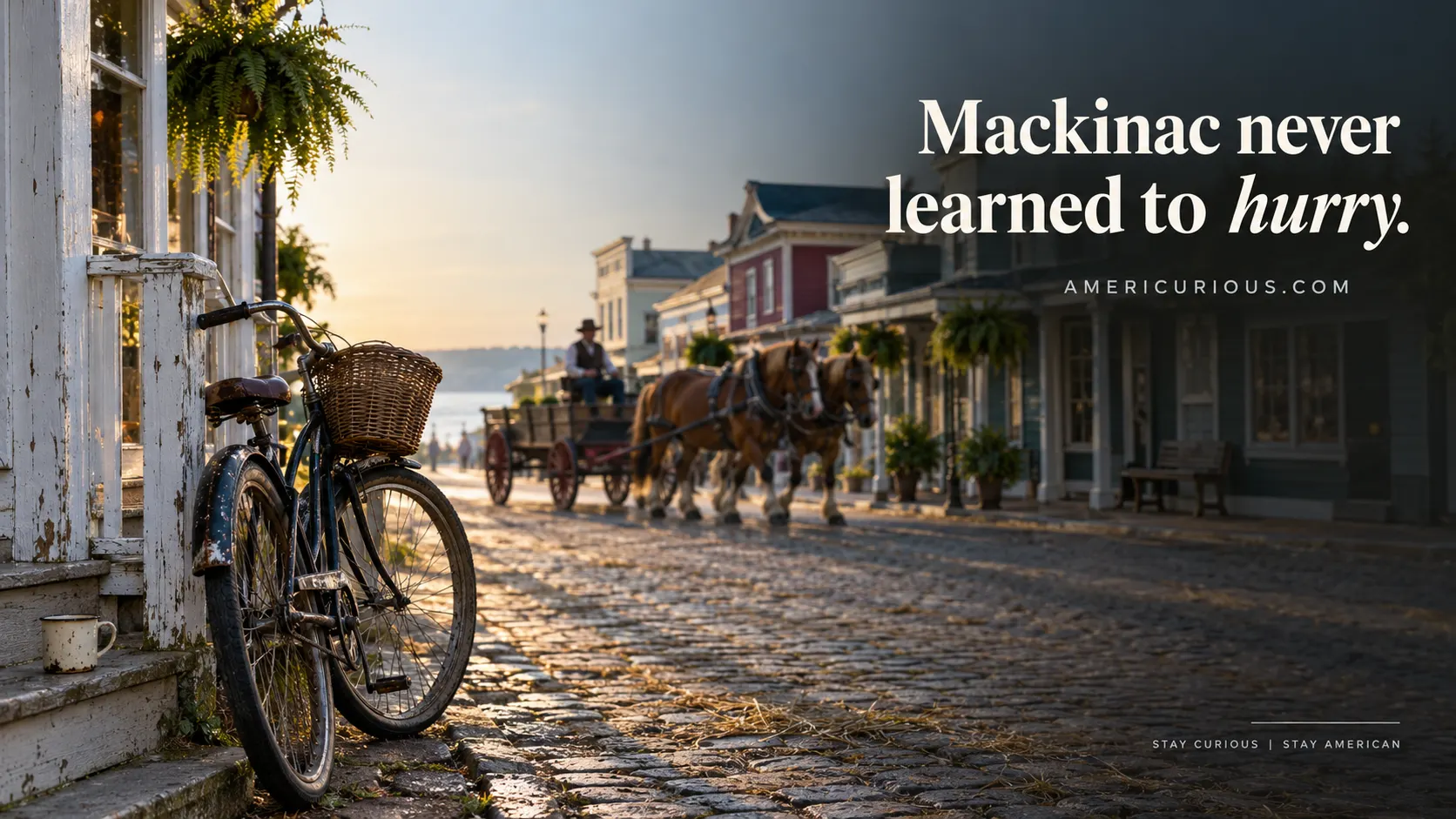
3. Mackinac Island, Michigan 🚲
The case: This is the closest thing America has to a control group. On 6 July 1898, after carriage drivers complained that “horseless carriages” were spooking their horses, the village council banned automobiles. The state park commission extended the ban in 1901, and it has held ever since.
The island’s own tourism bureau states it plainly: Mackinac has been car-free since 1898. About 80 percent of the island is protected state park, and M-185 — the 8.2-mile shoreline road — is the only state highway in the country where motor vehicles are prohibited. You arrive by ferry, and then you walk, cycle, or take a horse.
The catch: Car-free is not crowd-free. In July, Main Street’s fudge shops are as busy as any mall. The quiet is structural rather than guaranteed, and it’s seasonal — snowmobiles are allowed once the ferries stop.
4. Santa Fe, New Mexico ☀️
The case: Seven thousand feet up, built in adobe and lit by a sun that seems to have been hired for the purpose. The city’s tourism office counts more than 250 galleries and dealers and describes Santa Fe as the third-largest art market in the U.S. by sales — which is why so many people here seem to be mid-sentence with a canvas.
Why that matters for slowness: A town full of galleries rewards the exact behaviour slow living is trying to teach: standing still in front of one thing for longer than feels productive. Canyon Road is a mile of it.
The catch: Expensive housing, a thin job market, and an altitude that will humble anyone arriving from sea level. Santa Fe’s pace is genuinely unhurried; its housing costs are not.
5. Overland Park, Kansas 🌳
The case: The counterintuitive one, and the one the bathroom-fixture survey accidentally got right. This is a 75-square-mile suburb of about 204,000 people outside Kansas City, and its mean commute is 19.7 minutes, per the Census Bureau — against roughly 26 minutes nationally. No mountains, no fudge, no adobe. Just four highways that keep errands short, a lot of green space, and an unromantic truth: the single biggest daily theft of discretionary time in American life is the commute, and this town has less of it than almost anywhere.
The catch: It is car-dependent. The same Badeloft study that ranked it first lists its walkability at 35 out of 100, which is a strange thing to publish in your own winner’s column. Its slowness is a matter of minutes saved, not streets worth walking. That’s still real — it just isn’t picturesque.
Table 1. Five towns, five checkable claims, and the trade-off nobody puts in the brochure.
Town The checkable detail The catch Asheville, NC Gateway to Pisgah National Forest and the Blue Ridge Parkway; still rebuilding after Hurricane Helene (2024) Recovery is uneven; tourism revenue remains below its 2023 peak Ojai, CA Chain businesses regulated since 2007; permit triggered at more than five locations Ordinance stops at city limits — chains sit minutes away in Mira Monte Mackinac Island, MI Motor vehicles banned 6 July 1898; M-185 is the only U.S. state highway closed to cars Crowded in season; snowmobiles permitted in winter Santa Fe, NM 250+ galleries and dealers; third-largest U.S. art market by sales Housing costs and 7,000 ft of altitude Overland Park, KS 19.7-minute mean commute vs ~26 nationally (ACS 2020–2024) Walk Score 35 — car-dependent, unromantic, genuinely shorter days
A quick poll before we go on: what actually blocks you from a slower week — time, money, or the phone in your hand? Most people I ask say the phone, then look at the phone.
The quote that reframes all of this
Seneca, writing to his friend Lucilius in the early 60s AD, put it more compactly than any of us will manage:
“Nothing, Lucilius, is ours, except time.” — Seneca, Moral Letters to Lucilius, Letter 1, translated by Richard Mott Gummere (Loeb Classical Library, 1917)
In plain English: nothing you own is really yours — the house has a mortgage, the car depreciates, the achievements belong partly to luck — except the hours, which are the only property you can spend badly and never recover.
Because here’s the twist I promised. A town can lower the volume. It cannot change the station. Mackinac will hand you a bicycle and a car-free mile, and you can still spend the whole ride answering email in your head. Ojai will deny you a drive-through and you’ll still eat the sandwich standing up.
What these five places share isn’t a philosophy. It’s a set of defaults — fewer cars, shorter drives, more green, more things worth standing in front of — that make the slower choice the path of least resistance. Defaults are powerful. They are also not destiny.
And the fairness objection is real, so let’s not paper over it: moving to Ojai or Santa Fe is a wealthy person’s move, and “just slow down” is cold comfort to someone working two jobs. Petrini himself ran into this after visiting Venezuela in 1989 and adjusted Slow Food’s agenda in response. Which is why the takeaway below costs nothing and requires no relocation.
One thing to do this week
Book two hours outside in your calendar, the way you’d book a dentist appointment — one block or four, the research says it doesn’t matter. Then keep the appointment in weather you’d rather not.
That’s it. Not a lifestyle, not a philosophy, not a move to the mountains. Two hours, this week, outdoors, with the phone in a pocket rather than a hand.
The snails will respect you either way.
Quiz — answers at the very bottom of this page.
- Which of the five towns has banned motor vehicles since 1898?
- How many U.S. towns appear on Cittaslow International’s current country list: two, twelve, or forty?
- What walkability score does the study that ranked Overland Park #1 for slow living give Overland Park: 35, 65, or 88?
(Scroll.)
.
.
.
Answers: (1) Mackinac Island, Michigan — banned 6 July 1898. (2) Two — Sonoma and Sebastopol, both in California. (3) 35 out of 100 — from its own study’s own table, which is the most honest thing in the whole document.